

Today content creators face a new frontier in search visibility: Google AI Overviews. These AI-generated summaries appear at the top of search results and aim to instantly answer user questions using information pulled from multiple sources. If you want your content to influence what users see in summaries, without losing traffic, you must understand strategies for optimizing content for Google AI Overviews.
This blog will help you through what AI Overviews are, why they matter, and real strategies rooted in current SEO and AI research to help your content succeed. To better understand how AI models influence search visibility, explore our detailed guide on LLMs in SEO.
What Exactly Are Google AI Overviews?
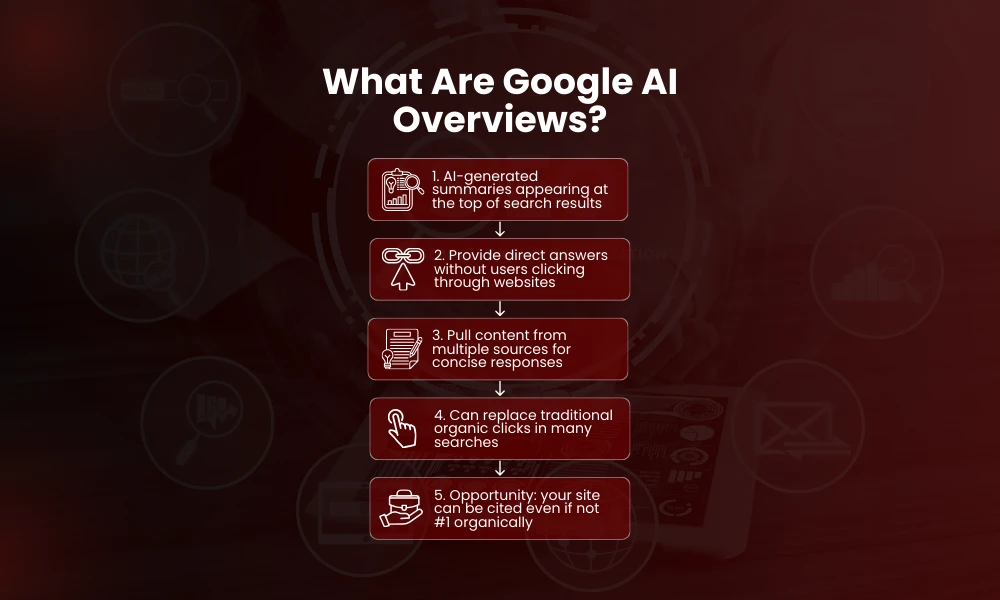
Google AI Overviews are short, AI-generated summaries that answer a user’s query using content from across the web. They live above traditional organic listings in search results, combining insights from multiple sources into one concise answer.
Think of them like an AI-powered highlight reel of the best bits of content online for a given topic.
These overviews have become widespread. In some SEO community data, AI Overviews appeared in up to 87.6% of searches in the top position, showing how influential they are in shaping what users see first in search results.
This means your content might get featured directly in search results without a click, which is a big shift from traditional SEO. Since credibility plays a major role in AI selection, understanding Google E-E-A-T can significantly improve your content strategy.
Why You Must Care About AI Overviews
AI Overviews change the game in two main ways:
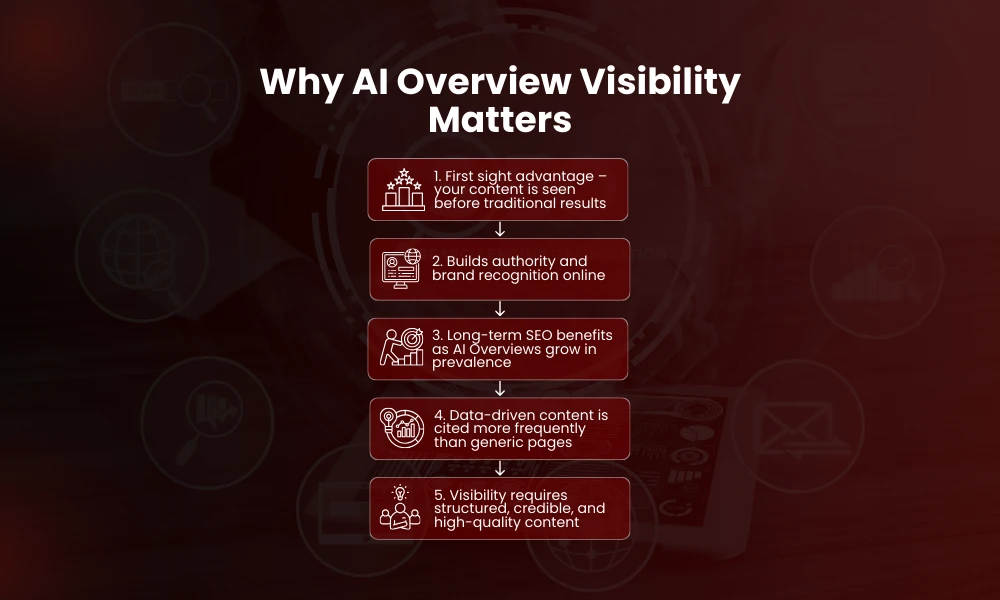
- Immediate answers reduce clicks: A large analysis from Ahrefs discovered that AI summaries can reduce click-through rates (CTR) by an average of 34.5% when featured for a query.
- Trust matters more than ever: Overviews aim to summarize what the AI “trusts” most based on quality, credibility, and structure, not just keyword placement.
Because of this, content strategies focused solely on old-school SEO are no longer enough. Modern optimization must align with updated quality ranking factors that prioritize clarity, authority, and intent alignment. You need strategies for optimizing content for Google AI Overviews that shift toward answer quality, structural clarity, credibility, and user intent.
A Quick Look at the Data Behind AI Overviews
Before diving into actionable strategies, it’s helpful to understand what research and industry experience tell us about AI Overviews and what they prefer.
What Gets Pulled Into AI Summaries?
A community-reported study analyzing thousands of keywords found the following content types most often featured in overviews:
| Content Type | Likelihood of Being Included |
| Facts & stats | 31.0% |
| Unique research | 21.6% |
| Comparisons | 19.6% |
| News | 14.4% |
| Personal experiences | 10.9% |
This suggests that data-rich content, not just keyword stuffing, performs best. Creating data-driven content improves your chances of being referenced in AI-generated summaries.
What SEO Experts See
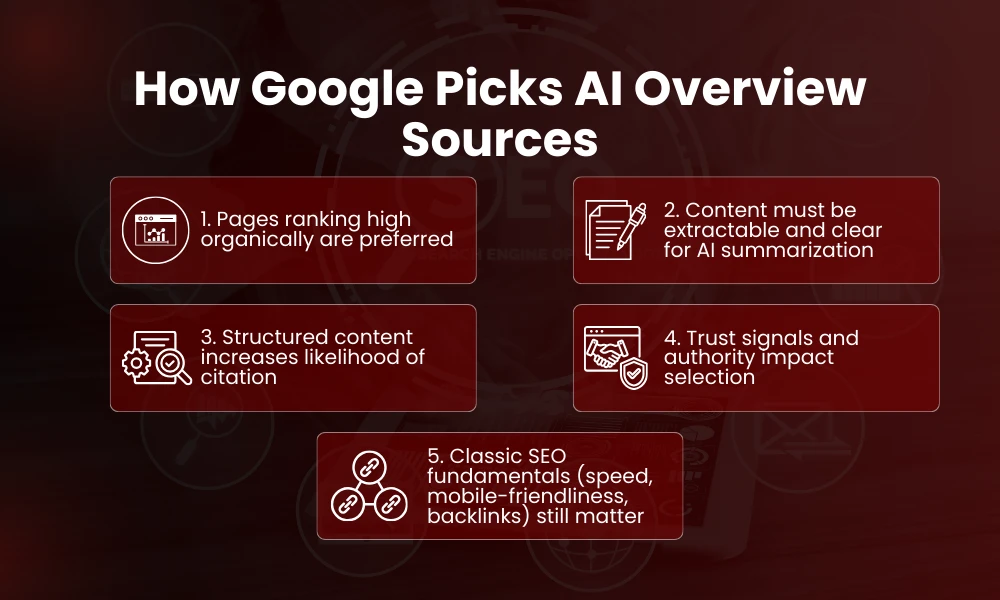
Many SEO practitioners report that structured, authoritative content consistently gets chosen for AI Overviews. Having strong E-E-A-T (Experience, Expertise, Authoritativeness, Trustworthiness) signals improves your chances of inclusion.
Additionally, well-formatted answers and natural language alignment with user intent are key factors.
What Google’s Own Signals Say
Google itself has indicated that normal SEO still matters for AI Overviews. A Google Search advocate stated that you don’t need special files like LLMS.txt to optimize for AI Overviews; good content and established SEO fundamentals are still essential.
But because overviews are AI-generated summaries, reducing friction for AI systems through clarity and structure becomes a supplementary requirement on top of standard SEO.
That brings us to the practical strategies that follow.
1. Create Clear, Answer-Focused Content
The most consistent pattern across SEO experiments is that AI Overviews love immediate answers.
When writing a section meant to rank in AI Overviews:
- Put the answer to the user’s question right at the start of the paragraph.
- Keep sentences short and direct.
- Use conversational language that mirrors how people ask questions.
For example, instead of starting with a long story about content history, start with a line like:
“To make your article more likely to appear in Google AI Overviews, answer questions directly and clearly at the beginning of each section.”
This strategy aligns with how overviews choose content based on relevance and clarity rather than length.
2. Use Question-Style Headings and Long-Tail Queries
One of the best ways to control the context AI systems use is to structure your article around common questions users ask.
For example:
- What are the key strategies for optimizing content for Google AI Overviews?
- How do I structure my content for AI Overviews?
- Why does E-E-A-T matter for AI Overviews?
These question headings help Google (and the underlying AI models) understand which parts of your content answer specific intents.
This type of structure helps both humans and AI systems scan and extract information quickly, increasing visibility in AI summaries. Learning how to properly structure blog posts can further improve extractability and AI readability.
3. Be Fact-Driven and Cite Credible Sources
AI systems, especially those behind Google AI Overviews, are trained to prioritize trustworthy information. That means citing:
- Academic studies
- Industry reports
- Verified data
- Original research
Adding data that supports your claims makes your content more appealing to AI systems that regularly weigh credibility.
For example, when studies show AI summaries reduce organic CTR by over a third, citing such data increases authority.
This is the heart of one of the most powerful proven strategies for optimizing content for Google AI Overviews, embedding verifiable facts.
4. Strengthen E-E-A-T Signals
E-E-A-T stands for Experience, Expertise, Authoritativeness, Trustworthiness. These signals help Google decide which content is reliable enough to show users.
Some ways to demonstrate E-E-A-T:
- Add author bios with real credentials
- Link to reliable, authoritative sources
- Include case studies and unique data
- Garner backlinks from trusted sites in your niche
Doing this helps AI see your content as credible, increasing the likelihood of inclusion in an AI Overview.
5. Use Structured Data (Schema Markup)
While structured data doesn’t guarantee inclusion in AI Overviews, it helps AI systems understand content sections better.
Useful schema types include:
- FAQPage (great for question-answer pairs)
- HowTo (for step-by-step guides)
- Article or BlogPosting
These markups explicitly label content sections and formats, making it easier for bots to extract relevant snippets. Implementing proper schema markup for SEO strengthens machine understanding and improves structured visibility.
6. Organize Content for Fast Scanning
AI Overviews scrape and interpret content quickly. The more visually and semantically organized your content is, the easier it is to digest.
Some practical techniques:
- Keep paragraphs short (2-3 sentences)
- Use bullet points for lists
- Use subheadings frequently
- Highlight key terms boldly
This reduces “noise” and helps AI algorithms pick out your most important points.
Imagine your article as a tree: clear branches (headings), labeled leaves (sentences), and direct paths (bullet points). That clarity makes extraction easier for AI.
7. Build Topic Clusters Instead of Lone Articles
Instead of publishing one-off posts, create groups of related content around a central theme.
If you’re writing about strategies for optimizing content for Google AI Overviews, then also write:
- Examples of good AI Overview content
- Case studies showing increases in visibility after optimization
- FAQ pages explaining different AI search features
This cluster strategy positions your site as a topic authority and signals to AI that you cover the subject comprehensively. Adopting a well-planned cluster content strategy reinforces topical depth and semantic authority
8. Update Regularly With Fresh Data
AI Overviews favor current and updated content. Regularly revisiting articles and refreshing statistics or strategies keeps them relevant to search engines.
Freshness signals often correlate with higher visibility because they signal that your content is relevant now, not just when first published.
9. Don’t Forget Technical SEO
Even though content quality matters, don’t abandon traditional SEO basics:
- Fast page speeds
- Mobile-friendly design
- Clear HTML structure
- Secure HTTPS
These elements help your content get crawled and indexed properly, which indirectly supports visibility with strategies for optimizing content for Google AI Overviews.
10. Track, Test, and Iterate
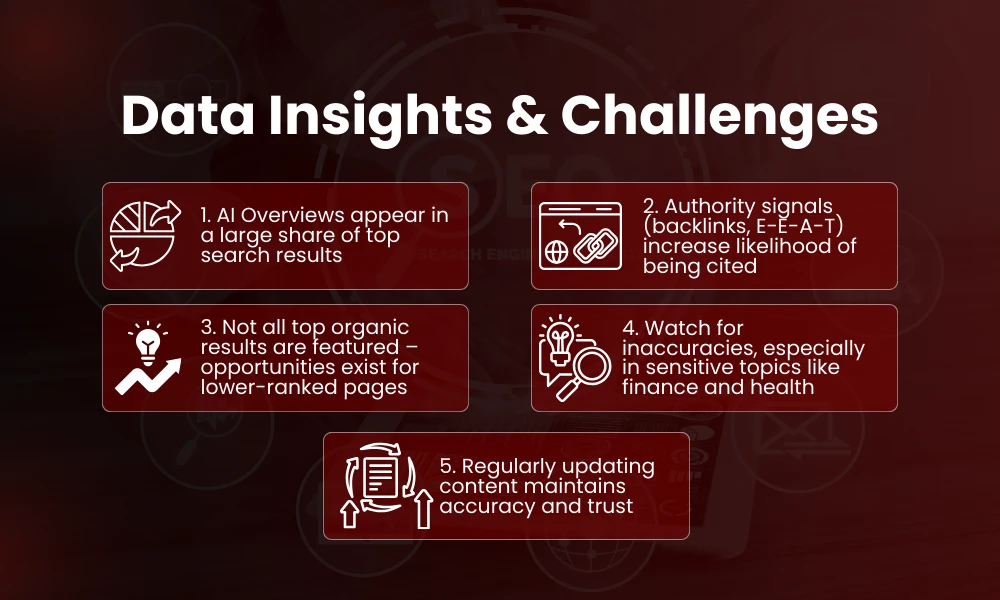
AI Overviews are still evolving. What works today might shift as Google refines its AI models.
Track:
- When your content appears in AI Overviews
- What queries trigger your inclusion
- How your visibility changes after updates
Use tools like Search Console and SEO analytics platforms to see real-world performance and adjust for strategies for optimizing content for Google AI Overviews. Advanced SEO analytics tools help you measure AI visibility trends and refine performance over time.
Frequently Asked Questions
What makes content eligible for Google AI Overviews?
Content is more likely to be included when it:
- Answers queries clearly and directly
- Uses structured formatting
- Demonstrates credibility and data
- Matches user intent closely
This is central to the strategies for optimizing content for Google AI Overviews covered here.
Do keywords still matter for AI Overviews?
Yes, but they matter differently. Instead of stuffing keywords, focus on natural language queries that users actually type, such as long-tail questions.
Can AI Overviews hurt my site traffic?
They can reduce click-through rates since users might see the answer they need without clicking. But strategies for optimizing content for Google AI Overviews can still influence what users see and build brand visibility.
Should I use AI to generate content?
AI can help, but human revision and factual accuracy are critical strategies for optimizing content for Google AI Overviews. AI alone won’t ensure authority or credibility, which are key factors for AI Overviews.
Final Thoughts
The rise of AI-generated summaries marks a new era in content visibility. Knowing the strategies for optimizing content for Google AI Overviews isn’t just about rankings, it’s about staying relevant in a search landscape where instant answers dominate.
The best path forward combines proven SEO fundamentals with thoughtful structuring, data backing, and user-focused clarity. This is how you give both humans and AI systems exactly what they look for.