
A Snapchat AR campaign can look successful before you know whether it actually helped the business. People may open the Lens, play with it, take a Snap and share it. Those actions matter, but they don’t tell you whether the experience changed a buying decision.
Snapchat AR ads use augmented reality through Snapchat’s camera so people can interact with a brand, product, or environment. The important part is not the technology itself. It is what the interaction gives the user that a normal ad cannot.
For one brand, that could mean seeing glasses on their own face. For another, it could mean playing a branded game. Both can earn attention. Only one may directly help someone decide what to buy.
Key Takeaways
- AR has the clearest value when it helps answer a real product question.
- Try-on and product visualization can reduce uncertainty before a purchase.
- Entertainment Lenses can build attention and sharing but follow a less direct path to revenue.
- Custom AR costs depend on what has to be created rather than a standard Snapchat fee.
- A successful Lens should be judged by the business change it was designed to create.
What Makes One AR Experience More Useful Than Another?
The biggest difference is what the user gets from the interaction.
When AR helps someone decide
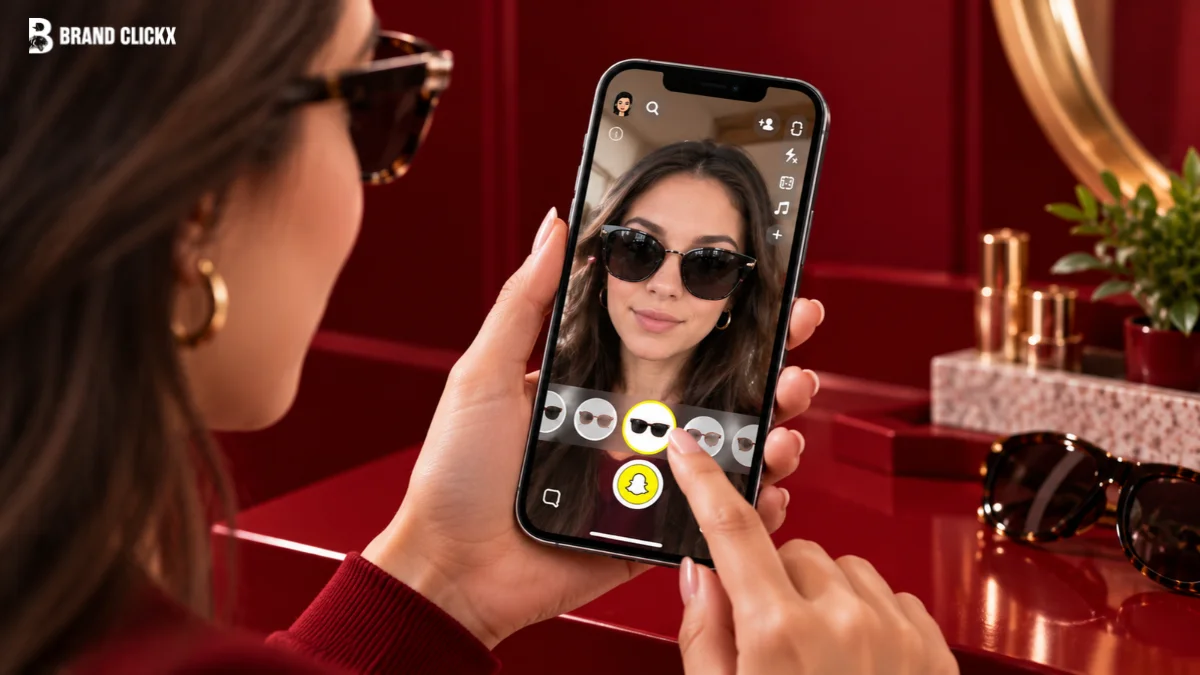
Imagine someone choosing between several pairs of sunglasses. A product photo shows the glasses, but it cannot show how each frame looks on that person’s face. A try-on Lens changes that. Brands can explore these interactive experiences using Snapchat Lens Studio. The customer becomes part of the product demonstration.
Understanding customer demand can also help brands identify what shoppers want and create more relevant experiences. The same principle works when someone wants to see how makeup appears on their face or how furniture might look in their room.
When AR is mainly entertainment
Now consider a Lens that puts a funny effect on someone’s face or turns a brand into a short game. There is still value. People may remember the brand, share the experience, or spend more time with the campaign. But the experience is not necessarily helping them answer a purchase question.
That gives us two different paths:
Utility AR: interaction → better understanding → consideration
Entertainment AR: interaction → attention → memory/sharing → possible later action
Neither path is automatically better. They simply need different expectations.
How Are Lenses Different From Filters?
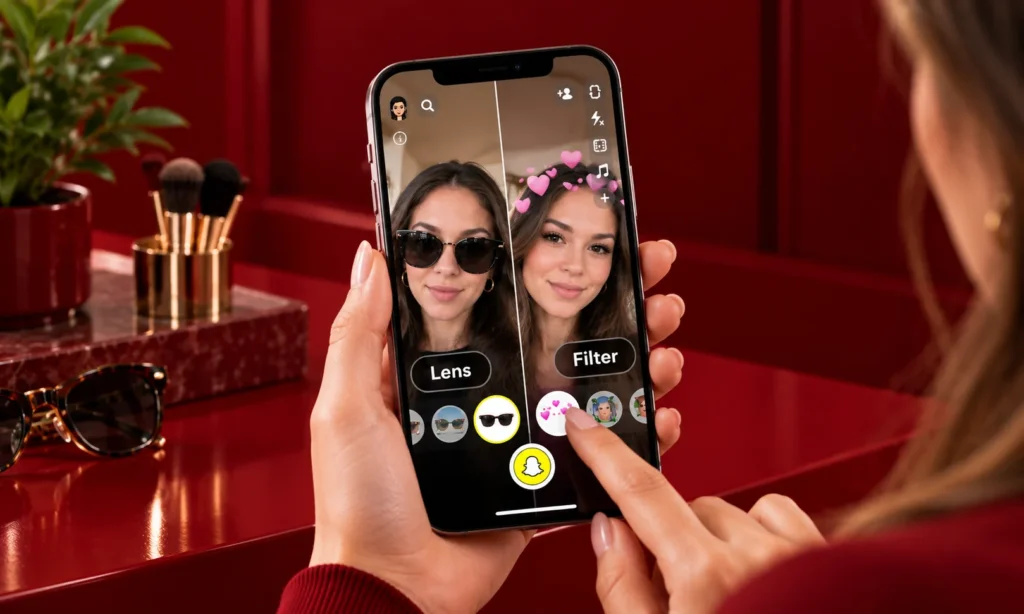
The two terms are often used together, but they do different jobs. A Lens is an interactive AR experience that can change the user’s face, surroundings or interaction with a product. A Filter is generally an effect added around captured content. That difference matters for advertisers. A Lens can make the product itself part of the experience, while a Filter can be more focused on the content people create and share.
Which Products Make the Best AR Candidates?
The strongest candidates have a visual uncertainty problem.
Beauty and eyewear
These products are easy to understand through try-on. The customer is not just asking, “What does this product look like?” They’re asking: “What will this look like on me?” AR can answer that question immediately.
Furniture and home products
Home products create another type of uncertainty. A shopper can see the dimensions on a product page and still struggle to imagine the item inside their own space. Placing a digital version into that environment can make the product easier to evaluate and improve the overall customer experience.
Footwear, accessories and similar products
The same logic can apply wherever appearance affects confidence. The important test isn’t whether a category is fashionable enough for AR. It is whether seeing the product in the user’s context changes what they know. If it does, AR has a stronger reason to exist.
When Is AR Harder to Justify?
AR becomes harder to defend when the interaction adds excitement but little useful information. If the product cannot meaningfully be seen, placed, or experienced through the camera, the Lens may simply become another creative wrapper. That can still work for brand awareness campaigns. But the advertiser should not pretend it is solving a product-selection problem.
Don’t confuse fun with failure
An entertainment Lens is not automatically a bad investment. A game can strengthen recognition, create social content, or make a campaign easier to remember. The mistake is judging it by a metric it was never designed to influence. If the purpose is brand attention, measure brand outcomes. If the purpose is product evaluation, measure what happens to shoppers after the evaluation.
Does AR Only Work for Fast Purchases?
No. A customer considering a car, property, or expensive home product may take weeks or months to decide. AR can still have a role earlier in that journey. The Lens might help someone explore an option, become interested, visit a product page, or submit an inquiry. The final transaction can happen much later.
So the better question is not: “Will the person buy immediately?” It is: “Where in the decision journey can AR make the next step easier?”
What Actually Makes AR Expensive?
There is no single Snapchat AR price that applies to every campaign. Simple experiences can be built with relatively accessible tools. Costs rise when the project requires custom 3D assets, advanced tracking, complex interactions, or a large range of products. The technology itself is only one part of the budget.
Think about the full production load
A custom experience may require:
- product or 3D asset preparation
- development
- testing
- tracking setup
- catalog connections
- creative revisions
- technical updates
- media distribution
A simple Lens may need only some of these. A commerce-focused experience may need most of them. That is why quoting one “average AR cost” can be misleading.
Build cost and media cost are different
The money used to create the Lens is not the same as the money used to put it in front of people. This distinction matters when judging profitability. A campaign can have a modest media budget but expensive custom development. Another can use a simple creative and spend much more on distribution. Look at both before deciding whether AR makes financial sense.
Does a Lens Need Constant Updating?
Not every Lens does. A simple entertainment experience may remain largely unchanged during its campaign. A shopping experience has more things that can move. Products can change, catalogs can expand, assets can be replaced, and landing pages can be updated.
That means commerce AR can create an ongoing operational requirement even after the original Lens has been built. The more the experience depends on live product information, the more important that upkeep becomes.
How Do You Measure an AR Campaign Properly?
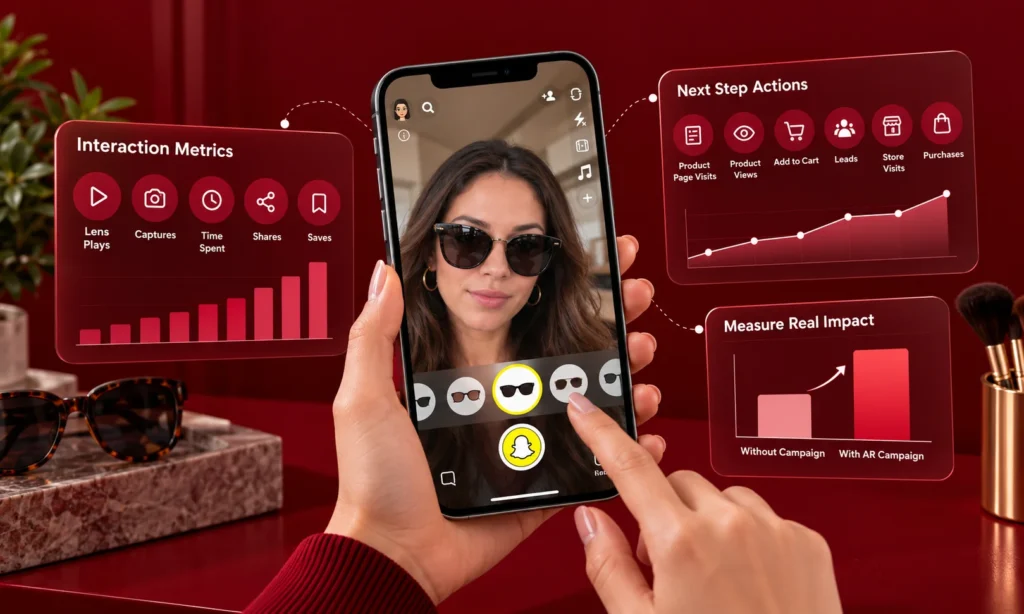
Start by separating interaction from business impact. A person playing with a Lens proves that the creative attracted them. It does not prove that the campaign generated a sale.
Start with interaction
Useful first-level signals include:
- Lens plays
- captures
- time spent
- shares
- saves
These tell you whether people used the experience. They are not sales metrics.
Then follow the user’s next move
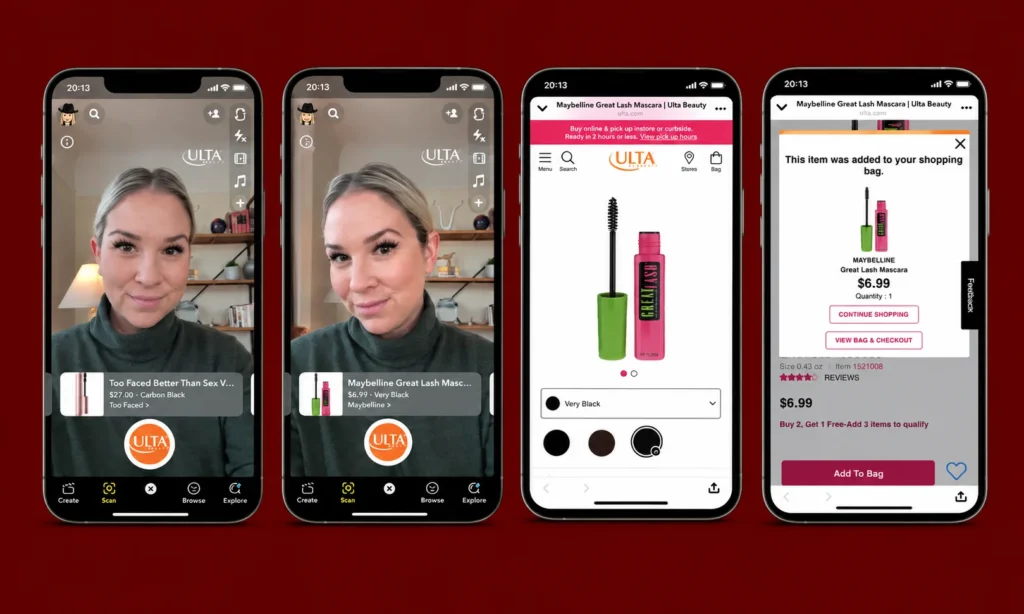
For a shopping Lens, look for actions such as:
- product-page visits
- product views
- add-to-cart activity
- leads
- store visits
- purchases
The right event depends on the product and the campaign objective.
Then ask whether the campaign changed the outcome
This is the step many campaigns skip. Suppose people who used the Lens bought more products. That sounds positive. But what if those people were already more interested in the brand? You need a comparison to estimate what the campaign actually added.
Tracking branded search demand alongside other brand metrics can also help marketers understand whether interest in the brand is changing over time, although it cannot prove that the AR campaign caused that change.
What Is Incrementality in AR Advertising?
Incrementality is basically the counterfactual question: What would have happened if these people had not received the AR experience? A holdout or control group gives you a way to estimate that difference. If exposed customers produce better results than a comparable unexposed group, the gap gives you stronger evidence that the campaign contributed something additional.
That is more useful than simply counting everyone who interacted with the Lens and later converted. For larger programs, other measurement approaches can also estimate AR’s contribution alongside the rest of the media mix.
Can Try-On AR Reduce Returns?
It can, but there is an important condition. A useful try-on experience can give shoppers a better idea of what they are getting. That may help them choose more confidently. But if the AR version creates an unrealistic expectation, the opposite can happen. The delivered product may then feel different from what the customer saw digitally.
So the safer conclusion is: Accurate AR can reduce uncertainty. It does not guarantee fewer returns. If reducing returns is part of the business case, measure actual post-purchase behavior instead of treating try-ons as automatic return prevention.
Does AR Creative Get Old?
There is no dependable Snapchat number that tells us how many days a Lens stays effective. And there probably shouldn’t be one universal number. A Lens built around a joke or game depends heavily on novelty. Once people have experienced it, some of its appeal may disappear.
A product try-on is different. As long as customers continue asking the same product question, the experience can remain useful. So think about useful life, not a fixed expiration date.
Can a Lens Reach People Beyond the Original Campaign?
Yes, and this is one reason interaction quality matters. Snapchat’s Lens discovery system uses signals from how people interact with Lenses. Playing, saving, sharing and creating content can all contribute to how experiences are surfaced to users.
That means a Lens can potentially travel beyond its original paid exposure. But don’t make the mistake of turning that into a sales claim. A Lens becoming popular proves that people wanted to use it. It does not automatically prove that they wanted to buy the product.
Should You Build a Utility Lens or an Entertainment Lens?
Choose utility when the camera can help answer a question that matters to the customer. Choose entertainment when the campaign’s job is to create attention, expression, sharing, or stronger brand memory. You can also combine both.
For example, an entertaining experience can attract people while a product interaction gives interested users a practical next step. The key is deciding the job before building the creative.
Five Questions to Ask Before Spending on AR
1. What question does the Lens answer?
If there is no meaningful answer, reconsider the idea.
2. Does AR provide something a normal image cannot?
If the customer learns exactly the same thing from a photograph, the extra production may not be worthwhile.
3. What should happen after the interaction?
Know whether you want a product visit, lead, store visit, purchase or brand response.
4. Which number will prove success?
Pick the metric before launch instead of choosing the best-looking number afterward.
5. Can you measure the additional effect?
For a significant investment, plan a control or lift measurement wherever practical.
Is Snapchat AR a Format or a Strategy?
It is a format. The strategy comes from the reason you use it. AR can make an advertisement more interactive, but interaction alone is not a marketing objective. The strongest campaigns give the interaction a specific purpose. They either help someone understand the product or give them a memorable reason to engage with the brand.
That is also why AR should not be evaluated separately from the rest of the campaign. A Lens can play one role while video, search, retail media or other channels handle the next part of the customer journey.
The Read
The best reason to use Snapchat AR is not simply that people enjoy augmented reality. It is that AR can let people do something they could not do as easily with a normal ad. They can see a product on themselves. They can place something into their surroundings. They can interact with a brand in a way that makes the experience easier to remember.
But entertainment has a place too. A branded game can create attention and sharing even when it does not directly answer a purchase question. So don’t begin with: “Should we make an AR Lens?” Begin with: “What should become easier, clearer, or more memorable because this Lens exists?”
If you cannot answer that, the technology is probably driving the campaign. If you can answer it and you can measure what happens next, AR has a much stronger business case.