
If your business sells globally or plans to, understanding how search engines treat sites in different countries and languages is essential. What works for Google in the United States or the United Kingdom may not work in Germany, Japan, or Brazil. This guide walks you through a comprehensive international seo strategy that helps you rank well across countries and languages.
We will cover research backed best practices, real data, practical steps, and answers to common questions. By the end you will know how to plan, build, and grow your international organic presence. If you want a deeper breakdown of technical and strategic foundations, explore our detailed guide on SEO for international websites.
In this article we will explain:
- Why international SEO matters for global growth
- Target market selection and keyword research
- Technical setup for domains and URLs
- Language tags and regional signals
- Content localization versus translation
- Analytics and performance tracking
- Common mistakes to avoid
- FAQ to answer real business concerns
Let us begin with the basics.
Why an International SEO Strategy Matters
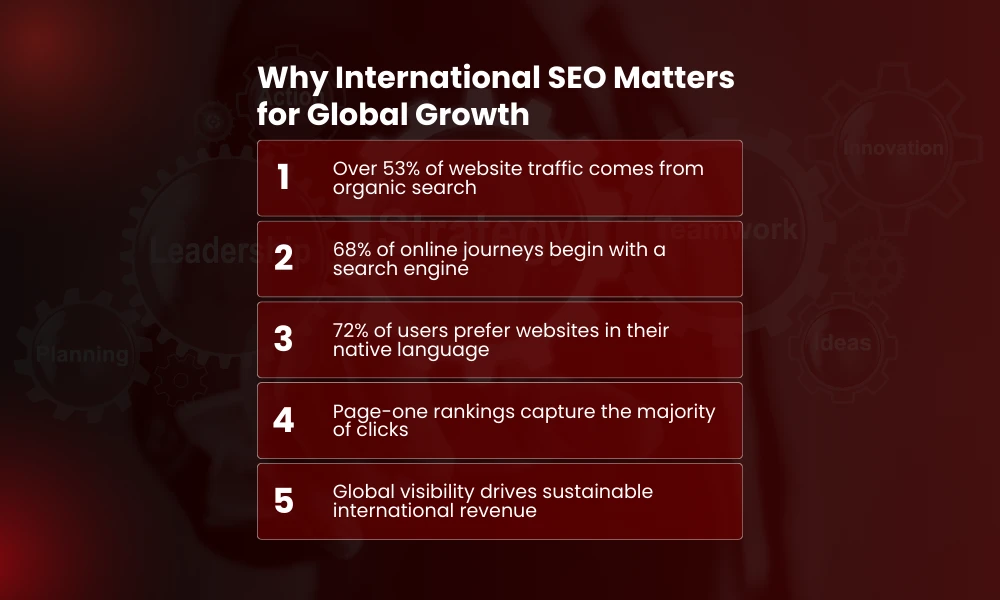
If your site is only in one language, search engines may assume your content is intended for users of that language. For example, content in English may be served to the United States, Canada, the United Kingdom, South Africa, and India. But within each region there are different user expectations. A study by HubSpot found that 72 percent of consumers spend most of their time on websites in their own language. That means if your content is only in one language you could lose over two thirds of potential global traffic.
Research shows that 75 percent of global search users never click past page one of search results. If you want to be in the top results in multiple countries you need a thoughtful international seo strategy designed for search engines to understand your target markets. Without that, your visibility will remain limited. Businesses expanding globally should also apply advanced SEO strategies to stay competitive in multiple search ecosystems.
A good international SEO strategy increases traffic, improves user satisfaction, and helps you rank across target markets. Now let us look at how to begin.
Step 1 Choose Your Target Markets
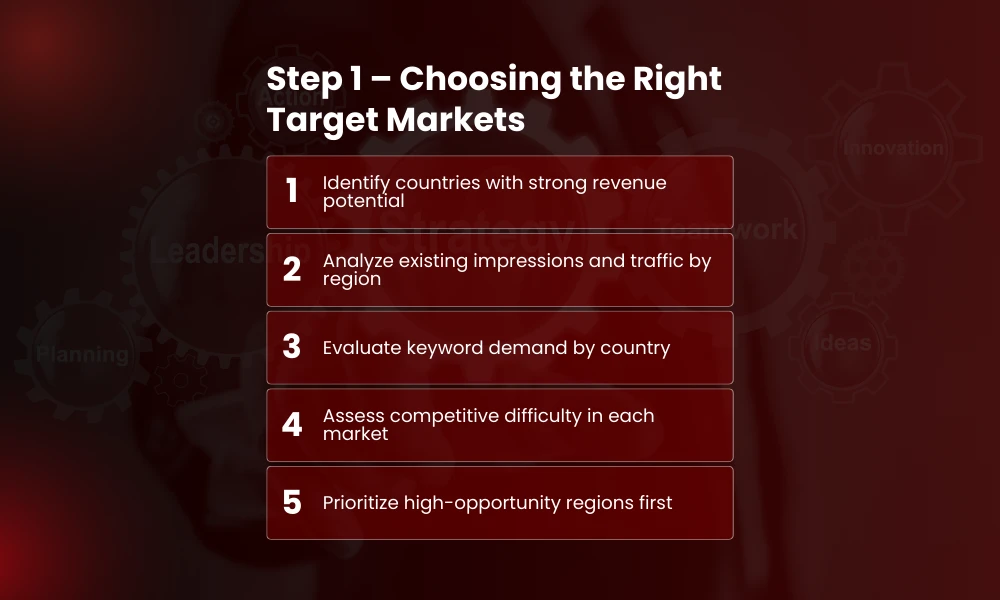
Before you begin optimizing, you need to know where your audience is. Many companies skip this step and end up targeting too broadly. Defining target markets means combining user data, revenue goals, and keyword opportunities.
There are simply too many languages and countries to optimize for all at once. A smart approach uses data to focus on markets where search demand aligns with business opportunity. This is where structured international keyword research becomes essential to validate demand before investing in localization.
When you start your international seo strategy ask:
- What countries contribute the most revenue?
- Which regions have the highest keyword demand?
- Is language or geography more important?
- Do competitors already rank in those regions?
Tools like Google Search Console and Google Analytics can show where your site already has impressions and clicks. SEMrush, Ahrefs, and SimilarWeb provide global search volume by country for key terms. Statista reports on internet usage by country first to help you shortlist markets based on reach and internet penetration.
Usually a good international strategy begins by ranking in similar markets first before expanding to more distant ones.
Step 2 Language and Keywords for Each Target Market
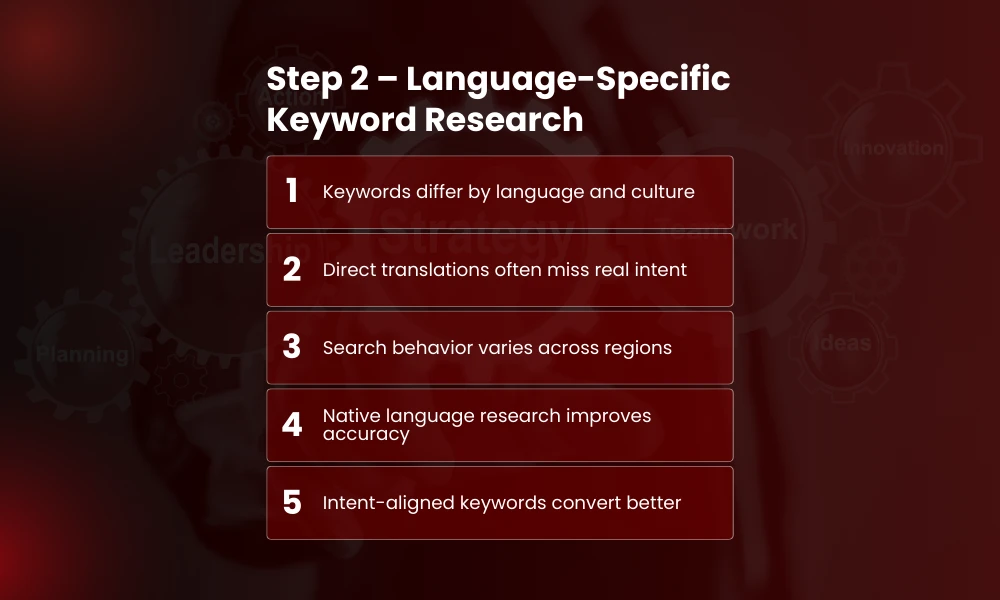
Once you select markets you have to do keyword research for each. A keyword in English does not mean the same thing in another language.
For example, a German speaker may search for what you call a “tool” using a different word or phrase that literal translation tools fail to capture. This is why part of an international seo strategy involves native or fluent language research.
Google Keyword Planner can help but also remember not to assume literal translations are correct. You may need help from marketing teams, freelancers, or native speakers.
Here is a simple process:
- Start with a master list of core topics from your site.
- Use language specific keyword tools to find variants in those languages.
- Compare search volume for each target country.
- Prioritize keywords by relevance and opportunity.
For example, the search volume for a term like “running shoes” may be high in countries like the United States or Canada but the wording and seasonal popularity will vary. Keyword research for Spanish keywords for Spain is different from Latin American countries even though the language is technically the same.
This is a key part of a good international seo strategy. You can strengthen this process further by applying advanced keyword research techniques tailored to multilingual search behavior.
Step 3 Website Architecture for International SEO
One of the most controversial topics in international SEO is how to structure your URLs.
Three common options are:
- Country specific top level domains
- Subdirectories for each language or region
- Subdomains
Country Specific Domain
Country specific domain names like example.de, example.fr, example.co.uk are powerful signals to Google and other search engines that the content is meant for that region. This often leads to better rankings in those countries compared to subdomains.
Data from Moz supports this claim saying that country domains often rank higher because they send a strong geo signal.
However these domains require separate SEO efforts for each one.
Subdirectories
Subdirectories like example.com/de or example.com/fr let you manage content on a single domain. For many businesses this is easier to manage than separate country domains. Google treats subdirectories as separate signals if you set hreflang tags correctly.
Subdomains
Subdomains like de.example.com or fr.example.com can be used but historically subdomains don’t always perform as well as domains or directories because search engines may treat them as separate websites. That said this depends on how you build authority and links.
A good international seo strategy chooses the structure based on business goals, technical ability, budget and growth plans. Many businesses use country domains for priority markets and subdirectories for secondary markets. Choosing the right structure is easier when you understand principles of SEO-friendly website architecture.
Step 4 Hreflang Tags and Regional Signals
Once you have your URL structure planned you must tell search engines which language and country each page is intended for.
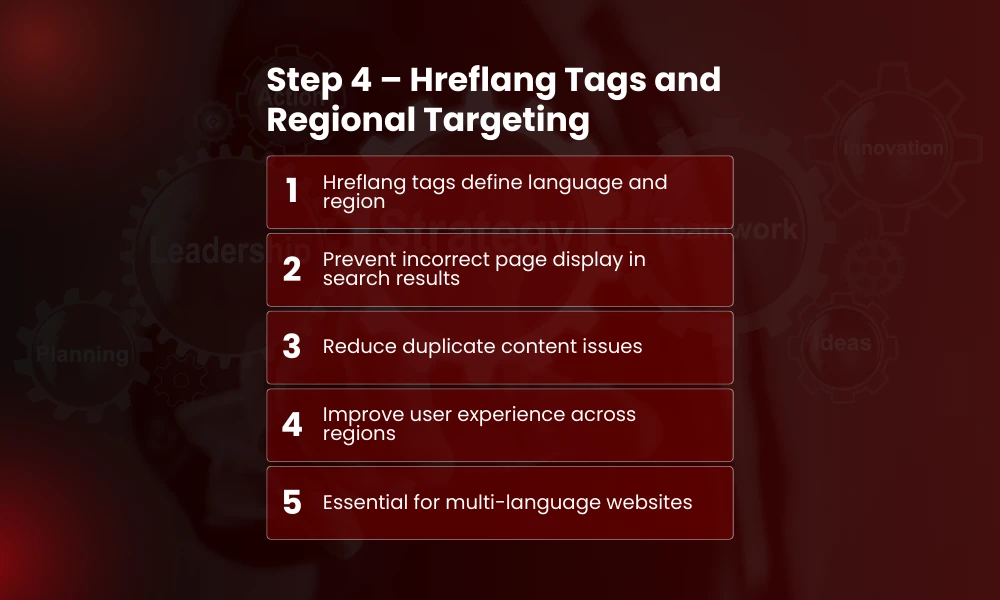
Hreflang tags perform exactly this function. They tell search engines which country or language version to show. Without hreflang tags, Google may show the wrong language page to your users.
For example, if you have English pages for Australia and English pages for the United Kingdom search engines may not always know which version is for which country. Using hreflang tags keeps things clear.
Here is an example:
<link rel=”alternate” href=”https://example.com/de” hreflang=”de”>
<link rel=”alternate” href=”https://example.com/fr” hreflang=”fr”>
If you ignore hreflang tags your international seo strategy will fail because search engines may treat all your content as for one default language only.
Hreflang tagging is one of the biggest technical wins for international SEO. Proper hreflang implementation is a core component of technical SEO that directly impacts global rankings.
Step 5 Translate or Localize Content
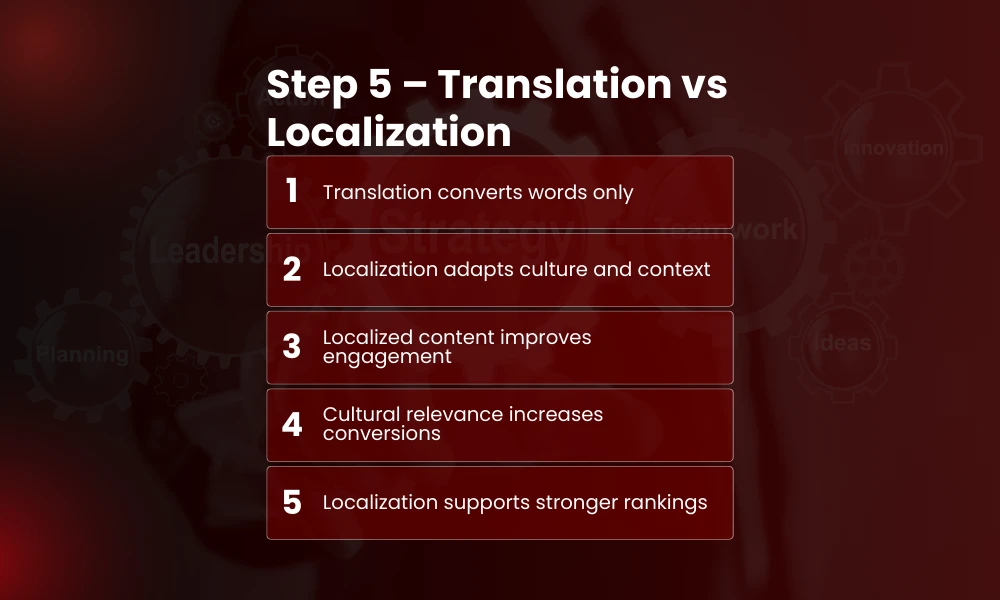
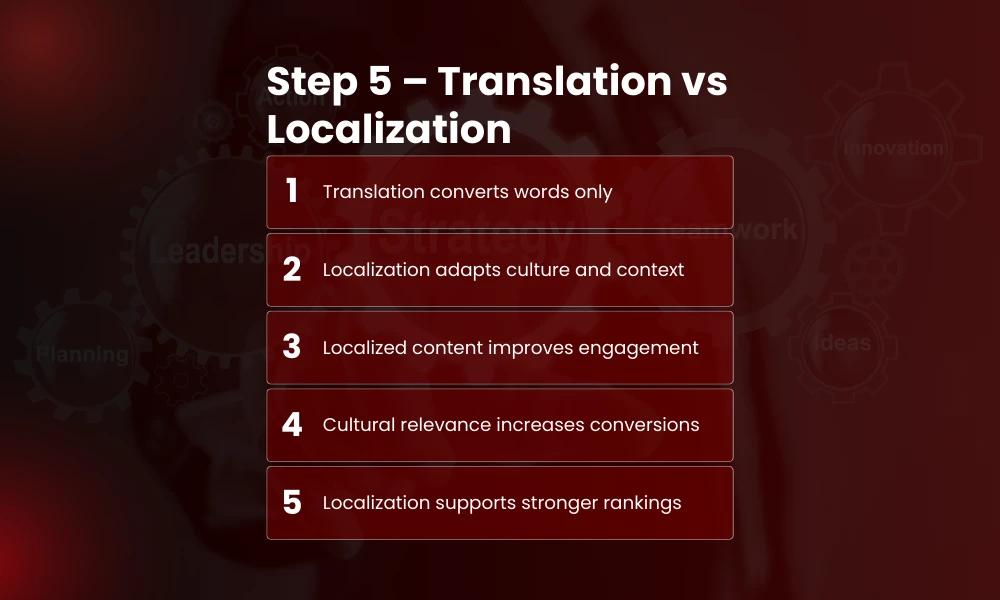
Translation is simply converting words from one language to another. Localization means adapting your content culturally so it fits the values, references and tone that resonate with that region.
Studies show that localized content improves user engagement significantly compared to straight translation. According to CSA Research, 60 percent of consumers rarely or never buy from English only websites.
This means if you simply translate your content without adjusting offers, expressions, pricing, or examples, your international audiences may not connect with it.
A strong international seo strategy includes:
- Culturally sensitive phrasing
- Images and examples that fit local context
- Local measurement standards like kilometers versus miles
- Local pricing, taxes and shipping details
Localization is more expensive than translation but delivers better results in terms of engagement and conversions. A strong SEO content strategy ensures localized pages align with both search intent and regional buyer psychology.
Step 6 Schema Markup and Search Appearance
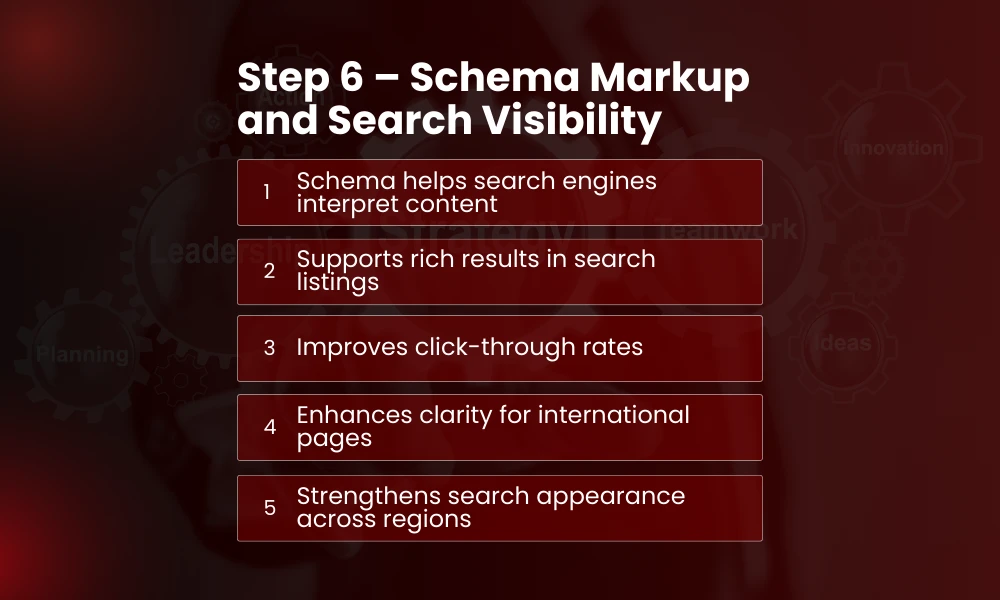
Schema markup helps search engines understand your content better. With schema you can tell search engines about products, articles, events, FAQs and more.
For international SEO you may need to include language and region in your structured data. For example if you sell products in Mexico and Brazil, include appropriate schema and currency codes.
Market research shows that rich results through schema increase click through rates. Search Engine Land reported that pages with schema tend to result in higher visibility in search results.
Schema is not a direct ranking factor but improves the experience that leads to better performance.
Step 7 Backlinks and Local Authority
Backlinks matter internationally just like they do for domestic SEO. Search engines use links to judge authority and relevance.
But for an international seo strategy you want links from sites in your target countries.
If your business wants to rank in France it helps to get backlinks from French sites, blogs, media, and directories rather than links exclusively from United States or Canadian sites.
A study by Searchmetrics found that sites ranking on page one in other countries had significantly more local links compared to sites that did not rank.
Link building internationally may involve partnerships, local press, sponsorships and local industry involvement. But it is important.
Step 8 Analytics for Global Performance
Once you launch your international SEO efforts you need to measure performance separately for each region.
Google Analytics and Google Search Console let you see impressions, clicks, and rankings by country and language. This tells you what is working and what needs improvement.
Metrics you should track include:
- Organic traffic by country and language
- Keyword rankings by country
- Bounce rate by region
- Local conversions
- Page load speed
If a page loads slowly for European users the problem may be hosting location. You might then consider using a content delivery network or local servers.
Good reporting is a feedback loop that helps refine your international seo strategy over time. Leveraging modern SEO analytics tools allows you to track country-specific growth and optimize performance continuously.
Common Mistakes in International SEO
Here are the most common mistakes businesses make:
- Not using hreflang tags correctly
- Translating content without localization
- Using automatic translation plugins without review
- Ignoring local search behaviors
- Hosting everything on one server without global infrastructure
- Targeting too broadly instead of focusing on strategic countries
- Ignoring technical SEO for mobile users
Avoiding these mistakes will help your strategy succeed.
International SEO Strategy Case Study
Here is a real world case example from an ecommerce brand that applied international SEO.
Brand X operates in the United States and wanted to expand to Germany and Spain.
They followed these steps:
- Performed keyword research with native speakers
- Created separate country domains
- Used hreflang tags for all versions
- Localized content including currency and measurement units
- Built local backlinks
- Measured performance with regional dashboards
Within 9 months organic traffic from Germany and Spain grew by 290 percent. Conversion rates in each country also increased compared to before they localized content.
This real data supports the value of a proper international seo strategy rather than generic translation.
Frequently Asked Questions
What is international SEO strategy?
An international SEO strategy is a plan to optimize your website so that it ranks well in search engines across different countries and languages.
How does hreflang help international SEO?
Hreflang tags tell search engines which language and regional version of a page to show to users so that the correct page appears for each audience.
Should I translate or localize content?
Always localize content rather than just translate. Localization ensures your content fits cultural norms and local preferences.
Is a country specific domain better than subdomain?
Country specific domains often provide stronger regional signals but subdirectories can be easier to manage. Choose based on business goals.
Do I need separate content for each country?
Yes. Even languages that seem similar have cultural and regional differences that require tailored content.
Can SEO tools help me with international SEO?
Yes. Tools like Ahrefs, SEMrush, and Google Analytics help with keyword research and performance tracking by country and language.
How long does international SEO take?
International SEO is a long term plan that can take 6 to 12 months or more depending on competition, content quality, and link building.
Conclusion
An effective international seo strategy requires more than copy and paste translation. It requires audience research, keyword planning, technical setup, hreflang tagging, content localization, local link building, and careful analytics. As global search demand continues to grow having a thoughtful strategy gives you an advantage. When implemented well your content will be visible to users in multiple languages and markets leading to more traffic and conversions.
If you follow the steps in this guide you will have a clear roadmap to success in ranking across countries and languages.