A business plan does not have to start with a blank page. A business plan is a written document that explains what your business does, who it serves, how it will make money and how you plan to grow it. It can also help you organize your ideas, make better decisions and show potential investors or lenders how the business can succeed.
This free business plan template gives you a ready-to-fill structure for describing your business, customers, competitors, marketing strategy, funding needs and financial outlook.
It works for startups, small businesses, entrepreneurs preparing for funding and owners planning their next stage of growth. You can use the full traditional format when you need a detailed plan or the shorter lean version when you need a simple, one-page overview.
Use the template below as your working document. Replace every bracketed prompt with your own information, add or remove sections as needed, and delete the instructions before sharing the finished plan.
Download or Copy the Business Plan Template
You can use this template in several formats:
- Word document for a traditional editable business plan
- Google Docs for online collaboration
- PDF for printing or sharing a finished version
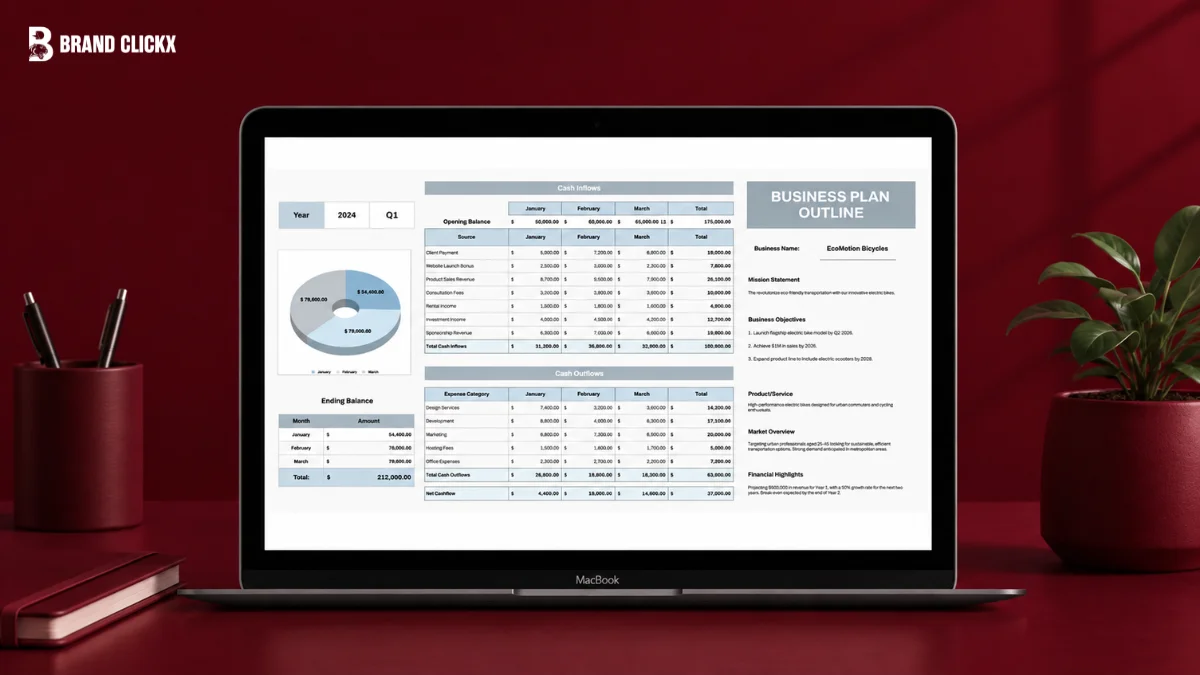
- Excel or spreadsheet format for financial projections
The template is designed to be copied, edited and customized for your business. If you are creating a plan for investors or lenders, keep the final version professional and remove all instructional prompts.
How to Use This Template
- Fill in the sections in order, or jump directly to the section you need.
- Replace every item inside brackets with information about your business.
- Use a spreadsheet for detailed revenue, expense and cash-flow calculations.
- Delete the instructions and sample information before submitting the final plan.
The Business Plan Template
The following template is designed to be copied directly into a Word document, Google Doc or other writing program.
1. Executive Summary

The executive summary gives the reader a quick understanding of the entire business. Although it appears first, many business owners find it easier to complete this section after writing the rest of the plan.
- Business name: [ ]
- Business location: [ ]
- Business structure: [ ]
- Mission statement: [ ]
- Business concept: [ ]
- Products or services offered: [ ]
- Target customers: [ ]
- Competitive advantage: [ ]
- Funding request, if applicable: [ ]
- Key financial highlights: [ ]
- Business goals: [ ]
Example:
- Business name: Green Bean Coffee House
- Location: Austin, Texas
- Mission statement: To provide high-quality coffee and a comfortable neighborhood space for local customers.
- Products or services offered: Specialty coffee, tea, pastries and light breakfast items.
- Funding request: $75,000 for equipment, interior improvements and initial working capital.
- Key financial highlight: The business expects to reach monthly operating break-even during its first year.
2. Company Description
Use this section to explain what the business does, why it exists and what you want it to become.
- Business name: [ ]
- Business structure: [ ]
- Date founded or planned launch date: [ ]
- Industry: [ ]
- Business location: [ ]
- What does the business do?: [ ]
- What problem does the business solve?: [ ]
- Who does it serve?: [ ]
- What makes the business different?: [ ]
- Short-term goals: [ ]
- Long-term goals: [ ]
- Business vision: [ ]
3. Market Analysis
The market analysis explains the environment in which your business will compete. Keep the information specific to your industry and target customers.
- Industry overview: [ ]
- Industry size and growth: [ ]
- Current market trends: [ ]
- Target market: [ ]
- Ideal customer description: [ ]
- Customer needs or pain points: [ ]
- Estimated market size: [ ]
- Geographic market: [ ]
- Customer buying behavior: [ ]
- Top competitor 1: [ ]
- How we differ: [ ]
- Top competitor 2: [ ]
- How we differ: [ ]
- Top competitor 3: [ ]
- How we differ: [ ]
- Main opportunity in the market: [ ]
- Main market risks: [ ]
A strong market analysis should explain more than who your competitors are. It should show why customers need your product or service and why your business has a realistic opportunity to compete.
4. Organization and Management
This section shows who owns and operates the business and how responsibilities are divided.
- Legal structure: [ ]
- Owner or founder: [ ]
- Ownership percentage: [ ]
- Co-founder(s): [ ]
- Management team: [ ]
- Key employee roles: [ ]
- Planned hires: [ ]
- Advisers or professional partners: [ ]
- Organizational structure: [ ]
- Relevant experience of the management team: [ ]
- Responsibilities of each key team member: [ ]
If the company is still small, you do not need a complicated organizational chart. Clearly explain who is responsible for sales, operations, finance, marketing and other important functions.
5. Products or Services
Describe exactly what customers will buy and why the offering is useful.
- Product or service name: [ ]
- Description: [ ]
- Main features: [ ]
- Customer benefit: [ ]
- Pricing: [ ]
- Pricing model: [ ]
- Production or delivery process: [ ]
- Suppliers or partners: [ ]
- What makes the offering different?: [ ]
- Customer problem it solves: [ ]
- Future products or services: [ ]
- Intellectual property, technology or proprietary assets: [ ]
For a product business, explain manufacturing, inventory and distribution. For a service business, explain how the service is delivered and how customers are charged.
6. Marketing and Sales Strategy
Explain how potential customers will discover your business and how you will turn them into paying customers.
- Target customer profile: [ ]
- Brand positioning: [ ]
- Main marketing message: [ ]
- Marketing channels: [ ]
- Website or online presence: [ ]
- Social media strategy: [ ]
- Search or content marketing strategy: [ ]
- Advertising strategy: [ ]
- Partnership strategy: [ ]
- Sales process: [ ]
- Lead-generation methods: [ ]
- Customer conversion strategy: [ ]
- Customer retention plan: [ ]
- Referral strategy: [ ]
- Expected customer acquisition cost: [ ]
The goal is to show a realistic path from reaching potential customers to generating revenue.
7. Funding Request

Optional: Complete this section if you are seeking outside financing.
- Amount requested: [ ]
- Funding type: [ ]
- Loan, equity or other financing: [ ]
- Purpose of funds: [ ]
- Equipment costs: [ ]
- Inventory costs: [ ]
- Marketing costs: [ ]
- Staffing costs: [ ]
- Technology costs: [ ]
- Working capital: [ ]
- Other expenses: [ ]
- Expected financial impact of funding: [ ]
- Repayment plan, if applicable: [ ]
- Investor return or exit plan, if applicable: [ ]
Explain exactly how the money will be used. A funding request is stronger when every major dollar amount has a clear business purpose.
8. Financial Projections
Financial projections show whether the business can realistically generate enough revenue to cover its costs and achieve its goals.
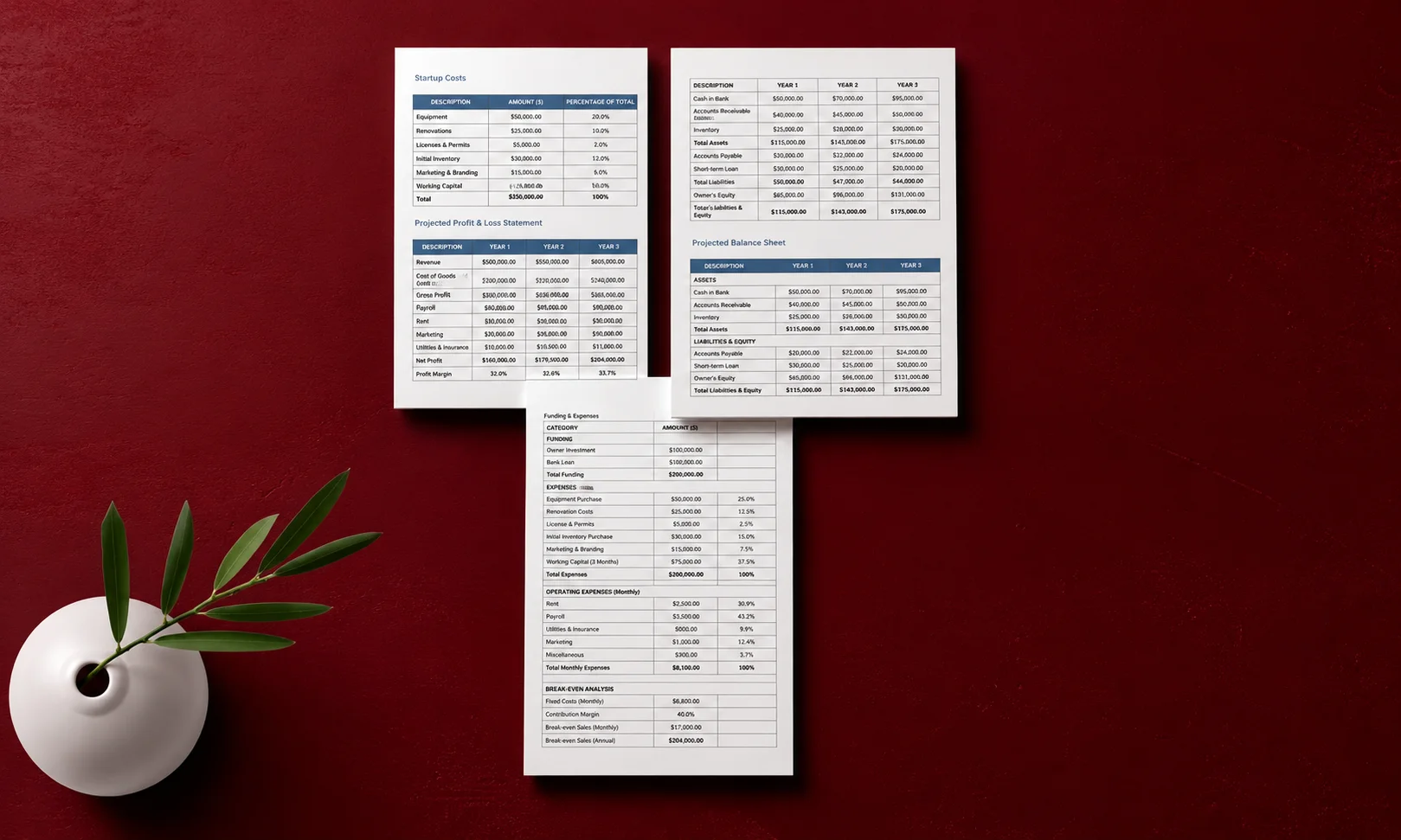
- Startup costs: [ ]
- Monthly fixed expenses: [ ]
- Variable costs: [ ]
- Revenue projections for Year 1: [ ]
- Revenue projections for Year 2: [ ]
- Revenue projections for Year 3: [ ]
- Gross profit estimate: [ ]
- Operating expense estimate: [ ]
- Net profit or loss estimate: [ ]
- Cash-flow estimate: [ ]
- Break-even point: [ ]
- Expected monthly sales: [ ]
- Key financial assumptions: [ ]
- Expected growth rate: [ ]
The financial section should be supported by a spreadsheet when detailed numbers are required. Use realistic assumptions rather than choosing figures simply because they make the business appear more profitable.
9. Appendix
Use the appendix for supporting information that is useful but would make the main business plan too long.
- Supporting documents: [ ]
- Owner or management resumes: [ ]
- Business licenses: [ ]
- Permits: [ ]
- Contracts: [ ]
- Supplier agreements: [ ]
- Product images: [ ]
- Market research: [ ]
- Financial statements: [ ]
- Detailed financial projections: [ ]
- Patents or intellectual property documents: [ ]
- Other supporting documents: [ ]
Not every business needs a large appendix. Include documents that strengthen the plan or support important claims made in the main sections.
Filled-In Example: Sample Business Plan
The following example shows how the template can look when completed for a fictional local coffee shop.
Executive Summary
- Business name: Green Bean Coffee House
- Location: Austin, Texas
- Business concept: A neighborhood coffee shop serving specialty coffee, tea, pastries and simple breakfast items.
- Mission statement: To provide quality coffee and a comfortable place for local residents to work, meet and relax.
- Target customers: Local residents, students, remote workers and nearby employees.
- Funding request: $75,000.
- Use of funds: Coffee equipment, furniture, renovations, initial inventory and working capital.
- Business goal: Reach monthly operating break-even during the first year and open a second location within five years.
Company Description
Green Bean Coffee House will operate as a limited liability company. The business will serve customers from a neighborhood location near residential buildings, offices and a university campus.
The company will compete by combining specialty coffee with fast service, comfortable seating and a community-focused atmosphere.
Short-term goals include opening the first location, building a loyal customer base and reaching monthly break-even. Long-term goals include adding catering services and opening additional locations.
Market Analysis
The business will target customers between approximately 18 and 45 years old who regularly purchase coffee outside the home.
Primary customers will include university students, remote workers, local professionals and neighborhood residents.
Competitors include national coffee chains, independent coffee shops and convenience stores. Green Bean Coffee House will differentiate itself through locally focused branding, a comfortable work environment and rotating specialty drinks.
Organization and Management
The company will be owned by one founder with previous experience in food service and small-business management.
The initial team will include one store manager, three baristas and part-time weekend employees.
The owner will oversee finance, supplier relationships, marketing and long-term strategy. The store manager will handle daily operations and employee scheduling.
Products and Services
The coffee shop will sell espresso drinks, brewed coffee, tea, cold beverages, pastries and light breakfast products.
Average customer spending is expected to be approximately $8 to $12.
Future services may include coffee subscriptions, office catering and packaged coffee beans.
Marketing and Sales Strategy
The company will use local search, social media, email marketing, loyalty rewards and community partnerships to attract customers.
Opening promotions will encourage first-time visits. A digital loyalty program will encourage repeat purchases.
The business will also partner with nearby offices and community organizations to increase awareness.
Funding Request
The business is seeking $75,000 in startup funding.
Funds will be used for:
- $30,000 for coffee equipment
- $15,000 for renovations and furniture
- $10,000 for initial inventory
- $5,000 for marketing
- $15,000 for working capital
The company plans to repay debt from operating cash flow if the funding is structured as a business loan.
Financial Projections
- Year 1 projected revenue: $300,000
- Year 2 projected revenue: $390,000
- Year 3 projected revenue: $480,000
The projections assume gradual customer growth, stable average transaction values and controlled operating expenses.
The business expects to reach operating break-even during its first year.
Appendix
The appendix will include the owner’s resume, equipment quotations, lease information, licenses, detailed financial projections and relevant market research.
Lean Business Plan Template: One-Page Version
Not every business needs a long traditional business plan. A lean business plan can be useful when you are testing an idea, planning internally or building an early-stage company.
- Problem: [What customer problem are you solving?]
- Solution: [What product or service solves the problem?]
- Target market: [Who are your customers?]
- Value proposition: [Why should customers choose you?]
- Revenue model: [How will the business make money?]
- Marketing channels: [How will customers find you?]
- Key metrics: [What numbers will measure success?]
- Competitive advantage: [What makes the business difficult to copy or replace?]
- Team: [Who will build and operate the business?]
- Key costs: [What will the business spend money on?]
- Funding needed: [How much money is required?]
- Key goals: [What must the business achieve in the next 6–12 months?]
Use the lean version when speed and clarity matter more than producing a detailed document. Use the full template when you need to present the business to lenders, investors or other outside stakeholders.
Industry-Specific Template Variations
Business Plan Template for a Service Business
A service business should place more attention on customer acquisition, pricing, service delivery and employee capacity.
Expand these sections:
- Services offered
- Pricing model
- Customer acquisition
- Sales process
- Staffing
- Customer retention
- Capacity and operating costs
Examples include consulting firms, marketing agencies, cleaning companies, accounting firms and freelance businesses.
Business Plan Template for a Product or Retail Business
Product and retail companies should provide more detail about inventory, suppliers, manufacturing, distribution and margins.
Expand these sections:
- Product descriptions
- Suppliers
- Manufacturing
- Inventory
- Distribution
- Retail channels
- Gross margins
- Product development
The financial section should clearly show how product costs affect profitability.
Business Plan Template for a Nonprofit
A nonprofit business plan should explain the organization’s mission, beneficiaries and funding model.
Expand these sections:
- Mission
- Social or community problem
- Beneficiaries
- Programs
- Fundraising strategy
- Grants
- Donors
- Partnerships
- Impact measurements
- Governance
Instead of focusing only on profit, explain how the organization will remain financially sustainable while achieving its mission.
Common Business Plan Template Mistakes to Avoid
Leaving the Prompt Text in the Final Plan
Replace every bracketed instruction before submitting your plan. A lender or investor should see your business information, not the template directions.
Copying Example Numbers
The sample figures in a template are only examples. Replace them with numbers based on your actual costs, prices, expected sales and market research.
Making Financial Projections Too Optimistic
Large revenue increases with little explanation can make an otherwise strong business plan less credible. Explain the assumptions behind your projections.
Skipping the Market Analysis
A good business idea still needs customers. Explain who those customers are, what they need and how your business will compete.
Ignoring Cash Flow
Profit and cash flow are not the same thing. A business can appear profitable on paper and still face cash shortages because of inventory purchases, loan payments or delayed customer payments.
Using Too Much Detail
A business plan should provide enough information to support the business case without burying the reader in unnecessary material. Put detailed research and supporting documents in the appendix.
Choosing the Wrong Format
A startup testing an idea may only need a lean one-page plan. A company applying for substantial financing may need the traditional format with detailed financial projections.
Frequently Asked Questions
Is this business plan template free to use?
Yes. The template is designed as a free fill-in-the-blank framework that you can copy, edit and customize for your business.
Can I edit this template in Google Docs or Word?
Yes. You can copy the template into Google Docs, Microsoft Word or another compatible document editor and replace the prompts with your own information.
Do I need to fill in every section?
Not always. A traditional plan should normally cover the major areas of the business, but some sections may not apply to every company. For example, the funding request can be omitted if you are not seeking outside financing.
What’s the difference between this and a lean business plan template?
A traditional business plan provides more detail about the company, market, management, marketing and finances. A lean business plan summarizes the most important information on one page and is useful for early-stage planning.
Can I use this template to apply for a small business loan?
Yes, it can provide a strong starting structure for a loan application. However, lenders may have specific requirements for financial statements, projections, collateral, ownership information and other documents.
How do I fill in the financial projections section without an accountant?
Start with your expected sales, pricing, startup costs, fixed expenses and variable costs. Build monthly projections and document the assumptions behind each major figure. For complex businesses or major financing applications, professional financial advice can be useful.
How long should a business plan be?
There is no universal length. A lean plan may fit on one page, while a traditional plan can run several pages. The right length depends on the business and the purpose of the document.
Should I update my business plan after writing it?
Yes. A business plan should change as your business, customers, costs, competition and financial expectations change. Review it periodically and update important assumptions and targets.
Final Thoughts
A business plan is easier to create when you start with a structure instead of a blank document. This template gives you the core sections needed to describe your business, market, products, management, marketing strategy, funding needs and financial expectations.
For a quick planning exercise, start with the one-page lean version. If you are preparing for investors, lenders or a major business decision, use the full template and support your claims with realistic research and financial assumptions.
Copy the template into your preferred document format, replace the prompts with your own information and remove the instructional text before sharing the finished plan.