On October 1, 2013, Healthcare.gov launched, and six people managed to enroll on day one. The project had consumed hundreds of millions of dollars and dozens of contractors, each delivering their piece on time, none responsible for the whole thing working. When the White House finally sent a small rescue team of Silicon Valley engineers, they did not write much new code.
They deleted, simplified, and shipped. The site worked within weeks. The lesson cost American taxpayers a fortune and the software industry learned it anyway: the difference between software companies is not how much code they write, it is how much of it ships, works, and survives contact with users.
That lesson matters more in 2027 than ever, because AI coding tools have collapsed the cost of writing code toward zero, which means buyers are no longer paying for typing. They are paying for judgment: architecture that survives scale, integration with systems older than the engineers touching them, security that passes audits, and the discipline to ship.
When SpaceX paid a reported $60 billion for Cursor’s maker in 2026, it confirmed that code generation itself is now infrastructure, and the value of a software company has moved entirely into what it knows. This edition of the World’s 100 Best, BrandClickX’s annual benchmark series, ranks the hundred firms by exactly that: shipped systems, client outcomes, engineering depth, and the honesty of their pricing.
The engineering specialists who anchored our web development edition (EPAM, Globant, Thoughtworks, Endava, SoftServe) remain category leaders; this list covers the wider software economy around them.
The Global 10
1. Tata Consultancy Services (Mumbai)

The largest pure software services company on Earth: roughly 600,000 employees, revenue approaching $30 billion, and the operational backbone of a sizable fraction of the Fortune 500. TCS built its empire on the least glamorous and most valuable promise in technology, that the system will run tomorrow exactly as it ran today, at a cost structure competitors cannot match.
Its scale lets it absorb transformations that would bankrupt a boutique, and its retention numbers suggest clients agree. When the codebase is mission-critical and the budget is a rounding error against the risk, TCS is the default.
2. Accenture (Dublin)
The largest technology consultancy in history, with revenue north of $65 billion and a delivery machine spanning 120 countries. Accenture’s software business is really three businesses: strategy that wins the boardroom, engineering that builds the platform, and managed services that run it afterward, a lifecycle no rival matches end to end.
Premium pricing is the constant complaint; premium outcomes are the constant rebuttal. For transformations measured in years and billions, this is the benchmark.
3. Cognizant (Teaneck, NJ)
The New Jersey-headquartered giant that grew up serving American enterprises, with roughly $20 billion in revenue and deep practices in healthcare, banking, and insurance modernization. Cognizant’s strength is domain fluency: its engineers speak claims processing and core banking, not just Kubernetes.
For regulated-industry software where compliance knowledge is half the deliverable, it remains the specialist among the giants.
4. Infosys (Bengaluru)
The company that taught Indian engineering to the world’s boardrooms, now a $18 billion-plus technology partner with a genuinely impressive AI practice through its Topaz platform. Infosys pairs cost-effective delivery with one of the industry’s strongest training machines, reskilling hundreds of thousands of engineers as the technology stack shifts. The thinking enterprise’s Indian major.
5. Capgemini (Paris)
Europe’s technology champion: more than €22 billion in revenue, deep SAP and cloud engineering practices, and an appetite for design-led engineering that its frog acquisition sharpened. Capgemini is the natural counterweight when a global enterprise wants an alternative to the American and Indian giants, with particular strength in European manufacturing, automotive, and public sector systems.
6. HCLTech (Noida)
The $13 billion-plus engineering company that outgrew its peers by betting on products and platforms rather than pure headcount. HCLTech’s heritage in semiconductor and systems engineering gives it unusual depth in embedded software, telecom, and infrastructure code, the unglamorous layers where outages live. For engineering-intensive industries, the most technical of the Indian majors.
7. IBM Consulting (Armonk, NY)
The reinvented consulting arm of the original technology company, pairing hybrid cloud and watsonx AI practices with a century of enterprise relationships. IBM Consulting’s advantage is proximity to the mainframe-era systems that still run banking, airlines, and government: it modernizes what others can only admire from a distance. The institutional choice, now with competitive energy again.
8. NTT Data (Tokyo)
The $30 billion Japanese giant that is quietly one of the world’s largest IT services companies, dominant across Asia-Pacific and expanding aggressively in Europe and the Americas. NTT Data’s strength is trusted-infrastructure relationships: when Japanese industry and global financial institutions need systems built to outlast decades, this is who answers. The underestimated giant.
9. GlobalLogic (San Jose)
Hitachi’s product engineering powerhouse, with 30,000-plus engineers building the software inside medical devices, vehicles, telecom equipment, and consumer electronics. GlobalLogic defined the product engineering category: not maintaining systems, but building the digital products that companies sell. As every manufacturer becomes a software company, this is the firm they call.
10. Wipro (Bengaluru)

The fourth Indian major, with $11 billion in revenue and a full-stack services portfolio from consulting to infrastructure. Wipro’s reinvention under new leadership has sharpened its cloud and AI engineering, and its pricing remains the most aggressive among the giants for comparable scope. The value play at global scale.
Indian Majors and Specialists (11–20)
- Tech Mahindra (Pune). The $6 billion telecom and enterprise software specialist, deep in 5G, network software, and communications industry transformation. Where the world’s carriers buy code.
- LTIMindtree (Mumbai). The Larsen & Toubro technology arm, strong in cloud, data, and core modernization for global enterprises. The merger that created a mid-tier with major-league clients.
- Mphasis (Bengaluru). Banking and financial services engineering with a cloud-first delivery model. The specialist that knows core banking’s dark corners.
- Hexaware (Mumbai). Automation-led application services with aggressive AI adoption and transparent pricing pressure on the giants. The mid-market’s Indian major.
- Persistent Systems (Pune). Product engineering heritage dating to 1990, now a leader in platform and data engineering for software companies themselves. The firm that builds software for the companies that build software.
- Coforge (Noida). Travel, insurance, and banking technology specialist with hyper-focused industry depth. The boutique disguised as a billion-dollar company.
- Birlasoft (Pune). ERP and enterprise application services from the CK Birla Group, strong in manufacturing and life sciences. Dependable SAP and Oracle country.
- Sonata Software (Bengaluru). Microsoft-partner engineering and platform modernization, with a growing AI services practice. The quiet performer of the mid-cap tier.
- Zensar (Pune). Digital engineering and experience services with retail and insurance depth. The reinvented veteran of Indian IT.
- KPIT (Pune). Automotive software specialist embedded in the global shift to software-defined vehicles. When the product is a car that updates, KPIT writes the code.
European Engineering (21–30)
- Nagarro (Munich / Global). The German-listed engineering network of nearly 20,000, known for flat structures and digital product engineering. Europe’s scalable engineering answer.
- Luxoft (Zug / Global). DXC’s premium engineering brand, deep in automotive software and banking platforms. The specialist for code that drives and code that settles.
- DataArt (New York / Eastern Europe). Twenty-five years of custom software for finance, healthcare, and travel, with unusually strong domain consulting. The engineer’s engineering firm.
- Ciklum (London / Eastern Europe). Digital product engineering and experience design for scale-ups and enterprises. The bridge between startup speed and enterprise process.
- Avenga (Cologne / Eastern Europe). The CoreValue-ITernal merger built a European engineering house strong in pharma, insurance, and automotive. Consolidation done right.
- Sigma Software (Stockholm / Ukraine). Product engineering and custom development with Scandinavian governance over Eastern European delivery. The Swedish-Ukrainian quality model.
- Infopulse (Kyiv / Global). Thirty years of software engineering, now within Tietoevry’s orbit, strong in SAP, cloud, and security. Ukraine’s enterprise engineering veteran.
- Netcompany (Copenhagen). Denmark’s digital transformation champion, builder of national-scale public systems and complex private platforms. Where governments go when failure is not an option.
- Zühlke (Zurich). Swiss engineering precision applied to software, medical devices, and industrial systems. When the specification must be met exactly, the Swiss answer.
- Xebia (Amsterdam / Global). Agile and DevOps pioneers turned global engineering consultancy, deep in cloud-native and platform engineering. The craftsman’s consultancy that scaled.
American Product Engineering (31–40)
- UST (Aliso Viejo). The $2 billion-plus engineering firm born in California, grown in India, serving healthcare, retail, and banking transformation. The bicultural digital builder.
- Virtusa (Southborough). Banking and financial services engineering with proprietary platforms and deep domain accelerators. The coders who speak Basel III.
- Ness (New York). Digital engineering for software companies, media, and financial services, where the product is the business. The engineer of engineers.
- CI&T (São Paulo / New York). The NYSE-listed Brazilian-American digital specialist behind Coca-Cola’s and J&J’s product engineering. Latin America’s engineering pride, publicly traded.
- Encora (Scottsdale / Global). Product engineering across the Americas and India, serving software companies and digital enterprises. The quiet consolidator of engineering talent.
- Brillio (Edison, NJ). Digital transformation engineering with a customer-experience edge, built for the Fortune 1000. New Jersey’s fast-growing digital native.
- Softjourn (Fremont / Lviv). Two decades of ticketing, fintech, and media software, with Ukrainian engineering depth. The domain-specialist boutique.
- Icreon (New York). Digital transformation and platform engineering for mid-market and enterprise brands. Manhattan’s full-lifecycle software partner.
- Oxagile (New York). Custom software and video platform engineering, from streaming infrastructure to AI solutions. The specialist behind the stream.
- Iflexion (Denver). Twenty-five years of custom software for enterprises, with portal and e-commerce depth. The dependable veteran of American outsourcing’s first wave.
Latin America (41–50)
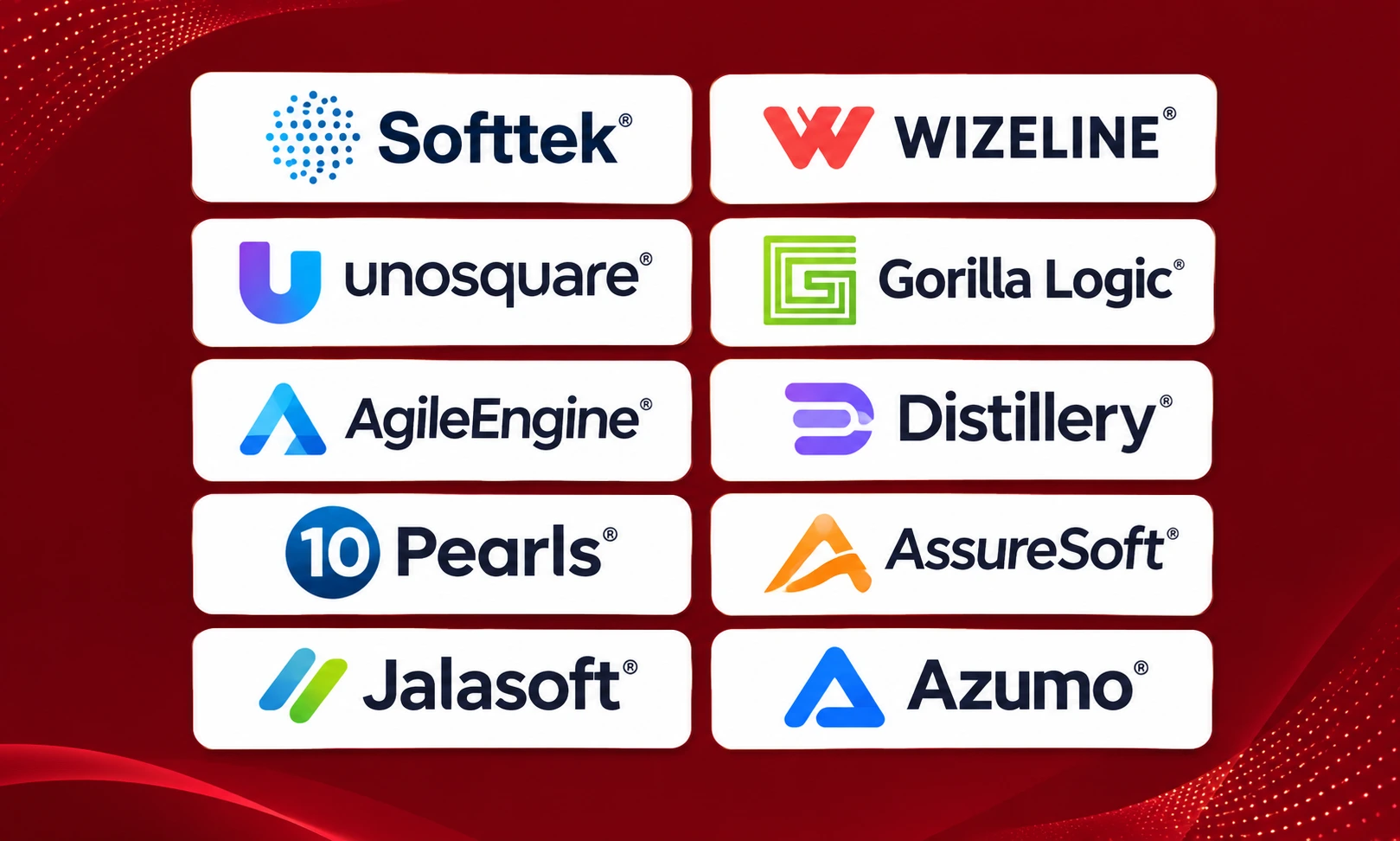
- Softtek (Monterrey). The company that coined “nearshore”: forty-plus years serving North American clients from Mexico, with time-zone alignment it invented. The original Latin American giant.
- Wizeline (San Francisco / Guadalajara). Product engineering for Silicon Valley companies, built on Mexican engineering talent. The bridge between the Bay Area and Guadalajara’s tech scene.
- Unosquare (Portland / Guadalajara). Agile delivery teams for US companies, with cultural alignment as the product. Nearshore with a personal touch.
- Gorilla Logic (Denver / Costa Rica). Full-stack agile engineering from Costa Rica and Colombia, serving US enterprises. The jungle gym of Latin American talent.
- AgileEngine (McLean / Buenos Aires). Top-rated engineering teams across Latin America and Eastern Europe, with a decade of Clutch leadership. The talent scouts of software.
- Distillery (Los Angeles / Global). Full-service software engineering with senior-only positioning and LATAM delivery. LA’s product engineering boutique.
- 10Pearls (Washington DC / Global). Digital product engineering across the Americas and South Asia, with a strong security practice. DC’s global engineering export.
- AssureSoft (Cochabamba). Bolivian engineering for US clients, with long-tenured teams and US-friendly delivery. The Andes’ quiet software hub.
- Jalasoft (Cochabamba). Two decades of software engineering and testing, built on a foundation that trains Bolivia’s engineers. Talent development as a business model.
- Azumo (San Francisco / Latin America). Modern software engineering with AI and data depth, delivered from the Americas. The new-school nearshore specialist.
United Kingdom and Ireland (51–60)
- Kainos (Belfast). The Workday and government digital services specialist that made Belfast a software capital, trusted with the NHS’s most critical systems. The UK’s public-interest engineers.
- BJSS (Leeds / London). Enterprise agile delivery for banking, retail, and public sector, with engineering discipline that survives audits. Leeds’ answer to the consultancies.
- Scott Logic (Newcastle). Software engineering consultancy beloved by developers, strong in financial services and data. The craft-first British consultancy.
- Softwire (London). Custom software for government, media, and enterprise, with an employee-ownership culture that retains senior talent. London’s quietly excellent engineers.
- Made Tech (London). Public sector digital transformation, rebuilding government services that millions depend on. The civic technologists.
- Audacia (Leeds). Bespoke software for scale-ups and enterprises, with Microsoft-stack mastery. Yorkshire’s engineering heavyweight.
- Codurance (London). Software craftsmanship consultancy founded on clean-code principles, for clients whose systems must last. The discipline merchants.
- Equal Experts (London / Global). Thoughtworks alumni built a global network of senior consultants for complex delivery. The connoisseur’s engineering network.
- Hippo Digital (Leeds). User-centered design and engineering for public services and regulated industries. Digital with a service-design conscience.
- Answer Digital (Leeds). Twenty-five years of healthcare, retail, and finance software, employee-owned and client-loyal. The dependable Northern engineer.
Nordics and DACH (61–70)
- Reaktor (Helsinki). The legendary Finnish consultancy that put software in orbit with its nanosatellite program and builds critical systems for clients who demand the best. Where engineering culture is the product.
- Futurice (Helsinki / Global). Digital engineering and design with Scandinavian pragmatism, serving industrial and consumer giants. Finland’s complete digital builder.
- Bouvet (Oslo). Norway’s homegrown engineering consultancy, deep in energy, public sector, and infrastructure systems. Where oil money meets clean code.
- Systematic (Aarhus). Denmark’s CMMI Level 5 software house, building defense, healthcare, and library systems where defects are unacceptable. The process perfectionists.
- Knowit (Stockholm). Nordic consultancy spanning management, design, and engineering, with sustainability woven through. Sweden’s integrated digital partner.
- Tietoevry (Helsinki). The Nordic IT giant formed by merger, running banking, public sector, and industrial systems across the region. The infrastructure of Nordic digital life.
- Adesso (Dortmund). Germany’s listed software house, serving insurance, banking, and public sector with thousands of engineers. The Mittelstand’s digital partner at scale.
- MaibornWolff (Munich). Premium software engineering for Germany’s automotive and industrial champions. Where Bavaria’s giants buy their code.
- iteratec (Munich / Stuttgart). Engineering consultancy for complex enterprise systems, with a developer-first culture. Germany’s software craftspeople.
- Ergon Informatik (Zurich). Swiss software engineering since 1984, from banking systems to public transport. Four decades of Swiss reliability in code form.
Central and Eastern Europe (71–80)
- Software Mind (Krakow). Two decades of engineering for telecom, fintech, and enterprise, with Central European scale. Poland’s consolidator of engineering talent.
- Sii Poland (Warsaw). Poland’s largest engineering consultancy, 7,000-plus specialists serving European industry. The industrial backbone of Polish IT.
- Spyrosoft (Wroclaw / Global). Fast-growing engineering for automotive, finance, and media, with listed-company transparency. Wroclaw’s engineering rocket.
- Britenet (Warsaw). Salesforce and custom software engineering with a decade of Polish market leadership. The platform specialist that delivers.
- Euvic (Gliwice / Global). The federated engineering group serving DACH and Nordic clients from Polish delivery centers. The confederation model that works.
- Transition Technologies (Warsaw). Industrial software and IoT engineering for energy, manufacturing, and utilities. Where Polish industry digitizes.
- Infinum (Zagreb / New York). Award-winning product engineering for European and American clients, with design polish unusual in the region. Croatia’s digital flagship.
- Q (Zagreb). Product engineering and venture-building for ambitious European companies. Zagreb’s other engineering powerhouse.
- HTEC (Belgrade / San Francisco). Product engineering for Silicon Valley companies and global enterprises, scaling fast across the Balkans. Serbia’s engineering champion.
- Levi9 (Amsterdam / Belgrade). Two decades of Dutch-Serbian engineering partnership, serving European digital businesses. The original Balkan-Dutch bridge.
Asia-Pacific Value Leaders (81–90)
- FPT Software (Hanoi). Vietnam’s technology champion: billion-dollar-plus IT services revenue, tens of thousands of engineers, and the fastest-scaling delivery story in Asia. The reason Vietnam joined the engineering map.
- NashTech (London / Hanoi). Harvey Nash’s engineering arm, blending UK account leadership with Vietnamese delivery. The Anglo-Vietnamese veteran.
- KMS Technology (Atlanta / Ho Chi Minh City). US-headquartered engineering with Vietnamese delivery, strong in healthcare and SaaS. The bridge built by Vietnamese-American founders.
- Axon Active (Ho Chi Minh City). Swiss-managed Agile development from Vietnam, with disciplined Scrum at its core. The process-first Vietnamese option.
- Saigon Technology (Ho Chi Minh City). Custom software for US, Australian, and European clients, with transparent pricing. Vietnam’s dependable mid-size specialist.
- Orient Software (Ho Chi Minh City). Two decades of web and mobile engineering for global clients. The quiet veteran of Vietnamese outsourcing.
- Rikkeisoft (Hanoi). Japan-focused Vietnamese engineering, serving demanding Japanese quality standards at Vietnamese costs. The Tokyo-Hanoi pipeline.
- Systems Limited (Lahore). Pakistan’s largest and oldest software company, serving global banking and telecom for four decades. The pioneer of Pakistani IT exports.
- Folio3 (San Mateo / Karachi). Silicon Valley management over Pakistani engineering, strong in e-commerce and mobile. The Pakistani-American product builder.
- Arcanys (Cebu / Zurich). Swiss-managed engineering teams in the Philippines, for startups that need committed developers. The Cebu model done right.
American Boutique Craft (91–100)
- Atomic Object (Grand Rapids). Twenty-five years of custom software built by employee-owners, with a culture that retains senior craftspeople. Michigan’s gift to serious software.
- Test Double (Columbus). The consultancy whose mission is improving how the industry builds software, embedding senior engineers who leave teams better than they found them. The teacher-consultants.
- 8th Light (Chicago / London). Software craftsmanship as a formal discipline, with an apprenticeship model that manufactures senior engineers. The guild of modern software.
- thoughtbot (Boston / Global). Two decades of Rails, product design, and open-source contribution, beloved by startups and CTOs. The Boston institution that taught a generation.
- Hashrocket (Jacksonville / Chicago). Ruby, Elixir, and React specialists with a decade-plus record of shipped products. The framework connoisseurs.
- Tandem (Chicago). Product and engineering consultancy for companies modernizing their software organizations. Chicago’s transformation partner.
- Bendyworks (Madison). Software craftsmanship from Wisconsin, with deep web and mobile expertise. The Midwest’s senior-only boutique.
- Stride (New York). Agile engineering consultancy embedding with New York’s most demanding product teams. Manhattan’s co-builders.
- LaunchPad Lab (Chicago). Product strategy and development for growing businesses, with a decade of polished launches. Chicago’s startup-to-scale-up shop.
- Table XI (Chicago). Custom software and product design for mission-driven organizations and ambitious businesses. The craft house of the Chicago tech scene.
How to use this list
The Healthcare.gov lesson applies at every budget: the failure mode of software projects is not bad code, it is unclear ownership of the whole. Before choosing from this list, decide what you are actually buying. If you need a system of record modernized, the giants in the Global 10 and Indian majors have done it hundreds of times and priced the risk accordingly.
If you need a digital product built, the product engineering tiers carry more relevant craft per dollar. If you need senior judgment embedded in your team, the American and British boutiques sell exactly that, at rates that reflect it. And if cost is the primary constraint, Latin America, Central Europe, and Asia-Pacific deliver excellent engineering at 40 to 70 percent of US rates, with time zones as the deciding variable.
Two questions predict project success better than any rate card. First: who, by name, is accountable for the whole system working, and what happens to them if it does not? Second: can the firm show a system they built five years ago that is still running, and let you talk to its owner?
The companies were evaluated on shipped systems, client longevity, engineering depth, security and compliance maturity, and transparent pricing behavior; bench size and marketing polish were noted, then ignored.
Frequently asked questions
What is the best software development company in the world in 2027?
At global scale, TCS, Accenture, and Cognizant lead on delivery breadth; for product engineering, GlobalLogic, Persistent, and CI&T; for senior embedded craft, Equal Experts, Test Double, and Reaktor. The right answer depends on whether you are buying transformation, a product, or judgment.
How much does custom software development cost in 2027?
US and Western European rates run $100 to $250 per hour, Central and Eastern Europe $40 to $90, Latin America $35 to $80, and India, Vietnam, and Pakistan $20 to $50. A meaningful business application starts around $50,000 to $150,000; enterprise platforms run into millions. AI coding tools have cut typing time, but architecture, integration, and accountability still carry the price.
Has AI made software development companies obsolete?
The opposite, so far. AI tools collapsed the cost of writing code, which collapsed the value of writing code, which concentrated remaining value in the firms that own outcomes: architecture, security, integration, and maintenance. Buyers in 2027 pay for shipped systems and accountability, not keystrokes, and this list is ranked accordingly.
Should I choose onshore, nearshore, or offshore development?
Nearshore (Latin America for the US, Central Europe for Western Europe) wins when collaboration intensity is high; offshore (India, Vietnam, Pakistan) wins on cost for well-specified work; onshore wins when regulation, security clearance, or co-location demands it. Most mature buyers blend all three.
How do I vet a software development company before signing?
Ask for a five-year-old system still in production and permission to call its owner; ask who is personally accountable for delivery; ask how they handled their last failed deadline; and check engineer retention, because your project’s memory walks out the door with every departure.