Best CRMs for Small Business in 2027: There is a split in American business that nobody in the software industry likes to talk about. Among companies with more than ten employees, 91 percent use a CRM. Among companies with fewer than ten, roughly half do not. The smaller half is not behind because its owners are unsophisticated. It is behind because the CRM industry spent two decades building for sales forces with RevOps departments, then wondered why a six person plumbing company would not buy in.
That is finally changing. Small and medium businesses are now the fastest growing CRM segment, expanding at 16.2 percent a year, faster than any other company size, and 71 percent of small businesses now run on one. But the graveyard statistic still stands: industry estimates put CRM project failure rates as high as 70 percent, and 43 percent of businesses that do buy a CRM use fewer than half its features. The number one killer is not price. It is buying a CRM built for a company three times your size, watching your team refuse to log in, and going back to the spreadsheet.
So this ranking is built differently. Every CRM here is scored for a business under 25 people: what it costs with no hidden tier traps, how fast a non technical owner can set it up, and what it actually fixes. Prices are as of November 2026, from vendor pricing pages and independent testing.
Methodology. We scored eight platforms on small business reality: entry price and price at 5 and 10 users, setup time for a non technical owner, free plan generosity, the upgrade path when you grow, and the failure risk, meaning how likely a small team is to abandon it within 90 days. Adoption and market data from Eurostat, Grand View Research, IDC, and company disclosures. Ranked for teams of 1 to 25 people. As of November 2026, re-scored quarterly.
Best CRMs for Small Business in 2027: The Quick Verdict
| Rank | CRM | Best For | Real Starting Price | The One Line Why |
| 1 | HubSpot CRM | Most small businesses | Free, then $20/seat | The best free CRM ever shipped, with room to grow |
| 2 | Bigin by Zoho | Solo founders and micro teams | Free for 1 user, then $9/user | PCMag’s 2026 Editors’ Choice, built for teams under 20 |
| 3 | Zoho CRM | Small teams planning to grow | Free for 3 users, then $14/user | Enterprise features at small business prices |
| 4 | Less Annoying CRM | The overwhelmed | $15/user flat | One price, every feature, setup in under an hour |
| 5 | Pipedrive | Small sales teams | $14/user | The cleanest visual pipeline in the category |
| 6 | Freshsales | Teams that live on the phone | Free for 3 users, then $11/user | Built in calling and AI at the lowest credible price |
| 7 | Capsule | Service businesses | Free for 2 users, then $18/user | A clean contact brain that plugs into your accounting |
| 8 | Keap | Service businesses that automate | $249/mo | CRM, payments, appointments, and automation in one bill |
1. HubSpot CRM: Best Overall for Most Small Businesses
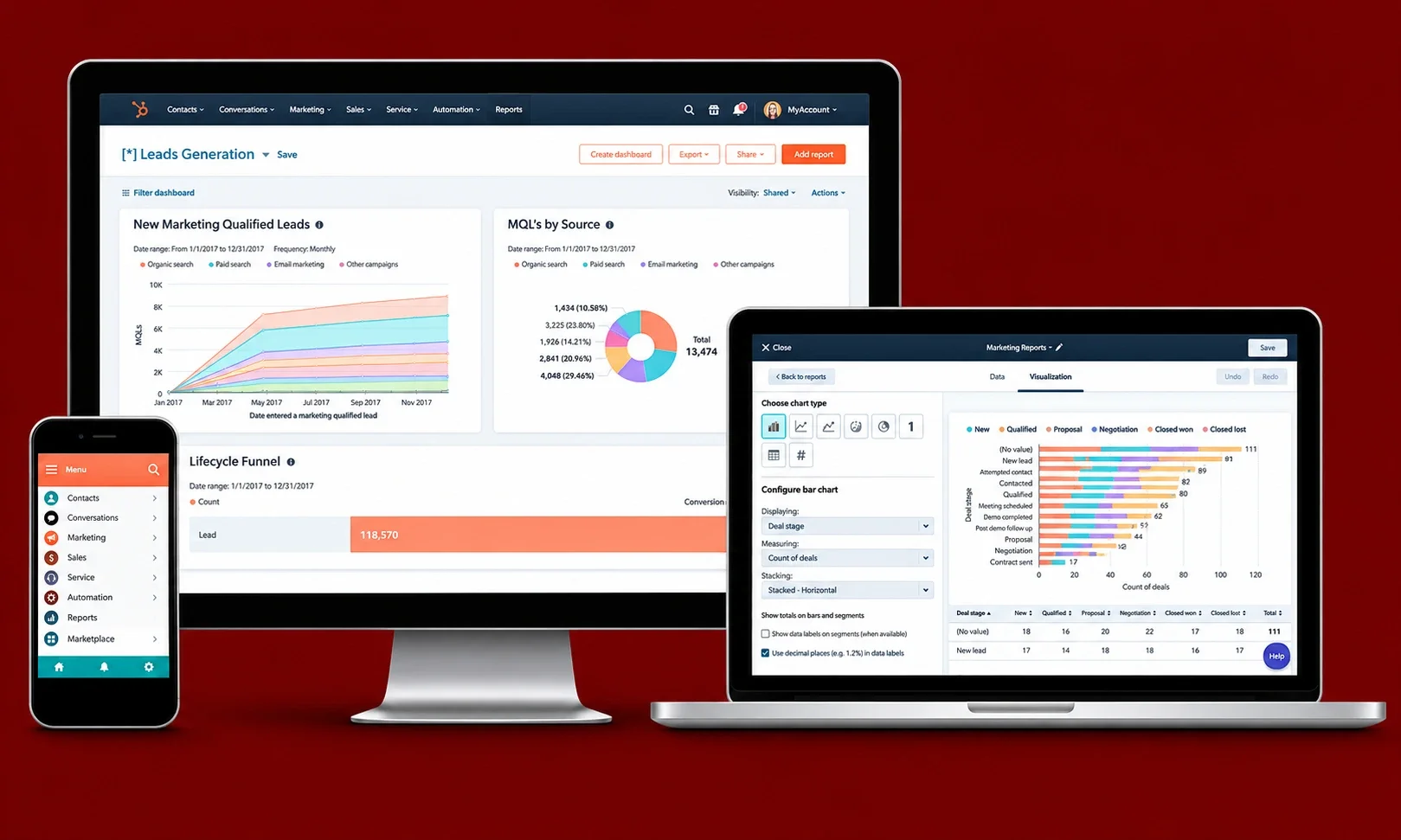
Why it wins: The free tier is genuinely usable: unlimited users, contact and deal management, email tracking, and basic marketing tools, with contact caps around 1,000 to 2,000 depending on the tools you enable. When you outgrow it, Starter begins around $20 per seat, and the same contact record scales into marketing and service hubs without a migration. Reviewers from TechRadar to Zapier have called it the best free CRM for years, and the average HubSpot customer pays about $11,800 a year, which tells you most customers start free and grow into it rather than buying big on day one.
Where it falls short: The growth path gets expensive. Professional tier automation runs $90 to $100 per seat with mandatory onboarding fees reported between $1,500 and $3,500. Free is real. The ladder above it is steep.
Pricing: Free. Paid from about $20/seat/mo.
2. Bigin by Zoho: Best for Solo Founders and Micro Teams
Why it wins: PCMag’s 2026 Editors’ Choice for small business CRM, and the cheapest serious option on this list: a free plan covering one user and 500 contacts with a built in phone line, then paid plans at $9, $15, and $21 per user per month. Best CRMs for Small Business in 2027: The whole product is a pipeline view with telephony and WhatsApp Business built in, setup takes minutes, and when you cross 20 users a one click migration moves you into full Zoho CRM. For the founder graduating from a spreadsheet, this is the fastest route to a working CRM that exists.
Where it falls short: Reporting is basic even on the top tier, customization is limited, and teams past 20 people hit walls quickly, which is precisely why the Zoho upgrade path exists.
Pricing: Free for 1 user. Express $9/user/mo.
3. Zoho CRM: Best for Small Teams Planning to Grow
Why it wins: If Bigin is the starter home, Zoho CRM is the same family’s house with room to add floors. Free for three users, then $14 per user, with workflow automation, the Zia AI assistant, and an integration library that rivals platforms costing three times more. Zoho’s parent company passed one million paying customers across its brands in February 2026 while growing at 20 percent, and the CRM Plus bundle at $69 per seat packs in campaigns, support desk, chat, and social for roughly half what comparable suites charge.
Where it falls short: The interface trails HubSpot and Pipedrive on feel, and for a two person shop it is already more system than needed. Buy it when growth is visible, not hypothetical.
Pricing: Free for 3 users. Standard $14/user/mo.
4. Less Annoying CRM: Best for the Overwhelmed
Why it wins: The name is the product strategy. One plan, $15 per user per month, every feature included, no tiers, no contracts, no add ons, a 30 day free trial with no credit card, and phone support even during the trial. Setup takes under an hour for most teams, and a daily agenda email each morning tells you exactly who to follow up with. Its customer support ratings are the highest we have seen in the category. For the owner who tried a big CRM, abandoned it, and now distrusts the whole genre, this is the antidote.
Where it falls short: The simplicity is deliberate and it is also the ceiling: no automation, no sequences, no AI, no two way email sync, basic reporting. When you need the machine to do the follow up, you have graduated.
Pricing: $15/user/mo, flat.
5. Pipedrive: Best for Small Sales Teams
Why it wins: If your business has three to fifteen people whose job is moving deals, Pipedrive’s drag and drop pipeline is the fastest adoption curve in the category. Activity based selling keeps reps focused on the next action rather than the dashboard, the mobile app is strong, and AI assistance is included in plans rather than metered separately. Independent reviewers consistently name it the best user experience in CRM.
Where it falls short: No free plan, and the Lite tier omits workflow automation and two way email sync, making the $39 Growth plan the realistic floor for a team. Marketing and service features live in add ons.
Pricing: From $14/user/mo, annual billing.
6. Freshsales: Best for Teams That Live on the Phone
Why it wins: Built in phone and chat on low tiers is rare at this price, and Freshsales pairs it with Freddy AI for deal insights and a modern interface, free for three users and from about $11 per user after that. For a small team whose sales motion is calls and quick follow ups, it consolidates tools that Pipedrive and Capsule make you bolt on.
Where it falls short: The free plan is limited, Freddy’s agent features meter by session on higher tiers, and the ecosystem is thinner than HubSpot’s or Zoho’s.
Pricing: Free for 3 users. Paid from $11/user/mo.
7. Capsule: Best for Service Businesses
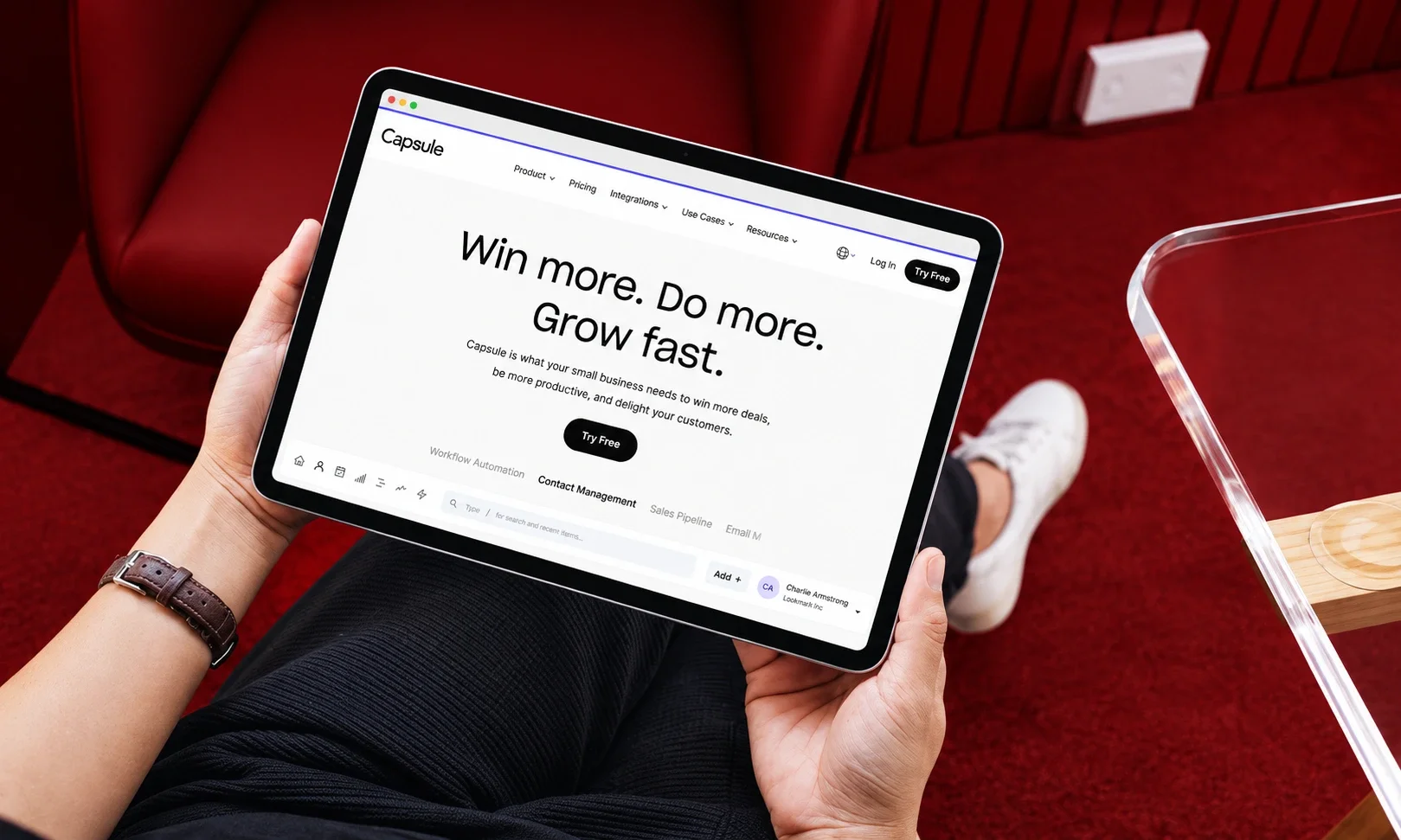
Why it wins: Capsule is the quiet professional’s CRM: a clean contact database, a simple pipeline, project tracking, and deep integrations with Xero, QuickBooks, Google, and Microsoft 365. Accountants, consultants, and agencies run their client relationships on it because it stays out of the way. Free for two users and 250 contacts, then from $18 per user.
Where it falls short: No built in calling, basic reporting, limited support on lower tiers, and automation that trails newer rivals. It organizes relationships; it does not run campaigns.
Pricing: Free for 2 users. Paid from $18/user/mo.
8. Keap: Best for Service Businesses That Automate
Why it wins: Keap is the outlier on price and on ambition: CRM plus email and SMS automation plus invoicing, payments, and appointment booking in one bill, built for service businesses where the owner is the sales team. When a lead fills out a form, Keap can follow up, book the appointment, send the invoice, and take the payment with no human touching it. For the right business that replaces three subscriptions and a part time assistant.
Where it falls short: The price, $249 a month entry, makes it the wrong answer for anyone who just needs contact tracking, and the learning curve matches the feature count. Buy it for the automation, or do not buy it.
Pricing: From $249/mo.
The Pricing Reality Table
What a 5 user team actually pays, as of November 2026:
| CRM | Free Option | Entry Paid, 5 Users | The Catch |
| HubSpot | Yes, unlimited users | $100/mo (Starter) | Automation jumps to $450+/mo |
| Bigin | 1 user, 500 contacts | $45/mo (Express) | Basic reporting, 20 user ceiling |
| Zoho CRM | 3 users | $70/mo (Standard) | Interface trails the leaders |
| Less Annoying CRM | No, 30 day trial | $75/mo (flat) | Zero automation, by design |
| Pipedrive | No | $70/mo (Lite) | Real features start at $195/mo |
| Freshsales | 3 users | $55/mo | AI agents metered by session |
| Capsule | 2 users, 250 contacts | $90/mo (Starter) | No calling, basic reports |
| Keap | No | $249/mo | Total overkill for simple needs |
The Mistake to Avoid
The research on CRM failure is unambiguous: projects fail on adoption and data, not on features. The single most common small business mistake is buying for the company you hope to be instead of the company you are. A six person team that buys an enterprise tier CRM does not get enterprise results; it gets an expensive empty database and a team that quietly returns to spreadsheets within 90 days. Buy the simplest tool your process genuinely needs, enforce the daily habit, and upgrade only when the current tool demonstrably cannot do something you are losing money over.
One more honesty note, because you will see it elsewhere: the famous claim that CRM returns $8.71 per dollar dates to a 2014 study that its own publisher later revised to roughly $3.10. The $3.10 figure, from 2023 research, is the defensible one. A CRM is a good investment. It is not magic, and any vendor page quoting the old number is telling you something about its standards.
Getting the tool is step one. Filling it with leads is the business: see our guides to lead generation for agencies, content marketing for lead generation, and inbound lead generation strategies. The economics behind your pipeline live in our customer acquisition cost benchmarks, and when marketing and sales share the system, read why CRM and marketing alignment is where the ROI actually comes from. For the wider picture on running a small business with modern tools, our coverage of small business digital marketing with AI and SEO marketing for small business completes the stack.
FAQ
What is the best CRM for a small business in 2027?
For most small businesses, HubSpot CRM, because the free tier is genuinely usable and the upgrade path scales without migration. For solo founders, Bigin by Zoho, PCMag’s 2026 Editors’ Choice at $9 per user. For teams overwhelmed by software, Less Annoying CRM at $15 flat.
What is the cheapest CRM that is actually good?
Bigin by Zoho at $9 per user per month, with a free plan covering one user and 500 contacts. Freshsales starts at $11 per user with built in calling. Both are real CRMs, not trials in disguise.
Is HubSpot really free for small businesses?
Yes. The free CRM includes unlimited users, contact and deal management, and email tracking, with caps around 1,000 to 2,000 contacts depending on enabled tools. Paid features like automation start at $20 per seat and climb steeply from there.
How much should a small business spend on a CRM?
Most small business teams land between $15 and $50 per user per month, with the typical answer around $20 to $30. A five person team should expect $45 to $100 a month total at the entry tier, and should treat anything above that as a purchase requiring a written reason.
Why do small business CRM projects fail?
Failure estimates run as high as 70 percent, and 43 percent of CRM buyers use fewer than half the features. The root causes are poor adoption and bad data, not missing features. The fix is buying simpler, setting up the pipeline properly, and enforcing daily use for the first 90 days.
When should a small business switch from spreadsheets to a CRM?
When leads fall through the cracks, when follow ups live in one person’s memory, or when you cannot answer “how many deals are open right now” in ten seconds. For most businesses that moment arrives between three and ten people, which is exactly the segment these eight CRMs are built for.