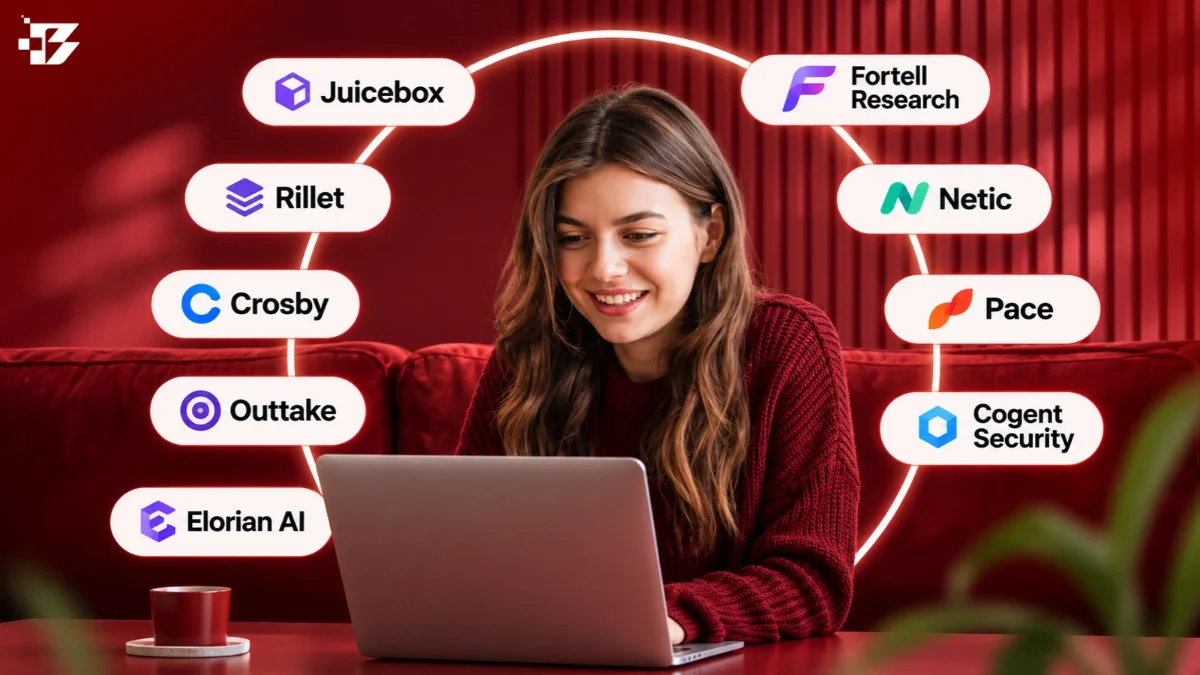
AI Startups Future Unicorns; Every summer, Forbes publishes a list that venture capitalists read the way scouts read draft reports. The Next Billion-Dollar Startups list, produced with TrueBridge Capital Partners, names 25 venture-backed companies valued under $1 billion most likely to cross the threshold. The reason people take it seriously is the track record: of 275 alumni across twelve years, 60% became unicorns, including Duolingo, DoorDash, and Rippling. Nearly half of last year’s picks have already crossed the line. Only about 2% imploded.
This year’s list tells one story above all others: nearly every company on it uses AI, and the interesting ones are not building models. They are building businesses on top of models, in the unglamorous places where money actually moves: contract review, accounting closes, insurance claims, HVAC dispatch, hearing aids, and the power lines feeding data centers. While OpenAI and Anthropic absorb roughly 80% of all AI venture funding (we covered the scale of that imbalance in our report on OpenAI’s $852 billion valuation), the next generation of billion-dollar companies is forming one floor below, selling picks and shovels to industries that do not care what transformer architecture is.
Here are the fifteen we expect to cross $1 billion by 2028, organized by where their money comes from, with current valuations from the Forbes list and 2026 funding disclosures.
The 15 AI Startups Future Unicorns at a glance
| Startup | What it does | Current valuation |
| Juicebox | AI recruiting dossiers | $850 million |
| Fortell Research | AI hearing aids | $740 million |
| DepthFirst | AI vulnerability hunting | $580 million |
| Rillet | AI accounting close | $500 million |
| Netic | AI agents for trade businesses | $450 million |
| Crosby | AI law firm, flat-fee contracts | $400 million |
| Pace | AI insurance claims agents | $375 million |
| Outtake | Deepfake and fraud detection | $375 million+ |
| American Terawatt | DC power grids for AI data centers | $350 million |
| Cogent Security | AI vulnerability triage | $320 million |
| Elorian AI | Spatial intelligence models | $300 million |
| Gumloop | No-code AI workflow automation | $300 million |
| Flora | AI design tools for creative teams | $260 million |
| Abby Care | AI-powered caregiver marketplace | $225 million |
| Valthos | AI biosecurity threat detection | $200 million+ |
The back office agents: selling time to boring industries
1. Juicebox: the closest to the line
At an $850 million valuation after an $80 million March round, Juicebox is the near-certain unicorn of this list. Its product solves a problem AI created: job seekers using AI to mass-apply have buried recruiters in resumes, so Juicebox pulls public information from profiles, personal sites, and projects into searchable candidate dossiers. More than 5,000 customers, including Ramp and Cognition, already use it. The irony is the business model: an AI company selling defense against AI behavior.
2. Rillet: the accounting close, unblocked
Traditional accounting software makes businesses wait days or weeks after a reporting period for humans to reconcile the books. Rillet’s AI agents compress that close toward real time, and investors including Andreessen Horowitz, Sequoia, and ICONIQ have put $110 million behind the idea at a $500 million valuation. Accounting is not a glamorous market, which is precisely the point. Every company on Earth closes books.
3. Crosby: the law firm where lawyers supervise machines
Crosby is structured like a law firm and priced like software. Its AI agents mark up NDAs and service agreements while human lawyers manage the agents, and clients pay a flat fee per contract instead of hourly billing. The client list tells you who believes it works: Cursor, Cognition, and Clay, three of the fastest-growing AI companies, trust it with their own contracts. At $400 million with backers including Sequoia and Bain Capital Ventures, Crosby is the clearest test of whether professional services can be productized.
4. Pace: insurance claims at disaster speed

Most losses from extreme weather went uninsured last year partly because claims processing collapses exactly when disasters hit. Pace’s AI agents handle submissions, renewals, servicing, and claims, with Prudential Financial among its customers. Valued at $375 million with Sequoia and Thrive backing, it sits at the intersection of two curves moving fast: climate-driven claim volume and insurers’ willingness to automate.
The trust layer: selling defense against AI itself
5. DepthFirst: the AI that hunts AI vulnerabilities
The founding premise is blunt: AI is already better than most humans at hacking. DepthFirst, founded by alumni of Google DeepMind, Block, and Databricks, builds models that find vulnerabilities in critical software and propose patches. Twenty-plus customers include Lovable, Ripple, and ServiceNow. At $580 million, it is the highest-valued security play on the list and the clearest beneficiary of the uncomfortable truth that AI-generated code ships with AI-sized bug counts.
6. Cogent Security: the triage workforce
Cogent’s agents identify critical vulnerabilities, triage them, and help IT teams fix them, a workflow its CEO learned at email-security unicorn Abnormal. Customers range from Valvoline to Las Vegas casinos. At $320 million with Bain Capital Ventures and Greylock behind it, Cogent is betting that the vulnerability backlog, which security teams have never kept up with, is an agent-shaped problem.
7. Outtake: deepfake detection with brand-name customers
Palantir alum Alex Dhillon started Outtake after a YouTuber asked for help finding deepfakes used in scams. The platform scores content and context for authenticity, and its customer list includes OpenAI and Panera Bread. As synthetic media floods every channel brands operate in, detection shifts from a nice-to-have to procurement line item. That budget shift is the $375 million thesis.
8. Valthos: the biosecurity bet
Valthos uses AI to characterize pathogens and assemble threat dossiers, aiming to catch biological threats, natural or engineered, before they spread. Backed by Founders Fund, Lux Capital, and OpenAI itself, with the Department of Defense and Los Alamos as early clients, it is the list’s most consequential swing: a company whose success metric is a disaster that never happens. Governments pay for that insurance in any budget climate.
The physical world: where AI meets atoms
9. American Terawatt: selling electricity to the AI boom
The most infrastructure-flavored bet on the list comes from a software founder. Anton Troynikov, who previously built the Chroma vector database, is constructing direct-current power grids for AI data centers, eliminating the energy lost converting AC power at every rack. With Altimeter and Founders Fund behind a $350 million valuation, American Terawatt is a wager that the AI boom’s binding constraint is not chips but watts.
10. Netic: the trades get their agent
After a maddening experience trying to get an HVAC company to answer the phone, former Scale AI engineering director Melisa Tokmak built Netic: AI agents that diagnose problems, walk customers through fixes, and book technicians for plumbing, HVAC, and electrical businesses. Valued at $450 million with Founders Fund and Greylock backing, it targets the same missed-call economics we documented in our coverage of AI agents for small business, applied to a $500 billion services sector that still runs on voicemail.
11. Fortell Research: the $6,800 hearing aid with a waiting list
Fortell’s AI hearing aids isolate voices in noisy rooms, the “cocktail party problem” that defeated a generation of signal processing. Launched in December at $6,800 a pair, available only through three clinics, they are near-impossible to get, with customers reportedly including Henry Kravis and Steve Martin. At $740 million, the question is not demand but whether Fortell can hire audiologists fast enough to meet it. Scarcity is a good problem, and a temporary moat.
12. Elorian AI: spatial intelligence before the robots arrive
Former Google DeepMind researcher Andrew Dai is building AI that understands three-dimensional physical space rather than text, the capability robotics and engineering will need when embodied AI scales. At $300 million and only months out of stealth, Elorian is the list’s most speculative entry and its biggest potential multiple: if physical AI follows the trajectory of language AI, the spatial layer will be worth more than most application companies combined.
The tools layer: workflow and creative picks
13. Gumloop: the automation platform enterprises actually deploy
Gumloop lets non-technical teams build AI workflows without engineers, and its customer list (Shopify, Instacart, and reportedly more than 110 internal teams at Shopify alone) shows the difference between a demo and a deployment. Valued at $300 million with Benchmark and First Round backing, it is winning the crowded automation category on the only metric that matters: usage that survives the pilot phase.
14. Flora: the creative tool built by an actual artist
Flora’s collaborative canvas lets design teams generate logos, storyboards, and product sketches with AI models in real time, and creatives at Nike, Netflix, and Levi’s already use it. Founder Weber Wong came from NYU’s art-and-technology program rather than a lab, and the product shows it: built for how creative teams actually work instead of how engineers imagine they do. At $260 million, it is the design category’s most credible challenger to incumbent creative suites.
15. Abby Care: the marketplace for family caregivers

Abby Care trains family members of disabled or elderly people to become paid Medicaid caregivers, with an app that consolidates timesheets, charting, and an AI assistant. Backed by Sequoia, Thrive, and Khosla at a $225 million valuation, it applies the Uber marketplace model to one of America’s largest unpaid workforces. The AI is a feature here, not the pitch, which may be exactly why the unit economics work.
What the list reveals about where AI value is heading
Read the fifteen together and three patterns emerge that any brand, investor, or operator can use. First, the application layer won: none of these companies trains foundation models, and most are deliberately model-agnostic. The value migrated to whoever owns a workflow. Second, the buyers are boring on purpose: insurance claims, accounting closes, HVAC dispatch, and Medicaid paperwork attract less competition than another chatbot and generate revenue that renews. Third, trust is becoming a market of its own: four of the fifteen (DepthFirst, Cogent, Outtake, Valthos) sell defense against the downsides of the same technology wave they ride.
For brands watching from the outside, the practical takeaway is timing. Companies at these valuations are hungry for reference customers, which means favorable terms for early adopters and case-study leverage later. The same logic we apply to choosing a marketing AI copilot applies to betting on a pre-unicorn vendor: pilot the workflow, verify the outcome, and sign before the valuation doubles. Forbes’ 60% hit rate says most of these names will be familiar by 2028. The discount for knowing them now is the entire point.
Frequently asked questions
Which AI startups are most likely to become unicorns by 2028?
Juicebox (850Mvaluation)isclosesttothethreshold,followedbyFortellResearch(850M valuation) is closest to the threshold, followed by Fortell Research (740M) and DepthFirst ($580M). The Forbes Next Billion-Dollar Startups list, with a 60% historical conversion rate, names venture-backed companies under $1 billion most likely to cross, and nearly all of this year’s picks use AI.
What is the Forbes Next Billion-Dollar Startups list?
An annual ranking by Forbes and TrueBridge Capital Partners of 25 US-based, venture-backed startups valued under $1 billion, selected for their likelihood of reaching unicorn status. Of 275 alumni, 60% became unicorns, including Duolingo, DoorDash, and Rippling, and about 60 more were acquired.
Why are AI application startups valued lower than model companies?
Foundation model labs absorb most capital: OpenAI and Anthropic account for roughly 80% of the $305.6 billion raised by the Forbes AI 50. Application companies raise less because they build on existing models, but they often reach revenue faster by owning specific workflows in insurance, accounting, legal, and healthcare.
Should businesses work with pre-unicorn AI startups?
Early customers typically get favorable pricing, direct access to founding teams, and case-study leverage. The risks are product maturity and company survival, though the Forbes list’s roughly 2% failure rate among alumni is unusually low for startups. Pilot with one workflow before expanding.
What industries are the next AI unicorns targeting?
The 2026 pipeline concentrates in back-office operations (accounting, legal, insurance claims), security and trust (vulnerability detection, deepfake defense, biosecurity), physical-world services (skilled trades, healthcare, hearing aids), and AI infrastructure (data center power).