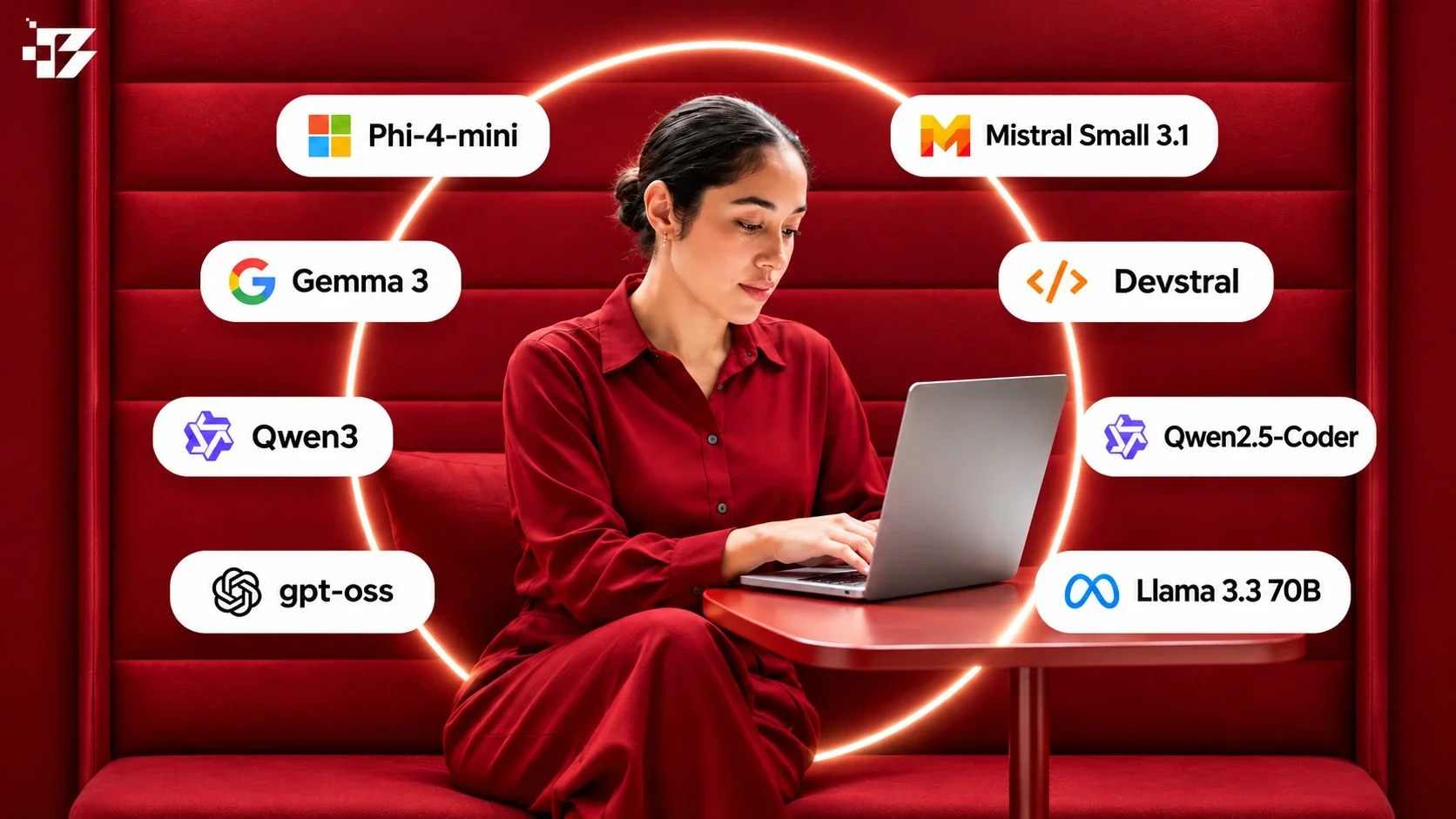
Best Open-Source AI Models: A fintech startup’s CTO told me about the email that changed her infrastructure strategy. Her company’s AI features were growing nicely, and so was something else: the API invoice, which crossed $30,000 in a single month and was projected to double by summer. Her team spent a weekend benchmarking open-weight models against their actual workload. The result surprised them twice — first because a model running on their own hardware matched the cloud API on 90% of their traffic, and second because the answer had been sitting on Hugging Face, free to download, the whole time.
Best Open-Source AI Models: That story is becoming ordinary, and it explains the strange new shape of the AI market heading into 2027. The best open-weight models now trade blows with closed flagships on real work, and the licensing has never been friendlier: Apache 2.0 and MIT, no user caps, no per-token meter. “Free” here means no cloud bill — you still need hardware, and the honest hardware requirements are half of what follows. The other half is picking the right model for the machine you actually have, because the biggest mistake in local AI is downloading a giant your GPU cannot comfortably run. We organized all twelve by the hardware tier where they make sense.
One note for teams evaluating the stack rather than the hobby: our roundup of the best developer tools covers the platforms around these models — Ollama, LM Studio, vLLM — that turn a download into a running system.
The 12 Best Open-Source AI Models at a glance
| Model | The job | License | Runs on |
| Phi-4-mini | Everyday assistant on any laptop | MIT | CPU, 8GB RAM |
| Gemma 3 | Multimodal work on one GPU | Gemma Terms | Laptop to 24GB GPU |
| Qwen3 | The default local LLM | Apache 2.0 | 16GB laptop and up |
| gpt-oss | OpenAI-grade reasoning, private | Apache 2.0 | 16GB (20B) to 80GB (120B) |
| Mistral Small 3.1 | Enterprise clarity, multimodal | Apache 2.0 | Workstation, 48GB |
| Devstral | Coding agents on your machine | Apache 2.0 | 24GB GPU |
| Qwen2.5-Coder | Code completion and generation | Apache 2.0 | 8GB and up |
| DeepSeek R1 distills | Chain-of-thought reasoning | MIT | 24GB and up |
| Llama 3.3 70B | The ecosystem standard | Llama Community | 48GB and up |
| Llama 4 Scout | 10M-token context | Llama Community | Serious GPU rig |
| GLM-4.6 | Coding agents at the frontier | MIT | Multi-GPU |
| OLMo 2 | The only fully open model | Apache 2.0 | Laptop and up |
Best Open-Source AI Models: The laptop tier: models that run on what you own
1. Phi-4-mini — the model that needs nothing
Microsoft’s 3.8-billion-parameter model runs on a CPU, carries an MIT license, and offers a 128,000-token context window — a combination that makes it the correct first download for anyone. It will not out-reason the giants, and it is not trying to. Its job is proving that local AI works on the machine already on your desk: students, prototypes, offline assistants, edge deployments. Start here, learn the workflow, then climb.
Run it with: ollama run phi4-mini
2. Gemma 3 — the serious single-GPU model

Google’s Gemma 3 is the sweet spot of local AI: four sizes from 1B to 27B, multimodal input on the larger three, 128K context, and 140-plus languages, with the 27B version delivering workstation-class reasoning on a single RTX 4090 or a well-specced Mac. The Gemma license is not Apache — read the terms before shipping commercially — but for personal, research, and internal use it is the strongest model most individuals can actually run.
Run it with: ollama run gemma3:27b
3. Qwen3 — the default answer
If you run only one local model family, the ecosystem’s consensus pick is Qwen3: Apache 2.0, sizes from 1.7B to 235B, strong coding and reasoning, and multilingual support across 100-plus languages that English-first models do not match. The 8B variant is the everyday choice; 14B balances quality and comfort on 32GB machines; the 30B MoE punches far above its weight on a 24GB card. Nobody predicted Alibaba would own this category. The benchmarks settled the argument anyway.
Run it with: ollama run qwen3:8b
4. gpt-oss — OpenAI’s open weights, no API key required
The strangest release in the category’s history remains its most interesting: OpenAI publishes gpt-oss-20b and gpt-oss-120b under Apache 2.0, and they are available nowhere in OpenAI’s own products — no ChatGPT, no API. You download, you run, you own the inference. The 20B fits in 16GB of memory; the 120B needs an 80GB GPU. For organizations that want OpenAI-style reasoning with total data control, this is the only way to get it.
Run it with: ollama run gpt-oss:20b
5. Mistral Small 3.1 — the enterprise-comfortable pick
Mistral’s compact flagship offers what procurement departments ask for: Apache 2.0 clarity, multimodal capability, 128K context, and a European vendor behind it. On a 48GB workstation it handles internal knowledge bases and document workflows capably, and its licensing page will never generate a legal review meeting. Sometimes the best feature is the absence of a question.
Run it with: ollama run mistral-small3.1
The workstation tier: where local gets serious
6. Devstral — the coding agent that lives on your GPU
Mistral’s agentic coding model was built for the workflow our AI coding tools guide describes — exploring repositories, editing across files, running tools — and it runs entirely on a 24GB consumer GPU under Apache 2.0. For teams whose code cannot leave the building, Devstral plus an open-source agent harness is the private alternative to a Claude Code subscription.
Run it with: ollama run devstral
7. Qwen2.5-Coder — the completion specialist
A distinction most local-coding guides miss: the model you want for chat is not the model you want for tab autocomplete. Fill-in-the-middle completion is its own discipline, and Qwen2.5-Coder owns it across sizes from 0.5B to 32B, Apache 2.0 throughout. The 14B variant on a modest GPU delivers the always-on, zero-latency completions that make an editor feel alive — no subscription, no telemetry, no rate limits.
Run it with: ollama run qwen2.5-coder:14b
8. DeepSeek R1 distills — reasoning that fits your rig
DeepSeek’s R1 triggered the market-moving “DeepSeek moment” by matching frontier reasoning at open weights under MIT. The full 671B model is cluster territory, but the distilled variants — reasoning capability compressed into Qwen and Llama bodies from 1.5B upward — run on ordinary workstations and remain the best way to learn what chain-of-thought models actually do differently. The full model is for GPU-server teams; the distills are for everyone.
Run it with: ollama run deepseek-r1:14b
9. Llama 3.3 70B — the ecosystem standard
Meta’s Llama line is no longer the quality leader, and it does not need to be: its moat is the ecosystem. Every tool, every fine-tune, every tutorial assumes Llama compatibility, and 3.3 70B remains the general-purpose reference point — near-frontier quality at a size that fits a well-equipped workstation quantized. The Community License permits commercial use below 700 million monthly users, a ceiling irrelevant to almost everyone but worth knowing exists.
Run it with: ollama run llama3.3:70b
The frontier tier: cluster-scale honesty
10. Llama 4 Scout — the 10-million-token brag
Scout’s context window is not a typo: ten million tokens, enough to ingest entire codebases or legal archives in a single pass. The fine print matters equally — long-context inference devours memory, and consumer hardware hits practical limits far below the advertised ceiling. Treat Scout as a private-cloud model that tolerates strong local rigs for shorter contexts, not a laptop experiment.
Run it with: serious hardware and the Llama stack.
11. GLM-4.6 — the coding-agent frontier, MIT-licensed
Zhipu’s GLM line closes the year as the strongest open-weight family for agentic coding: hundreds of billions of parameters under an MIT license with no usage restrictions, designed for long-horizon tool use rather than chat. The hardware truth is equally frontier — multi-GPU nodes at a minimum — which makes GLM the enterprise self-hosting pick rather than a local experiment. When the workload justifies the cluster, the license cannot be beaten.
Run it with: vLLM or SGLang on a multi-GPU node.
12. OLMo 2 — the only one that is actually open source
Every other model on this list is open-weight: you get the parameters, not the recipe. AI2’s OLMo 2 publishes everything — weights, training data, code, and methodology — under Apache 2.0, making it the only fully open model in the field and the foundation for anyone who needs to audit, reproduce, or teach rather than merely use. At 7B and 13B it is also the easiest model here to run. The distinction sounds academic until a regulator, a journal, or a security review asks how your model was made.
Run it with: ollama run olmo2
What “no cloud bill” actually costs
The startup from the opening cut its AI spend by 80%, and the other 20% is the honest ledger of local AI: a workstation with a 24GB GPU, the electricity to run it, and the engineering hours to keep models current as the field ships a new generation every few months. The math wins decisively at volume — a $2,000 GPU pays for itself against a five-figure monthly API bill in weeks — and loses for light, bursty usage where the cloud’s pay-per-token is simply cheaper.
The deeper return is strategic, and it explains why fifty companies including OpenAI, Google, and GitHub signed Jensen Huang’s open letter defending open weights: models you can download, audit, and run anywhere are insurance against a vendor’s pricing decision, a model retirement, or a terms-of-service change landing in your production system. Run the cloud for convenience. Keep the open stack for sovereignty. The organizations that learned this in 2026 — many of them via an alarming invoice — are the ones whose AI features will still be running on their own terms in 2028.
Frequently asked questions
What is the best open-source AI model to run locally in 2027?
For most people, Qwen3 — Apache 2.0, sizes for every machine, strong at everything. Phi-4-mini for weak hardware, Gemma 3 27B for the best single-GPU experience, and Qwen2.5-Coder or Devstral for coding work.
Can I run an AI model without a GPU?
Yes. Small models like Phi-4-mini, Gemma 3 4B, and Qwen3’s smaller variants run on CPU with 8–16GB of RAM — slower than GPU inference but entirely usable for chat, summaries, and prototyping.
Are open-weight models really free for commercial use?
Mostly, but read the license. Apache 2.0 (Qwen3, gpt-oss, Mistral, Devstral, OLMo 2) and MIT (Phi-4-mini, DeepSeek, GLM) allow unrestricted commercial use. Llama’s Community License caps free use at 700 million monthly users, and Gemma has its own terms. Download is free; the license still governs.
How much does it cost to run AI models locally?
The models cost nothing; the hardware is the investment. A capable local setup runs from a laptop you already own (small models) to a $2,000-class 24GB GPU workstation (the sweet spot) to multi-GPU servers for frontier models. At high volume, self-hosting undercuts API pricing within weeks.
What is the difference between open-weight and open-source?
Open-weight means downloadable parameters. Open source means the training data and code are public too — which almost no frontier model offers. OLMo 2 is the exception, publishing weights, data, code, and methodology under Apache 2.0.