
Best AI Research Assistants: A doctoral candidate I met at a conference described her comprehensive review the way climbers describe Everest base camps. Four hundred and sixty papers screened by hand over eleven weeks, each one opened, skimmed, judged, and logged in a spreadsheet that became the dread center of her life. Her advisor suggested she repeat the search before submission, because the field had moved. She laughed, then she didn’t. The following semester she ran the same review through an AI research assistant and finished the screening pass in nine days — then spent the saved weeks doing the part the software couldn’t: deciding what it all meant.
Best AI Research Assistants: That division of labor is the honest promise of this category heading into 2027. None of the eight tools below reads the literature for you in the sense of replacing your judgment, and any vendor implying otherwise should be discounted on principle. What they do absorb is the mechanical 80% of research: finding the papers, screening them, extracting the comparable data, and checking whether the study you’re about to cite has been quietly contradicted by three later ones. Wiley’s researcher survey found 80% of AI-using researchers still reach for a general chatbot first — which is exactly backwards, since general chatbots are the tools most likely to invent a citation. The specialists exist precisely to fix that.
The 8 Best AI Research Assistants at a glance
| Tool | The research job it owns | Starting price |
| Consensus | What does the evidence say? | Free; Pro around $12–15/month |
| Elicit | Systematic reviews and extraction tables | Free; Pro at $49/month (academic discounts) |
| Scite | Has this paper been contradicted? | ~$12–20/month; 7-day trial |
| Semantic Scholar | Free discovery across every field | Free, forever |
| ResearchRabbit | Finding the papers you didn’t know existed | Free; RR+ at $10/month |
| Undermind | Deep search when keywords fail | Free trial; Pro at $16/month |
| SciSpace | Reading dense papers faster | Free; Premium at $12/month (annual) |
| Gemini Notebook | Synthesizing your own sources | Free |
Best AI Research Assistants: The evidence engine
1. Consensus — ask a question, get the literature’s answer
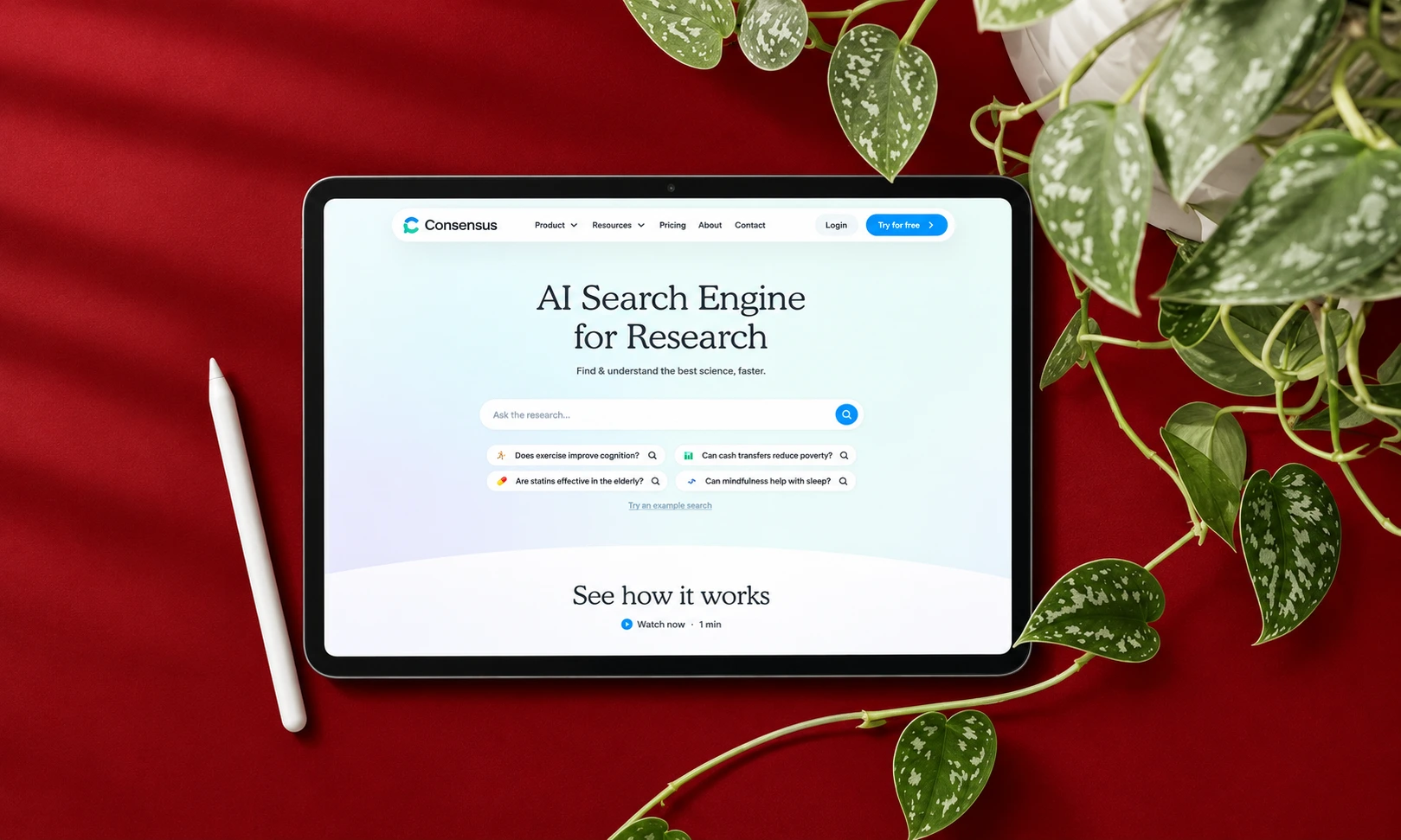
Consensus answers the most common research question in the world — what does the evidence actually say about this? — with a meter showing how many studies support, dispute, or hedge on your claim, every point linked to a real paper. Its database tops 200 million papers, with a biomedical and social science lean. The free plan’s allowance (a handful of Pro analyses and Deep Searches monthly) covers casual use; paid plans run roughly $12–15 a month with academic discounts up to 40%. For the consultant checking a client’s health claim or the student testing a thesis statement, it is the fastest legitimate answer available anywhere.
Best for: evidence-stance questions — “does X cause Y?” — answered in seconds.
2. Elicit — the systematic review machine
Elicit is built for the brutal middle of research: screening hundreds of papers and pulling the same fields from each. Define your columns — population, method, sample size, outcome — and it fills one row per paper across a corpus of 138 million, with the Pro tier ($49/month, academic plans from $11–19) screening up to 5,000 papers and Enterprise reaching 40,000 for formal reviews. More than two million researchers reportedly use it. The honest limitations: coverage skews toward empirical, quantitative work — theory-heavy humanities research gets thin — and its search isn’t a reproducible Boolean strategy, so PRISMA-grade reviews still need a documented protocol around it.
Best for: systematic reviews, meta-analyses, and evidence tables at scale.
3. Scite — the fact-checker for your citations
Scite answers the question citation counts can’t: not how often was this paper cited, but how — with each of its 1.6 billion-plus indexed citation statements classified as supporting, contrasting, or merely mentioning. A foundational study with 500 citations that are mostly disputes is a trap traditional metrics walk you straight into; Scite surfaces it before your peer reviewers do. Around $12–20 a month depending on billing, with a 7-day trial. For any argument that leans on a specific paper, checking it here first is the cheapest insurance in research.
Best for: verifying the papers your argument depends on.
The discovery layer
4. Semantic Scholar — the free foundation
Built by the nonprofit Allen Institute for AI, Semantic Scholar is the rare tool with no catch: 200-million-plus papers, AI-generated TLDR summaries, citation classification, alerts, and a free public API, with no premium tier and no paywall, ever. It does no synthesis and no extraction — it is the discovery layer the other tools build on, and the correct first install for any researcher.
Best for: everyone, starting now, at no cost.
5. ResearchRabbit — Spotify for papers
ResearchRabbit’s analogy to music discovery holds: seed it with a few papers you love and it maps the citation network around them — earlier foundations, later work, thematic neighbors keyword search would never surface. The core product is genuinely free forever across 280 million-plus articles with 50 seed papers; RR+ at $10/month raises the ceiling to 300 and syncs with Zotero. For the disorienting first week of a new field, nothing else gets you oriented faster.
Best for: exploring unfamiliar territory from a handful of seed papers.
6. Undermind — when you don’t know the right words
Undermind’s founding insight, from a team of MIT physics PhDs, is that keyword search fails exactly where research is hardest: interdisciplinary and emerging fields where the relevant papers use different vocabulary than you’d guess. Its agent explores the literature iteratively, reading and reasoning across hundreds of papers per search. It is slower than a keyword engine by design, and Pro at $16/month (annual) is priced for the researchers who need it: anyone whose field hasn’t settled on its own terminology yet.
Best for: interdisciplinary and emerging-field research.
The reading room
7. SciSpace — the paper whisperer
SciSpace solves the daily friction of research: the dense PDF that fights back. Highlight an equation, figure, or tortured methodology paragraph and it explains in plain language, pulls related citations, and answers follow-ups grounded in the paper’s actual text. The free plan’s 100 monthly credits suit occasional reading; Premium at $12/month (annual) unlocks unlimited literature searches and summaries. It won’t find your papers for you — it makes the ones you found legible.
Best for: reading outside your specialty without a translator.
8. Gemini Notebook — synthesize your own library
Google’s research notebook (the evolution of NotebookLM) inverts the discovery model: instead of searching the world’s papers, it becomes an expert on yours. Upload up to 50 sources per notebook — PDFs, transcripts, reports — and it answers questions with citations to exact passages, builds mind maps, and generates audio overviews for commute-time review. Free accounts hold 100 notebooks. Because it only knows what you upload, its hallucination risk is the lowest in the category — and its usefulness is bounded by the same wall.
Best for: synthesizing a source collection you already have.
The workflow that actually works
The researchers getting the most from these tools run them as a pipeline, not a pile: discover with Semantic Scholar and ResearchRabbit, screen and extract with Elicit, verify load-bearing citations with Scite, answer quick evidence questions with Consensus, and synthesize the final set in Gemini Notebook or SciSpace. Total cost for the free-tier version of that pipeline: zero. Total for the full professional version: under $100 a month — less than a single hour of the research assistant labor it replaces.
Two disciplines matter more than tool choice. First, treat every output as a screening shortlist, never a final synthesis — even the specialists misjudge papers, and the synthesis is the part you will be asked to defend. Second, verify citations before they reach your draft: general chatbots still invent plausible-looking references, which is why the specialist stack above exists, and why verification habits like those in our guide to AI content detection tools belong in academic workflows too. The tools read the 500 papers. The reading that matters — the judgment — remains gloriously, defensibly human.
Frequently asked questions
What is the best AI research assistant in 2027?
For evidence questions, Consensus. For systematic reviews, Elicit. For citation verification, Scite. For discovery, the free pairing of Semantic Scholar and ResearchRabbit. Most researchers need two or three matched to their workflow stage rather than one subscription for everything.
Can AI research assistants replace a literature review?
No. They absorb the mechanical work—discovery, screening, extraction, citation checking—but the synthesis and argument remain yours, and those are the parts you must defend. Treat outputs as a screening shortlist, not a finished review.
Are AI research assistants reliable about citations?
The specialists are, because they pull from real indexed databases: Semantic Scholar, Consensus, Elicit, and Scite work from hundreds of millions of actual papers. General chatbots like ChatGPT and Claude can invent plausible-sounding references — always verify a chatbot’s citation before citing it.
What’s the best free AI research tool?
Semantic Scholar, with no premium tier and no paywall. ResearchRabbit’s core discovery is free forever, Consensus covers casual evidence questions, and Gemini Notebook synthesizes 50 sources per notebook free. A full research pipeline can run on free tiers alone.
How much do AI research tools cost?
Semantic Scholar and ResearchRabbit: free. Consensus: around $12–15/month. Undermind: $16/month. SciSpace: $12/month annually. Scite: $12–20/month. Elicit Pro: $49/month with academic discounts from $11. A complete professional stack costs under $100/month.