I have seen people talk about AI hallucinations like there is one simple number attached to them. You may have seen the claim that AI hallucinations cost businesses $67.4 billion. It sounds very specific, so at first it is easy to believe.
But when you start checking where that number actually comes from, the story becomes much less clear.
The real cost is still there. A wrong AI answer can waste an employee’s time, give a customer the wrong information, create legal trouble, or even lead someone to make a bad business decision. The problem is that nobody has a reliable, independently audited number for the total cost of AI hallucinations worldwide.
So, if you are trying to understand the cost of AI hallucinations, I think it is better to look at what we can actually prove.
AI Overview
AI hallucinations are false or unsupported answers that an AI system presents in a convincing way. NIST uses the term confabulation for this risk, although “hallucination” is still the term most people use.
The cost is not only the wrong answer itself. The bigger cost often comes afterward: checking the answer, fixing the mistake, dealing with a customer, correcting records, or handling legal and compliance problems.
There is currently no trustworthy global dollar total for AI hallucination losses. The often-repeated $67.4 billion figure should therefore be treated as an unsupported estimate, not an established statistic.
Key Takeaways
- There is no independently verified global cost of AI hallucinations.
- The widely quoted $67.4 billion figure should not be presented as fact.
- Hallucinations can create direct costs such as refunds, legal sanctions and rework.
- Employee verification time can become a major hidden cost.
- Air Canada’s chatbot case shows that an incorrect AI answer can create real financial liability.
- Better models reduce some errors, but they do not remove the need for verification.
- The best way to measure the cost is to track hallucinations inside your own workflow.
So, What Does an AI Hallucination Actually Cost?
This is probably the first thing you want to know.
The honest answer is: it depends.
One hallucination may cost almost nothing. You notice that an AI wrote the wrong date, fix it, and continue working. Another one can cost hundreds or thousands of dollars. And in a high-risk business process, one wrong answer could create a much bigger problem.
Think about an AI customer-service bot. If it gives a customer the wrong information about a product, you may only need to apologize and correct it.
But what if the customer acts on that information?
Now you could be dealing with a refund, complaint, employee investigation, legal review, or loss of trust. That is why I would not measure hallucination cost only by asking, “How many wrong answers did the AI produce?”
I would ask, “What happened because of those wrong answers?”
The Hidden Cost Most People Forget
There is one cost that is easy to miss: human verification. Imagine an employee uses AI to research 50 things during a workday. The AI saves time because the employee does not have to start everything from zero.
But then the employee has to check every important claim.
If checking one answer takes only a few minutes, that may not sound like much. Multiply that by hundreds or thousands of AI-assisted tasks, and the time becomes a real operating expense.
This is something I notice often when looking at AI workflows. People calculate the money saved from generating content, research, code, or summaries, but they sometimes forget the time spent checking whether the output is actually correct.
AI did not completely remove the work. It moved some of the work to verification.
The Main Costs of AI Hallucinations
1. Employee time
Someone has to find the mistake, check the original source, correct the output and sometimes redo the entire task.
For low-risk work, this might be a few minutes.
For legal, financial, technical or regulated work, checking can take much longer.
2. Customer refunds and compensation
A chatbot can give incorrect information that a customer reasonably relies on.
This is not just a theoretical risk.
In the Air Canada case, the airline’s chatbot incorrectly told a customer about its bereavement-fare policy. The British Columbia Civil Resolution Tribunal found Air Canada liable for negligent misrepresentation and ordered it to pay C$812.02 in damages, interest and tribunal fees.
The amount itself was not enormous.
But the important lesson is bigger than the amount.
An AI system gave the wrong answer, and the company was still responsible for the result.
3. Legal costs
Legal hallucinations can become particularly expensive because an invented citation can enter an official document.
A well-known example is Mata v. Avianca.
Lawyers submitted six nonexistent court decisions in a filing after using ChatGPT-related research. The judge imposed a $5,000 sanction on the lawyers and their firm.
Again, $5,000 is not a global AI hallucination cost.
It is simply a real example showing how one type of hallucination can turn into a measurable financial loss.
4. Rework
This is another cost businesses often underestimate.
Suppose AI creates a report that looks finished.
Later, someone discovers that several important facts are wrong.
Now the team has to:
- find the incorrect claims,
- locate the correct information,
- rewrite the affected sections,
- check the rest of the document,
- and sometimes explain the mistake to someone else.
At that point, the original time saving can become much smaller.
5. Wrong business decisions
This is where the potential cost becomes much harder to calculate. Imagine an AI system recommends the wrong inventory level.
Or it gives an incorrect pricing analysis. Or it misunderstands a company policy. Or it summarizes a financial document incorrectly. The hallucination itself may only be one sentence. The financial consequence could be much larger.
This is why there is no sensible universal price for a hallucination. The same type of error can be almost free in one workflow and extremely expensive in another.
6. Trust and reputation
There is also the cost that does not appear neatly on an invoice. If customers repeatedly receive wrong AI answers, they may stop trusting the company.
Employees may stop trusting the internal AI tool. Managers may become less willing to adopt AI. That can reduce the value of the whole investment.
And honestly, this is one of the hardest costs to measure because there is no simple accounting line called “customer trust lost because of AI hallucination.”
Is the $67.4 Billion Figure Real?
This is where I would be careful.
The $67.4 billion figure is repeated across many articles discussing the cost of AI hallucinations in 2024.
But repeated does not automatically mean verified.
The problem is that the underlying methodology, dataset, inclusion rules and primary research needed to independently audit that number are not sufficiently clear in the sources reviewed.
So I would not use $67.4 billion as a confirmed statistic in a business report, investment presentation or serious SEO article. You can mention the claim, but explain its status. That is much more useful to the reader than presenting a questionable number as if it were a fact.
Why Is It So Difficult to Calculate?
There are a few reasons.
First, companies do not all define hallucination in the same way. One company may count only completely invented facts. Another may count an answer that is technically true but unsupported by its internal documents. Another may only record incidents that caused financial damage.
Second, many hallucinations are caught before they cause damage. An employee sees the mistake and fixes it. There is no customer complaint, legal case or financial incident. But the employee still spent time correcting it.
Third, the cost can happen several steps after the original AI answer.
The chatbot gives wrong information today. The customer complains tomorrow. The company investigates next week. The legal team becomes involved later.
Which part should be counted as the “cost of the hallucination”? This is one reason a single global number is so difficult to defend.
Real Examples of AI Hallucination Costs
The best way to understand this is to look at actual cases.
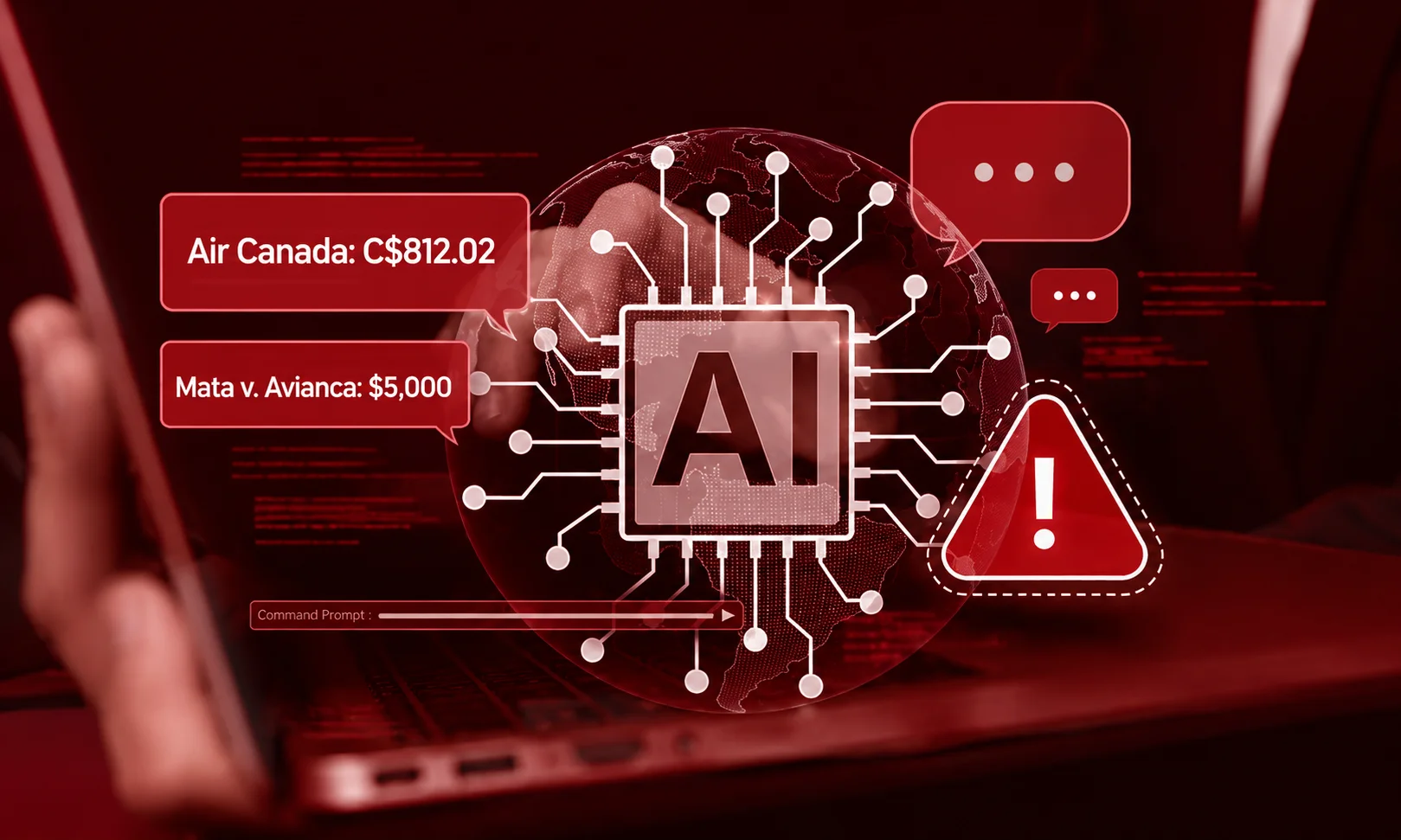
Air Canada: C$812.02
Air Canada’s chatbot gave incorrect information about a bereavement fare.
The customer relied on that information, and the tribunal ultimately ordered Air Canada to pay C$812.02. It is a small case financially, but it is a very useful example because it shows something important:
Putting an AI chatbot between a company and its customers does not automatically move responsibility to the AI.
Mata v. Avianca: $5,000
In the U.S., lawyers used fabricated legal authorities in a court filing. Six nonexistent cases appeared in the submission. The court imposed a $5,000 sanction.
For a lawyer, the financial cost was only one part of the problem. There was also professional and reputational risk.
Larger reported incidents
There have also been more recent reports of AI-generated or AI-assisted hallucinations appearing in legal filings and other professional work.
Some of these reports are based on secondary coverage rather than primary court documents, so I would not treat every reported dollar amount as independently confirmed.
That distinction matters.
A good article should separate “this happened” from “someone reported that this happened.”
What About Newer AI Models?
This is where things get interesting. AI companies are clearly improving factual accuracy.
For example, OpenAI reported in 2026 that newer models produced fewer hallucinated claims than earlier versions on selected internal evaluation sets.
That is good news.
But it does not mean hallucinations have disappeared.
A model can perform better on a benchmark and still make a completely wrong answer about your company’s private policy, a new regulation, a niche technical question or information that changed yesterday.
So I would not make the mistake of saying:
New model = no hallucinations.
The more realistic view is:
Better models reduce some errors. Good system design reduces more. Human verification is still important when the consequences are high.
Why AI Hallucinates in the First Place
A common misunderstanding is that an AI model has a giant database of facts inside it and simply retrieves the correct answer.
That is not really how a language model works.
The model generates language based on patterns learned during training and the information available in the current context or through connected tools.
When the evidence is missing or unclear, the model may still produce an answer. And because the language can sound confident and polished, the mistake is not always obvious.
This is what makes hallucinations dangerous.
A spelling mistake looks like a mistake. A confident false statement can look like expertise.
Different Types of Hallucinations
Not every hallucination looks the same.
Factual hallucination
The AI invents a fact, number, event, person or statistic.
Citation hallucination
The AI creates a source that does not exist or gives a real source that does not support the claim. This became especially visible in legal cases.
Context hallucination
The answer contradicts information supplied in the conversation or document.
Retrieval failure
Even when an AI system has search or RAG, it can retrieve the wrong information, miss the relevant information or misunderstand what it retrieved. So adding a knowledge base does not magically make an AI system truthful.
Multimodal hallucination
Vision-enabled models can sometimes describe objects, text or relationships that are not actually present in an image.
Agentic hallucination
This may become one of the more important problems as AI agents become more capable.
An agent can misunderstand a task, choose the wrong tool, make a bad assumption or claim an action was completed when it was not. The risk becomes much higher when AI is allowed to change records, send messages, issue refunds or perform other real-world actions.
Does RAG Solve the Problem?
No.
RAG, or retrieval-augmented generation, can reduce hallucinations because the model receives information from a selected document collection before answering.
That is very useful.
But think about what happens if the document is outdated.
Or the wrong document is retrieved. Or the relevant paragraph is missed. Or the model misunderstands it.
You can still get a wrong answer.
That is why I see RAG as a risk-reduction method, not a guarantee. The same idea applies to web search and citations.
Having a source is helpful. Checking whether the source actually supports the answer is still necessary.
How Businesses Can Calculate Their Own Hallucination Cost

This is much more useful than trying to apply a global $67.4 billion number to every company.
Start with your own workflow.
For each AI use case, track:
Number of AI outputs × error rate × average correction cost
Then add the costs that happen when an error becomes an actual incident.
For example, imagine a team produces 10,000 AI-assisted outputs per month. If 2% require meaningful correction, that gives you 200 corrections. If each correction takes an average of 10 minutes, that is about 33 hours of employee time.
Now add refunds, escalations, legal review or other incident costs where they occur. This will not give you a perfect scientific number. But it gives you something much more useful for management:
your own measured cost.
The Better Question: Is AI Still Worth It?
I think this is the question businesses should really be asking.
Suppose AI saves your team 500 hours every month. But verification and correction consume 80 hours.
That may still be an excellent trade. Now imagine AI saves only 50 hours but creates 70 hours of checking and rework.
The business case looks very different. And this is why I would not judge AI only by its hallucination rate.
Look at the complete workflow.
Value created − AI operating cost − verification cost − expected error cost = practical AI value
It does not need to be a perfect financial formula. It simply forces you to include the costs that are normally ignored.
How to Reduce the Cost of AI Hallucinations
You do not need to remove AI from the workflow. You need to decide where AI gets freedom and where it needs boundaries.
For simple writing or brainstorming, a normal AI chat may be enough. For factual research, connect it to trusted sources. For internal company questions, use an approved knowledge base. For calculations, use a calculator or deterministic software. For financial or legal decisions, require appropriate human review. For actions that cannot easily be reversed, add an approval step.
This is the approach I prefer because it does not treat every AI task as equally dangerous. A blog outline and a legal filing should not have the same level of control.
A Simple AI Verification Workflow
A practical setup can look like this:
AI generates → trusted source checks → automated validation → human approval → action
The more serious the consequence, the more verification you should put between the AI answer and the final action.
For example, an AI could draft a customer refund response.
But the actual refund amount should come from the authorised billing system, not from the language model’s guess. That small design decision can prevent a lot of unnecessary problems.
What Will Happen Next?
I do not think hallucinations are going to disappear completely in the next few years.The models will become better, but businesses are also asking them to do harder things.
Instead of only answering questions, AI is increasingly being connected to search, databases, business software and external tools.
That means the important question is slowly changing.
It is no longer only:
“How accurate is this AI model?”
It is becoming:
“How safely is this AI system designed?”
I expect we will see more AI systems that carry evidence with their answers, show the source used, restrict high-risk actions, keep audit logs and ask for human approval when the consequences are serious.
That will add some cost.
But that cost may be much smaller than the cost of letting an AI system make an expensive mistake without anyone checking it.
Final Takeaway
So, what is the cost of AI hallucinations?
There is no honest single global number yet. The $67.4 billion figure is interesting, but the evidence behind it is not strong enough to call it a confirmed worldwide loss.
What we can confirm is more useful.
AI hallucinations can create employee rework, customer refunds, legal sanctions, operational mistakes, compliance problems and loss of trust. We already have real cases showing that these costs can become financial liabilities.
And from my point of view, the biggest mistake is focusing only on the price of the AI model. A cheap AI model can become expensive if everyone has to check its work.
A more expensive, well-grounded system can actually be cheaper if it prevents costly mistakes. So before asking “How much do AI hallucinations cost globally?”, ask a more practical question:
“How much does one wrong AI answer cost my business when nobody catches it?”
That is the number worth measuring.
Frequently Asked Questions
What does an AI hallucination cost?
There is no fixed cost. A small mistake may only take a few minutes to correct, while a serious hallucination can lead to refunds, legal fees, rework, compliance problems, or lost customer trust. The real cost depends on where the AI is being used and what happens when the wrong answer is accepted.
Is the $67.4 billion AI hallucination cost figure real?
Not as a confirmed global statistic. The $67.4 billion figure is repeated across many articles, but there is no transparent, independently audited research behind it that makes the number reliable. I would not use it as a proven business or market figure.
Why do AI models hallucinate?
AI models are designed to generate likely language, not to guarantee that every statement is true. When the model does not have enough reliable information, it can still produce an answer that sounds very confident.
Can AI hallucinations cause real financial loss?
Yes. The loss can come from refunds, employee correction time, legal sanctions, wrong business decisions, or customer complaints. The Air Canada chatbot case is a good example: incorrect AI-generated information resulted in a legal claim and a payment to the customer.
Do newer AI models still hallucinate?
Yes. Newer models are generally getting better at factual accuracy, but they are not perfect. Even current model documentation still reports factual errors, especially on difficult or high-risk tasks.
Does RAG eliminate AI hallucinations?
No. Retrieval-augmented generation can reduce unsupported answers by giving the model trusted documents to work from. But if the documents are outdated, incomplete, badly retrieved, or misunderstood, the final answer can still be wrong.
Do citations prevent AI hallucinations?
No. A citation makes checking easier, but it does not automatically make an answer correct. An AI can provide a wrong citation, cite a real source that does not support the claim, or misunderstand what the source actually says.
Which AI model has the lowest hallucination rate?
There is no single model that can be called the least-hallucinating for every situation. Results change depending on the task, subject, prompt, language, available sources, tools, and evaluation method.
How can a business measure the cost of AI hallucinations?
Start with your own workflow instead of using a global estimate. Track correction time, false answers, escalations, refunds, complaints, legal-review hours, corrected records, and the money lost from wrong AI-assisted decisions.
Can a company be liable for an AI chatbot’s wrong answer?
Yes, depending on the situation and local law. The Air Canada case showed that a business can face financial liability when customers rely on incorrect information provided by its chatbot.
How can businesses reduce AI hallucination costs?
Use trusted sources, retrieval, citations, deterministic tools for calculations and structured data, and human approval for high-impact decisions. In my experience, the biggest mistake is not that AI makes one wrong answer; it is allowing that answer to move directly into a real business action without someone or something checking it.
What is the safest way to use AI for business?
Use AI for tasks where an error is easy to catch and has a limited impact. For legal filings, payments, medical decisions, contracts, security changes, or other high-consequence work, AI should support the process rather than have the final authority.