If you search “Who Owns PayPal?”, the answer is simpler than the company’s history makes it seem. PayPal Holdings, Inc. is a publicly traded company, so PayPal is collectively owned by its shareholders rather than by one individual or parent company.
That matters because several names are still closely associated with PayPal. eBay once owned the company, Elon Musk was involved in its early history, and major investment firms such as Vanguard and BlackRock now hold substantial stakes. None of those facts means that one of them owns PayPal outright today.
As of August 20, 2026, PayPal remains an independent public company trading on Nasdaq under PYPL.
Its recent ownership story also includes a reported acquisition proposal from Stripe and Advent International, but a proposal is not the same thing as a completed takeover.
AI Overview
PayPal is owned collectively by shareholders of PayPal Holdings, Inc., the publicly traded company behind the PayPal platform. Vanguard and BlackRock are among its major disclosed institutional shareholders, but neither owns a controlling majority. eBay owned PayPal from 2002 until the company was spun off in 2015. As of August 2026, reports of a proposed Stripe-Advent acquisition have not established a completed change in ownership.
Key Takeaways
- PayPal Holdings, Inc. owns the PayPal business and is itself publicly owned by shareholders.
- PayPal trades on Nasdaq under the ticker PYPL.
- Vanguard disclosed a 9.65% beneficial stake in January 2026.
- BlackRock reported 71,769,305 shares in its June 30, 2026 filing.
- eBay owned PayPal from 2002 until its 2015 separation.
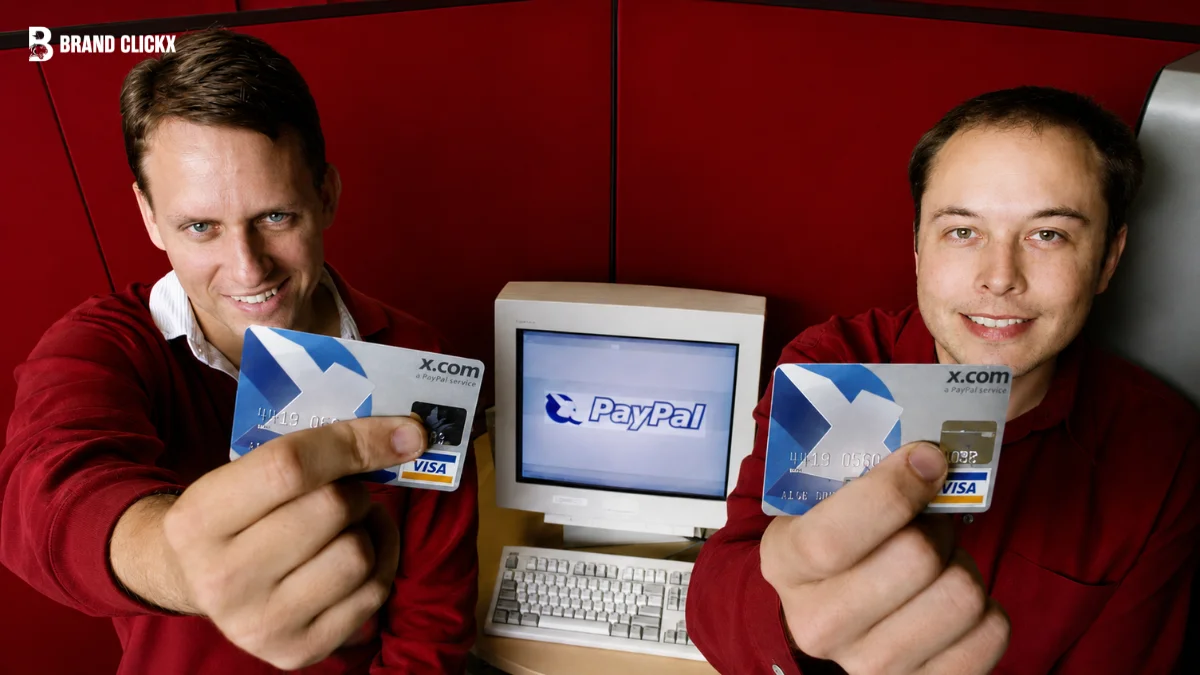
- Elon Musk was involved in X.com, one of the companies that became part of PayPal’s early history, but he does not own today’s PayPal.
- Enrique Lores became PayPal’s president and CEO on March 1, 2026.
- A reported $53 billion-plus Stripe-Advent proposal does not mean Stripe owns PayPal.
Featured Snippet
PayPal is owned collectively by the shareholders of PayPal Holdings, Inc., a publicly traded company listed on Nasdaq as PYPL. No single disclosed shareholder owns a majority of the company. Vanguard and BlackRock are major institutional shareholders, while PayPal’s management and board are responsible for running and overseeing the business.
Who Owns PayPal Today?
The most accurate answer is PayPal’s shareholders.
PayPal Holdings, Inc. is the public company that owns and operates the PayPal business. Because its shares trade publicly, ownership is divided among investors who hold those shares.
That distinction is easy to miss. The CEO runs PayPal, but the CEO does not personally own PayPal. Likewise, the board oversees the company but does not become its sole owner.
PayPal’s 2025 Form 10-K identifies PayPal Holdings, Inc. as the company and describes its global two-sided network connecting consumers and merchants. At the end of 2025, the company reported 439 million active accounts across approximately 200 markets.
Who are PayPal’s largest disclosed shareholders?
Two major investment managers stand out in the ownership records provided.
| Shareholder | Disclosed holding | Disclosure date | What it means |
|---|---|---|---|
| Vanguard | 90,375,902 shares / 9.65% | January 30, 2026 | Major minority stake |
| BlackRock | 71,769,305 shares | June 30, 2026 | Major minority stake |
| Other shareholders | Remaining shares | Varies | Collectively own the rest |
Vanguard’s January 2026 Schedule 13G/A reported beneficial ownership of 90,375,902 PayPal shares, or 9.65%.
BlackRock’s filing dated June 30, 2026 reported 71,769,305 shares with sole dispositive power. That filing is another indication of substantial institutional ownership, not proof that BlackRock controls PayPal.
So, if you’re looking for a single answer to “Who owns PayPal?”, neither Vanguard nor BlackRock is the right answer. They are shareholders in PayPal, not the parent company of PayPal.
Who Owns PayPal? The Difference Between Ownership and Management
This is where many ownership articles become confusing.
Ownership refers to who holds the company’s shares. Management refers to the people responsible for operating the business.
As of August 2026, Enrique Lores is PayPal’s president and CEO. PayPal announced that he would take the position effective March 1, 2026, succeeding Alex Chriss. David W. Dorman became independent board chair.
That leadership change does not mean Lores bought PayPal.
Instead, PayPal’s board appointed him to lead the company on behalf of its shareholders. The company’s SEC filing confirms the appointment and the separation of Lores’ CEO role from Dorman’s board-chair position.
CEO vs. owner
| Role | Person or group | Responsibility |
|---|---|---|
| Ownership | PayPal shareholders | Hold economic ownership through shares |
| CEO | Enrique Lores | Runs the company |
| Board chair | David W. Dorman | Leads the board’s oversight |
| Public listing | Nasdaq: PYPL | Shares can be publicly traded |
This distinction is useful whenever you see a headline saying that a particular executive “runs” PayPal. Running the company and owning the company are two different things.
Was PayPal Owned by eBay?
Yes, historically. No, today.
PayPal’s relationship with eBay is one of the biggest reasons people still ask whether eBay owns PayPal.
PayPal developed from the combination of Confinity and X.com around 2000. eBay later acquired PayPal in October 2002, making PayPal part of the eBay corporate structure.
For years, PayPal operated as an eBay subsidiary and became closely associated with payments on the marketplace.
That changed in July 2015, when eBay separated PayPal into an independent publicly traded company. PayPal Holdings then operated independently rather than as an eBay subsidiary.
The ownership timeline is therefore straightforward:
| Period | PayPal’s status |
|---|---|
| 2000–2002 | Developed through the Confinity/X.com combination |
| October 2002–July 2015 | Owned by eBay |
| July 2015–August 2026 | Independent publicly traded company |
So if someone tells you “eBay owns PayPal,” they are describing the historical relationship, not PayPal’s current ownership.
Does Elon Musk Own PayPal?
No.
Elon Musk is part of PayPal’s early corporate history because X.com, the online financial company he founded, became part of the combination that developed into PayPal.
That connection is real, but it does not make Musk the owner of today’s PayPal.
The company’s ownership structure changed significantly when eBay acquired PayPal in 2002 and again when PayPal became an independent public company in 2015. Today’s PayPal is owned through its publicly traded shares.
This is an important distinction between historical involvement and current ownership.
What Does PayPal Own?
The question can also be reversed: what businesses are part of PayPal?
PayPal’s current ecosystem includes the main PayPal wallet and checkout business alongside brands and services such as Venmo, Braintree, Xoom, Zettle, Hyperwallet, Honey and Paidy. PayPal also offers PayPal USD, known as PYUSD.
| Product or business | Main role |
|---|---|
| PayPal | Digital wallet and payment services |
| Venmo | Consumer payments |
| Braintree | Business payment processing |
| Xoom | International money transfers |
| Zettle | In-person commerce tools |
| Hyperwallet | Business payouts |
| Honey | Shopping and deal discovery |
| Paidy | Buy-now-pay-later services |
| PayPal USD | Dollar-denominated stablecoin |
This matters because these brands are sometimes mistaken for independent competitors or companies that own PayPal.
The relationship goes in the other direction: they are part of PayPal’s broader business portfolio.
Does PayPal own Venmo?
Yes. Venmo is part of PayPal’s ecosystem.
PayPal itself lists Venmo among the consumer services available across its commerce platform.
That means Venmo does not own PayPal. PayPal Holdings is the publicly traded company at the top of the corporate structure.
How Large Is PayPal?
The ownership question becomes more meaningful when you look at the scale of the business.
According to PayPal’s 2025 SEC filing:
- 439 million active accounts at the end of 2025.
- $1.79 trillion in total payment volume during 2025.
- 25.4 billion payment transactions during 2025.
- $33.172 billion in net revenue during 2025.
- $6.4 billion in cash flow from operations and adjusted free cash flow, as highlighted in PayPal’s 2026 proxy materials.
- PayPal operated across approximately 200 markets at the end of 2025.
These figures describe the size of the company whose shares investors own.
They also explain why a potential acquisition of PayPal would be a major transaction rather than a simple change in management.
How Does PayPal Make Money?
PayPal operates a two-sided payments network connecting consumers and merchants.
Consumers can use PayPal and Venmo for payments, transfers and other financial services, while businesses can use PayPal’s merchant and payment-processing services.
The company’s 2025 filing reported $33.172 billion in net revenue. It also reported revenue from other value-added services, including interest and fee revenue connected to its loan receivables portfolios.
That makes PayPal more than a simple digital wallet.
Its business combines consumer payments, merchant processing, transfers, credit-related products and other services within one corporate group.
What Happened With the Stripe and Advent PayPal Offer?
This is the most important current ownership development to keep separate from established facts.
On July 15, 2026, Reuters reported that Stripe and Advent International had made a joint proposal to acquire PayPal for more than $53 billion, at a reported $60.50 per share. Reuters also reported that there was no certainty the proposal would result in a transaction.
The following day, Reuters reported that PayPal’s board viewed the offer as inadequate, citing people familiar with the matter. The report said PayPal had not formally responded to the proposal at that point.
That creates an important ownership rule:
A reported acquisition proposal does not make the proposed buyer the owner.
Until a transaction is actually completed and the relevant corporate and regulatory records establish the change, it would be inaccurate to say Stripe or Advent owns PayPal.
Could Stripe own PayPal in the future?
It is possible, but it remains a future outcome rather than a present fact.
The July reporting establishes that a proposal was made. It does not establish that the acquisition closed.
Therefore, as of August 20, 2026, the defensible answer remains that PayPal is a publicly traded company owned collectively by its shareholders.
PayPal vs. Other Major Payment Companies
Ownership becomes easier to understand when you compare PayPal with other payment businesses.
| Company | Ownership structure | Main focus |
|---|---|---|
| PayPal | Public company | Consumer wallet and merchant payments |
| Stripe | Private company | Business payment infrastructure |
| Block | Public company | Consumer and merchant financial products |
| Adyen | Public company | Business payment processing |
The key difference is that PayPal is not a private company controlled by one founder or investment group.
Its shares are publicly traded, meaning investors can buy and sell ownership interests in the company.
Who Should Use PayPal and Who Should Avoid Assuming Too Much About It?
If you’re trying to understand whether PayPal fits your needs, the ownership question is only one part of the picture.
PayPal may be relevant if you want:
- A consumer digital wallet.
- Online payment options.
- Merchant payment services.
- Person-to-person payment capabilities through supported products.
- Access to a broader ecosystem that includes services such as Venmo, Braintree and Xoom.
PayPal’s actual features, fees and availability vary by product and location.
You should also avoid assuming that PayPal’s buyer or seller protection covers every transaction. PayPal states that eligibility, exclusions, documentation and other conditions apply.
Common PayPal Ownership Mistakes to Avoid
The most common mistakes are surprisingly simple.
Mistake 1: Saying eBay still owns PayPal. eBay owned PayPal historically, but PayPal became independent in 2015.
Mistake 2: Calling Elon Musk the owner. Musk is part of the company’s early history, not the current corporate ownership structure.
Mistake 3: Calling Vanguard the owner. Vanguard’s disclosed stake is substantial, but 9.65% is not a controlling majority.
Mistake 4: Treating an acquisition proposal as a completed sale. The Stripe-Advent proposal reported in July 2026 does not establish that ownership changed.
Mistake 5: Confusing the CEO with the owner. Enrique Lores runs PayPal as CEO; shareholders collectively own the publicly traded company.
How to Check Who Owns PayPal Yourself
If ownership changes in the future, you do not need to rely on old articles.
Start with PayPal’s SEC filings and look for its latest annual report, proxy statement and ownership disclosures.
Then check recent Schedule 13D or 13G filings for major shareholders. Those filings provide a much stronger basis for ownership claims than a third-party article published months earlier.
Finally, if you see an acquisition headline, look for evidence that the transaction actually closed. A proposal, negotiation or reported approach should not automatically be presented as a completed ownership change.
That simple process helps you separate current ownership from historical ownership and takeover speculation.
Why PayPal’s Ownership Story Is More Complicated Than It Looks
There are really three different stories behind the name PayPal.
First, there is the early PayPal story, involving Confinity, X.com and the people who built the business.
Second, there is the eBay era, when PayPal operated as an eBay subsidiary from 2002 until 2015.
Finally, there is the public-company era, which began with the 2015 separation and continues today.
Those periods should not be blended together. Doing so creates the common but incorrect impression that an early founder, eBay or a current institutional investor still owns the entire company.
Practical Application: How to Interpret PayPal Ownership News
When you encounter a new headline about PayPal ownership, use this four-step check:
- Identify the legal company. Look for PayPal Holdings, Inc., rather than simply the PayPal brand.
- Check whether the named party owns shares or controls the company. A large institutional stake is not automatically controlling ownership.
- Separate management from ownership. A CEO appointment changes leadership, not necessarily the shareholder structure.
- Verify takeover claims. Look for evidence of an actual completed transaction rather than relying only on reports of an offer.
This approach is especially useful when financial news moves faster than corporate filings.
Conclusion: Who Owns PayPal?
So, who owns PayPal? The clearest answer is still the same: PayPal Holdings, Inc. is a publicly traded company collectively owned by its shareholders.
Vanguard and BlackRock are significant shareholders, but neither is PayPal’s sole owner. eBay’s ownership belongs to the past, while Elon Musk’s connection belongs primarily to PayPal’s early history.
The July 2026 Stripe-Advent proposal adds an important wrinkle, but it does not change the present answer. A proposed acquisition is not a completed acquisition, and current reporting did not establish that PayPal had changed hands.
The simplest way to remember it is this: PayPal has had different owners at different points in its history, but today’s PayPal belongs to its shareholders. That distinction keeps the history interesting without confusing it with the present.
Frequently Asked Questions About Who Owns PayPal?
Who owns PayPal right now?
PayPal is owned collectively by the shareholders of PayPal Holdings, Inc., which is publicly traded on Nasdaq under PYPL. Major disclosed institutional shareholders include Vanguard and BlackRock, but neither represents a controlling majority.
The people running the company are different from the people who own its shares. As of August 2026, Enrique Lores is president and CEO, while David W. Dorman serves as independent board chair.
Is PayPal owned by eBay?
No. eBay acquired PayPal in 2002 and operated it as a subsidiary for years. PayPal was separated from eBay and became an independent publicly traded company in July 2015.
Does Elon Musk still own PayPal?
No. Elon Musk was associated with X.com, which became part of PayPal’s early corporate history. Today’s PayPal is a publicly traded company whose ownership is distributed among shareholders, so Musk should not be described as its current owner.
Who is PayPal’s largest shareholder?
Vanguard disclosed beneficial ownership of 90,375,902 PayPal shares, representing 9.65%, in a January 30, 2026 Schedule 13G/A. Ownership positions can change, so the latest regulatory filings should always be checked before describing any institution as the largest shareholder.
Does BlackRock own PayPal?
BlackRock is a major PayPal shareholder, but it does not own PayPal outright. Its filing for June 30, 2026 reported 71,769,305 shares, making it a significant minority holder rather than the company’s sole owner.
Who is the current CEO of PayPal?
Enrique Lores is PayPal’s president and CEO. PayPal announced his appointment in February 2026, with the appointment becoming effective on March 1, 2026, when he succeeded Alex Chriss.
Is PayPal a private or public company?
PayPal is a public company listed on Nasdaq under the ticker PYPL. Its shares can therefore be held and traded by investors rather than being owned privately by one founder or corporate parent.
Does PayPal own Venmo?
Yes. Venmo is part of PayPal’s broader product ecosystem. PayPal identifies Venmo alongside its other consumer and merchant services, so Venmo is not the company that owns PayPal.
Is Stripe buying PayPal?
A reported Stripe-Advent acquisition proposal was made in July 2026, but that does not mean Stripe owns PayPal. Reuters reported that the proposal was worth more than $53 billion and that there was no certainty it would result in a completed transaction.
Is PayPal a bank?
PayPal is primarily a digital-payments and financial-technology company rather than simply a conventional retail bank. Its business includes digital wallets, payment processing, transfers, merchant services and credit-related products, with specific arrangements varying by product and location.