In April 2026, Bright Data stopped selling mobile proxies to new customers. The product page now redirects to a generic proxy-types page, the mobile pricing URL returns a 404, and only accounts with an active mobile subscription can keep using the service. Several rankings published this year still put it first.
The top 6 mobile proxy providers below were all selling carrier IPs to new accounts in September 2026. Published entry prices run from $4.30 for a day on a dedicated 4G port to $9 for a single gigabyte of metered traffic, and picking the wrong billing model usually costs more than picking the wrong vendor.
Why websites treat carrier IPs differently
Mobile operators ran out of public IPv4 space long ago. RIPE NCC, which allocates addresses in Europe, handed out its last free /22 in November 2019, so carriers put phones on private addresses from the 100.64.0.0/10 block reserved by RFC 6598 and translate them through carrier-grade NAT (CGNAT).
One public IPv4 address on a 4G network can therefore front hundreds or thousands of subscribers at once. Blocking it would cut off every legitimate phone behind it, so anti-abuse systems tend to score carrier ranges more cautiously than datacenter ASNs, where one IP usually maps to one server.
A mobile proxy is a 4G or 5G modem with a SIM card, plus a gateway that forwards your HTTP or SOCKS5 traffic through it. Ask for a new IP and the modem re-attaches to the network, picking up a different public address from the carrier’s pool. The price is latency (radio link, CGNAT and distance to the exit) and throughput that depends on cell load, which is why vendors quote ranges like 3–30 Mbps instead of a fixed speed.
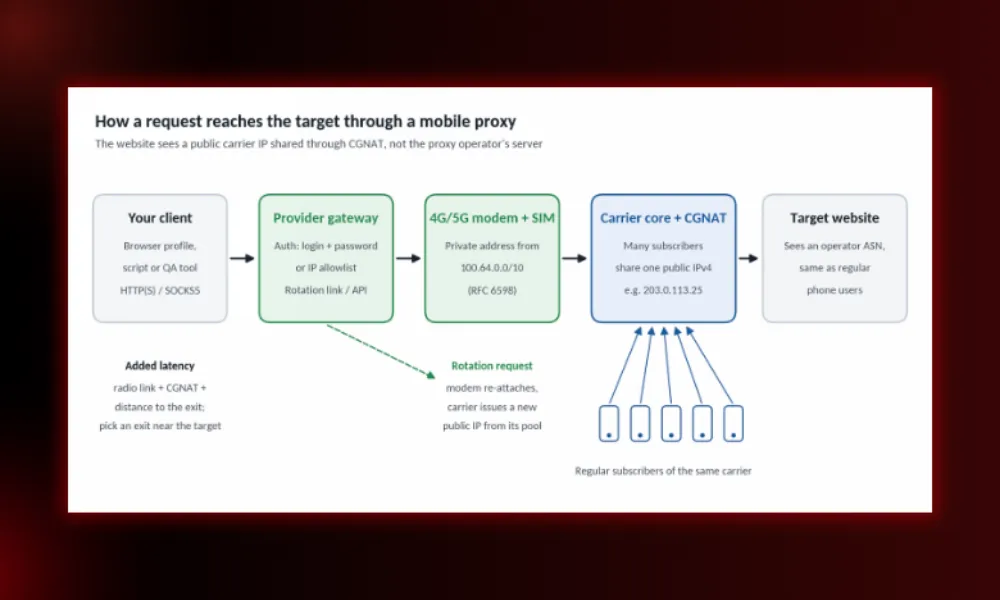
Figure 1. A mobile proxy forwards your traffic through a carrier modem, so the target sees a CGNAT address shared with regular subscribers. 203.0.113.25 is a documentation example address.
That trust profile justifies the price for a fairly narrow set of jobs: checking how ads and search results render for users on a specific carrier, testing mobile apps under real network conditions, collecting public pricing from mobile-only storefronts, and running brand social accounts within each platform’s rules. For crawling open sites, residential or datacenter IPs cost less and are usually enough.
How the providers were compared
Every figure below is something a buyer can check before paying: prices on each vendor’s own pages as listed between July and September 2026, the billing unit (per GB, per port-day or per IP-week), rotation mechanics, session length, geographic granularity and the cheapest way to test. Speeds are the ranges vendors publish. Your real numbers depend on the distance between your servers and the exit.
The top 6 mobile proxy providers were ranked on cost per usable exit, not headline pool size. Twenty million IPs matter to a crawler that rotates on every request. They matter far less to a QA engineer who needs one stable UK carrier IP for six hours.
Mobile proxy providers compared side by side
Treat these as entry points. Per-GB vendors get cheaper with committed volume, and per-port vendors charge different rates by country.
Table 1. Top 6 mobile proxy providers at a glance, entry prices listed July to September 2026
| Provider | Billing unit | Published entry price | Rotation and sessions | Coverage | Cheapest way to test |
| Proxys.io | Per port (1, 7, 30 or 90 days); per-GB plan also available | $4.30/day dedicated; 30 days from $56.79 | Timer 2–60 min or rotation link (max once a minute) | About 15 countries; city and operator choice | 24-hour refund; test on request for new accounts |
| Oxylabs | Per GB, monthly or pay-as-you-go | $9/GB pay-as-you-go; $30 for 4 GB | Per request or sticky up to 24 h | 140+ countries; state, city, ASN, coordinates | Starter plan (4 GB) |
| Decodo | Per GB, wallet or monthly | $8/GB pay-as-you-go list price; frequent 50% promotions | Rotating or sticky | 160+ locations, 700+ carriers | 3-day, 100 MB trial |
| SOAX | Per GB, same credits as residential | $5/GB Sandbox tier (Tier 1 countries) | Per request or sticky up to 60 min | 195+ geolocations; city and ASN | $1.99 for 400 MB over 3 days |
| IPRoyal | Per device-day or per GB | $10.11 per 24 h dedicated; $5.20/GB rotating at 100 GB | Manual; automatic every 6 min on 30+ day plans | 4.5M+ carrier IPs | 1-day dedicated plan |
| Proxy-Seller | Per IP, 1-week minimum | $10 per IP per week, shared | Link, or every 5 or 30 min | 20 countries; carrier choice | No trial; enterprise proof of concept |
The top 6 mobile proxy providers, ranked
Proxys.io for dedicated 4G ports
Proxys.io has sold proxies since 2016 and bills its 4G mobile proxies per port rather than per gigabyte. A Personal port is a private channel with unlimited traffic: the IP rotates on a timer you set between 2 and 60 minutes, or when you call a rotation link, while host, port and credentials stay the same.
One feature is unique in this list. Once every 24 hours you can move a Personal port to a different city or operator inside the country you bought, and each city-operator pair has a pool of roughly 2,000 to 5,000 addresses behind it. Checking a campaign on two Polish carriers over two days takes one port, not two.
Price is the other reason it ranks first. At the time of writing, dedicated Individual ports start at $4.30 a day, Personal ports with the location switch at $9.23, Premium high-speed ports at $7.38, and 30-day rentals from $56.79. Shared ports, where the channel is split with other customers, start at $11.70 for 30 days. Every port accepts HTTP and SOCKS5, payment goes through Stripe, crypto or Alipay, and dedicated purchases carry a 24-hour refund window.
The limits are worth knowing. Coverage is about 15 countries, mostly in Europe and Asia, and a US port costs several times more per day than an Eastern European one. Link rotation is capped at once per minute, and speed follows carrier load: 3 to 30 Mbps by the provider’s own figures. Teams that need 100 countries or a new IP on every request will be better served by a per-GB pool.
Oxylabs for enterprise-scale targeting
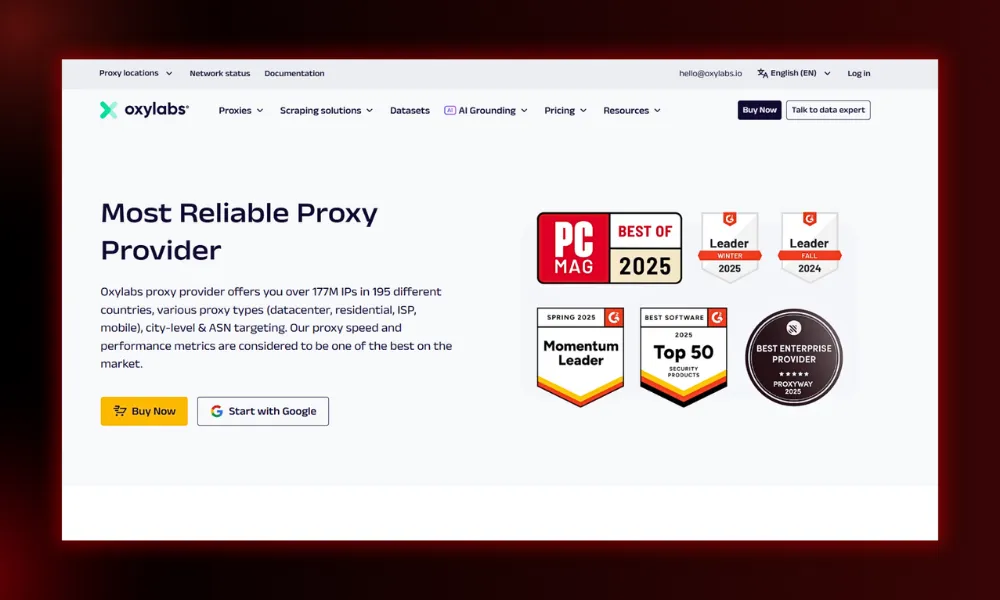
Oxylabs fits teams whose procurement checklist includes ISO/IEC 27001 and a vendor with a formal KYC process. Its mobile pool lists 20M+ IPs in 140+ countries, targeting down to state, city, ASN and GPS coordinates, sticky sessions of up to 24 hours, and HTTP(S), SOCKS5 and HTTP/3 support.
Pay-as-you-go traffic costs $9/GB. Monthly plans lower that to $7.50 on 4 GB ($30), $5 on 100 GB ($500) and $3.50 on 715 GB ($2,500). Oxylabs quotes a 1.1-second average response time. The trade-off is that every byte is metered, including scripts and images your workflow never needed.
Decodo for the widest carrier choice
Decodo, formerly Smartproxy, offers the broadest self-serve carrier selection here: 10M+ mobile IPs from 700+ carriers in 160+ locations, over HTTP(S) and SOCKS5. List pay-as-you-go pricing is $8/GB from a prepaid wallet, although the site displayed a 50% promotion through mid-2026, and volume tiers drop to $2.25/GB. New accounts get a 3-day, 100 MB trial.
IPhey’s May 2026 benchmark found Decodo’s mobile IPs clean on reputation checks but uneven on throughput, with occasional endpoints that refused traffic. Build retry logic before you scale a job on it.
SOAX for ASN targeting and UDP
SOAX sells mobile and residential traffic from the same credit balance at one rate. The no-minimum Sandbox tier costs $5/GB in its Tier 1 countries (US, UK, Canada, Germany), 100 GB on the Builder plan costs $300, and committed plans fall to $0.85/GB at a $3,000 monthly minimum. A $1.99 trial buys 400 MB for three days.
Its technical edge is targeting and transport: 195+ geolocations with city and ASN filters, sticky sessions of up to 60 minutes, and UDP and QUIC support alongside HTTP and SOCKS5. That UDP option matters when you test apps whose traffic doesn’t run over TCP.
IPRoyal for day-rate dedicated devices
IPRoyal rents whole devices by the day. A dedicated mobile proxy costs $10.11 for 24 hours, $130 for 30 days or $117 a month on a 90-day term, with unlimited concurrent sessions and a 30 GB daily cap per device. Rotation is manual on the 1-day plan and manual or automatic every 6 minutes on longer ones.
This suits long, stable sessions, such as a QA run that must keep one carrier IP from login to checkout. There is no free trial, so the 1-day plan is the test. A separate rotating product starts at $5.20/GB at the 100 GB tier.
Proxy-Seller for weekly per-IP rentals
Proxy-Seller sells mobile IPs per address with a one-week minimum: shared access from $10 per IP, dedicated ports priced by country and carrier. It lists 20 countries, carriers including AT&T, T-Mobile, Verizon, Vodafone, Jio and Orange, rotation by link or every 5 or 30 minutes, and 5–30 Mbit/s channels with unlimited traffic under carrier fair-use rules.
Its model is the closest to Proxys.io’s, and its US carrier choice is wider. It ranks lower because the rotation schedule is coarser (fixed 5 or 30 minutes versus any value from 2 to 60), the shortest rental is a week rather than a day, and there is no trial outside enterprise proof-of-concept deals.
Per-GB or per-port: where the bill comes from
HTTP Archive’s 2025 Web Almanac puts the median mobile home page at 2,164 KB. A browser workflow that loads 500 uncached pages a day therefore moves about 1 GB daily, or roughly 32 GB a month.
On metered plans those 32 GB cost about $290 at Oxylabs’ pay-as-you-go rate and $160 on SOAX’s Sandbox tier. A port costs the same whether you push 5 GB or 50: $56.79 for 30 days at Proxys.io’s entry rate, $130 at IPRoyal. Against $5/GB, the $56.79 port breaks even at about 11 GB a month. Against $9/GB, it breaks even at about 6 GB.
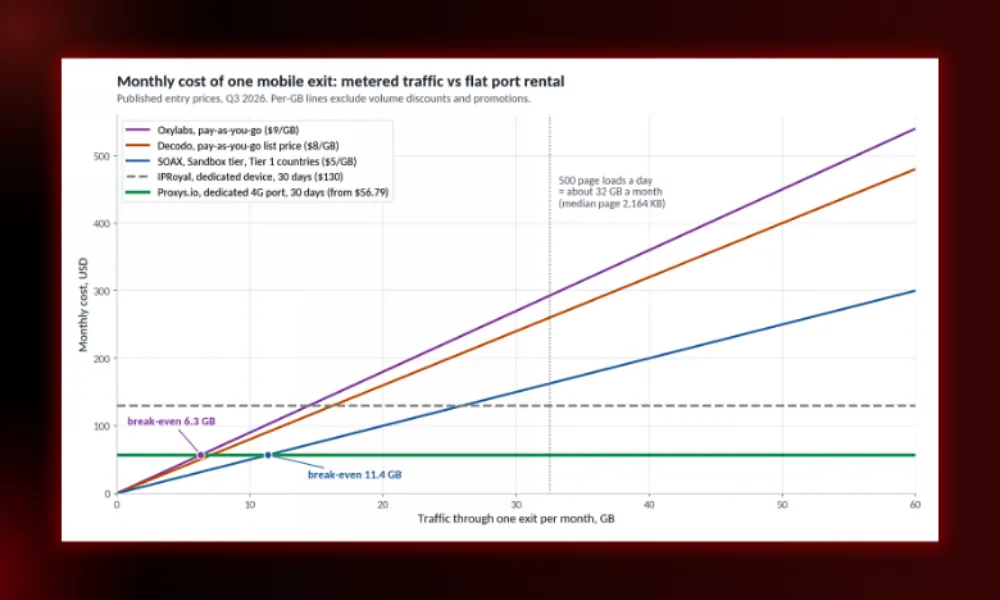
Figure 2. Monthly cost of one exit at published entry prices. Per-port lines assume the cheapest available country; per-GB lines exclude volume discounts and promotions.
The chart leaves out one asymmetry. A per-GB subscription usually lets you open many concurrent sessions on different IPs, while a port is one exit at a time. If a job needs 200 parallel IPs for ten minutes, buy traffic. If it needs three stable exits all month, rent ports. Across the top 6 mobile proxy providers, that single decision moves the bill more than any vendor discount.
What to check in the first 24 hours
Most refund and trial windows here last a day or less, so run the same checks on every port before real work goes through it. Turn this into a repeatable SOP so every new port gets the same six checks before it touches production, rather than re-deriving them each time you switch vendors. Replace the placeholder credentials with your own.
Table 2. Six checks to run on a new mobile proxy port
| Check | How to run it | What a pass looks like |
| Carrier ownership | curl -x socks5h://USER:PASS@HOST:PORT https://ipinfo.io/json | The org field names a mobile operator, not a hosting company |
| DNS path | Keep socks5h:// (the h resolves DNS at the exit), then open a DNS leak test through the proxy | Every resolver shown sits in the exit’s country |
| Rotation | Call the rotation link, then poll ipinfo.io every 2 seconds | A new public IP appears within the provider’s stated window |
| Throughput | Download a 100 MB test file from a server near your target site | Speed inside the published range, for example 3–30 Mbps on 4G |
| Reputation | Look up the exit IP on AbuseIPDB and the Spamhaus blocklist checker | No recent abuse reports or listings |
| Geolocation | Compare country and city in two independent geolocation databases | Both match the location you paid for |
Setting up rotation in browsers and scripts
In scripts, keep one proxy endpoint in the config and call the provider’s rotation URL between jobs instead of hard-coding IP lists. Port-based services such as Proxys.io keep host, port and credentials unchanged across rotations, so nothing in the HTTP client has to change.
In a browser, an extension saves clicks. Proxys.io’s free Proxy Control extension for Chrome, Opera and Firefox imports ports from your account through an API key and switches between them in one click, and the Proxy Control setup guide walks through installation and the site whitelist. Pair it with the rest of your dev tooling stack for QA and scraping work, since rotation logic is only half the setup. One limitation applies to every extension of this kind: Chrome’s proxy API can’t pass a login and password to a SOCKS5 server, so authenticated SOCKS5 needs Proxifier or an anti-detect browser profile.
How to choose a mobile proxy provider
Four questions settle most decisions.
- How much traffic goes through each exit per month? Above about 15 GB, a flat-rate port with unlimited traffic costs less than any pay-as-you-go rate listed here, promotions included.
- How many exits do you need at the same moment? Dozens of concurrent IPs point to a per-GB pool from Oxylabs, Decodo or SOAX.
- Do you need carrier or ASN precision in 100+ countries? That is Oxylabs or SOAX territory.
- How long must one IP survive? For multi-hour sessions, take a dedicated port where you control rotation, or use Oxylabs’ 24-hour sticky sessions.
Read the acceptable-use policy before the pricing page. Bright Data’s April 1, 2026 update removed social account management as a supported use case, and Proxy-Seller issues credentials only after you state the purpose of use at checkout.
Among the top 6 mobile proxy providers, Proxys.io gives the lowest cost per stable carrier exit in Europe and Asia. Start with a one-day port, run the six checks above, and move to 30-day rental once throughput and rotation hold up on your real targets.