A plain-English guide to buying, selling and tracking cards on the biggest TCG marketplace with the fee numbers straight from TCGplayer’s own help pages
Published: Monday, 27 July 2026 | BrandClickX Games
Summary
TCGplayer is an online marketplace for trading cards, owned by eBay. Buyers use it to find single cards from thousands of sellers; sellers use it to reach a dedicated card audience. It raised marketplace commission on 10 February 2026 and rebuilt its Direct fee structure on 18 June 2026. Anyone can browse free. If you sell, those two changes affect what you actually take home.
What is TCGplayer?
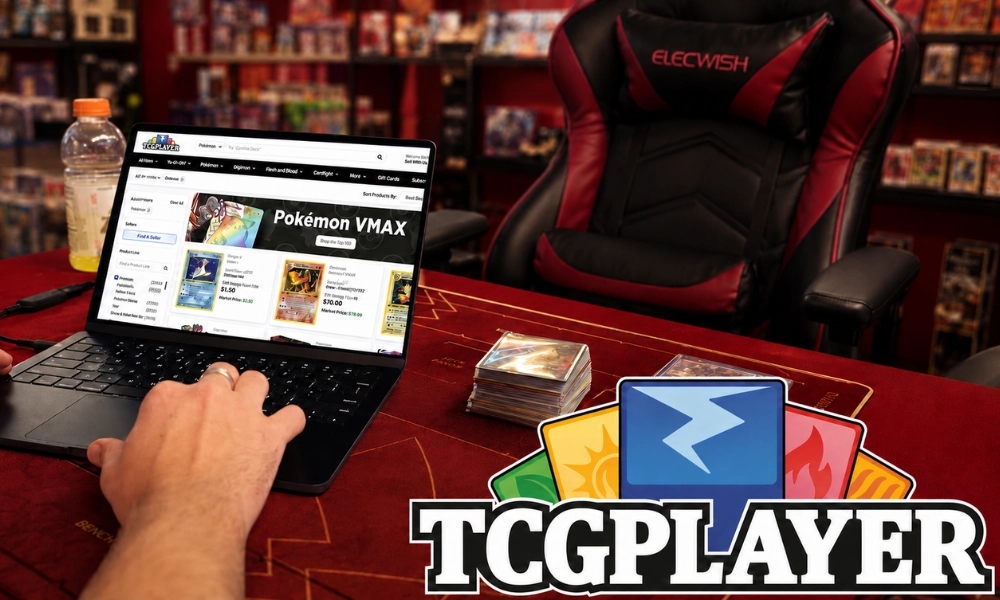
TCGplayer is a marketplace where thousands of independent card shops and individual sellers list their inventory in one place. Think of it as a specialist version of eBay, built specifically for trading card games.
It started in 2008 in Syracuse, New York, founded by Chedy Hampson under the original name TradeMatches. eBay acquired it, and it now runs as an eBay subsidiary. The headquarters moved from Syracuse to Louisville, Kentucky in 2025.
The catalogue covers Magic: The Gathering, Pokémon, Yu-Gi-Oh!, One Piece, Disney Lorcana, Star Wars Unlimited, Digimon, Flesh and Blood, Cardfight!! Vanguard and a growing list of newer games including Riftbound: League of Legends.
Browsing and buying cost nothing beyond the cards themselves. Selling is where fees apply.
What Changed in 2026?
Two things, and they matter in opposite directions.
10 February 2026 — commission went up. Marketplace Seller accounts on Levels 1 to 4 moved from 10.25% to 10.75%. TCGplayer said the increase funds marketplace growth and seller programs. Rates for other seller types did not change.
Early 2026 — Direct minimum pricing arrived. Items sold through TCGplayer Direct and Store Your Products now carry a $0.40 minimum price. Cards listed below that are adjusted up to $0.40 for Direct-eligible inventory. It rolled out in phases: the Lorwyn Eclipsed Magic set on 23 January, all Yu-Gi-Oh! Direct products on 30 January, and everything else on 10 February.
18 June 2026 — Direct fees were rebuilt. TCGplayer scrapped Shipping Replacement Costs entirely and replaced them with a flat, item-based Direct Fee. The company said the aim was a <cite index=”302-1″>”clearer, more predictable way to understand your fees”</cite>, and that over 95% of Direct sellers should pay less under it.
Most third-party fee guides still quote the old SRC model or a vague “10–13%.” They are out of date.
TCGplayer Fees, Straight From the Source
Here is the current structure as published on TCGplayer’s own help pages.
| Seller type | Commission | Pro fee | Transaction fee |
| Marketplace (Level 1–4) | 10.75% | — | 2.5% + $0.30 |
| Marketplace (Pro, non-Direct) | 9.25% | 2.5% | 2.5% + $0.30 |
| Marketplace (Sync account) | 9.25% | — | 2.5% + $0.30 |
| Direct Seller (non-Pro) | 8.95% | — | 2.5% |
| Direct Seller (Pro) | 8.95% | 2.5% | 2.5% |
Commission is capped at $75 per product sold.
The Direct Fee Has Two Tiers
This is the part that catches sellers out:
- Cards under $2.49: the Direct Fee is 50% of card value. Commission, Pro, Sync and transaction fees are waived on these
- Cards over $2.49: a flat $1.12 per card, plus all standard fees
That first tier is brutal on cheap singles and is the clearest signal that Direct is built for mid- and high-value cards.
Selling from outside the US? Non-US sellers paid via PayPal pay a 2% processing fee, capped at $20. The transaction fee on international orders is 3.5% + $0.30 rather than 2.5% + $0.30.
TCGplayer also uses bankers’ rounding on fee calculations, which rounds midpoint values to the nearest even number rather than always rounding up.
How to Buy on TCGplayer
Search the card name, pick your condition and price, add to cart. No account is needed to browse, though you need one to check out.
The feature worth knowing is the Cart Optimizer. Because your order may span dozens of sellers, each charging their own shipping, the optimizer rebuilds your cart to find the cheapest total combination across sellers.
Conditions run from Near Mint down through Lightly Played, Moderately Played, Heavily Played and Damaged. Prices drop sharply as condition falls, and for a card you are playing rather than collecting, a Moderately Played copy can be a large saving.
Three price figures appear across the site:
- Market Price — TCGplayer’s calculated going rate
- Listed Median — the middle of current listings
- Most Recent Sale — the last confirmed transaction
Market Price is the useful one for judging whether a listing is fair.
How to Sell on TCGplayer
You cannot list unlimited inventory on day one. New sellers are capped at 100 listed items and must work up through seller levels.
Reaching Level 4, which removes the listing cap, requires 51 fulfilled orders and a feedback rating of 90% or higher. Depending on your volume, that takes weeks to months.
The listing process itself is fast. For ungraded near-mint singles you do not need to photograph anything TCGplayer uses stock images and a shared catalogue. You select the card, set condition, quantity and price.
Marketplace vs Direct
Marketplace means you store, pack and ship your own cards.
Direct means you send inventory to TCGplayer’s warehouse once, and they fulfil orders on your behalf. Buyers like Direct because multiple sellers’ cards arrive in one package.
Direct carries a lower commission, 8.95% against 10.75%, but adds the per-item Direct Fee. Run the numbers on your own average card value before switching.
Is Pro Worth It?
Pro drops your commission from 10.75% to 9.25% and adds bulk pricing tools, but charges a 2.5% Pro fee on top plus a subscription. The break-even sits somewhere around a few hundred dollars of monthly sales. Below that, stay on standard Marketplace.
How to Track Your Collection
TCGplayer has a free collection tracker built into the site and mobile app. You scan cards with your phone camera and they are added to lists with live price data attached.
The app supports condition, language and printing variants, so a foil Japanese copy tracks separately from a standard English one. You can export lists as plain text or CSV. Level 4 sellers can import scanned lists straight into the Seller Portal.
The app works without an account for scanning and price checks. Collections require you to log in.
An honest note: the collection tracker is a marketplace feature first. Reviewers on Google Play regularly criticise the lack of collection sorting and difficulties importing CSV files. TCGplayer’s support team responds to that feedback publicly and says updates are in progress, but dedicated apps like Collectr and ManaBox are more capable as pure trackers.
If you buy and sell on TCGplayer, the built-in tracker is convenient. If you only want portfolio tracking, look elsewhere.
Best Tips
- Buy from fewer sellers. Shipping stacks per seller. Consolidating five cards from one shop usually beats five cheaper cards from five shops
- Check Market Price before listing. Undercutting by a cent to win the top slot is common, and it erodes margins across the board
- Do not send cheap singles to Direct. The 50% fee on sub-$2.49 cards removes the point
- Watch the $0.40 Direct minimum. Bulk priced below it gets adjusted upward, which changes your positioning
- Grade conditions honestly. Feedback below 90% blocks progress to Level 4
- Recalculate after 18 June. If you built your pricing around SRCs, that model no longer exists
Common Problems
- My order arrived in several packages. Normal on Marketplace orders spanning multiple sellers. Direct consolidates
- I cannot list more items. You are below Level 4. Fulfil more orders and maintain feedback
- My fees look higher than expected. Check whether the items went through Direct, and check the sub-$2.49 tier
- The scanner misreads my card. Common with alternate art and non-English printings. Search manually instead
- Prices differ between the app and site. Market Price recalculates continuously
Pros and Cons
| Pros | Cons |
| Huge catalogue of singles in one place | Fee structure changed twice in 2026 |
| No listing fees | Seller level cap slows new sellers |
| Fast listing with stock images | Direct fees punish low-value cards |
| Free collection tracking and scanning | Collection tools weaker than dedicated apps |
| Cart Optimizer cuts shipping costs | US-centric; international sellers pay more |
Expert Analysis
The direction of travel is clear. TCGplayer is optimising for professional, higher-volume sellers moving mid- and high-value cards.
The $0.40 Direct minimum, the 50% fee on sub-$2.49 cards, and the seller level system all push the same way. Bulk commons are increasingly uneconomic to move through Direct.
That is not necessarily bad for buyers. Consolidated Direct shipping and the Cart Optimizer genuinely reduce what you pay. But casual sellers clearing a shoebox will find the maths tighter than it was two years ago.
The June restructure is the more interesting move. Replacing order-level SRCs with per-item fees makes costs predictable before you list, which is what sellers had been asking for.
What Happens Next?
TCGplayer has adjusted fees twice this year and publishes changes on its seller blog ahead of time. Expect that pattern to continue rather than stop.
The eBay relationship is worth watching. eBay has moved some TCGplayer development work to its India hub, and the two platforms overlap heavily in trading cards.
Nothing further is announced. Check the seller blog and the fees help page before making pricing decisions — TCGplayer’s own change log is the fastest way to spot updates.
Frequently Asked Questions
What is TCGplayer and who owns it?
TCGplayer is an online marketplace for trading card games including Magic, Pokémon and Yu-Gi-Oh!. Founded in Syracuse in 2008, it is now an eBay subsidiary headquartered in Louisville, Kentucky. Thousands of independent shops and individual sellers list inventory through it.
How much does TCGplayer charge sellers in 2026?
Standard Marketplace sellers on Levels 1 to 4 pay 10.75% commission plus a 2.5% + $0.30 transaction fee. Pro and Direct sellers pay lower commission but add Pro or per-item Direct fees. Commission is capped at $75 per product.
Is TCGplayer free for buyers?
Yes. Browsing, searching and price checking cost nothing, and no account is needed to look. You pay only for cards and shipping at checkout. The mobile app’s scanner and price lookup are also free without signing in.
What is TCGplayer Direct?
Direct means you ship inventory to TCGplayer’s warehouse and they fulfil orders for you. Buyers get multiple sellers’ cards in one package. Sellers pay lower commission of 8.95% but add a per-item Direct Fee that replaced the old SRC system in June 2026.
Why are my TCGplayer fees higher than expected?
Most likely the Direct Fee. Cards valued under $2.49 sold through Direct are charged 50% of card value. Cards above $2.49 carry a flat $1.12 per card plus standard fees. Check whether your items routed through Direct.
How do TCGplayer seller levels work?
New sellers are limited to 100 listed items. Reaching Level 4, which lifts the cap, requires 51 fulfilled orders and a feedback rating of at least 90%. Most sellers take weeks or months to get there depending on volume.
Can I track my card collection on TCGplayer?
Yes, free. Scan cards with the mobile app and save them to collection lists with live pricing, condition, language and printing. You can export as CSV. Dedicated apps like Collectr offer stronger tracking if you are not selling.
Is TCGplayer cheaper than eBay for selling cards?
It depends on card value. TCGplayer’s 10.75% commission is simpler and there are no listing fees. eBay store subscriptions and high-value discounts can beat it on expensive singles. Run both against your actual average sale price.
Conclusion
TCGplayer is still the default place to find a specific card, and the Cart Optimizer alone makes it worth using as a buyer.
For sellers, 2026 has been a year of recalculation. The February commission rise and the June Direct rebuild both change the maths, and a lot of published advice has not caught up.
Before you list anything, open TCGplayer’s fees page and check the change log. It is the one source that is always current.