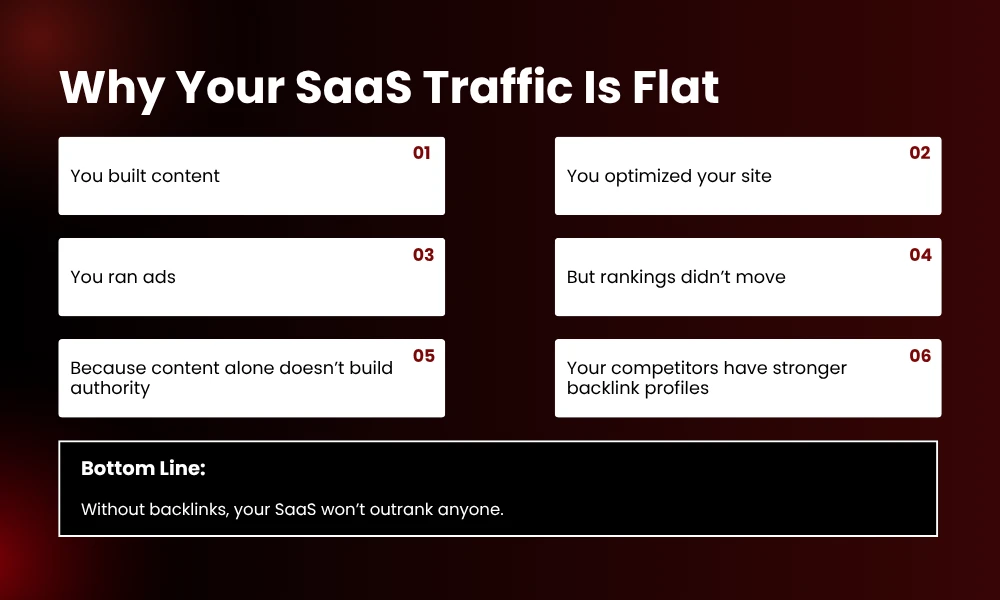
Let me guess. You have a solid product. Good reviews from the people who actually use it. A blog that covers the right topics. And your traffic graph still looks like a flat line.
That is a specific kind of frustrating because you have done what everyone said to do for a successful SaaS link building. You wrote the content. You fixed the technical SEO. You even paid someone to run ads for a while. And still, whoever you are trying to outrank is just… sitting there. On page one. Collecting leads.
SaaS link building is usually the missing piece. Not always, but usually.
Most founders either skip it entirely or try it once, get burned by a sketchy agency promising a hundred links for three hundred dollars, and then decide it does not work. It does work. Just not like that.
What actually works is a mix of tactics that earn tech backlinks from real sites, built over months, aimed at the specific pages where you need authority. This playbook covers five of those tactics. Real ones. The kind that actually show up in ranking improvements three months later.
First, Why SaaS link building Is a Different Animal
SaaS link building is not the same as link building for a local plumber or a news site. The buyer takes longer to convert. They do research across a dozen different surfaces before they even hit your homepage.
A person looking for project management software is not typing one query and buying. They are reading “Asana vs Monday” articles. Checking Subreddit threads from six months ago. Looking at someone’s YouTube comparison video. Browsing a best-of list on some mid-tier SaaS link building blog that somehow ranks really well.
Every one of those pages is a link opportunity. But the way you get into them is not the same as submitting a link request. You have to be worth linking to. Which is what this whole playbook is about.
The other thing worth knowing up front: product page SEO and link building are not two separate workstreams. They feed each other. A feature page that is properly built and optimized becomes a destination that bloggers and writers want to reference. A page that looks like a generic SaaS template gets ignored. We will come back to that later.
And if at any point you want someone to do this for you rather than run it in-house, there are SaaS link building services built specifically for this. But read through the tactics first. Knowing what good looks like matters whether you do it yourself or not.
5 SaaS Link Building Tactics Worth Your Time
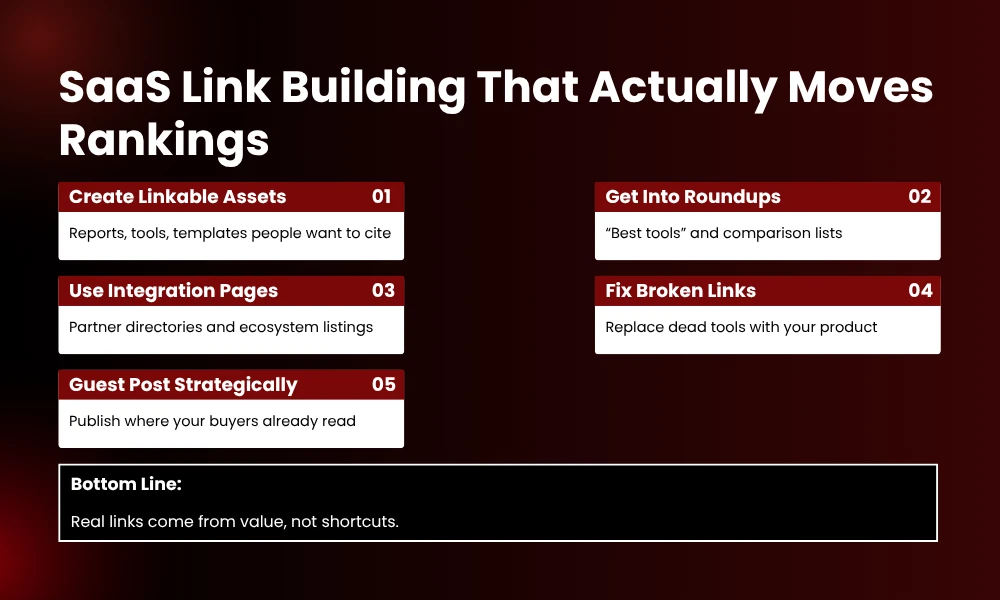
1. Make Something People Actually Want to Cite
This sounds obvious. It is not, because most SaaS link building companies do not actually do it.
The easiest link you can ever earn is one where a writer links to your site because it genuinely helps their article. Not because you emailed them. Not because you paid them. Because what you published answered something their readers needed.
That means building assets that exist independently of your product. Things like:
- A benchmark report based on your platform’s aggregated data
- A free calculator relevant to your category, something with real utility
- An honest comparison page, yes even one that shows where a competitor is better
- A template library that people download and use regardless of whether they ever buy
I have seen a single benchmark report earn a SaaS link building company over two hundred backlinks in a year with zero additional outreach after the initial promotion push. Not because it was marketing. Because journalists and bloggers kept citing it in their own articles.
The bar here is higher than most people think. A mediocre research report or a calculator that does not really do anything interesting will not get picked up. It has to be the best version of that resource in your niche, or close to it.
2. Get Into the Roundup Articles That Already Rank
Go to Google right now and type something like “best [your category] software” or “top tools for [use case].” You will find a bunch of listicle articles sitting on page one. Some are from high-authority SaaS link building blogs. Some are from general tech publications. All of them are getting traffic you want a piece of.
Being listed in those articles is worth real money in organic visibility. And it is achievable if you go about it the right way.
Here is roughly how to do it:
- Export a list of roundup URLs ranking for your target keywords
- Check their DA and traffic estimates in Ahrefs or Semrush, skip the low-traffic ones
- Find the author or editor contact, usually LinkedIn or a contact page
- Write a pitch that leads with what your tool does for their readers, not what you need
The pitch is where most people mess up. They send an email that is basically “please add my tool to your list.” That gets deleted. What works is something like: “I noticed your article covers X tools but does not mention [specific feature area] which a lot of your readers probably care about. Here is what our tool does there, and I am happy to set up a demo if it helps.”
Also worth doing in parallel: G2, Capterra, GetApp, Trustpilot if relevant. Not exciting. But those sites have massive domain authority and they push referral traffic that converts above average because the intent is already strong.
3. Integration Pages Are a Goldmine Nobody Is Using
Seriously. This is probably the most underused link building tactic in SaaS link building and it requires almost no creativity.
If your tool integrates with Slack, HubSpot, Zapier, Notion, Stripe, Salesforce, or any other well-known platform, those companies have partner directories, integration listings, and ecosystem pages. Most of them accept submissions. Many of them link directly to the relevant page on your site.
That is a link from a site with a domain authority of 80 or 90. For basically the effort of filling out a form.
But it goes further than just directory listings. Integration partners often write about their ecosystem. They publish blog posts about “best tools that connect with HubSpot” or update their documentation to mention new integrations. If you have an integration and a halfway decent relationship with the partner team, you can get referenced in that content.
- Map every integration your product currently supports
- Check each partner’s website for a directory or ecosystem page
- Submit or reach out with integration details and a link to your integration page
- Offer to write the technical documentation for them, it saves their team work
This is warm SaaS link building. You already share customers. The conversation starts from a place of mutual benefit rather than cold asking.
4. Find the Links That Are Broken and Replace Them
The SaaS link building graveyard is real. Tools that raised money in 2019 and shut down quietly in 2021. Products that got acquired and had their domains redirected or killed. Platforms that rebranded and left a trail of dead URLs behind them.
Every one of those dead URLs is currently sitting on someone else’s website as a broken link. The site owner has no idea. Their readers hit a 404. And if your product fills the same gap that the dead tool did, you have a legitimate reason to reach out.
The workflow is fairly straightforward:
- Use Ahrefs Site Explorer on competitor domains or niche resource pages
- Filter for broken outbound links pointing to dead SaaS link building tools
- Export the list and identify where your product is a relevant replacement
- Email the site owner with the specific broken link, be helpful about it, then mention your tool
The reply rate on this kind of outreach is much higher than cold link requests. You are opening the conversation by doing them a favor, not asking for one. That matters more than most people think when you are doing outreach at scale.
Focus on resource pages and comparison articles. Those pages are maintained long-term and the links on them carry real equity.
5. Guest Posts on the Publications Your Buyers Actually Read
Tech backlinks from guest posts still work. But only if you are writing for publications that have real editorial standards and real audiences. A guest post on a DA 30 blog that nobody reads does almost nothing for you.
The publications worth targeting are the ones your buyers reference in conversation. SaaStr if you are selling to SaaS link building founders. Product-led growth blogs if your ICP is product managers. Security-focused publications if you are selling something in that space. You know your buyer. Start there.
What most people get wrong about guest posting is the pitch. They lead with “I would love to contribute to your blog” which is a complete non-starter for any editor who gets more than five emails a week. What works:
- Come in with a specific angle, not a topic, an angle with a contrarian or data-backed take
- Show that you read the publication recently and reference a specific piece
How to Decide Where to Start
Running all five at once is not realistic for most teams. The way I would think about it:
Weeks one through four: hit integration directories first. It is the lowest effort and you can probably knock out ten to fifteen partner listings in a month. That alone can move your domain authority noticeably.
Month two: pick one linkable asset to build. Not five. One. Whatever is most needed in your niche right now. A benchmark, a calculator, an honest comparison page.
Month three onward: run broken link prospecting in parallel with roundup outreach. Both are systematic and can be delegated once you have a template.
What Separates a Valuable SaaS link building From a Waste of Time
Not all links are the same and spending time on the wrong ones is genuinely worse than doing nothing because it gives you false confidence.
Topical Match Matters More Than DA Alone
A DR 50 blog about marketing automation linking to your marketing SaaS is worth more than a DR 70 general tech blog linking to the same page. Google has gotten very good at understanding whether a link makes contextual sense. Relevance is a quality signal now, not just domain authority.
In-Body SaaS link building vs Everything Else
A link placed naturally inside a paragraph of relevant content passes more authority than a link in a sidebar, a footer, or an author byline. This is not a massive difference for a single link but across a hundred links it adds up. When you have any control over placement, push for in-body.
Anchor Text Needs Variety
If eighty percent of your backlinks use the exact same keyword phrase as anchor text, that pattern looks manipulative to Google. Healthy profiles mix branded anchors, generic phrases, partial match keywords, and a smaller share of exact match. When you are doing outreach or writing guest content, vary it intentionally.
Slow and Steady Actually Wins Here
A spike of fifty links in two weeks followed by nothing for three months is a red flag in link profile analysis. Google expects link acquisition to follow natural patterns. Ten solid links a month for a year is more durable than a hundred links crammed into a sprint. Build a calendar, not a campaign.
Product Page SEO and Link Building: Why They Have to Work Together
Product page SEO is the part most SaaS teams underinvest in because they think of their feature pages as conversion assets, not search assets. They are both.
A feature page that is technically optimized, clearly written, and structured around the way your buyers actually search is the kind of page that earns links organically. Bloggers writing about CRM integrations would rather link to a clear, useful integration page than a generic homepage. That specificity matters.
What a linkable product page actually needs:
- A headline that matches search intent, not a clever tagline
- Schema markup for software applications and reviews where applicable
- Internal links to related blog posts and comparison content
- Load speed that does not embarrass you, especially on mobile
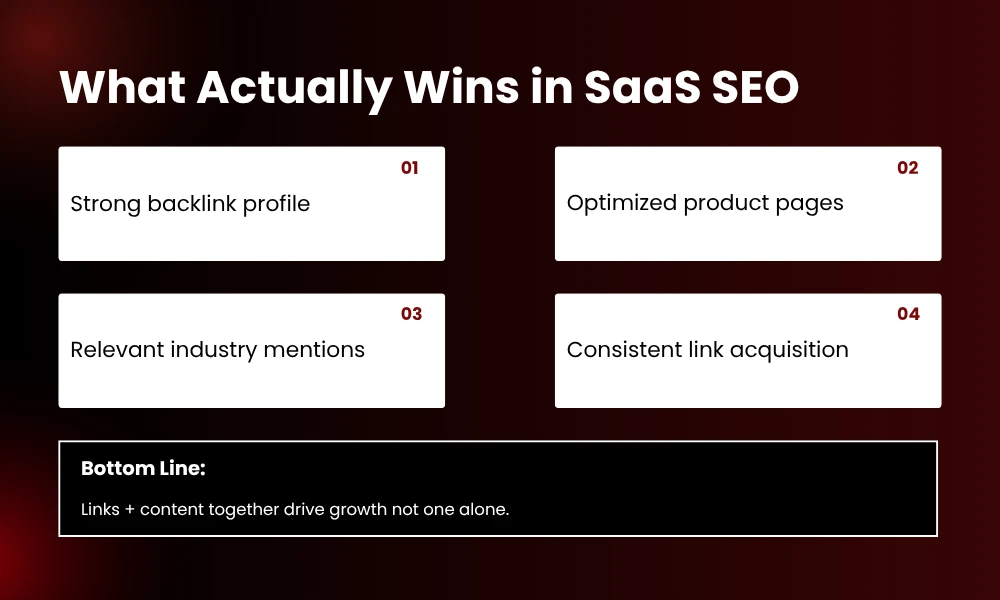
The combination of clean on-page optimization and consistent external link acquisition is what creates compounding organic growth. One without the other plateaus. Together they build something that is genuinely hard for competitors to knock off the first page. That is what makes investing in SaaS link building services worth it over time, not just as a short-term ranking play.
Putting It Together
Link building for SaaS is not some black box that only agencies with secret relationships can crack. It is a set of repeatable tactics aimed at earning links from the places your buyers and their trusted sources already hang out.
The companies on page one for your target keywords are not there by accident and they are not there because they had a better product. A lot of them have worse products. They just have more relevant, authoritative links pointing at the right pages. That is a gap you can close.
Start small. Pick one tactic, run it for ninety days, measure what moves. Add the next one. That is how this compounds.
And if you want a team that has already built out the systems, the outreach infrastructure, and the editorial relationships to move faster, our SaaS link building services are built exactly for this. Take a look and see if it fits where you are right now.
Frequently Asked Questions
How long before SaaS link building shows up in rankings?
Realistically, three to six months before you see meaningful ranking shifts. The first month is mostly setup and outreach. Links that get placed in month two start getting indexed and crawled. By month four you can usually see movement in Google Search Console on the specific pages you targeted. Some competitive keywords take longer. That is not a sign the strategy is not working, it is just the reality of how Google processes authority signals.
How many backlinks does a SaaS site actually need?
Depends entirely on the competition. Pull up the top three ranking pages for your target keyword in Ahrefs and look at their referring domain counts. That is your benchmark, not some abstract number. A niche keyword in a less saturated vertical might only need forty strong referring domains. A keyword like “best email marketing software” could require several hundred. Start with a gap analysis, not a target number.
Is SaaS link building still relevant with Google’s AI Overviews?
More than ever, actually. The pages that show up in AI Overviews are not random. They tend to be pages with strong topical authority signals, which link profiles contribute to heavily. SaaS companies with credible backlink profiles from relevant publications show up in AI-generated answers, comparison features, and organic results at the same time. The visibility surface has gotten bigger. The underlying ranking factors are still the same.
What should an early-stage SaaS prioritize for link building?
Integration partner pages first. They are warm, relatively frictionless, and can be done in parallel with product development. After that, build one linkable asset, something genuinely useful to your niche audience that exists independently of your sales funnel. Those two things together can give a new SaaS site a meaningful authority base within the first six months without requiring a large outreach budget.
Are paid backlinks worth the risk for SaaS companies?
No. The short version is that Google’s spam detection has gotten significantly better and the penalty when you get caught, either algorithmically or via manual review, is severe and slow to recover from. Some paid link schemes go undetected for a while. Most do not, and the ones that do tend to lose their effect when algorithm updates roll out. The SaaS companies that hold their rankings through multiple algorithm cycles are the ones that built their profiles through earned links. It takes longer. It also lasts longer.