Are you ready to explore the boldest, most Innovative Marketing Campaigns reshaping how brands connect with audiences in 2026. These aren’t your average ads. These are strategies that broke molds, sparked conversations, and turned fleeting attention into lasting engagement.
In this blog, we are going to talk deep about the latest marketing genius,spanning disruptive digital trends, experiential activations, AI-powered creativity, and community-first movements. We’ll break down what made these standout efforts succeed, highlight learnings you can apply, and reveal how top brands are setting new benchmarks for innovation in 2026.
What Makes a Marketing Campaign Truly Innovative in 2026?
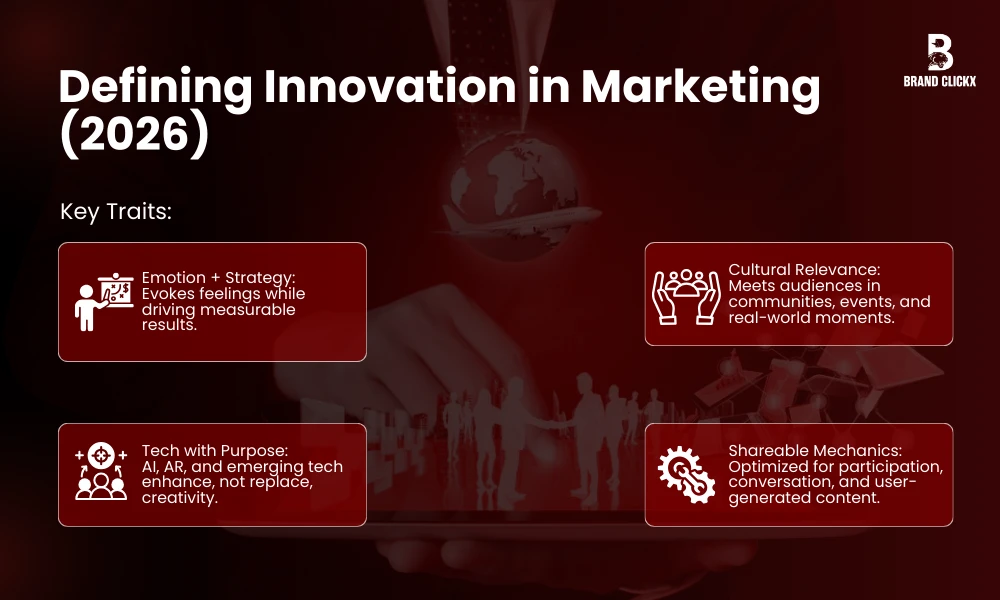
Before we jump into specific examples, let’s define innovation in today’s marketing landscape. In 2026, a campaign isn’t innovative just because it uses cool tech or eyeball-grabbing visuals. The most impactful campaigns have these qualities:
- Emotion meets strategy: They make people feel something while driving measurable results.
- Cultural relevance: They meet audiences where they already are, online communities, events, and real-world moments.
- Tech with purpose: Emerging technologies like AI and AR are used to enhance experience, not replace human creativity.
- Shareable mechanics: They’re optimized for community participation, conversation, and user-generated content.
With that foundation, let’s explore the most buzzworthy marketing campaigns defining 2026.
1. Unilever’s Vaseline Social Listening Campaign
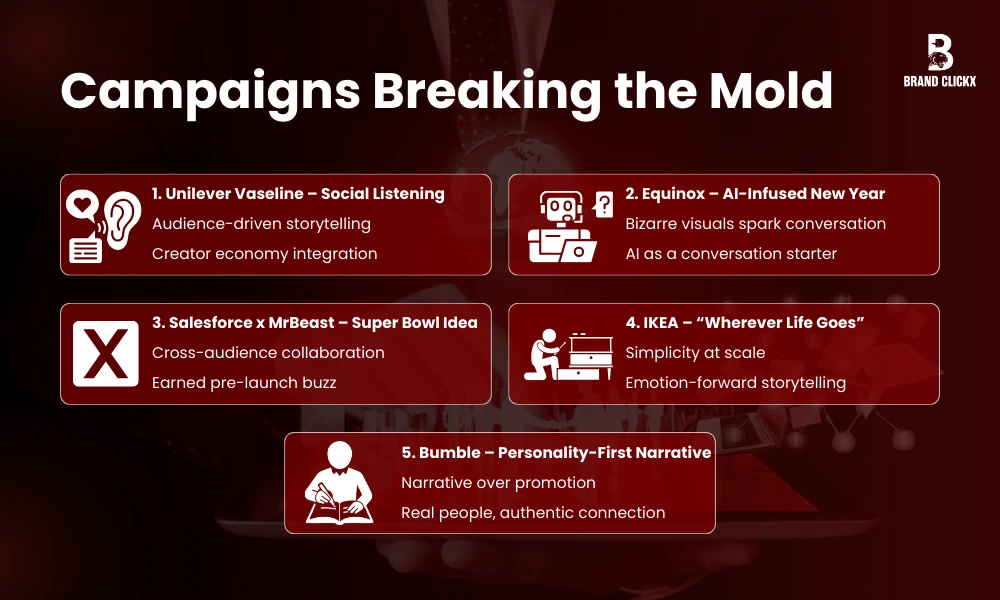
Unilever shifted its Vaseline brand away from traditional ads and fully leaned into social listening, monitoring TikTok trends and community conversations to shape its content strategy. This move allowed the company to respond with real-world validation of user-generated hacks and creative usage, rather than generic influencer collaborations.
Audience-driven storytelling: Feedback from social communities became the creative brief. Brands can leverage social media listening tools to track trends and validate content ideas.
Why It’s Innovative
- Audience-driven storytelling: Feedback from social communities became the creative brief.
- Human-centric trust: Instead of top-down ads, the brand validated user curiosity with expert insights.
- Creator economy integration: By working with creators already passionate about the product, Unilever built authentic affinity, not forced messaging.
Takeaway: Listening beats broadcasting. When brands embrace real conversations, their messaging becomes not only relevant but desired.
2. Equinox’s Provocative AI-Infused New Year Campaign
Fitness brand Equinox did something audacious: it leaned into bizarre, AI-generated visuals, like steak-made-of-cake and unexpected celebrity interpretations, to cut through the noise. The purpose wasn’t just to entertain; it was to reframe authenticity as the ultimate personal value.
Why It Stands Out
- AI as a conversation starter: Instead of hiding algorithmic production, Equinox amplified it to spotlight its real human value.
- Bold creative risk: The polarizing imagery sparked debate, precisely what virality looks like in 2026.
AI as a conversation starter: Instead of hiding algorithmic production, Equinox amplified it to spotlight its real human value, showing how AI in marketing can redefine brand storytelling. This shift reflects a broader industry movement explored in depth in this blog on how AI is changing social media marketing, where brands are learning to balance automation with authenticity.
3. Salesforce X MrBeast Super Bowl Idea
While not fully confirmed yet, Salesforce CEO Marc Benioff publicly invited YouTube megastar MrBeast to direct the company’s 2026 Super Bowl ad.
A Tech Giant Meets YouTube Stardom
This fusion of enterprise branding with YouTube virality is highly unusual, and emblematic of 2026 strategy trends.
Why It Matters
- Bridging audiences: Enterprise brands traditionally speak to niche professional audiences. MrBeast’s channel flips that script.
- Earned buzz before launch: Even the idea of this collaboration generated massive industry conversation.
Key takeaway: Don’t just chase formats, blend audiences. Cross-channel partnerships can unlock entirely new attention vectors.
- IKEA’s “Wherever Life Goes” Series
While technically launched in late 2025, IKEA’s brand platform has carried significant cultural momentum into 2026. The campaign focused on everyday life moments using receipts and ordinary objects to frame life narratives instead of lofty mission statements.
Cross-channel partnerships can unlock entirely new attention vectors, a key lesson in modern cross-channel partnerships and one that is central to effective social media marketing strategies in today’s multi-platform digital ecosystem.
What Makes It Innovative
- Simplicity at scale: Universal experiences built brand love without overcomplication.
- Consistency: From film to social to out-of-home, the single creative device carried everywhere.
- Emotion-forward messaging: Rather than hard selling, IKEA connects with lived experience.
5. Bumble’s Personality-First Narrative
Love Stories Over Swipe Metrics
Bumble flipped the dating app playbook by centering real narratives, featuring Pete Davidson and Elsie Hewitt in a social-first storytelling series about genuine connection.
Why It Worked
- Narrative over promotion: This wasn’t a product push. It was an identity play.
- Authenticity sells: By spotlighting real people and real talk, Bumble reset expectations around dating app marketing.
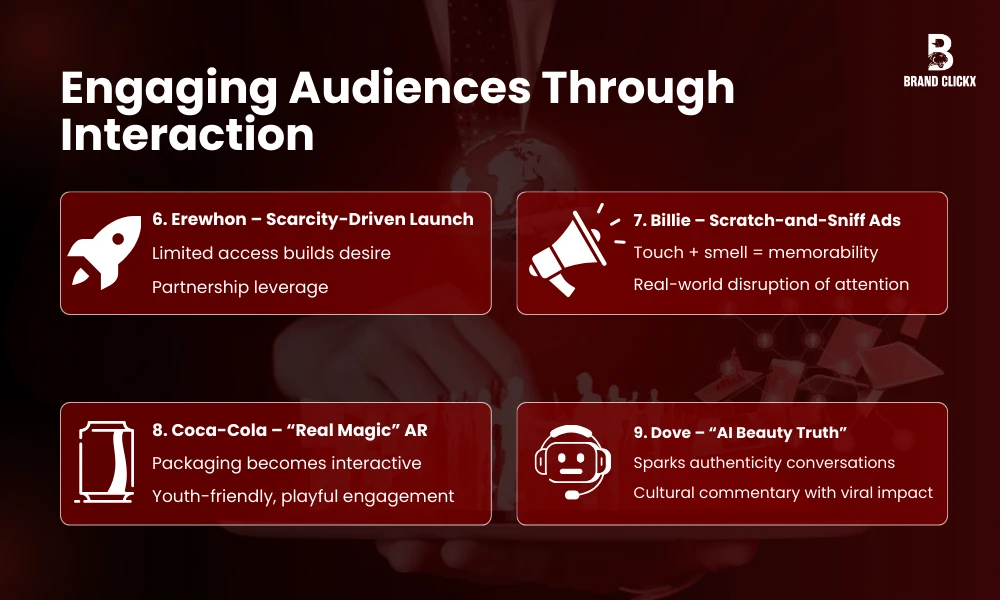
6. Erewhon’s Scarcity-Driven Delivery Launch
When Erewhon entered NYC via delivery-only smoothies from a hidden West Village location, it created an exclusive buzz without a flagship.
Strategic Insights
- Scarcity equals desire: By limiting access, Erewhon became an instant status symbol.
- Partnership leverage: Using Uber Eats as a distribution vehicle turned platform audience into brand audience.
7. Billie’s Interactive “Scratch-and-Sniff” Ads
Billie placed giant deodorant posters in NYC and invited people to literally scratch and smell, turning a static ad into a sensory experience.
Interactivity drives memorability: Touch + smell + shareable moments = organic virality, a principle also applied in interactive websites for better user engagement, where user participation becomes the core driver of attention and recall.
Why It Stood Out
- Interactivity drives memorability: Touch + smell + shareable moments = organic virality.
- Unexpected formats win: In an age of screens, real life interrupts attention in powerful ways.
8. Coca-Cola’s “Real Magic Immersive” AR Experience
Coca-Cola transformed limited-edition bottles into interactive AR experiences tied to music and gaming, effectively turning packaging into engagement.
AR wasn’t tacked on; it enhanced the product moment, similar to other innovative AR marketing campaigns that integrate technology meaningfully, an approach increasingly supported by advances in AI in app development.
Innovation Highlights
- Utility with delight: AR wasn’t tacked on, it enhanced the product moment.
- Younger audience appeal: Interactive tech gives youth a reason to play with the brand.
9. Dove’s “AI Beauty Truth” Movement
Dove’s campaign contrasted real women with AI-generated beauty standards to spark authenticity conversations.
Why It Resonated
- Cultural commentary: It wasn’t just an ad, it made people think.
- Viral discourse: Conversations around AI ethics now lead to deeper brand loyalty.
Innovation Patterns Emerging in 2026
Here are the recurring themes shaping the most successful campaigns this year:
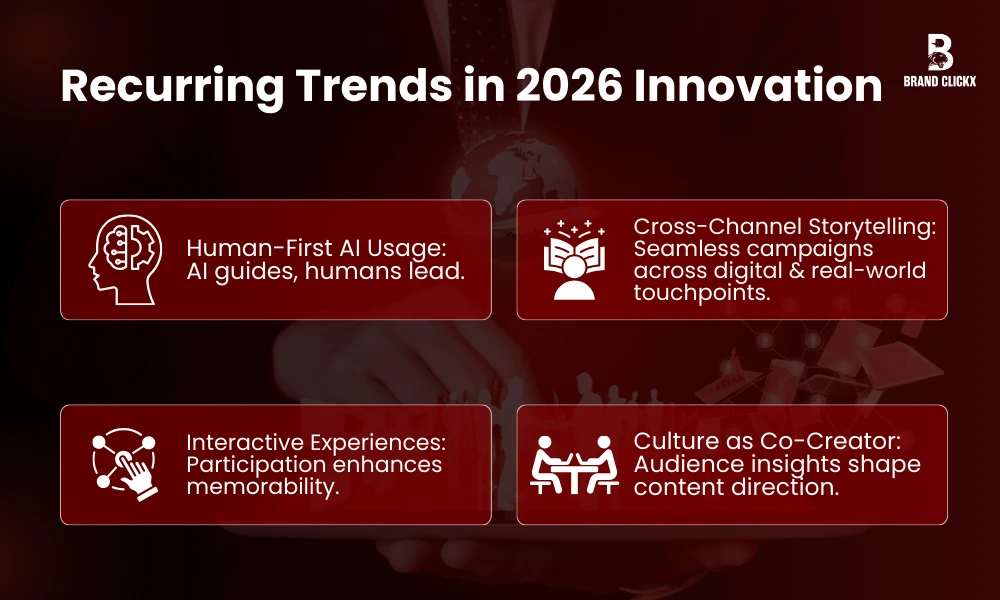
1. Human-First AI Usage
Artificial intelligence isn’t the star, humans still are. AI guides personalization and creative exploration, but it never replaces narrative.
2. Cross-Channel Storytelling
Campaigns now operate seamlessly across screens, real-world touchpoints, and physical formats, not just social ads.
3. Interactive Experiences
Whether tactile posters or AR activations, participation is key to memorability.
4. Culture as Co-Creator
Audience insights shape storytelling direction, rather than top-down executive decisions.
Final Thoughts
2026’s most innovative marketing campaigns share a common thread: they connect with humans first and technology second. Whether through playful interaction, cultural resonance, or transcendent storytelling, brands that put people at the center are winning hearts, and market share.
These case studies aren’t just inspiring, they reveal the future of marketing where strategy, authenticity, and creativity converge. You don’t need a megabudget to compete. You need relevance, insight, and the courage to do something different.
FAQs
What are innovative marketing campaigns?
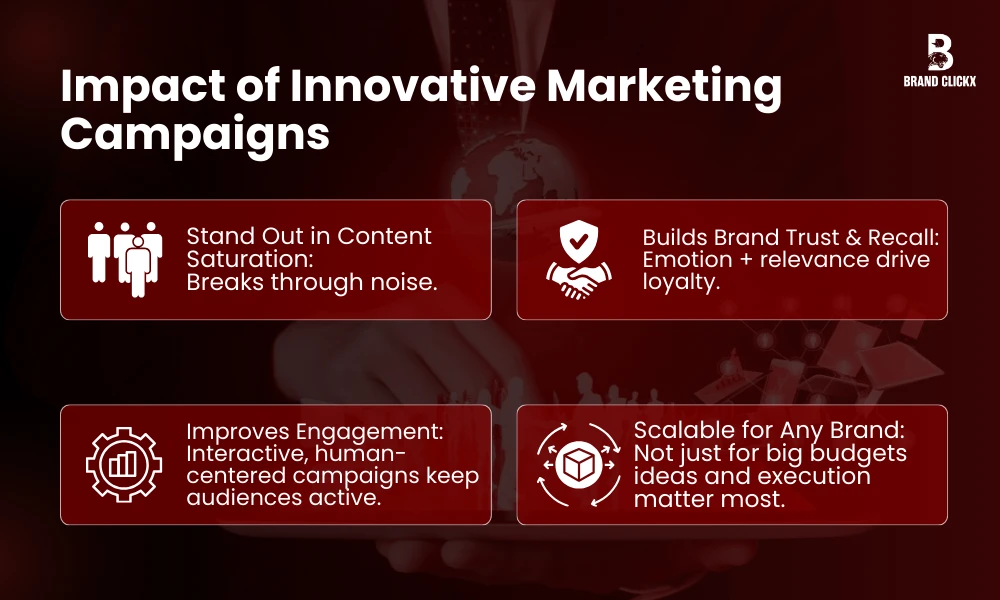
Innovative marketing campaigns are strategic brand initiatives that use creative ideas, emerging technologies, or unconventional formats to capture attention and drive engagement. In 2026, innovative marketing campaigns focus more on human emotion, cultural relevance, and interactive experiences rather than just flashy visuals or aggressive promotion.
Why are innovative marketing campaigns important in 2026?
Innovative marketing campaigns are important in 2026 because audiences are overwhelmed with content across platforms. Brands that innovate stand out by offering meaningful experiences, personalized messaging, and authentic storytelling. These campaigns help improve brand recall, trust, and long-term customer loyalty.
What makes innovative marketing campaigns successful?
Successful innovative marketing campaigns combine creativity with clear strategy. They usually involve human-first AI usage, cross-channel storytelling, interactive elements, and strong cultural alignment. Most importantly, they focus on solving audience problems or reflecting real-life experiences instead of purely promoting products.
How do innovative marketing campaigns use AI effectively?
Innovative marketing campaigns use AI to enhance personalization, analyze audience behavior, and optimize creative performance. However, AI is not used to replace human storytelling. Instead, it supports marketers by improving relevance, speed, and decision-making while keeping emotional connection intact.
Are innovative marketing campaigns only for big brands?
No, innovative marketing campaigns are not limited to large brands. Small and mid-sized businesses can also create impactful campaigns by leveraging creativity, social platforms, community engagement, and data insights. Innovation often comes from ideas and execution, not budget size.
What channels work best for innovative marketing campaigns?
Innovative marketing campaigns perform best when spread across multiple channels, including social media, video platforms, email, websites, outdoor advertising, and experiential events. A unified story across channels ensures consistent messaging while reaching audiences at different touchpoints.
How can businesses measure the success of innovative marketing campaigns?
The success of innovative marketing campaigns is measured beyond impressions or clicks. Key metrics include engagement quality, participation rates, social sharing, brand sentiment, conversions, and long-term customer retention. These metrics reflect deeper audience connection.