

Fourteen tracking tools spiked into 5 and 6 August. Google has confirmed nothing. And the community reports contradict each other badly enough that “August update” may be the wrong frame entirely.
Summary
Google search ranking volatility spiked on 5 and 6 August 2026, with roughly fourteen third-party tracking tools registering elevated movement and heavy discussion on WebmasterWorld and Black Hat World. Google has not confirmed an update. The last confirmed change was the June 2026 spam update, which completed on 26 June. Community reports are inconsistent, and at least one severe traffic drop reversed within hours.
Key Takeaways
- Volatility spiked on 5 and 6 August 2026 across roughly fourteen tracking tools
- Google has confirmed no update
- The last confirmed change was the June 2026 spam update, completed 26 June
- This is the fourth unconfirmed spike since 18 July
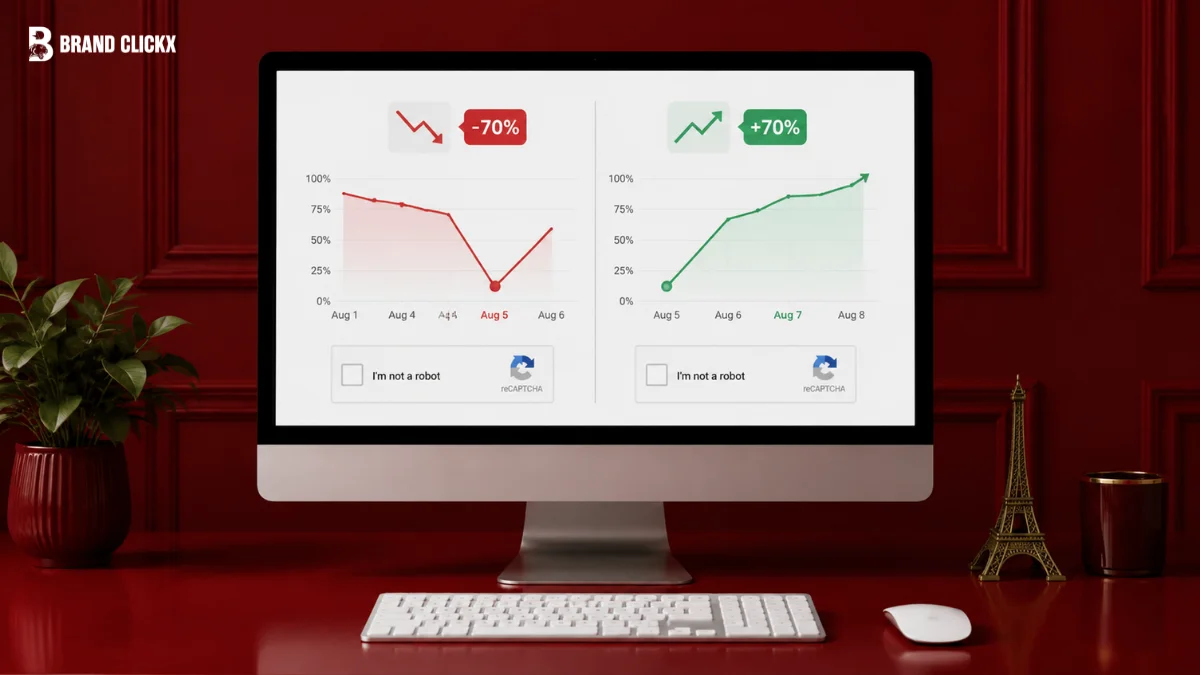
- One publisher reported a 70% traffic drop on 5 August that reversed within hours
- Community reports describe timelines ranging from mid-July to 6 August
- At least one report described conditions improving rather than worsening
- YouTube visibility and authority weighting are the two recurring observations
What the Tools Show
Spikes registered across effectively the entire tracking ecosystem.
AccuRanker, Algoroo, AWR, CognitiveSEO, DataForSEO, Mangools, Mozcast, SEMRush, Serpstat, SimilarWeb, Sistrix, Wincher, Wireboard and Zutrix all recorded elevated volatility.
Wireboard aggregates the others onto a single chart, which is the fastest way to see whether a spike is broad or confined to one tool’s keyword basket.
A methodological note worth understanding. Most of these tools re-scrape a fixed set of keywords daily and measure how results differ. At least one index instead computes movement from real Search Console position data across live sites. Those two approaches can disagree, and knowing which you are looking at matters when interpreting a spike.
This Is the Fourth Spike in Three Weeks
| Period | Status |
| 18–19 July | Unconfirmed, lasted through the week |
| 24 July | Unconfirmed |
| 1–3 August | Unconfirmed |
| 5–6 August | Unconfirmed |
The last confirmed update was the June 2026 spam update, which ran from 14 to 26 June. Before that, the May 2026 core update ran from 21 May to 2 June.
So Google has confirmed nothing for six weeks while the trackers have lit up four times.
The Detail That Should Stop Anyone Panicking
A publisher on WebmasterWorld reported Google traffic across several sites dropping by at least 70% on 5 August a shop, advertising campaigns and a news site all affected.
Hours later, the same person reported traffic had surged back, sales had jumped, and fresh news articles were appearing again by the following morning.
That is the single most useful data point in this episode. A catastrophic-looking drop that fully reversed inside a day.
Anyone who had spent 5 August rewriting titles, cutting content or making structural changes would now be attributing a natural recovery to their own intervention — and would carry those changes forward on false evidence.
The Reports Do Not Line Up
If this were a discrete August update, the timing evidence would be more consistent than it is.
- A Reddit account showed organic traffic declining from around 22–24 July over a week before the supposed August event
- A Brazilian publisher said Discover traffic had been falling since mid-July
- An Indonesian publisher reported slower indexing on 5 August
- A UK operator said results on 6 August appeared to be returning to their pre-July state an improvement, not a decline
Those four accounts describe four different timelines, and one of them is positive.
What that suggests is either several overlapping changes rather than one, continued settling from the June spam update, or ordinary variance being read as signal because everyone is looking for one.
Two Patterns Worth Watching
YouTube visibility appears to be gaining. Multiple site owners observed YouTube results occupying more space while their own rankings fluctuated. That is consistent with algorithmic reshuffling rather than a penalty, but it is a pattern worth checking in your own SERPs.
High-authority pages appear to be favoured. There is concern in the community that Google is weighting authority more heavily, pushing smaller sites further down. This is a recurring perception during volatility and is difficult to verify from outside but it is worth measuring against your own data rather than accepting or dismissing.
What to Actually Do
- Do not make changes during a spike. The 70% reversal is the reason
- Segment Search Console by query, page, device and country. This is the fastest way to tell whether a drop is sitewide or confined to one pocket
- Compare SERPs directly for affected keywords before assuming a penalty
- Check what you changed recently. Volatility is a convenient explanation for a self-inflicted problem
- Wait for a meaningful date range before drawing conclusions. Several days minimum
- Check whether your vertical was among the most affected volatility is rarely uniform across industries
If your traffic moved on a spike day, the cause is more likely algorithmic than something you did. That cuts both ways: it also means your recent optimisation probably did not cause the recovery.
The Larger Point
Barry Schwartz made an observation in his report that deserves more attention than the volatility itself.
These ranking movements matter less and less to publishers, because Google is sending less and less traffic regardless of where you rank.
Which is why, as he notes, many large publishers are now considering blocking Google Search from their sites entirely. The exchange Google crawls your content, Google sends you visitors has been inverted.
That reframes the whole exercise. Chasing position through an unconfirmed August update is a smaller prize than it was two years ago, and the sites tracking their rankings most obsessively may be optimising for a channel that is shrinking underneath them.
Frequently Asked Questions
Did Google release an algorithm update in August 2026?
Google has not confirmed one. Third-party tools registered volatility on 1–3 August and again on 5–6 August, but the last confirmed update was the June 2026 spam update, which completed on 26 June.
Which tools are showing volatility?
AccuRanker, Algoroo, AWR, CognitiveSEO, DataForSEO, Mangools, Mozcast, SEMRush, Serpstat, SimilarWeb, Sistrix, Wincher, Wireboard and Zutrix. Wireboard aggregates the others onto a single chart.
My traffic dropped should I change my site?
Not immediately. One publisher reported a 70% drop on 5 August that fully reversed within hours. Making changes during a spike risks attributing a natural recovery to your own intervention.
How do I tell if a drop is an update or something I did?
Segment Search Console data by query, page, device and country to see whether the decline is sitewide or narrow, compare SERPs directly for affected terms, and check what you changed in the preceding weeks.
Why are the community reports so inconsistent?
Because the timelines do not match. Reports place declines anywhere from mid-July to 5 August, and at least one operator reported conditions improving on 6 August. That points to several overlapping factors rather than one discrete update.
Is YouTube taking more search visibility?
Multiple site owners have observed YouTube results appearing more prominently while their own rankings fluctuated. It is consistent with algorithmic reshuffling but has not been confirmed by Google.
How long does volatility usually last?
It varies. Movement continued for weeks after both the May 2026 core update and earlier core updates were officially marked complete. Several days to several weeks is a reasonable expectation.
Does ranking volatility still matter as much?
Less than it did. Google is sending progressively less traffic to publishers regardless of ranking, which is why some large publishers are considering blocking Google Search entirely.
Conclusion
Fourteen tools spiked, the forums lit up, and Google has said nothing which is now the normal shape of a week in search.
The detail worth carrying away is not the spike. It is the publisher who lost 70% of their traffic on 5 August and had it back before the next morning, having done nothing.
Whatever moved on 5 and 6 August, the correct response to it on the day was to wait. It usually is.