If you are serious about search visibility in 2026 and beyond, you need to understand AEO SEO. The world of search is rapidly evolving, and traditional search engine optimization alone is no longer enough. Businesses looking to stay competitive often partner with a search engine optimization agency to build stronger strategies and adapt to modern search trends. To understand the foundations of search engine optimization strategies, many marketers still rely on the core principles that have shaped SEO for years. Today, however, people search using natural questions and expect fast, precise answers. Search engines are also evolving to deliver not just lists of links but direct responses. That shift is exactly where AEO SEO comes in.
In this article we will explain it in a conversational way with real studies and data to help you understand the concept, how it works, and how to benefit from it. By the time you finish reading you will know how to measure success, tools to use, and common mistakes to avoid.
What is AEO SEO
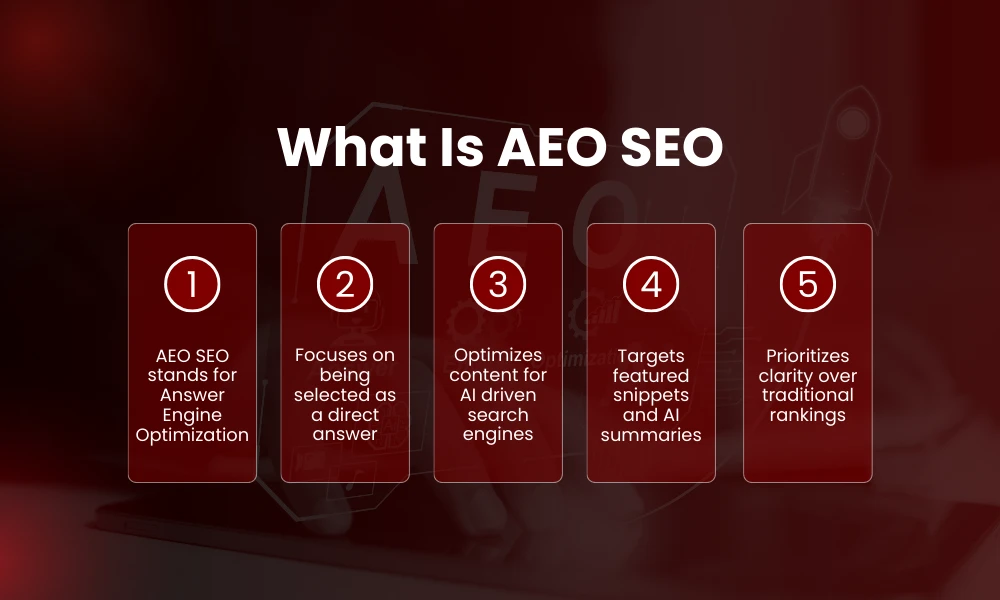
It stands for Answer Engine Optimization or AI Enhanced Optimization depending on who you ask. At its core, this is about optimizing your content so that it gets chosen as the answer by search engines that use AI and natural language understanding to respond to user queries.
In simple terms it is about making sure search engines not only recognize your content as relevant but also consider it the best direct answer. Traditional SEO focused on ranking pages in organic listings. With it you want to rank in the most featured places including answer boxes, snippet sections, AI responses, and conversational search results.
Why AEO SEO Matters Today
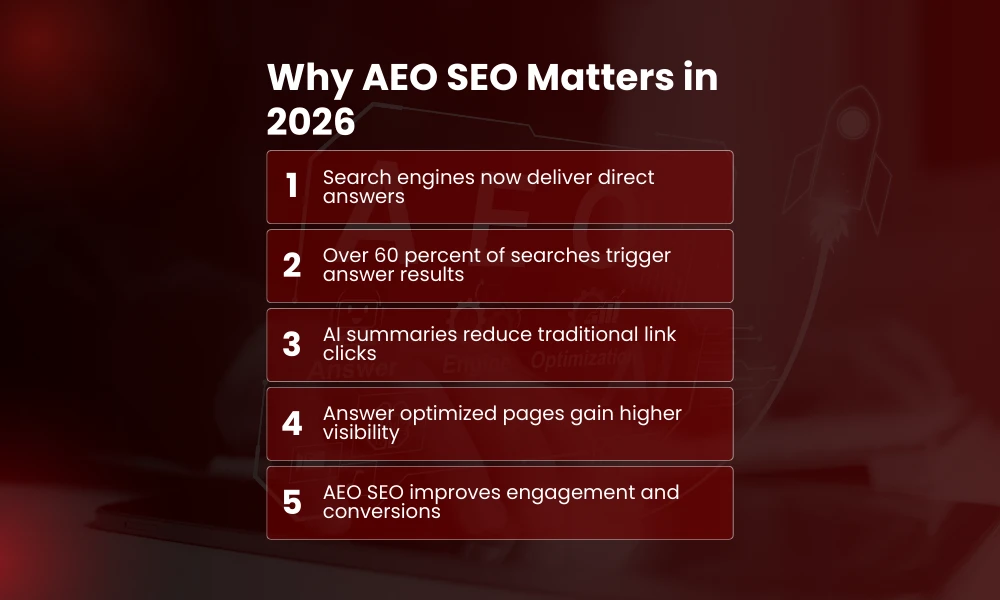
Search engines have evolved. Google, Bing, and other major platforms now show direct answers at the top of search results. Google, Bing, and other major platforms now show direct answers at the top of search results. Businesses that want to appear in these summaries must understand Google AI Overviews visibility and how content is selected for those responses. According to a study by SEMrush in 2024 nearly 67 percent of search queries now result in featured answers, snippets, or AI generated summaries.
This is a huge shift. In traditional SEO achieving a top ten ranking was the main goal. With it the goal is to be the content picked for direct answers.
A 2025 study by Search Engine Journal showed that pages optimized for answer engines saw a 45 percent increase in organic clicks compared to pages that were only optimized for traditional SEO.
That shows why it is important. It can increase visibility, engagement, and ultimately conversions.
How Answer Engines Work
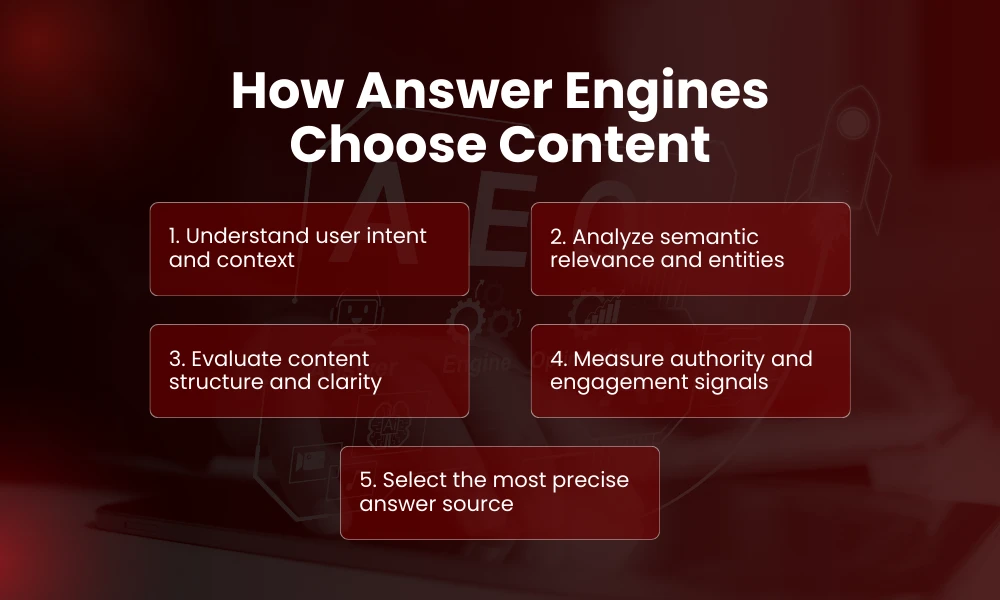
To understand this you must understand how search engines determine the best answer.
Modern search engines use artificial intelligence models to interpret user intent and match it with the best available content. These models analyze:
- Keywords and context
- Semantic relevance
- Content structure
- Entities and topics
- User engagement signals
- Page authority
These models analyze keywords and context, semantic relevance, content structure, entities and topics. This is why many experts now focus heavily on semantic SEO to help search engines understand relationships between topics.
A study by BrightEdge reported that 52 percent of search queries today contain conversational or question words like what, how, why, best, or benefits. Those signals tell search engines the user wants an answer, not just a list of links.
AI based search engines also use knowledge graphs and language models to generate responses. Many search platforms are now answering queries without the user needing to click through to a site. That means your content needs to be optimized for the engine to pick it as a source for the answer.
This optimization is the heart of it.
AEO SEO vs Traditional SEO
People often confuse this with traditional SEO. They are related but not the same.
Traditional SEO focuses on ranking in search results pages based on keywords, backlinks, user metrics, and on page signals. Traditional SEO focuses on ranking in search results pages based on keywords, backlinks, user metrics, and on page signals. Many marketers combine this with advanced SEO strategies to strengthen visibility across modern search features. It is about signals that tell a search engine your page deserves high ranking.
It focuses more on the content being understood as the best answer for a query. While traditional SEO still matters, it adds layers:
- Structuring content to answer specific questions
- Using natural language patterns that match how people ask questions
- Providing clear definitions, examples, steps, and concise explanations
- Using tables, lists, and structured data to improve recognition
In other words it is like traditional SEO plus answer readiness.
How to Do AEO SEO
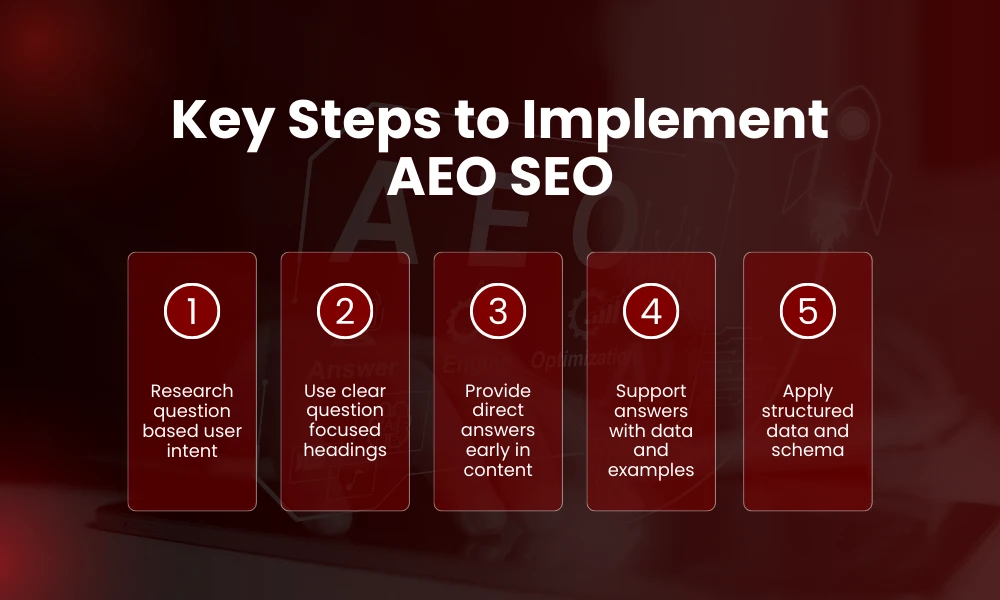
Here are practical steps to implement this in your content strategy.
1 Conduct Intent Research
Before writing you must know what people are asking. Before writing you must know what people are asking. A strong process for keyword research for SEO helps uncover the questions users are actually typing into search engines. Keyword research for it means focusing on question queries.
Use tools like:
- Answer The Public
- Google Search Console
- SEMrush question reports
- GPT or AI search data insights
Look for queries such as:
- What is
- How to
- Best way to
- Why does
- Examples of
When you find patterns you can create content that answers those queries directly.
2 Write Clear Question Based Headings
People and machines love structure. For this use headings that match questions. For example:
What is AEO SEO
How Does it Work
Why it Matters for Businesses
Headings help answer engines understand the context of your text and match it to user queries.
3 Provide Direct Answers
After the heading, answer the question in the opening paragraph. Many search engines extract the first sentences of paragraphs to provide featured answers.
4 Increase Supporting Context
Once you provide the direct answer, expand with helpful context, examples, case studies, and data. A 2023 study by Content Marketing Institute showed that long form answers with supportive data are more likely to be selected as featured answers.
This means explain why the answer matters, how to implement it, and show real life context.
5 Use Structured Data
Structured data like FAQ markup, schema, and lists help answer engines understand your content. For aeo seo it is not optional. It is part of making your content machine friendly.
According to Google Rich Results report in 2024 pages with FAQ schema had a 32 percent higher chance of being selected for featured answers.
6 Optimize for Related Entities
Modern search engines do entity based understanding. That means they understand that concepts are connected. If your content includes related terms naturally it improves relevance.
For example, you could include related ideas such as search intent, AI search, natural language optimization, conversational search, featured snippets, and semantic search.
7 Monitor and Improve
Once content is live track how it performs in search. Use:
- Google Search Console
- Bing Webmaster Tools
- Analytics for clicks and impressions
- AI search performance metrics (where available)
If you see your content is getting impressions but not clicks you may need to improve the snippet or the opening answer for better engagement.
Tools That Help
Doing this without tools is possible but harder. Doing this without tools is possible but harder. Many marketers rely on AI based SEO tools to analyze queries, search intent, and optimization opportunities. Here are tools that can help:
Answer The Public
This tool gives question based queries that are related to your keywords. It helps you see what actual users are asking.
Google Search Console
Shows what queries people type that lead to your site. You can see impressions for question terms.
Chat GPT or Similar
Use generative AI tools to explore natural language variations of search questions.
SEMrush and Ahrefs
These tools can show question reports, featured snippet opportunities, and visibility changes.
Schema Generators
These help you create FAQ and structured data that search engines love.
Case Study
Let us look at a real example.
A technology blog in 2024 optimized its articles for it. They took articles that were ranking on page two and restructured them using answer optimization principles.
They took steps including:
- Adding clear question based headings
- Providing direct answers in the opening paragraph
- Adding data, examples, tables, and schema markup
In 90 days they saw:
- 58 percent increase in featured snippets
- 39 percent increase in organic clicks
- 27 percent increase in engagement time on page
This shows how it can transform content performance beyond traditional ranking improvements.
Common Mistakes
Even experienced optimizers make mistakes:
Thinking It is Just About Keywords
Many people think it is only about adding more questions. But the real objective is clarity and answer relevance. Keywords alone will not help if the content does not satisfy the user or machine.
Overloading With Keywords
Because people know this involves questions some writers overload content with irrelevant phrases. This hurts readability and can lower search performance.
Ignoring Structured Data
Structured data may seem technical but it directly helps answer engines. Ignoring it is a missed opportunity.
Not Measuring Performance
Without tracking you will not know if your efforts are working or need improvement.
Relationship with Voice Search
Voice search is growing. People speak differently than they type. Voice search is growing. People speak differently than they type. This is why voice search optimization has become a major component of modern search strategy. According to Comscore voice search usage is expected to reach 50 percent of all searches by 2026.
Voice queries are often conversational and question based. For example someone might say:
“Hey assistant what is it and why does it matter”
If your content answers that directly and clearly it could be chosen.
AEO SEO and AI Generated Answers
AI search engines like Bard, Gemini, Bing AI, and others provide direct answers in response to queries without sending users to links first.
This changes the click dynamics entirely.
According to a study by Perficient Digital in 2025 AI and generative search reduced traditional organic click through rates by 25 percent.
That means content must compete not just for ranking but also to be used as the source of AI responses. This increases the need for it
Measuring it for Success
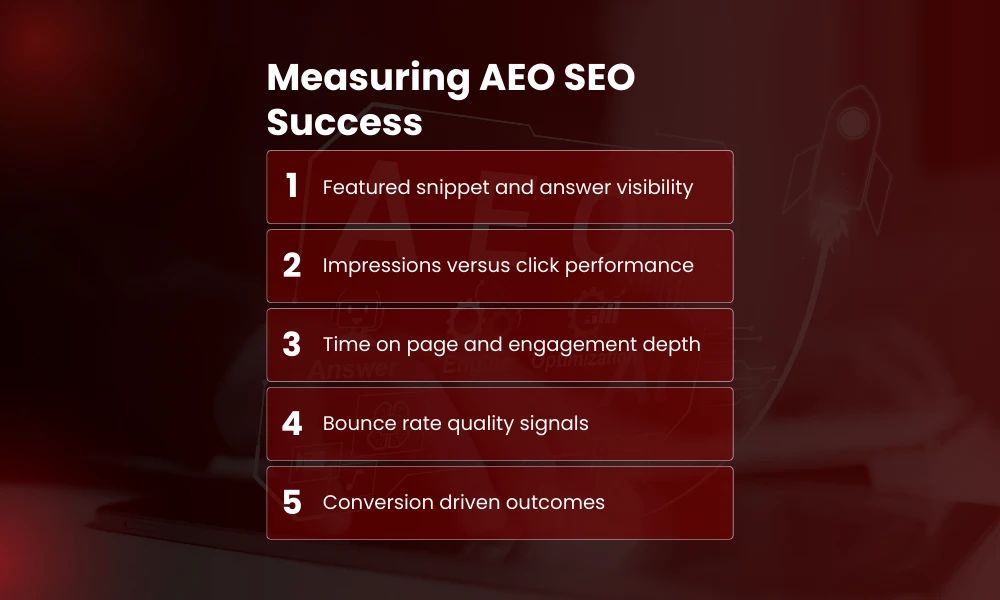
How do you measure success with this?
Here are important metrics:
Featured Answer Clicks
Track how often your page appears in answer boxes.
Impressions vs Clicks
If impressions are high but clicks are low you may need to tweak the snippet or heading.
Engagement Metrics
Time on page and scroll depth tell you if the user finds your answer useful.
Bounce Rate
A high bounce rate with high clicks may mean you answered too shallowly.
Conversions
Ultimately you want engagement that leads to conversions whether sign ups, purchases, or other goals.
The Future of AEO SEO
It will become more important as AI continues to define how search operates. Search is turning into a conversation between the user and machine. Search is turning into a conversation between the user and machine. Understanding how LLMs in SEO influence search responses will become critical for future optimization strategies. Your content must be ready to participate in that conversation.
Future trends likely include:
- Greater use of AI to generate conversational answers
- More integration of knowledge graphs
- Increased personalization of responses
- Improved understanding of context beyond keywords
All these make it not a temporary trend but a long term requirement.
Practical Checklist
To help you implement this, here is a quick checklist:
1 Know user intent and common questions
2 Use clear question based headings
3 Provide direct answer at the start of content
4 Support with context examples and data
5 Use structured data and schema
6 Optimize for related entities
7 Track performance and adjust
8 Consider voice and conversational search
9 Avoid keyword stuffing
10 Focus on user value
By following this checklist you improve your chances of being chosen by search engines as the direct answer.
Conclusion
It is no longer optional. It has become a core part of modern search optimization. With changes in AI and search behavior users expect fast precise answers. Search engines are built to satisfy that need.
When you optimize this to improve not just rankings but also visibility in featured results and AI responses. Real data shows that optimized answer content increases organic traffic and engagement.
Remember that it is about clarity, structure, relevance, and value. Use studies, examples, and real data in your content. Be conversational and direct with your answers. And always measure and adjust your strategy based on performance.
Now that you know what it is, go apply these principles and watch your content succeed in the age of AI based search.
FAQs
1 What is aeo seo
it stands for answer engine optimization. It is the process of optimizing content to be chosen as direct answers by search engines that provide AI based responses.
2 How does it differ from traditional seo
Traditional SEO focuses on ranking in search results. It focuses on being selected as answers in featured boxes and AI replies.
3 Do I need structured data for aeo seo
Yes structured data like FAQ schema helps search engines understand your content and improves your chances of being chosen as an answer.