Security is no longer just about locking doors. In 2026, it’s about controlling who enters, when they enter, and what happens when something goes wrong.
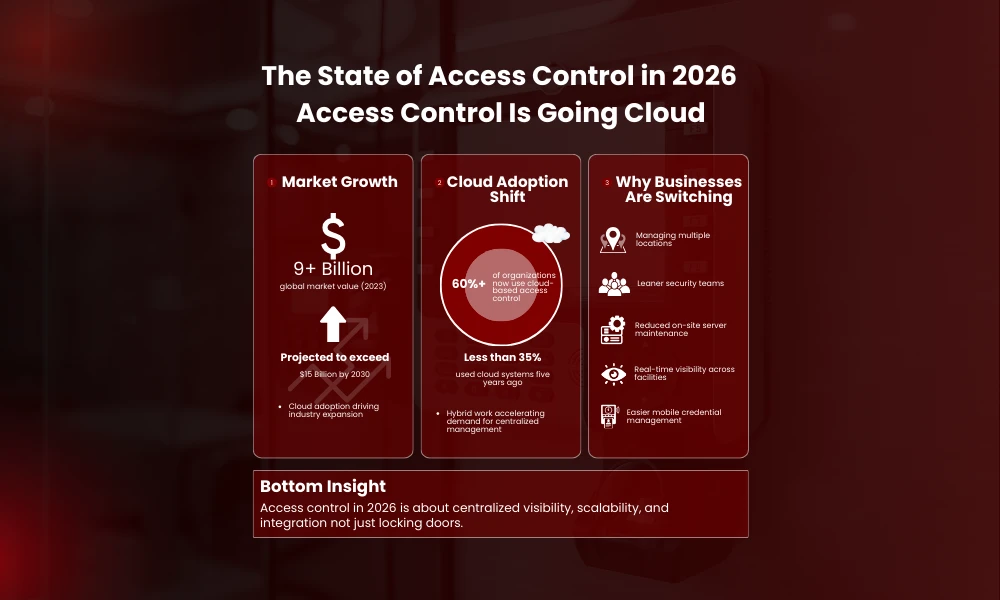
The numbers show how fast the market is evolving. According to Fortune Business Insights, the global access control market was valued at over $9 billion in 2023 and is projected to exceed $15 billion by 2030, driven largely by cloud adoption and mobile credentials. At the same time, a 2024 industry survey found that more than 60% of organizations now use cloud-based access control systems, compared to less than 35% five years ago.
Why the shift?
Businesses are managing more locations, hybrid work models are common, and security teams are leaner than ever. Companies want centralized control without complex servers, easier credential management, and better integration with video and emergency systems.
This guide compares five of the best access control systems in 2026. Each platform serves a slightly different need, from fast-growing startups to multi-site enterprises.
What to Look for in an Access Control System in 2026
Before diving into the list, here are the key factors modern buyers should evaluate:
- Cloud vs on-prem deployment
- Scalability across multiple sites
- Hardware flexibility
- Integration with video surveillance
- Mobile and card credential support
- Real-time alerts and analytics
- Long-term cost structure
Now let’s compare the top systems.
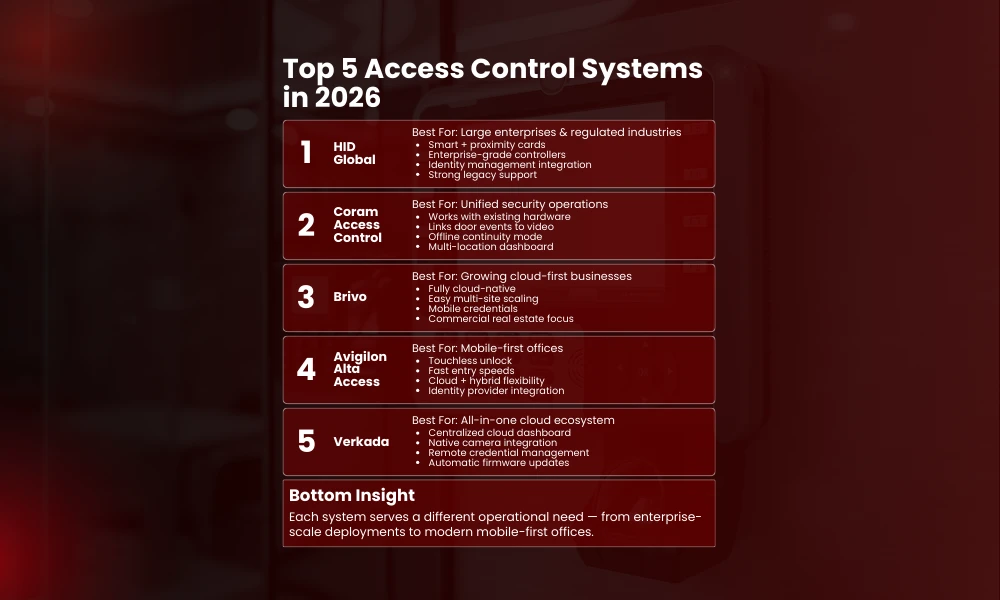
1. HID Global (Enterprise Access Control Solutions)
Best for: Large enterprises and regulated industries
HID Global has long been a leader in physical access control hardware. In 2026, its systems remain widely used in government, healthcare, and financial institutions.
Strengths
HID supports:
- Smart cards, proximity cards, and mobile credentials
- Enterprise-grade controllers
- Integration with identity management platforms
- Support for legacy and modern systems
Because of its long history, HID hardware is often found in large campus environments.
Considerations
HID deployments can require more planning and IT coordination compared to cloud-native systems. However, they offer deep customization and long-term flexibility.
2. Coram Access Control
Best for: Enterprises seeking unified security operations
Coram approaches access control as part of a broader security ecosystem rather than a standalone door system.
Secure Every Door, Without Complexity
Coram’s access control system is designed to scale from a single office to a nationwide operation. It supports:
- Doors, gates, elevators, and specialty access points
- Hardware-agnostic integration with existing locks and readers
- Offline mode to ensure continuity during outages
One of its most practical advantages is the way it connects door events with video. Every entry, denied access, forced door, or propped door can automatically link to live or recorded footage.
Instant Awareness Across Locations
Instead of juggling multiple tools, businesses manage doors, users, schedules, and alerts from a single cloud dashboard. This is particularly useful for companies operating multiple facilities.
Coram also supports:
- Time-based schedules
- Temporary credentials
- Real-time alerts for tailgating
- Smart monitoring of restricted zones
For organizations that already have cameras installed, Coram’s ability to work with existing infrastructure reduces disruption and upfront replacement costs.
3. Brivo Access Control
Best for: Growing companies that prioritize cloud-first deployment
Brivo is one of the most established cloud access control providers in North America. It has built a strong presence in commercial real estate, multifamily properties, and small-to-medium enterprises.
Why It Stands Out
Brivo offers:
- Fully cloud-native management
- Mobile credentials and card/fob options
- Simple multi-site administration
- Integration with video and building management systems
The platform is known for being easy to use and scalable. Adding new users or sites does not require major reconfiguration.
Considerations
While Brivo supports integrations, its hardware ecosystem is more structured compared to fully open systems. Businesses with extensive legacy hardware may need partial upgrades.
4. Avigilon Alta Access (formerly Openpath)
Best for: Modern offices focused on mobile-first access
Avigilon Alta Access, part of Motorola Solutions, emphasizes convenience and speed.
What Makes It Different
Alta Access focuses on:
- Touchless mobile credentials
- Fast unlock speeds
- Cloud-based management
- Integration with identity providers for secure login
The system supports both local hardware and cloud configuration, offering flexibility for offices that want modern access methods without abandoning hybrid setups.
Ideal Use Case
Alta Access is popular among coworking spaces, tech offices, and companies that want a smooth user experience. Its mobile-first design reduces reliance on physical cards.
However, enterprises with highly customized security requirements may need deeper configuration than Alta’s streamlined model provides.
5. Verkada Access Control
Best for: Businesses that want an all-in-one cloud ecosystem
Verkada has built its reputation on simplicity and centralized cloud management. Its access control system integrates tightly with Verkada cameras, environmental sensors, and intercoms.
Why Businesses Choose Verkada
Verkada’s strength lies in ease of deployment. Devices are pre-configured, and management happens through a single cloud dashboard. Administrators can:
- Assign mobile or card credentials remotely
- Set role-based access permissions
- View door events alongside video footage
- Manage multiple locations in one interface
Because everything runs through Verkada’s cloud platform, updates and firmware patches are automatic.
Where It Fits Best
Verkada works well for distributed organizations such as retail chains, schools, and corporate offices that prioritize centralized management and minimal IT overhead.
The tradeoff is hardware lock-in. Verkada requires its own controllers and readers, meaning existing infrastructure cannot be reused.
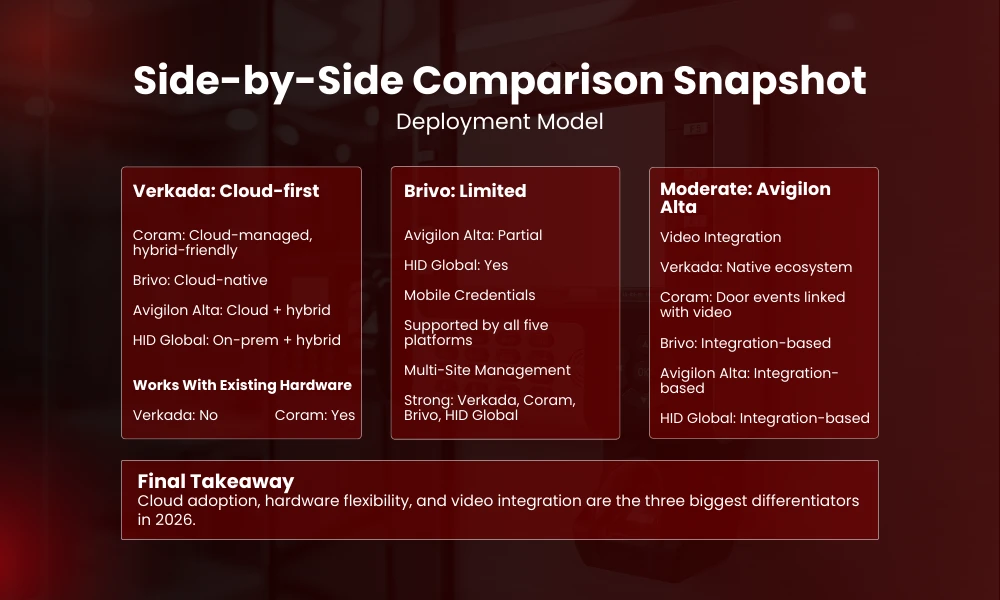
Side-by-Side Comparison Table
| Feature | Verkada | Coram | Brivo | Avigilon Alta | HID Global |
| Deployment Model | Cloud-first | Cloud-managed, hybrid-friendly | Cloud-native | Cloud + hybrid | On-prem + hybrid |
| Works With Existing Hardware | No | Yes | Limited | Partial | Yes |
| Mobile Credentials | Yes | Yes | Yes | Yes | Yes |
| Multi-Site Management | Strong | Strong | Strong | Moderate | Strong |
| Video Integration | Native | Linked with door events | Integration-based | Integration-based | Integration-based |
| Best For | Fast cloud rollout | Unified security operations | Growing businesses | Modern offices | Large enterprises |
Key Takeaways
- Cloud adoption is reshaping access control in 2026
- Mobile credentials are now standard in modern offices
- Multi-site visibility is critical for growing companies
- Integration with video systems improves response time
- Hardware flexibility can significantly reduce upgrade costs
- The right system depends on your growth plans and existing infrastructure
FAQs
What is the difference between cloud and on-prem access control?
Cloud systems are managed remotely and receive automatic updates. On-prem systems require local servers and IT management.
Are mobile credentials secure?
Yes. Most platforms use encrypted communication and multi-factor authentication to secure mobile access.
Can I use my existing card readers?
Some systems, like Coram and HID, support legacy hardware. Others require proprietary devices.
How much does an access control system cost?
Costs vary widely. Small office deployments may start around a few thousand dollars, while enterprise installations can scale significantly depending on site count and hardware needs.
Is access control only for large enterprises?
No. Cloud systems have made advanced access control affordable for small and mid-sized businesses.
Conclusion
Access control in 2026 is about more than doors. It’s about visibility, flexibility, and integration.
Verkada delivers simplicity and centralized cloud management. Coram stands out for unifying access with video and broader security workflows. Brivo offers a strong cloud-first option for growing companies. Avigilon Alta prioritizes mobile convenience. HID continues to serve enterprise and regulated industries with proven hardware strength.
The best choice depends on your organization’s size, IT resources, and long-term strategy. Evaluate your current infrastructure, future growth plans, and how tightly you want access control connected to your overall security system.