A strong pitch makes it easy for the right buyer to see why your line suits their shoppers, what it can earn, and how to place an order. A line sheet is a wholesale document that presents products, prices, options, and ordering terms. Pitching your fashion brand takes three connected jobs: earn attention, make a buyer-focused case, and follow through with care. For a small business, a clear plan can save time and help you focus on stores that fit your work. You do not need a grand speech. You need a specific reason the products belong in that store, plus clear details that help the buyer judge them. Treat each buyer conversation as a chance to learn what would make the next conversation more useful.
Key Takeaways
- Choose stores whose shoppers match your customer.
- Give each buyer a clear reason to consider your line.
- Share easy-to-read product and ordering details.
- Check retailer requirements before promising delivery.
- Follow up with useful, well-timed messages.
How to Pitch Your Fashion Brand to Retail Buyers
A boutique owner and a chain category buyer may both buy apparel, but they need different reasons to take a meeting. Match your pitch to the store’s customer, price range, and buying process. A focused brand story helps a buyer see why your products belong beside the lines already on the sales floor.
Study the retailer’s website, social pages, and physical store before writing. Note its categories, brands, price architecture, and the customers who shop there. The online store experience can also show how the retailer presents products and serves shoppers.
Match the store to your customer
Look for evidence of fit, not a vague sense that your fashion line feels right. Compare fabric, use, style, and pricing with brands the retailer already carries. A clear audience and distinct point of view can sharpen your case; a brand position built around customer needs offers a useful model.
Avoid telling a buyer, “this would be perfect for your store,” without proof. Name comparable lines already in the assortment, then explain how your product adds a different style, price point, or customer choice.
Do not call a line a perfect fit without evidence. Point to comparable brands the retailer carries and explain the difference your products offer.
Learn about the retailer’s shoppers through product reviews, social posts, and in-store displays. You can also use audience research methods to organize customer needs before shaping your message.
Find the person who makes the buying decision

Independent retailers often let the owner choose products. Medium and large chains typically use category buyers or product teams, often on a set review calendar.
Find a named buyer through the retailer’s company information or professional networks. Keep your first ask small and suited to the account: an owner may welcome a brief product review, while a chain buyer may need category details and a planned review period.
| Retailer segment | Likely decision-maker | Pitch emphasis | Useful first ask |
|---|---|---|---|
| Owner-run boutique | Owner or store manager | Local customer, distinct styles, small opening order | Ask for a short product review |
| Regional chain | Category buyer or product team | Category fit, pricing, supply capacity | Ask about the next category review |
| National department store | Category buyer or merchant team | Sales case, scale, vendor readiness | Ask how new lines enter review |
Before contacting anyone, write down one specific detail that proves you understand that store’s assortment.
Where can you connect with fashion retail buyers?
A trade show can put you in front of buyers quickly, while a marketplace or direct email may suit a more targeted approach. Choose the route that fits your category, budget, and sales plan. Each channel takes time, and none guarantees an order.
Trade shows can help fashion brands meet buyers in a focused setting. Select events that match your assortment instead of paying to attend every show on the calendar. MAGIC’s Las Vegas event schedule lists its February dates and venue.
Use trade shows for focused conversations
Use this 2027 calendar to compare events by product category and travel needs:
- MAGIC Las Vegas: February 16-18 at the Las Vegas Convention Center; MAGIC Nashville: May 11-12 at Music City Center.
- Surf Expo, Orlando: January 6-8; FFANY footwear shows: February 1-5 and August 2-6.
- SwimShow: June 5-7; Licensing Expo, Las Vegas: May 25-27.
- Outdoor Retailer, Minneapolis: August 19-20.
- As of September 6, 2026, Coterie New York had not posted 2027 dates. Its 2026 shows fell in late February and mid-September, useful weeks for planning.
Apparel, footwear, swim, outdoor, and licensed-product brands should focus on events that fit their products. A booth makes little sense if the show audience does not buy your category.
Try wholesale marketplaces with a clear cost plan
JOOR, NuOrder, and FashionGo offer wholesale marketplace options, but listing on a platform does not guarantee buyer access. Faire reviews brand applications based on category supply and demand, location, product type, SKU count, wholesale experience, business establishment, and social-media presence.
For North American brands, Faire charges 15% commission on marketplace orders, plus a one-time $10 fee on a buyer’s first marketplace order. Faire Direct orders from retailers you source have 0% commission. Payment processing costs 3.5% plus $0.30 for next-day payout, 2.4% plus $0.30 for 30-day payout, or 1.9% plus $0.30 for 60-day payout.
Next-day payout starts the day after an order ships. The other payout periods start 30 or 60 days after shipment. Eligible retailers can pay in 60 days without interest and return products from their first order from a brand at no cost.
Those retailer terms may help a buyer, but payment timing and fees still affect your cash flow and margin. Compare the costs for each order type before choosing a platform.
Combine direct outreach with in-person contact
Email, phone, mail, and in-person visits can support one another. Use consumer lead-generation ideas only where they fit; wholesale outreach needs a clear business reason for the buyer to respond.
Useful, personal emails and active social engagement can keep a brand familiar between meetings. Read about inbound outreach methods for ideas that can support that work.
Contact a store before dropping in with samples, so staff can confirm the right person and a suitable time. Compare the event calendar with your delivery season before paying to exhibit or committing time to travel.
What belongs on a fashion line sheet?
A buyer should be able to scan a line sheet and understand both the product and the order terms without requesting a second document. Show clear product details, prices, options, and delivery timing in one file. Group styles in a way that makes similar products easy to compare.
Use consistent images with clean white or neutral backgrounds. Flat-lay or ghost-mannequin photos usually show shape and construction better than editorial shots.
Show each product clearly
For every style, include product images, style number, wholesale price, suggested retail price (SRP), sizes, colors, fabric composition, and care details. Add the season and delivery window, such as “Spring/Summer 2026, Delivery March-April.”
Keep each image consistent in size and angle, with color, shape, and construction easy to judge. Editorial photography can set a mood, but it can hide product details that a buyer needs to assess the item.
For print, product images should be at least 300 DPI. For digital use, 150 DPI is the minimum. These product photography tips can help you plan clear, consistent images.
Make ordering details easy to find
State minimum order quantities and explain your payment terms, minimum opening order, reorder minimums, shipping methods, and return or exchange policy. Include a simple way to order, full contact information, and your terms and conditions.
Keep options visible beside each style rather than making the buyer search through separate pages. If a color is unavailable for one size, show that clearly instead of implying every option is in stock.
Use a short note for any special detail that affects an order, such as a limited color run or a delivery window that differs from the rest of the season. Avoid extra copy that does not help the buyer judge fit or place an order.
Check every style number against its image and price before sending the file.
How do you prepare for a buyer meeting and retailer onboarding?
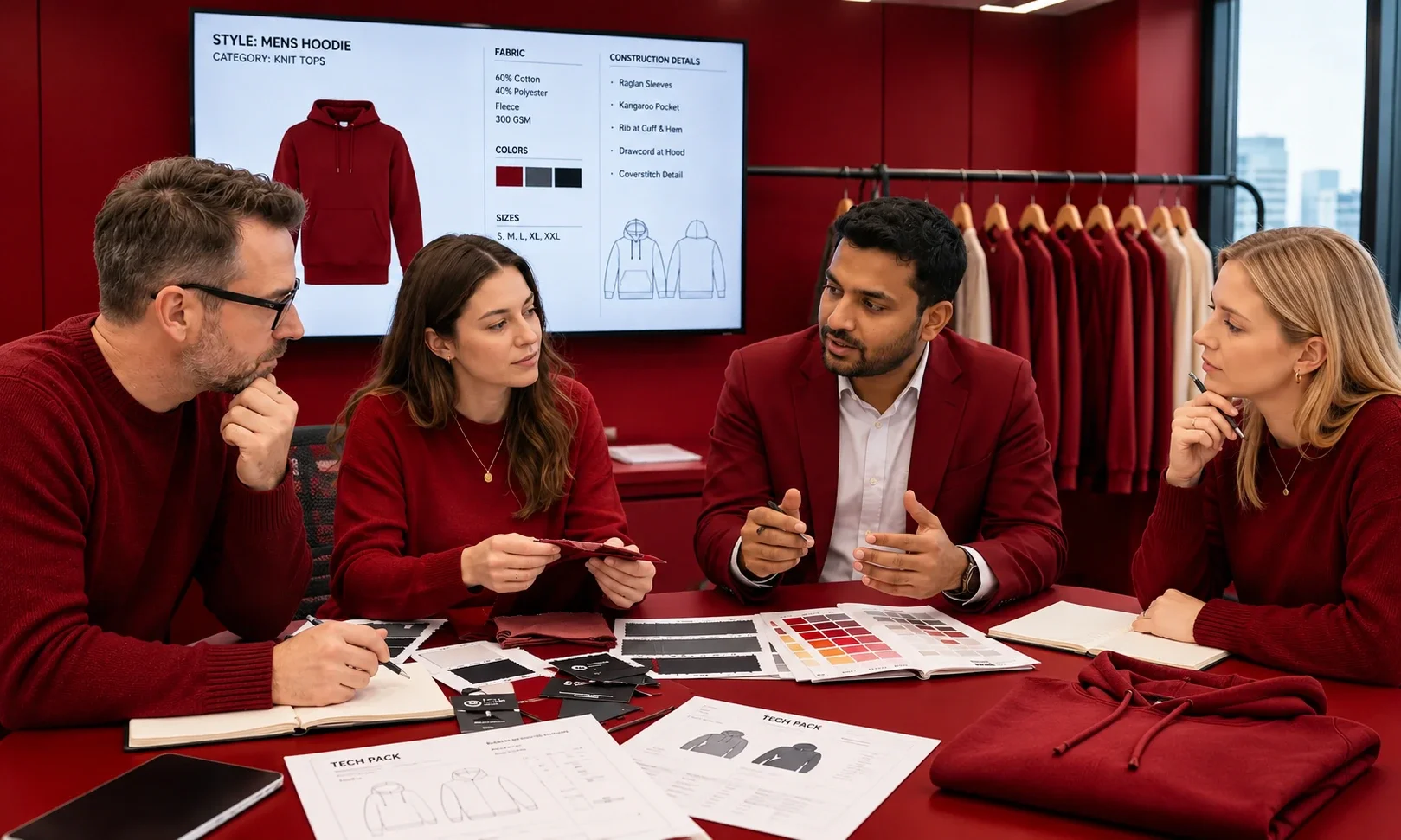
A buyer meeting goes better when you can explain the product’s commercial case and answer practical questions without guessing. Be ready to discuss customer fit, pricing, margin, production capacity, and delivery timing. Bring product samples and fabric swatches when they help the buyer judge quality.
Rehearse a short explanation of why the category fits the retailer and how the products support its assortment. Be direct about customization and exclusivity; do not promise work your business cannot deliver.
Rehearse the commercial case and bring samples
Prepare clear answers about wholesale price, SRP, expected margin, production limits, and available delivery dates. A buyer may ask whether you can repeat a style or support a larger order, so know your capacity before the meeting.
Samples help buyers assess fabric, fit, finish, and color in person. Bring swatches when fabric choice matters, but send samples only to the right recipient after confirming delivery details.
Check chain requirements and product compliance
Retailers set their own vendor steps. Macy’s accepts vendor inquiries across women’s, men’s, and kids’ clothing, accessories, cosmetics, home décor, textiles, small electrics, housewares, food, and candy.
Macy’s supplier-diversity program accepts MBE certification from NMSDC or its 23 regional affiliate councils, and WBE certification from WBENC or its 14 regional partners. It also accepts SBA WOSB, VA or SBA SDVOSB, NGLCC LGBTBE, and Disability:IN DOBE certifications.
Macy’s registration starts with an inquiry about basic business details, certification type and number, and product or service category. Full Ariba onboarding follows only if a category match and buyer interest exist.
Nordstrom begins vendor setup after buyer commitment. The company then provides company, tax, and contact details to receive a vendor number. Nordstrom assigns an EDI compliance date and provides guidelines and testing; purchase orders, advance ship notices, and invoices move through EDI.
Nordstrom requires RFID tickets for apparel, shoes, accessories, and home and gift goods. Each ticket needs a GS1-compliant UPC or EAN barcode. Suppliers must follow Nordstrom’s Routing Guide for approved carriers, freight invoices, and distribution-center assignments. Drop-ship setup is separate, and its goods also need RFID tickets.
16 CFR Part 1610 covers flammability of clothing textiles, not every product-compliance duty. Class 1 textiles have normal flammability and are acceptable for clothing; the rule also permits Class 2 raised-fiber textiles.
Plain-surface fabrics weighing at least 2.6 ounces per square yard are exempt from testing for an initial guaranty. The exemption also covers fabrics made entirely from acrylic, modacrylic, nylon, olefin, polyester, or wool.
The rule excludes certain hats, gloves no longer than 14 inches, footwear other than hosiery, and interlining fabrics between an outer shell and inner lining. Before making a delivery promise, confirm that production capacity and any retailer-specific setup steps can support it.
What should you do after sending a pitch?

A thoughtful follow-up makes it easier for a busy buyer to remember the conversation and act on an agreed next step. Send a meeting recap within 24 hours, but give an unanswered first email about a week. Those are different messages with different purposes.
After a meeting, capture what the buyer said and the next action. A no-reply follow-up should add a useful detail or ask a simple question, not repeat the original pitch.
Do not send several nudges within a few days. Give the buyer room to review your note and respond.
- Send a personalized recap within 24 hours of a meeting.
- State the agreed action and name who will handle it.
- If an initial email gets no reply, follow up after about a week with one relevant update or a simple question.
- If the buyer gives a review date or declines, record the outcome and respect it.
Track each buyer, contact date, topic, response, and next action in one place. A simple spreadsheet can keep the sales process organized without filling your calendar with extra reminders.
If a buyer says no, thank them and ask whether timing, assortment, or price affected the decision. Reconnect only if they invite you or a relevant change gives you a clear reason.
If the buyer names a review date, set your reminder for that date instead of sending another message early.
Conclusion
A useful pitch begins with one carefully chosen store and a clear reason to start a conversation. A buyer is more likely to understand your offer when you connect it to the store’s shoppers and share details that support a real decision.
You cannot control a buyer’s budget, timing, or current plans. You can make your first message specific, professional, and easy to answer. That gives you a solid starting point, even when the store is not ready to order.
Choose one store whose customers match your products, find the person who buys that category, and draft a short opening. Name a concrete reason your product suits those shoppers, then make one clear request. Choose the store, write the buyer-specific opening, and send it when your materials are ready.