
I have spent enough time around paid campaigns to learn one thing: the hardest part is usually not launching the ad. Anyone can press the publish button. The difficult part comes later, when you have to decide which audience is actually worth paying for, why one ad is converting while another is not, and whether the platform is really improving your results or simply reporting them in a way that looks good.
That is where AI advertising has become useful.
Google, Meta, Amazon, and other advertising platforms now use AI to make many of those decisions automatically. At the same time, AI is becoming a new place where people discover products, compare options, and potentially see sponsored recommendations.
So when someone searches for “AI advertising,” they may actually be asking two different questions:
What happens when advertising moves into AI search and chat?
This guide covers both, with a practical focus on what marketers and businesses can actually do with the technology in 2026.
AI Overview:
AI advertising is the use of artificial intelligence, machine learning, predictive models, and generative AI to create, target, deliver, optimize, and measure advertisements.
Instead of a marketer making every decision manually, AI can look at large amounts of data and make predictions about what is likely to work.
That can mean choosing an audience, changing a bid, selecting a creative variation, predicting a conversion, or deciding where part of a budget should go.
There is another side to the term now. Advertising is also starting to appear inside AI-powered search and conversational experiences, including ChatGPT and Google’s AI search products.
Key Takeaways
- AI can handle much more than ad copy and image generation.
- Google and Meta already use AI for targeting, bidding, placements, and campaign optimization.
- Generative AI makes creative production much faster, but speed does not guarantee good advertising.
- AI does not automatically reduce ad costs.
- Bad conversion tracking can make automated campaigns optimize for the wrong thing.
- Human review is still needed for strategy, brand safety, claims, privacy, and important business decisions.
- AI search is creating a new advertising environment where the recommendation may happen before the user ever visits a website.
How Does AI Advertising Actually Work?

You do not need to understand the mathematics behind a machine-learning model to understand what it is doing to your campaign.
Think about a normal ecommerce campaign.
Someone visits a product page. They look at the product, leave the website, and come back two days later. Another person searches for the same type of product but has never visited the site. A third person has bought from the company before.
Those three people are not equally valuable.
An AI system can use available signals to estimate those differences at a scale that would be almost impossible to manage manually.
It starts with data
Depending on the platform and permissions, the system may use first-party customer information, website activity, previous conversions, campaign history, contextual signals, and other available data.
This is why tracking matters so much.
If your purchase event is firing twice, for example, the algorithm may believe the campaign is performing better than it really is. More automation will not solve that problem.
It can make the wrong optimization happen faster.
Then AI looks for patterns
Machine-learning systems can estimate the probability that someone will click, convert, purchase again, or generate a particular amount of value.
This is much more sophisticated than simply saying:
“Show this ad to women aged 25 to 34.”
The system may find that people with very different demographics behave similarly when certain signals appear together.
The system adjusts the campaign
Once enough signals are available, AI can help change bids, audiences, placements, budgets, and creative combinations.
In programmatic advertising, these decisions can happen extremely quickly because the buying process is automated.
The marketer sets the business goal and the boundaries. The system handles many of the small decisions happening underneath.
Creative can change too
Generative AI adds another layer.
A marketer can create different headlines, images, product backgrounds, video concepts, and calls to action without starting every asset from zero.
This is useful when testing creative is slowing down the campaign.
But I would not confuse more variations with better creative.
If the offer is weak, AI can give you 50 versions of a weak offer.
That does not help much.
Finally, the results go back into the system
The campaign produces clicks, leads, purchases, revenue, and other outcomes.
Those results become signals for future decisions.
That is the part people sometimes miss. AI advertising is not just automation. It is a continuous prediction and feedback process.
How Is AI Used in Advertising?
AI is touching almost every major part of paid advertising.
AI ad targeting
Instead of relying only on manually selected interests or demographics, AI can predict which people are more likely to complete a desired action.
This is especially useful when a platform has enough conversion data to learn from.
For a small business with ten conversions, however, I would be much more careful about handing over every targeting decision.
More data generally gives the system more to learn from.
AI media buying
AI can decide how aggressively to bid for different opportunities.
One impression may be worth more than another because the people seeing it have different probabilities of converting.
The system can react to those differences much faster than a person changing bids in a spreadsheet.
AI campaign optimization
This is probably where most advertisers notice the technology first.
Modern advertising systems can continually adjust campaigns according to their chosen objective.
The catch is that the objective matters.
If you tell the system to find cheap clicks, it will work hard to find cheap clicks.
That does not mean you will get good customers.
Give the system a business outcome that actually matters.
AI ad personalization
AI can help match different messages with different users.
An existing customer may need a different message from someone seeing your company for the first time.
A person who abandoned a shopping cart may need a reminder. Someone who has never heard of your brand probably needs an explanation first.
Good personalization changes the message for a reason. It is not just putting someone’s first name in the headline.
AI-generated ads
Generative AI can now help produce:
- Ad copy
- Headlines
- Product descriptions
- Images
- Video concepts
- Backgrounds
- Creative variations
This can cut down the time between an idea and a test.
That is a real advantage for small marketing teams.
Still, every generated asset should be checked before it goes live. AI can make an advertisement look polished while getting an important product detail completely wrong.
AI Advertising Examples
The easiest way to understand the technology is to look at what advertisers are already using.
| Platform or technology | AI role | Practical use |
| Google Performance Max | Automated targeting, bidding and delivery | Manage campaigns across Google’s inventory |
| Google AI Max for Search | AI-assisted matching and asset expansion | Reach relevant searches beyond tightly defined keyword matching |
| Meta Advantage+ | Audience, placement, budget and creative automation | Reduce manual campaign management |
| Amazon Ads AI tools | Generative creative assistance | Create product imagery and advertising assets |
| The Trade Desk Kokai | Predictive programmatic technology | Evaluate and buy digital and CTV inventory |
| Generative AI tools | Copy, image and video generation | Produce and test more creative ideas |
| ChatGPT Ads | Advertising inside an AI conversation environment | Reach users during AI-powered discovery |
These are not all the same thing.
Google Performance Max, for example, is primarily using AI to run advertising more automatically.
ChatGPT Ads represent something different: the AI experience itself becomes a place where advertising can appear.
That distinction will matter more over the next few years.
AI Advertising Platforms and Tools
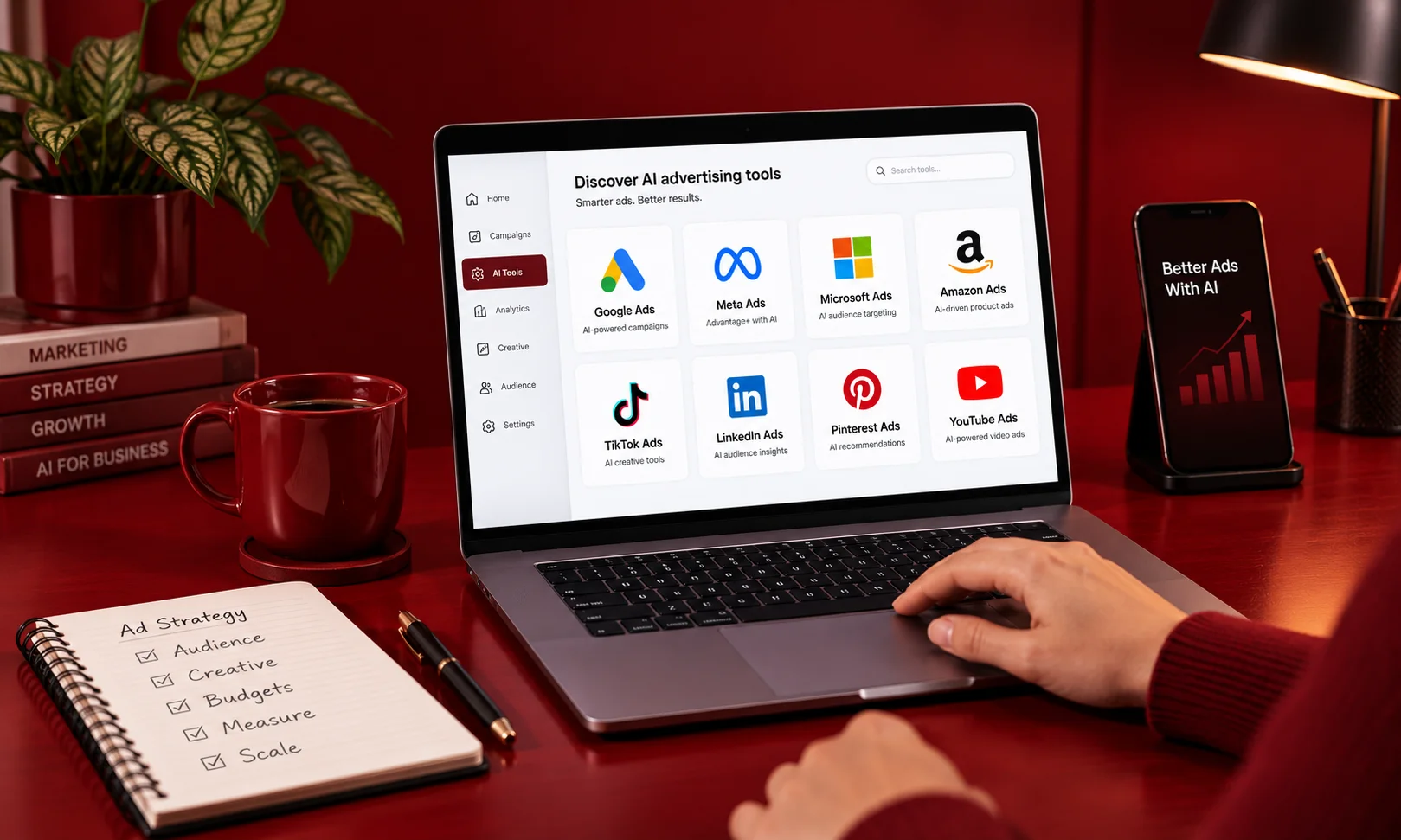
There is no universal “best AI advertising platform.”
The right choice depends on what you sell, how much data you have, where your customers are, and how much control you want over the campaign.
Google Ads and Performance Max
Performance Max lets advertisers provide campaign goals, assets, budget information, and other inputs while Google’s systems handle much of the delivery and optimization.
Google is also expanding AI Max for Search.
Google says its AI Max feature set delivered an average 7% increase in conversions or conversion value at similar CPA or ROAS in its internal testing. That is useful evidence, but it is still Google’s own performance data, not a promise that every advertiser will see the same result.
That distinction is important whenever you read platform case studies.
A result can be real and still not be representative of your account.
Meta Advantage+
Meta has pushed heavily toward automated advertising through its Advantage+ products.
The system can make decisions around audiences, placements, budgets, and creative combinations.
For a performance marketer, that can save a lot of manual work.
The downside is familiar to anyone who has managed heavily automated campaigns: you may have less visibility into exactly why the system made a particular decision.
The Trade Desk Kokai
The Trade Desk’s Kokai technology is aimed at programmatic advertising and uses predictive models to help advertisers evaluate opportunities across digital inventory.
It is more relevant to agencies, larger brands, and advertisers buying media at scale than to a small company running a basic local campaign.
Generative AI advertising tools
There is a growing market of tools focused specifically on ad creation and optimization.
Some generate copy. Some create images. Others combine creative production with campaign management.
These tools can be useful when a team has a creative bottleneck.
If your real problem is poor tracking or an offer that does not convert, though, another AI subscription probably will not fix it.
Who Should Use AI Advertising Tools?
They are most useful for businesses that:
- Already run paid advertising
- Have reliable conversion tracking
- Need to test creative regularly
- Manage multiple products or audiences
- Have enough data for algorithmic optimization
- Need to manage campaigns at scale
Who Should Avoid Heavy Automation?
Be more cautious if your business has very little conversion data, strict compliance requirements, poor tracking, or a campaign where every placement needs manual approval.
For many small businesses, starting with the AI features already built into Google or Meta makes more sense than buying an expensive advertising stack.
AI Advertising vs Traditional Advertising
The difference is mainly about who makes the individual decisions.
| Traditional approach | AI-powered approach |
| Marketer selects many audiences manually | System predicts valuable audiences |
| Bids changed periodically | Bids can change automatically |
| Small number of creative versions | Many creative combinations can be tested |
| Campaign reviewed at set intervals | Campaign can react continuously |
| Rules based on known segments | Predictions based on many signals |
Traditional advertising is not automatically worse.
If you are running a very small campaign, manually controlling the important decisions can actually be easier.
AI becomes more useful as the number of decisions grows.
AI Advertising vs AI Marketing vs Programmatic Advertising
These terms get mixed together quite often.
AI marketing covers a broad area, including content, email, customer service, sales, SEO, analytics, and advertising.
Programmatic advertising is mainly about the automated buying and selling of advertising inventory.
AI advertising describes the wider use of artificial intelligence in advertising, including targeting, creative generation, prediction, bidding, personalization, and measurement.
So programmatic advertising can use AI, but AI advertising is not limited to programmatic buying.
AI-Native Advertising: What Changes With ChatGPT and AI Search?
This is the part of the subject I would pay closest attention to in 2026.
For years, advertising was built around places such as search results, social feeds, websites, apps, and television.
Now people are asking AI systems questions directly.
Instead of searching:
“best accounting software for small business”
someone may ask an AI assistant:
“I run a small agency with five employees. Which accounting software would make sense for me?”
That question contains far more context.
The answer can also be much more direct.
OpenAI announced in August 2026 that ChatGPT Ads had reached a $1 billion annualized revenue run rate in less than 200 days, with tens of thousands of advertisers using the platform. OpenAI also expanded the advertising product into additional markets during 2026.
OpenAI says its ads are separate from ChatGPT’s answers and are clearly labeled. Availability depends on the user’s plan and market.
Google is moving in this direction as well, with advertising experiments and new formats connected to AI Mode, AI-powered shopping, and conversational discovery.
This creates a new advertising question:
What happens when the customer asks the machine to make the shortlist?
That is different from fighting for position number one on a search results page.
AI Advertising and the Future of Search
Traditional search advertising is heavily connected to keywords.
AI search is much more connected to context.
A person can describe a problem in several sentences and expect the system to understand what they mean.
That means advertisers may need to think beyond keywords and focus more heavily on:
- Product information
- Brand reputation
- Customer reviews
- Structured data
- Pricing
- Availability
- Trust signals
- Clear product positioning
- Useful first-party information
This is also where SEO and GEO start to overlap with paid advertising.
You are no longer thinking only about how to win a click.
You are thinking about how your business is understood when an AI system is trying to answer a commercial question.
How to Build an AI Advertising Campaign

If I were starting a new campaign today, I would not begin by asking, “Which AI tool should I buy?”
I would start with the campaign itself.
1. Pick one business goal
Decide what success actually means.
It could be purchases, qualified leads, revenue, lower CPA, better ROAS, or customer acquisition.
Do not make “more traffic” the main goal unless traffic itself is the business objective.
2. Check tracking before automation
Look at your conversion events.
Are purchases being recorded once?
Are qualified leads separated from poor-quality leads?
Is revenue being passed correctly?
This step can feel boring, but it can save a lot of wasted advertising money.
3. Give the system useful inputs
Make sure your product feed, landing pages, conversion events, customer data, and creative assets are accurate.
AI can work with messy inputs.
It just will not necessarily produce a good result from them.
4. Set creative rules
If you are using generative AI, don’t let it invent your brand from scratch.
Give it approved product information, tone guidelines, visual rules, claims it can make, and claims it cannot make.
Then use it to produce variations.
5. Let AI handle repetitive work
This is where automation earns its place.
Use it for bid adjustments, audience modeling, testing, reporting, creative variations, and other repetitive decisions where the system has enough data to make useful predictions.
6. Keep important decisions with people
I would not hand over everything.
A human should still review sensitive claims, unusual performance changes, brand risks, compliance issues, and major budget decisions.
7. Test the result against reality
Do not simply accept the platform’s dashboard.
Compare campaign performance with your actual sales, qualified leads, revenue, and customer quality.
Sometimes an account looks excellent inside the advertising platform and much less impressive when you look at the business.
How Much Does AI Advertising Cost?
This question has no single answer.
There are several different costs involved.
You may pay for advertising media, AI software, creative production, campaign management, data infrastructure, or agency services.
Some standalone AI advertising tools charge monthly subscriptions. Enterprise solutions may charge according to advertising spend or require larger onboarding and management fees.
And then there is the biggest cost: the actual advertising budget.
So if someone tells you that AI advertising costs “$99 per month,” that is only the software part.
The software is not the campaign.
Does AI Advertising Actually Save Money?
Sometimes it does.
AI can reduce the amount of manual work involved in campaign management and creative production. It can also improve media efficiency when its predictions are accurate.
But there is a very common mistake here.
A business sees an AI tool that can produce 100 ad variations and assumes it will reduce costs.
Maybe.
If those 100 ads are poor, you have simply produced poor ads faster.
The better question is:
Does AI improve the economics of the whole campaign?
That includes creative costs, media spend, management time, conversion quality, and revenue.
How to Measure AI Advertising ROI
Do not stop at CTR.
A campaign can have a great click-through rate and still lose money.
Look at:
CTR — Are people interested enough to click?
Conversion rate — Are those clicks turning into customers or leads?
CPA — How much are you paying for each conversion?
CAC — What does it cost to acquire a customer?
ROAS — How much revenue comes back for the advertising spend?
LTV — How valuable are those customers over time?
Incrementality — Did the advertising create additional business, or did it simply capture people who were already going to buy?
That last question is especially important with automated platforms.
A system can become very good at finding people who were already likely to convert.
That can make the dashboard look impressive without creating as much additional demand as you expected.
What Are the Main Benefits of AI Advertising?
Speed
Creative ideas that once took days can often be produced much faster.
Scale
AI can manage more combinations of audiences, bids, placements, and creative than a small team could handle manually.
Personalization
Different users can receive different messages based on available signals.
Continuous optimization
Campaigns do not have to wait for someone to open a dashboard every Monday morning.
Pattern recognition
AI can identify relationships in large datasets that would be difficult for a marketer to spot manually.
Those are real advantages.
They are also the reason it is tempting to automate too much.
What Are the Risks of AI Advertising?
Black-box optimization
The more control platforms take, the harder it can become to understand every individual decision.
That creates a problem when performance suddenly changes and you need to know why.
Hallucinated advertising claims
Generative AI can write something that sounds perfectly believable and is completely wrong.
Never assume polished wording means accurate wording.
Brand inconsistency
If several people use different AI tools with different prompts, your brand can slowly start sounding like five different companies.
Creative fatigue
Producing more variations does not automatically solve audience fatigue.
Sometimes the audience is tired of the message itself.
Privacy
Customer data needs to be handled carefully, particularly when it is used for personalization and targeting.
Platform dependency
There is another risk that gets less attention.
If most of your campaign depends on one advertising platform’s algorithm, a major product or optimization change can affect your results very quickly.
You need enough first-party measurement to understand what is happening outside the platform dashboard.
Do Humans Still Matter in AI Advertising?
More than people sometimes think.
AI is very good at processing information and repeating decisions at scale.
It is not responsible for your brand.
A human still needs to decide what the company is promising, who it wants to attract, what kind of customer it actually wants, and where the business should not advertise.
The best setup is usually not “human versus AI.”
It is human strategy with machine-scale execution.
Three Things Most AI Advertising Guides Miss
AI does not fix a bad offer
If nobody wants what you are selling, better targeting will only help you discover that problem faster.
Before blaming the campaign, look at the offer.
Automation needs boundaries
Giving a platform more control should come with stronger monitoring.
Set budgets, conversion rules, creative guidelines, exclusions, and review processes.
The click may become less important
This is a big shift.
If an AI assistant answers a product question and recommends a brand inside the conversation, the customer may never click through a traditional search result.
That means visibility can happen before the website visit.
For marketers, this brings paid media, SEO, GEO, product data, and brand reputation closer together.
AI Advertising Trends to Watch in 2026
AI search advertising
Advertising is moving into AI-powered search and conversational interfaces.
The format is still developing, but the direction is clear: search is becoming more conversational.
AI shopping
Product discovery is becoming increasingly connected with AI.
Instead of opening ten product pages, a user may ask an AI system to compare products and narrow down the choices.
Agentic commerce
The next step could be AI systems helping users complete purchases.
That changes the customer journey again.
A business may eventually need to make its product information understandable not only to people but also to software agents making comparisons on their behalf.
More generative creative
AI-generated images, video, and copy will continue becoming normal parts of advertising workflows.
The competitive advantage will probably shift away from simply “using AI.”
Most marketers will use it.
The difference will be in the ideas, testing process, brand judgment, and data behind the campaigns.
Less manual control
Platforms are moving toward more automation.
That means marketers need to become better at measurement, experimentation, and interpreting business results.
The less you can see inside the platform, the more important your own measurement becomes.
Who Is AI Advertising Best For?
AI advertising makes the most sense when the business already has something worth scaling.
That usually means a proven product or service, reliable tracking, a clear conversion goal, and enough campaign activity for the system to learn from.
Ecommerce brands, SaaS companies, lead-generation businesses, agencies, retailers, and larger advertisers can benefit significantly.
A small business spending a modest amount on one local campaign may not need an advanced AI stack.
Sometimes simple is better.
Best Practices for AI Advertising
Keep the fundamentals in place:
- Fix tracking before increasing automation.
- Give the system a clear conversion goal.
- Use accurate first-party data where permitted.
- Review every important AI-generated claim.
- Keep your brand guidelines close to the creative workflow.
- Test AI-driven campaigns against real business results.
- Watch CPA and revenue, not only CTR.
- Check for creative fatigue.
- Keep humans involved in sensitive decisions.
- Review performance after major platform changes.
Conclusion
The interesting thing about AI advertising is that it is no longer just about making ads with AI.
The bigger change is happening underneath the campaign. Machines are increasingly deciding which users are valuable, which bid makes sense, which creative to show, and how a campaign should react to new data. At the same time, AI search is changing how people discover products before they ever reach a website.
That does not make the marketer unnecessary.
If anything, it makes good judgment more valuable. Someone still needs to decide what the business should say, which customers are worth pursuing, what data can be trusted, and when an algorithm is making a decision that looks good in a dashboard but does not make sense for the business.
The best approach in 2026 is not to automate everything.
Use AI where it is genuinely better at repetitive, data-heavy decisions. Keep people responsible for strategy, trust, and the decisions that can seriously affect the business.
Frequently Asked Questions
What is AI advertising?
AI advertising uses artificial intelligence to improve targeting, bidding, ad creation, personalization, and campaign optimization. It can also include ads shown inside AI-powered search and chat platforms.
How does AI advertising work?
AI analyzes campaign, customer, and conversion data to find patterns. It then helps adjust bids, audiences, budgets, placements, and creatives based on those signals.
What are some AI advertising examples?
Examples include Google Performance Max, Google AI Max, Meta Advantage+, Amazon’s AI creative tools, and The Trade Desk Kokai. Generative AI tools can also create ad copy, images, and videos.
What are the benefits of AI advertising?
AI can save time, automate repetitive tasks, test more creative variations, and improve targeting and optimization. Results still depend on good data, tracking, and human oversight.
Is AI advertising cheaper?
Not always. AI can reduce some production and management costs, but businesses still pay for ad spend, software, testing, and campaign management.
Can AI replace advertising jobs?
AI can automate repetitive advertising tasks, but strategy, creative judgment, analysis, and business decisions still need people. AI is more likely to change advertising jobs than remove them completely.
Can you advertise on ChatGPT?
Yes. ChatGPT Ads are available in supported markets and plans. OpenAI says these ads are clearly labeled and separate from ChatGPT’s answers.
How does AI target ads without third-party cookies?
AI can use first-party data, contextual signals, conversion data, and modeled signals to identify likely customers. The exact methods depend on the advertising platform and privacy settings.
Are AI-generated ads safe?
Not automatically. AI can create incorrect claims, unsuitable images, or misleading content, so human review is important before an ad goes live.
What is the difference between AI advertising and programmatic advertising?
Programmatic advertising focuses on automated ad buying and selling. AI advertising is broader and can include targeting, creative generation, personalization, optimization, and measurement.