
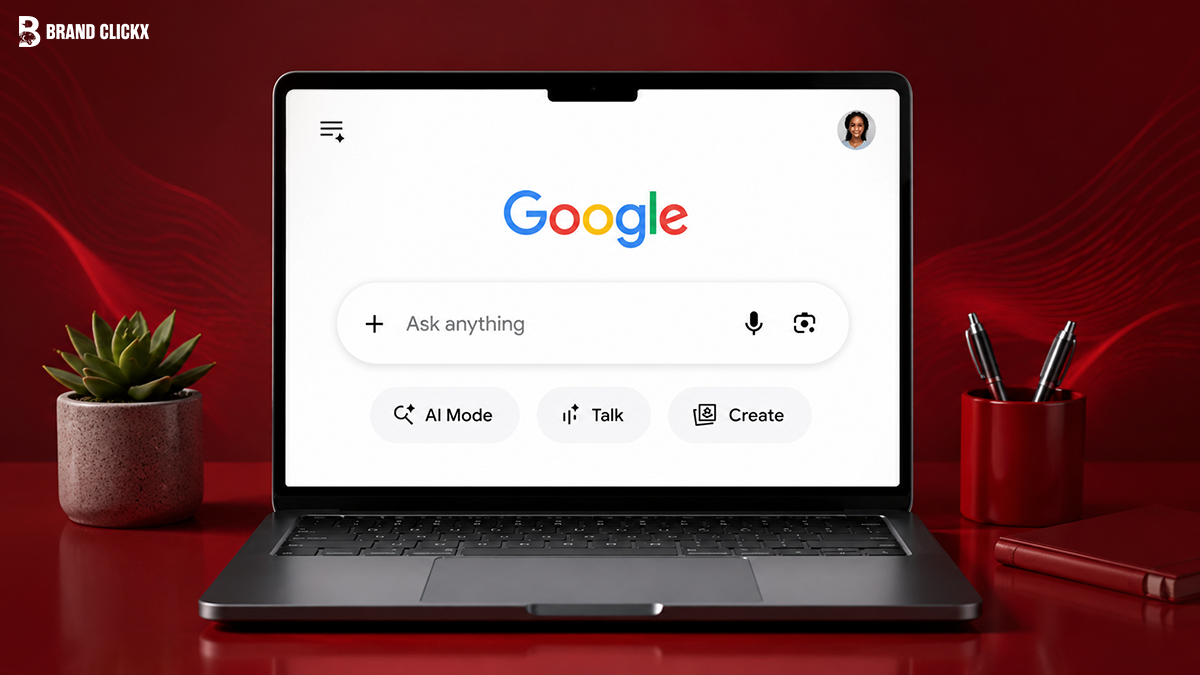
Google announced on May 19, 2026, that it is completely redesigning its search bar. The company called it the biggest change to its search product in more than 25 years. The announcement was made at Google’s annual developer conference called Google I/O 2026 in Mountain View, California.
The new search bar is now powered by Google’s latest AI model called Gemini 3.5 Flash. It began rolling out on May 20, 2026, in all countries and languages where Google’s AI Mode is already available.
AI Overview
For over two decades, Google’s search bar has worked the same way. You type a few words, press enter, and Google gives you a list of links. That experience is now changing.
At Google I/O 2026 on May 19, Google announced what it calls the “intelligent search box.” Google’s VP and Head of Search, Liz Reid, described it as “the biggest upgrade to our iconic search box since its debut over 25 years ago.”
The new search bar expands as you type, accepts text, images, videos, files, and Chrome browser tabs as input, and generates interactive results including custom charts, comparison tools, and dashboards instead of just a list of links. Google also introduced “information agents” that can go search the web on your behalf and bring back results, and a new Gemini feature called Spark that can work on long-term tasks in the background even when your device is turned off or locked.
Google CEO Sundar Pichai said the announcements marked the beginning of what he called the “agentic Gemini era,” where AI can independently plan, reason, and complete tasks rather than just answering questions.
Key Facts
| Detail | Information |
| Announcement date | May 19, 2026 at Google I/O developer conference |
| Where | Mountain View, California |
| Rollout began | May 20, 2026 |
| Availability | All countries and languages where AI Mode is active |
| What Google called it | The biggest upgrade to Search in more than 25 years |
| Who announced it | Liz Reid, VP and Head of Search at Google |
| New name for the search bar | “Intelligent Search Box” |
| AI model powering the new search | Gemini 3.5 Flash |
| Input types accepted | Text, images, videos, files, Chrome browser tabs |
| New result types | Interactive dashboards, charts, comparison tools, custom mini apps |
| Old result type | A list of ten blue links |
| New feature: Information Agents | AI that searches the web on your behalf and brings back results |
| New feature: Spark | A Gemini mode that works on long-term tasks in the background |
| Spark works even when | Your laptop is closed or your phone is locked |
| Android Halo | A new feature that lets you monitor your AI agent from your phone |
| Google 2026 capital spending plan | $180 billion to $190 billion, mostly on AI infrastructure and chips |
| CEO quote | Sundar Pichai called it the beginning of the “agentic Gemini era” |
What Changed: The Old Search vs The New Search
The old way: You type a short keyword or phrase into a small white box. Google returns ten blue links. You click one and go to a website. This has been the same experience since Google launched in 1998.
The new way: The search box expands as you type. You can type long, detailed questions in natural language. You can also attach images, videos, files, or even a tab from your Chrome browser. Instead of ten blue links, Google may build a custom interactive page just for your question. If you want to compare three apartments by rent, commute time, and size, Google builds a comparison table for you. You do not have to click through multiple websites to gather the information yourself.
What Is the Intelligent Search Box?
Google is calling the new search entry point the “intelligent search box.” Three things make it different from the old search bar.
- It expands dynamically The old search bar was a small, fixed-size rectangle. The new one gets bigger as you type. This is designed for longer, more conversational questions that would not fit in the old box.
- It accepts many types of input You can now search using text, images, video, files, and Chrome browser tabs. For example, you can take a photo of a plant and ask Google what it is and how to care for it. You can upload a document and ask Google to summarize it or answer questions about it.
- AI suggestions go beyond autocomplete The old search bar would suggest how to finish your typed phrase. The new one uses AI to suggest entire directions your search could go, including related questions and deeper research paths.
What Are Information Agents?
One of the biggest new features announced at Google I/O 2026 is something Google calls “information agents.”
These are AI systems that can go search the internet on your behalf. Instead of you searching, clicking links, reading pages, and piecing together information yourself, the information agent does all of that work and delivers a summary or answer to you.
Liz Reid gave this example at the I/O keynote: “You could send an alert to track market movements in a particular sector with very specific parameters, and the agent will map out a monitoring plan for you, including the tools and the data it needs to access, like our real-time finance data.”
The agent carries out the search task automatically. You get the result without doing the searching yourself.
What Is Spark?
Spark is a new mode inside Google’s Gemini assistant. It was announced at the same I/O 2026 event.
Spark is designed for long-term and recurring tasks. It works in the background, even when your phone is locked or your laptop is closed. It can:
- Monitor your email inbox for important updates
- Review credit card statements and flag unusual charges
- Compile notes from Google Docs, Gmail, and Slides into summaries
- Create to-do lists from your information
- Work with third-party apps, with more supported in the future
Spark is also being added to the Gemini app on Mac computers so it can work with files saved on your computer.
A new Android feature called Android Halo lets you check on what your Spark agent is doing from your phone at any time.
What Is Generative UI?
Google Search can now build custom interactive pages in real time based on your specific question. Google calls this “generative UI,” which stands for generative user interface.
Here is how it works. Instead of getting a list of links when you search, Google builds a custom page designed specifically for your question. The page could include charts, comparison tables, dashboards, or other visual tools depending on what you asked.
The example given by Google at I/O 2026 was apartment comparison. Ask Google to compare three apartments by commute time, rent price, and square footage, and Search builds the comparison tool for you on the spot. You do not have to visit multiple real estate websites and build the comparison yourself.
What Google Said About the Changes
Sundar Pichai, CEO of Google, said at I/O 2026: the announcements marked the beginning of what he called the “agentic Gemini era.” He said AI systems are now moving beyond just answering prompts and can independently plan, reason, and perform tasks.
Liz Reid, Google’s VP and Head of Search, said: “The biggest upgrade to our iconic search box since its debut over 25 years ago.”
She also said: “You could send an alert to track market movements in a particular sector with very specific parameters, and the agent will map out a monitoring plan for you.”
Google and its parent company Alphabet said they plan to spend $180 billion to $190 billion on capital expenditures in 2026, with most of that money going to AI infrastructure and chips.
How This Affects Websites and Businesses
CNN reported that the changes bring Google Search closer to the experience offered by competitors like Anthropic and OpenAI, whose AI models have taken over some of what search engines used to do.
TechCrunch reported that “the era of the ten blue links is officially over.”
For businesses that rely on search traffic to reach customers, the generative UI feature means people may get their answers directly from Google without clicking through to a website at all. TechWyse noted that content which is “clearly structured, topically authoritative, and directly useful to a specific task is better positioned to be drawn into AI-generated summaries and agent-led experiences.”
The Ask YouTube feature, also announced at I/O 2026, means Google’s AI can pull specific moments from YouTube videos to answer search questions, rather than just listing the video in results.
When Does the New Search Roll Out?
The intelligent search box and Gemini 3.5 Flash as the default AI Mode model began rolling out on May 20, 2026, one day after the I/O announcement.
The rollout is going to all countries and languages where Google’s AI Mode is already available. Google has not announced a specific date for when the full rollout will be complete in all regions.
FAQs
What did Google announce at I/O 2026 about Search?
Google announced a complete redesign of its search bar, calling it the biggest change in more than 25 years. The new “intelligent search box” accepts text, images, videos, files, and Chrome tabs, and is powered by the Gemini 3.5 Flash AI model.
What is the intelligent search box?
It is Google’s new search bar that expands as you type, accepts multiple types of input beyond text, and delivers AI-generated interactive results like comparison tools and dashboards instead of just a list of links.
What are Google information agents?
AI systems within Google Search that can go search the web on your behalf, gather information, and deliver it to you. You give the agent a task and it completes the research automatically.
What is Google Spark?
A new mode in Google’s Gemini assistant that works on long-term tasks in the background, including monitoring emails, reviewing credit card statements, compiling notes, and more. It works even when your phone is locked or laptop is closed.
What is generative UI in Google Search?
The ability of Google Search to build a custom interactive page, such as a comparison chart or dashboard, in real time based on your specific search question. Instead of a list of links, you get a custom tool built for your exact query.
When did the new Google search start rolling out?
May 20, 2026, one day after the Google I/O 2026 announcement. It is rolling out in all countries and languages where AI Mode is available.
Does this mean Google is removing its blue link results?
Google did not say it is removing link results entirely. The new search experience adds AI-generated answers and interactive results. Links to websites will still appear but the experience will no longer be limited to just a list of links.