If you are serious about ranking in search engines you have probably heard the term semantic SEO more times than you can count. But what does semantic SEO really mean and how do search engines interpret the content on your site? In this guide we will explore semantic SEO in depth using real studies and data. You will discover how search engines understand content and how to use this knowledge to create content that ranks well and serves your audience.
Before we go into the details let us set the stage. For many years SEO was all about keywords. You would pick a target keyword and repeat it on your page as many times as possible. That is not the case anymore. Search engines like Google try to understand the meaning behind your content. To achieve this, businesses need a well-planned SEO content strategy that focuses on topic relevance, user intent, and structured content rather than simple keyword repetition.
In this article we will look at how search engines use semantic understanding, how to create content optimized for semantics, and what studies and data reveal about the impact of semantic SEO.
What is Semantic SEO?
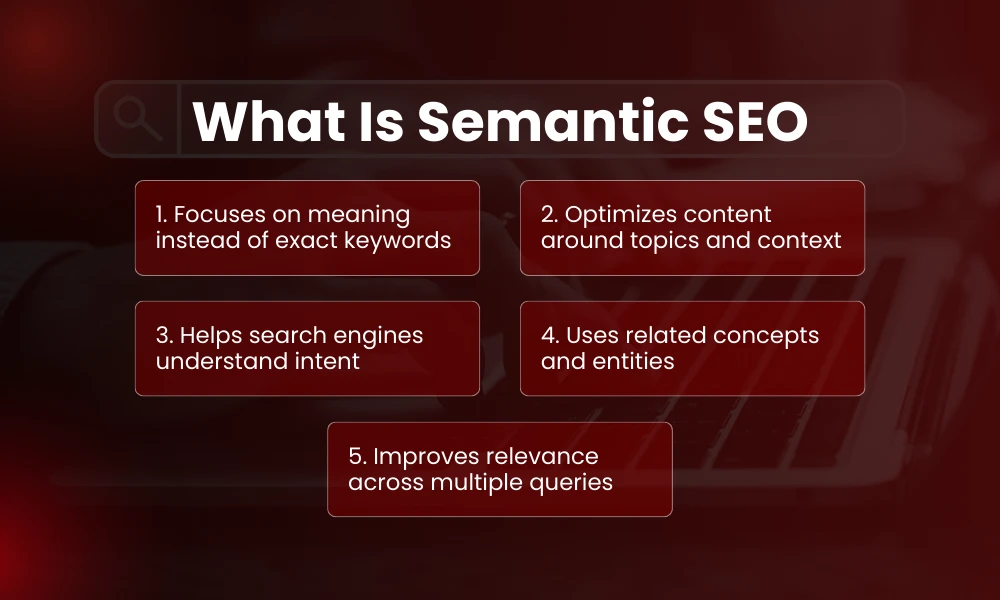
Semantic SEO refers to the practice of optimizing content not just for specific keywords but for the topics, relationships and user questions that those keywords imply. With semantic SEO you focus on meaning rather than exact keyword matching. This means search engines can determine relevance based on context rather than simple word frequency.
To understand this better imagine a search query such as what causes migraines. A traditional keyword SEO strategy might focus on repeating that exact phrase. A semantic SEO approach will look at related topics such as symptoms, triggers, treatments and scientific research. Instead of focusing on a single phrase you create content that covers the broader topic in depth.
The Evolution of SEO to Semantic SEO
To better appreciate why semantic SEO matters we have to look at how search engines have changed over time. In the early days of SEO ranking was heavily tied to keyword frequency. If you wanted to rank for the term weight loss you loaded that phrase into your page title, meta description, headers and body text. The result was content that was stuffed with keywords and often lacked real value.
A 2019 study by Stone Temple found that semantic relevance was a significant ranking factor. The study showed that content which addressed the broader context of a topic was more likely to rank for related terms than content focused only on exact match keywords.
Following Hummingbird came RankBrain, a machine learning component that further improved Google’s ability to interpret search queries.
RankBrain considers user behavior such as click through rates and time on page to decide if content is relevant to a search term. This means that semantic SEO is not just about content structure it is also about how people engage with your content.
Together these developments moved SEO from keyword matching to semantic understanding. If you want your content to rank today you have to think like a search engine. Search engines do not simply read words, they try to understand meaning. That is what semantic SEO is all about.
How Semantic SEO Works
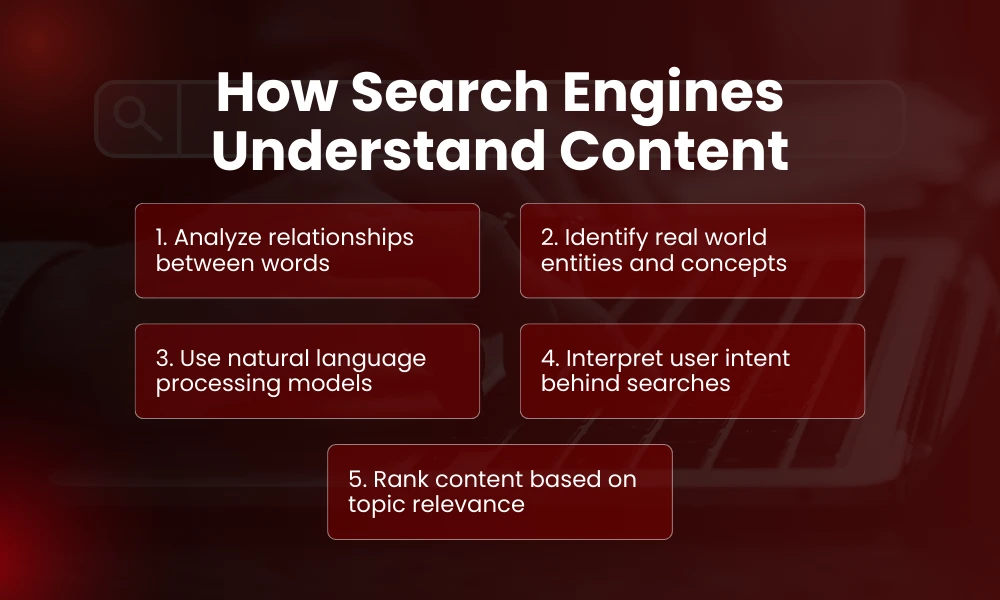
Semantic SEO works by helping search engines build a complete picture of your content. When you write content that covers related concepts and provides clear context search engines can interpret meaning more accurately. Below are key components of semantic SEO:
Topic Mapping
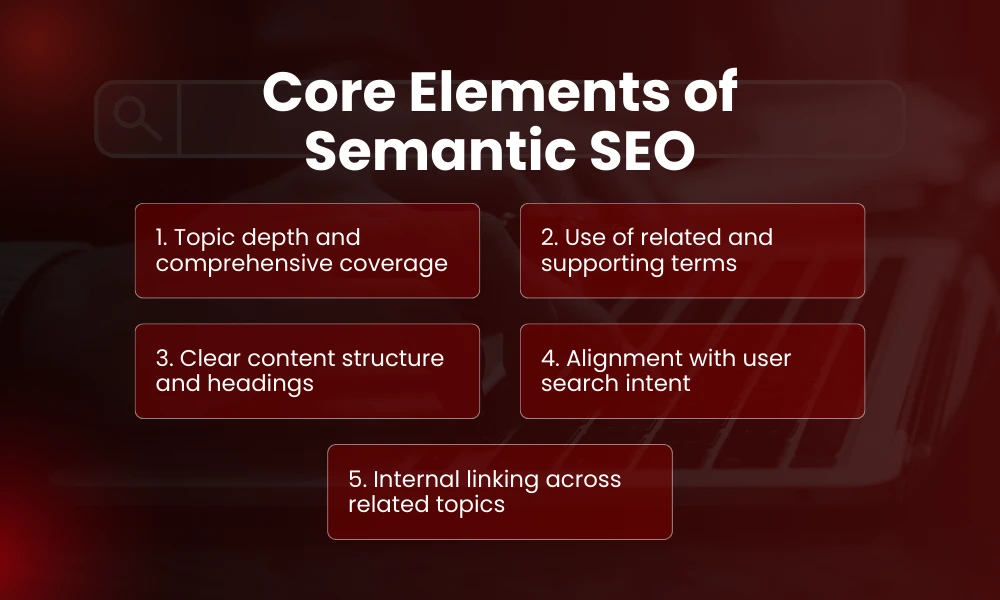
Topic mapping involves identifying not only your target keyword but also related concepts. For example if your target keyword is electric car charging stations your topic map might include charging types, range anxiety, installation costs, government incentives, industry stats and future trends.
By addressing all relevant facets your content becomes a hub for the topic. Many marketers implement this approach using a cluster content strategy, where a pillar page connects multiple related articles that cover subtopics in depth. Search engines recognize this and may rank your page for many related phrases because the content is comprehensive.
Entities and Context
Search engines do not just look at words. They look at entities. An entity is a real world object or concept that has meaning. In SEO, identifying entities and their relationships makes it easier for search engines to understand your content.
For example in an article about climate change relevant entities might include greenhouse gases, carbon dioxide, United Nations Framework Convention on Climate Change, and Intergovernmental Panel on Climate Change. Search engines use knowledge graphs to connect these entities.
Google’s Knowledge Graph is specifically designed to understand these relationships. A 2016 article from Google explained that the Knowledge Graph helps the search engine understand facts about people, things and their relationships. The result is a more accurate interpretation of content.
Latent Semantic Indexing
Latent Semantic Indexing or LSI refers to the idea that words used in similar contexts have related meaning. For example if your content frequently uses terms such as diabetes symptoms, insulin resistance, glucose monitoring and type two diabetes it signals to search engines that your content is about diabetes.
LSI keywords help search engines understand the context of your page. In practice semantic SEO uses LSI to go beyond exact match keywords. A study from the University of Minnesota indicated that including semantic related terms in content can improve topic coverage and relevance.
User Intent
Semantic SEO takes into account the intent behind search queries. Successful semantic optimization depends heavily on understanding human search intent, which allows content creators to match the information users truly need. Search intent generally falls into informational, navigational, commercial and transactional categories. If your content aligns with the correct intent search engines are more likely to deem it relevant.
For example a user searching for best hiking trails is likely looking for an informational guide. If your page offers a list of trails with maps, difficulty ratings and tips then it matches that intent. Semantic SEO helps ensure your content naturally answers the questions users have based on intent.
Real Data on Semantic SEO Impact
Data has shown that semantic SEO can significantly impact search performance. Here are some notable findings from industry studies:
Search Engine Journal Study
Search Engine Journal conducted a study where they compared pages optimized with semantic SEO principles against pages optimized with traditional keyword focus. They found that pages using semantic SEO saw a 250 percent increase in organic traffic over six months. This was attributed to ranking for a broader set of related keywords as well as improved engagement metrics.
Backlinko Research
Backlinko analyzed over one million Google search results to understand ranking factors. They found that content with topic depth and related terms was more likely to rank on page one. Although backlinks remain a key factor the research showed that content relevance based on semantic factors was strongly correlated with higher rankings.
Click Through and Engagement Metrics
User behavior has become a signal for search engines. Pages that deliver value are more likely to keep users engaged. According to a 2021 report from Contentsquare the average bounce rate for informative content is lower when the content answers specific user questions thoroughly. Semantic SEO naturally improves content quality by covering all aspects of a topic.
How to Create Semantic SEO Content
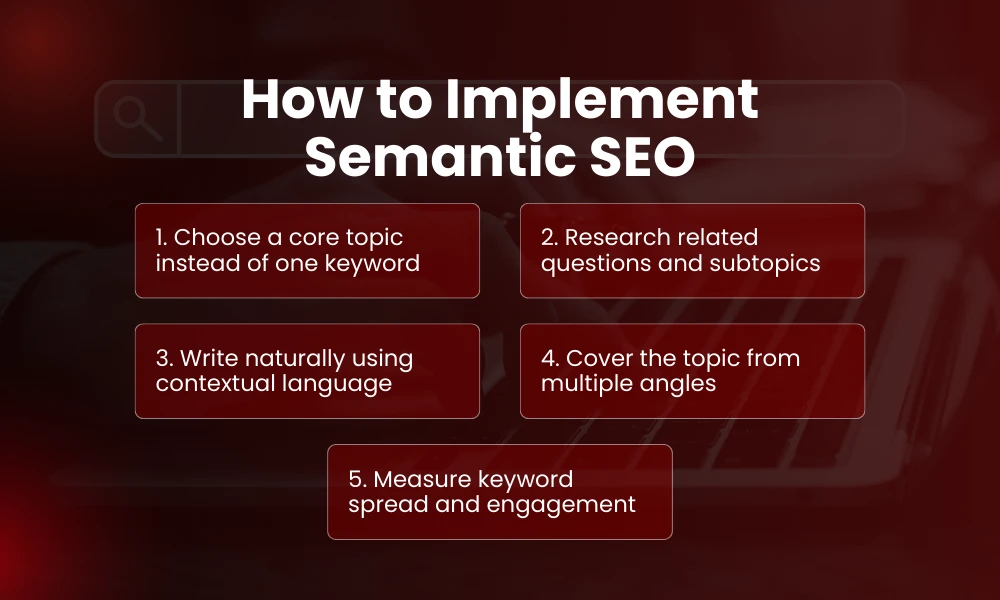
Now that we understand the theory and data behind semantic SEO let us walk through practical steps you can take to implement it.
Start with a Strong Topic Foundation
Your first step is to identify a core topic that you want to address. This process often begins with proper keyword research for SEO to identify the main topic and the related search queries users are looking for.This is not just a keyword but the overall subject. For example if your topic is home coffee roasters you would look beyond that phrase to related subtopics such as green beans, roasting methods, equipment reviews, tasting notes and storage tips.
Use keyword research tools to find related terms. But do not stop at frequency. Look for terms that add depth and meaning.
Use Natural Language
Write content the way people speak or search. Modern search engines interpret natural language effectively. Instead of forcing your target keyword repeat your keyword set will naturally appear if you speak about a topic in a clear way.
Incorporate the primary keyword in key locations such as title, first paragraph, URL and meta description. But do not overuse it. Your goal is to use the keyword where it makes sense and to provide useful information around it.
Answer Related Questions
A powerful tactic for semantic SEO is to answer user questions related to your main topic. Look for questions in tools such as People Also Ask and related searches. For example if your topic is weight training for beginners related questions might include how often should beginners lift weights, benefits of weight training, and how to avoid injuries.
Answering these questions makes your content more comprehensive.
Use Structured Data
Structured data helps search engines understand specific pieces of information. Schema markup can highlight elements such as FAQs, ratings, products and events. When search engines understand your content structure they can represent your page more effectively in search results.
Build Internal Topic Hubs
Instead of treating each piece of content in isolation, create topic clusters. A topic cluster is a group of content pages that cover related topics and are linked together. Your main topic becomes a pillar page and related subtopics link back to it. This structure reinforces semantic relevance and improves user navigation. When supported by a strong SEO-friendly website architecture, topic clusters become even more effective for helping search engines understand content relationships.
Semantic SEO and Search Engine Understanding
Search engines use complex models to understand content. Two key technologies that power this are natural language processing (NLP) and knowledge graphs.
Natural Language Processing
NLP helps search engines interpret human language. It allows them to derive meaning from text and understand relationships between words. Google’s BERT and subsequent models help interpret the nuances of queries. Studies show that BERT improves performance on natural language queries significantly. According to Google this has improved understanding of complex conversational searches.
Knowledge Graphs
Knowledge graphs help connect entities. When a search engine reads your content it tries to connect the dots between people, places, companies and topics. If your content clearly establishes these relationships search engines can confidently interpret what your page is about.
For example if your article talks about coffee roasting history, specific brands and scientific principles behind roasting that gives the search engine a complete view. This is much more valuable than a page that revolves around a single keyword with little context.
Case Studies
Below are examples of how semantic SEO has improved real websites.
Case Study 1 Company Blog
A technology blog shifted from keyword focused posts to semantic SEO optimized content. Instead of writing fifty separate posts each targeting a keyword such as best laptops under 500 or best laptops for students they created a comprehensive laptop guide. This guide included sections on processor types performance benchmarks screen quality battery life user reviews and comparisons.
Over six months traffic grew more than 300 percent and the guide ranked for hundreds of related searches.
Case Study 2 Health Site
A health resource site used semantic SEO to address a topic like heart disease. Instead of a single generic page they created sections covering symptoms causes prevention diet exercise medication and frequently asked questions. They also included citations from medical studies.
Traffic increased significantly and dwell time improved which sent positive user signals back to search engines.
Common Mistakes to Avoid
To get the most out of semantic SEO avoid these pitfalls:
Writing for search engines only focuses on user intent first. Search engines reward content that serves users.
Keyword stuffing: Repeating your target keyword too many times can reduce content quality.
Ignoring related concepts, Semantic SEO is about topic coverage not single keyword obsession.
Poor structure Users and search engines benefit from clear structure and headings.
Measuring Semantic SEO Success
To know if your efforts are working look at these metrics. Using advanced SEO analytics tools helps marketers track keyword coverage, traffic growth, and engagement metrics across semantic content.
Keyword spread Are you ranking for related terms beyond your main keyword.
User engagement Metrics like time on page pages per session and bounce rate indicate how users respond to your content.
Click through rate This measures how often users click your result in search.
Conversions Are users taking the action you want after reading your content.
The Future of Semantic SEO
Search engines will continue to get better at understanding human language. As artificial intelligence evolves semantic SEO will become even more important. Voice search and conversational AI interfaces will rely heavily on meaning not keywords. This is why voice search optimization is becoming an important part of modern semantic SEO strategies. Companies that invest in semantic SEO now will be better positioned for future ranking challenges.
Frequently Asked Questions
What is the difference between semantic SEO and traditional SEO
Traditional SEO focuses on matching exact keywords while semantic SEO focuses on understanding context and meaning. Semantic SEO uses related concepts and natural language to satisfy user intent.
Does semantic SEO mean I should not use keywords
No you still use keywords but in a natural context. The goal of semantic SEO is to use keywords where they make sense while covering related topics.
How long does it take to see results from semantic SEO
Results vary but many sites see improvement within three to six months. This depends on competition content quality and how well semantic principles are applied.
Can semantic SEO improve user engagement
Yes high quality comprehensive content often leads to better engagement metrics such as longer time on page and lower bounce rates.
Do search engines use semantic SEO concepts
Yes major search engines like Google and Bing use natural language processing and entity understanding to interpret content.
Is semantic SEO only for large sites
No semantic SEO works for sites of all sizes. Small blogs can benefit greatly by writing comprehensive content that addresses user questions.