To align sales messaging with brand positioning, build one buyer-tested value story and make it the guide for every sales conversation. Brand positioning is the deliberate choice of how a brand should be understood and distinguished by its target customers. When marketing and sales make different promises, prospects must work harder to understand the value. That confusion can weaken trust across the buyer journey, from a first campaign to a sales call.
Use a five-step method: find the gap, learn from buyers, set the shared story, make it practical, and check whether it works. This approach gives sales and marketing a steady guide without turning reps into script readers. It also helps each conversation speak to the buyer’s pain points and the company’s place in the market. The goal is a consistent promise that still lets each rep speak to the buyer’s needs.
Key Takeaways
- Build the story from buyer evidence, not internal guesses.
- Give sales and marketing one shared positioning statement.
- Support differentiators with proof buyers can judge.
- Make the sales playbook easy to find and use.
- Track how buyers respond, not just whether reps download content.
Why does shared sales and marketing messaging matter?

When buyers hear one promise in a campaign and another from a rep, they have to work harder to understand the value. Shared messaging helps sales and marketing explain the same benefit in ways that fit each moment. Conflicting claims can weaken trust, waste lead-generation effort, and cloud decisions about lead quality.
Marketing may lead with a campaign benefit that sales rarely mentions in live conversations. Reps may focus on a different product strength or make claims that the campaign cannot support. The customer then has to decide which version is reliable. Even a strong campaign can attract prospects who expect something the product or sales team does not promise.
Make every sales claim traceable to a promise marketing can support and buyers can understand.
Misalignment can also make it harder to judge which leads are ready for sales. If teams use different definitions of value, they may disagree about whether an MQL deserves follow-up or qualifies as an SQL. Useful inbound lead generation depends on relevant content and a follow-up that fits the prospect’s interest.
In 2026, 41% of top sales leaders and reps said alignment improves lead quality. Companies with aligned teams were reported to be 67% better at closing deals. Strong alignment was also linked to an average annual growth rate of 20%.
Other reported findings connect effective alignment with revenue increases of up to 208% in high-performing organizations. Aligned teams were reported to have 38% higher win rates and 36% higher customer retention. Organizations prioritizing alignment were nearly three times more likely to exceed new client acquisition targets.
Yet only 30% of sales professionals said their teams were strongly aligned in 2026. You can read the sales and marketing alignment statistics as reported findings, not promises. Treat the performance figures as reasons to investigate alignment, not as a forecast for your company.
How can you spot a positioning gap before rewriting messaging?
A positioning gap is visible when a buyer gets a different explanation of your value from marketing than from sales. Look for patterns across campaigns, sales calls, and buyer feedback before changing copy. Five recurring warning signs can point to a story that needs attention.
- Reps rewrite the pitch because the approved version does not fit their calls.
- Campaigns lead with benefits that sales does not use.
- Proof points differ across the website, pitch deck, and case studies.
- Sales and marketing teams dispute which buyers qualify for follow-up.
- Win/loss feedback conflicts with the brand story the company tells.
Check what sales and marketing actually say, not just what their plans claim. A rep’s notes may reveal one value story, while a campaign headline promises another. The financial services branding strategy approach also stresses clear customer needs and a distinct reason to choose a brand.
Use a quick rating to focus the team’s discussion. BrandRusso’s positioning scorecard rates clarity, differentiation, and relevance on a 1-to-5 scale. Use the scores to find disagreement, not to prove that buyers accept the message.
| Check | Question to ask | Score |
|---|---|---|
| Clarity | Can buyers understand the value? | 1 to 5 |
| Differentiation | Does the story explain what stands out? | 1 to 5 |
| Relevance | Does the promise matter to the target buyer? | 1 to 5 |
In a 2026 analysis of more than 150,000 deals, 79% of buyers said sellers looked the same. That finding makes distinct, buyer-relevant language worth examining, but it does not name your company’s gap. The table is a quick discussion aid, not proof that a message works with buyers.
Ask sales and marketing to name the point where their accounts differ most. Compare one campaign, one sales call, and one buyer comment about that point. Before changing the story, agree on the one buyer-facing contradiction causing the most friction.
How to Align Sales Messaging With Brand Positioning Through Buyer Research
Start with buyers who can explain both the problem they faced and the alternatives they considered. Buyer evidence helps sales and marketing test whether the claimed value matches real needs. A B2B interview program can begin with 6 to 8 important customers.
Choose customers with varied roles, needs, and experiences, rather than interviewing only your strongest advocates. Ask what they would use to solve the problem if your product did not exist. Find out which alternatives they considered and what words they use to describe the pain points.
Keep questions open and listen for concrete examples. The University of Cambridge Institute for Manufacturing offers guidance on structured customer interviews that explore needs, problems, and alternatives. Avoid steering buyers toward the answer your team hopes to hear.
Learn how customers describe the problem and alternatives
Ask buyers to recall when the problem became hard to ignore. Their account can show what triggered a search and what they tried first. Separate a customer’s own words from the language your team uses to explain the problem.
Interviewees may also offer comments that work as testimonials. About 75% of customer interviews in Weidert’s experience result in testimonials clients can use in marketing. That figure does not mean every interview produces a usable testimonial.
Test which outcomes and differentiators matter
Ask buyers to rank product capabilities by importance, then explain why their top choices matter. Find out what measurable outcome they expected and what changed after purchase. This helps separate a feature from the result a buyer hoped to achieve.
A city-by-city positioning check is different from a customer interview program. It can include 8 to 12 recent buyers or late-stage prospects in each city. Use the local check to see whether the same value story fits across markets.
Review rankings and outcome accounts together before changing a claim. One customer’s favorite feature may not matter to the wider target group. Record exact customer wording separately from your interpretation of what it means.
What belongs in a positioning statement sales can use?
A useful positioning statement tells the team whom it serves, what value it promises, and why buyers should believe it. Keep it internal as a guide for sales and marketing, not necessarily as a tagline. It should name a target customer, a need, primary value, distinction, and proof.
A B2B positioning statement identifies its target customer, primary value, and evidence for the promise. It also describes the product, its audience, and how it meets a need differently from competitors. The statement gives teams one anchor for campaigns and sales conversations.
A short template can help you organize the evidence without making a claim for you:
Illustrative template: “For [target customer] facing [need], [product] delivers [primary value] through [distinctive approach], supported by [evidence].”
Fill every bracket with specifics your team has validated. The target customer should be clear enough to guide choices about who the product serves. The need should reflect a problem buyers recognize, not an internal label.
State the primary value in terms the customer can understand. Name a distinctive approach only when it sets the product apart in a way buyers care about. Use evidence that supports the promise, such as customer data or a relevant case study.
The brand positioning guide explains how an internal statement can connect an audience, need, benefit, and reason to believe. Keep the wording plain enough for teams outside marketing to use. Keep the statement internal until its claims and supporting evidence have been checked.
How do you choose differentiators buyers will believe?
A differentiator earns a place in the sales story only when buyers care about it and the company can prove it. Buyer value comes first, not the number of features a product has. Lead with a claim only when it is distinct, important, and backed by evidence.
A feature describes what a product does; an outcome explains what that feature helps a customer achieve. For example, a feature may automate a task, while its value depends on whether that change matters to the buyer. Ask which benefit can carry the main promise, then choose proof that fits.
| Benefit type | Role in the decision | Evidence to check |
|---|---|---|
| Table stakes | Meets a basic buyer expectation | Buyer feedback and product details |
| Purchase driver | Gives a buyer a reason to choose | Customer data and case studies |
| Reassurance | Reduces concern about a choice | Buyer feedback and support records |
Table stakes may matter, but they rarely explain why a customer should pick your product. A purchase driver can make the choice more compelling when buyers value it. Reassurance can support a decision without becoming the headline benefit.
Use customer data, case studies, and buyer feedback to check whether a claim holds up. A case study can show how a customer used a feature, while feedback can show whether the outcome matters. Do not turn one example into a promise for every buyer.
To keep the message clear, focus on the evidence that supports the buyer’s decision. The landing page copy tips also advise explaining benefits and backing claims with trust signals. Remove any claim that depends on a competitor being worse rather than on evidence of your own value.
How do you turn positioning into a practical messaging framework?
A messaging framework gives every team the same structure while leaving room to emphasize the most relevant proof. Build a shared message architecture from the positioning, then test how buyers understand it. The Message House has three layers: a core value proposition, supporting pillars, and proof points.
The roof holds the core value proposition, or the main promise to the target audience. Three to five pillars support that promise with distinct themes. The foundation contains proof points that make each theme believable.
Build the shared message architecture
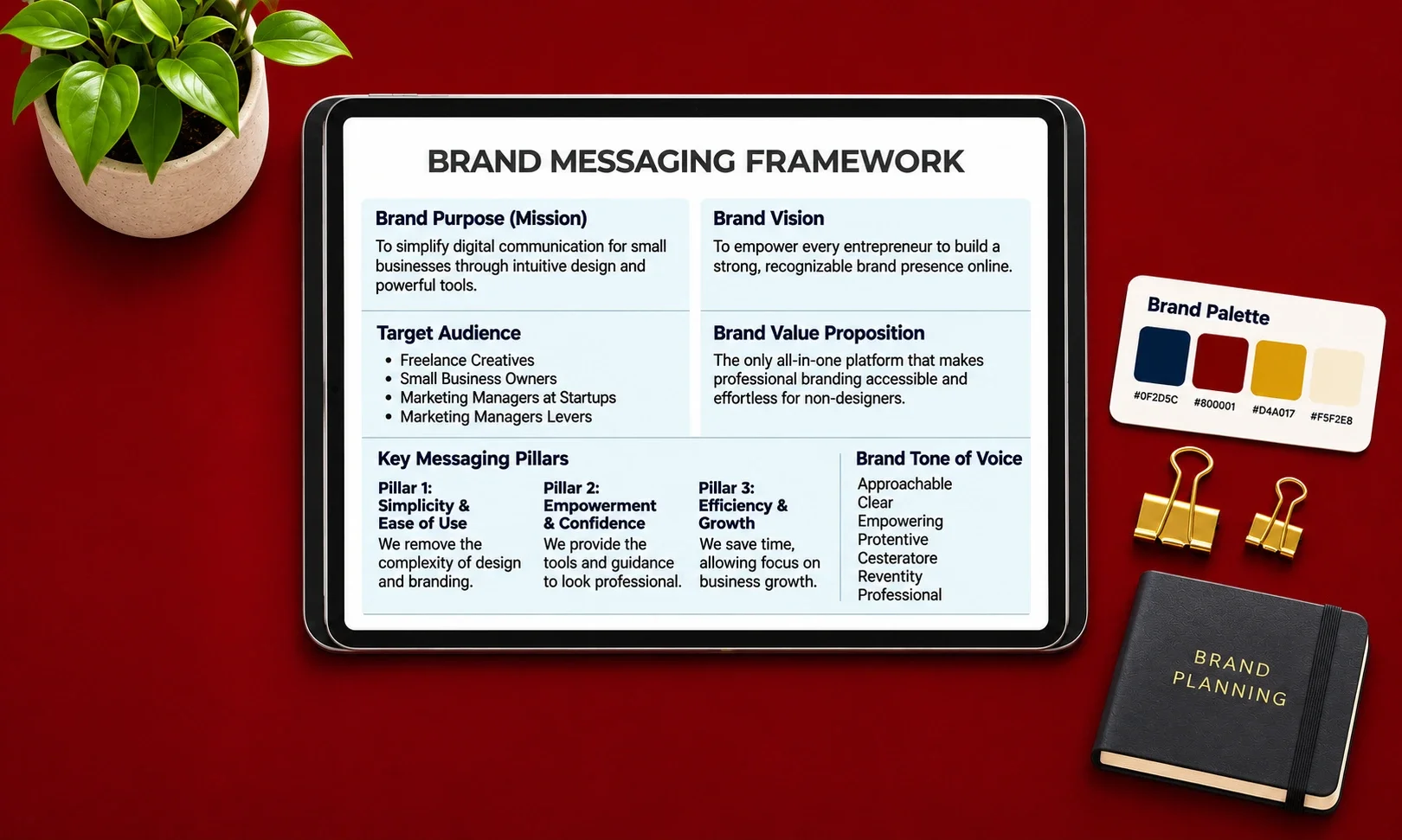
A wider brand messaging framework can also include the positioning statement, target audience, brand voice and tone, brand pillars, and proof points. The house gives those parts a clear order. Voice guides how teams express a point, while audience and proof keep the message relevant.
Give each pillar a clear job, such as explaining a buyer outcome or a distinct way the product helps. Use proof that supports the pillar instead of adding facts that do not fit. The same structure can guide campaign content and sales conversations.
Test messages against buyer response
Test specific, buyer-relevant details against broad claims that could describe any product. Ask buyers which version makes the value clearer and what evidence they trust. Use their feedback to revise wording, emphasis, and proof.
In a 2026 study comparing commercial messages, the Telling Details message produced a 91 percent difference in buyers who said it offered more value than the other message versions. That is a reported difference between the messages tested, not a guaranteed lift for your company. A clear brand strategy can also help teams keep customer needs and proof points in view.
Keep the message consistent without forcing every team to repeat the same sentence. Marketing can use a pillar in a campaign, while a rep can lead with the pillar most relevant to a prospect. Keep the pillars distinct enough that each gives a buyer a different reason to care.
How can you help sales reps use the approved story?
Reps are more likely to use messaging when they help shape it and can find the right asset quickly. Make the story usable in real deals, not just easy to file. Keep every sales resource traceable to the positioning statement and approved proof points.
Sales enablement can turn the shared story into a sales playbook, pitch decks, case studies, one-pagers, and objection-handling guidance. These tools should help a rep respond to a buyer’s needs without adding unsupported claims. Four practical actions can make adoption easier:
- Involve sales in drafting so the language fits real conversations.
- Connect each asset to a buyer need or deal stage.
- Make the current approved version easy to find.
- Train reps to personalize without changing the promise.
Involvement matters because reps can point out where a phrase sounds awkward or fails to answer a common concern. Marketing can then adjust the asset while keeping its claims within the approved story. This gives both teams a reason to trust the final version.
Make assets easy to sort by buyer need or deal stage, not just by file type. A rep preparing for an early call may need a one-pager, while a later deal may need a case study. A pitch deck should support the conversation, not bury the main point in extra slides.
Approved personalization changes the example or emphasis to suit the buyer. Unsupported personalization adds a result or product claim the company cannot back up. Give every asset an owner who can retire outdated versions.
What makes a sales and marketing handoff feel consistent to buyers?
A smooth handoff lets the buyer continue the same conversation instead of explaining their interest again. Carry the buyer’s context from marketing engagement into the first sales contact. A useful handoff gives the rep enough detail to make a relevant next move.
Marketing should share context that helps sales personalize, while sales should acknowledge what the prospect has already seen. A buyer who downloaded a guide should not receive an opening message that ignores that interest. Timely follow-up with relevant content can help preserve trust.
Pass these five details to the rep:
- Prospect source and last touch.
- Content the prospect consumed.
- Buyer role.
- Relevant account context.
- Agreed next action or response expectation.
The list gives sales a starting point, not a script for the next call. A rep can refer to the prospect’s recent content and ask what they want to solve. That keeps the exchange connected to the buyer’s own actions.
In 2026, 53% of companies were reported to experience broken sales and marketing handoffs. B2B buyers were reported to be 1.8 times more likely to complete a high-quality deal when digital tools are paired with a sales representative. Useful follow-up is part of a larger inbound lead process, not a substitute for a relevant conversation.
Make sure the handoff does not leave the rep guessing about the buyer’s latest interest. Check that a rep can see the prospect’s latest engagement before reaching out.
How often should teams review brand and message alignment?
Review alignment on more than one rhythm: active deals need attention more often than the full positioning framework. Set regular check-ins so teams can catch drift before it spreads across campaigns or sales calls. Use weekly, monthly, quarterly, and annual reviews for different decisions.
Weekly pipeline reviews help teams address live deals and buyer questions. They can surface a claim that is unclear or proof a prospect needs. Keep the focus on current opportunities, not a full rewrite of the brand story.
Monthly sales and marketing debriefs can compare campaign response with what reps hear in conversations. Teams can discuss which content supports useful talks and where buyers seem confused. Keep the discussion grounded in recent examples.
Quarterly brand-alignment reviews bring leaders together to check shared measures and the buyer promise. BrandRusso recommends quarterly reviews with leaders from each key team. Include sales, marketing, product, and customer success when their work affects what buyers experience.
Those reviews can help teams see whether a product change or service issue has altered the promise. The marketing OKR review approach also shows how regular check-ins can support timely decisions. Keep measures connected to actual work rather than creating a meeting with no decision to make.
An annual review should examine the full value proposition framework. Revisit its audience, main benefit, and proof when the market or product has changed. Use the quarterly review to decide whether the promise still matches what buyers value.
Which metrics show whether sales messaging is working?

Measure whether reps use and follow the message, then check whether buyers respond and deals progress. Track behavior first, then connect it to results. Downloads and training attendance alone do not show whether the guidance changed a sales conversation.
Track whether reps use and follow the guidance
Sales content engagement rate equals reps who used or shared an asset divided by active reps, multiplied by 100. Active reps form the denominator, so inactive users do not distort the measure. This rate shows whether content reaches the people selling.
Playbook and messaging adoption rate equals reviewed interactions that follow approved guidance divided by all reviewed interactions, multiplied by 100. The denominator is every interaction reviewed, not only those that followed the rules. Use a consistent sample of calls, emails, and deal records.
Connect adoption to buyer and deal outcomes
Review calls, emails, and deal records for specific behaviors, such as whether reps explain the approved value and use supported proof. Record the behaviors before reviewing so each reviewer looks for the same signs. A sample can reveal patterns without grading every word a rep says.
Compare content engagement and adoption with buyer response and deal outcomes. A rise in asset use matters more when buyers respond and opportunities move forward. Do not treat a busy team or a high download count as proof of success.
- Buyer response: Did prospects engage with the message or ask a useful follow-up?
- Conversion: Did prospects move from one stage to the next?
- Win/loss reasons: Which value claims shaped the decision?
- Deal progression: Did opportunities advance or stall?
Conversion rates alone can hide why buyers moved or stopped. Pair them with feedback from calls and deal records to learn which message needs work. The marketing measurement guide can help teams use regular check-ins to adjust goals and decisions.
Look at adoption alongside the buyer’s response, rather than rewarding use for its own sake. If usage rises but buyer response does not, revisit the message rather than celebrating adoption alone.
How can you tailor the message to different buyer roles?
Different stakeholders can value the same benefit for different reasons. Adapt the emphasis to the person’s stated needs while keeping the underlying promise fixed. Personalization changes the proof and framing, not the claim.
A CFO may hear “reduce overhead” as cost savings, while an operations manager may hear team efficiency. The same core value story can speak to both without splitting into competing promises.
| Buyer role | Likely emphasis | Message framing |
|---|---|---|
| CFO | Cost savings | Connect the benefit to spending priorities |
| Operations manager | Team efficiency | Connect the benefit to daily work |
Use discovery to confirm what each stakeholder wants from the decision. A person’s title can suggest a concern, but it cannot tell you the whole story. One CFO may focus on savings, while another may care more about risk or planning.
Choose evidence that fits the priority the buyer names. A cost-focused stakeholder may want evidence tied to spending, while an operations leader may ask about how work changes. Keep the promise fixed and adapt the evidence to the buyer’s stated priority.
Do not turn different buyer roles into different promises; tailor the reason each person should care.
A single account may have several people shaping the decision. Keep their concerns visible in deal notes so the team can answer each one without changing the story. This makes personalization more useful than a generic pitch for a job title.
Conclusion
Consistent sales messaging starts with one promise that buyers recognize and the company can support. Reps do not need identical scripts. They need a shared, evidence-backed story that leaves room for a natural conversation.
Start with one current campaign claim and compare it with what reps say buyers value. Look for a gap in the benefit, proof, or language, then agree on what the team should test. A small review can give sales and marketing a practical first step.
Keep the focus on a promise buyers can understand and the company can support. Choose one current campaign and schedule a joint review of its promise against recent buyer conversations.