
GPT-6 Astra pricing can look confusing at first because there is not one single price for everyone. The amount you pay depends on how you access Astra. If you use Astra through ChatGPT, access is connected to your ChatGPT plan and the particular ChatGPT product you are using.
If you use Astra through the API, the system works differently: you pay according to the amount of input and output the model processes. This difference is the first thing you need to understand before looking at any price table.
The current standard API price for GPT-6 Astra is $10 per 1 million input tokens and $50 per 1 million output tokens. OpenAI also charges different rates for cached input and cache writes, and very large prompts can fall under higher pricing.
This guide explains the entire pricing and access system in simple language. The goal is not just to tell you the prices, but to help you understand what those prices actually mean, who can access Astra, how API billing works, and when paying for Astra makes sense.
GPT-6 Astra Pricing at a Glance
The easiest way to begin is with the standard API prices. These are charged according to the number of tokens processed rather than according to the number of questions you ask.
| GPT-6 Astra API usage | Current standard price |
| Input | $10 per 1M tokens |
| Cached input | $1 per 1M tokens |
| Cache writes | $12.50 per 1M tokens |
| Output | $50 per 1M tokens |
These prices come directly from OpenAI’s current GPT-6 Astra API documentation. The model also has a special pricing rule for prompts containing more than 272,000 input tokens.
An important lesson here: $10 and $50 are not monthly subscription prices. The $10 figure means that processing 1 million standard input tokens costs $10. The $50 figure means that generating 1 million standard output tokens costs $50. Most individual requests use far less than 1 million tokens, so the cost of a single request can be much smaller than these headline numbers.
What Is the Difference Between ChatGPT Pricing and API Pricing?
This is the most important pricing distinction to understand. ChatGPT access is subscription-based. API access is usage-based. When you pay for a ChatGPT plan, you are paying for access to the ChatGPT product and the features and models included with your plan. You normally do not receive a separate invoice for every token you type into the ChatGPT interface.
The API works differently. A developer can connect an application to GPT-6 Astra and send requests programmatically.
Those requests are measured according to the API’s pricing rules. This means someone using Astra in ChatGPT should not look at the “$10 per million input tokens” figure and assume that this is the monthly price of using Astra. It is an API usage rate, not a ChatGPT subscription price.
How Much Does GPT-6 Astra Cost Through the API?
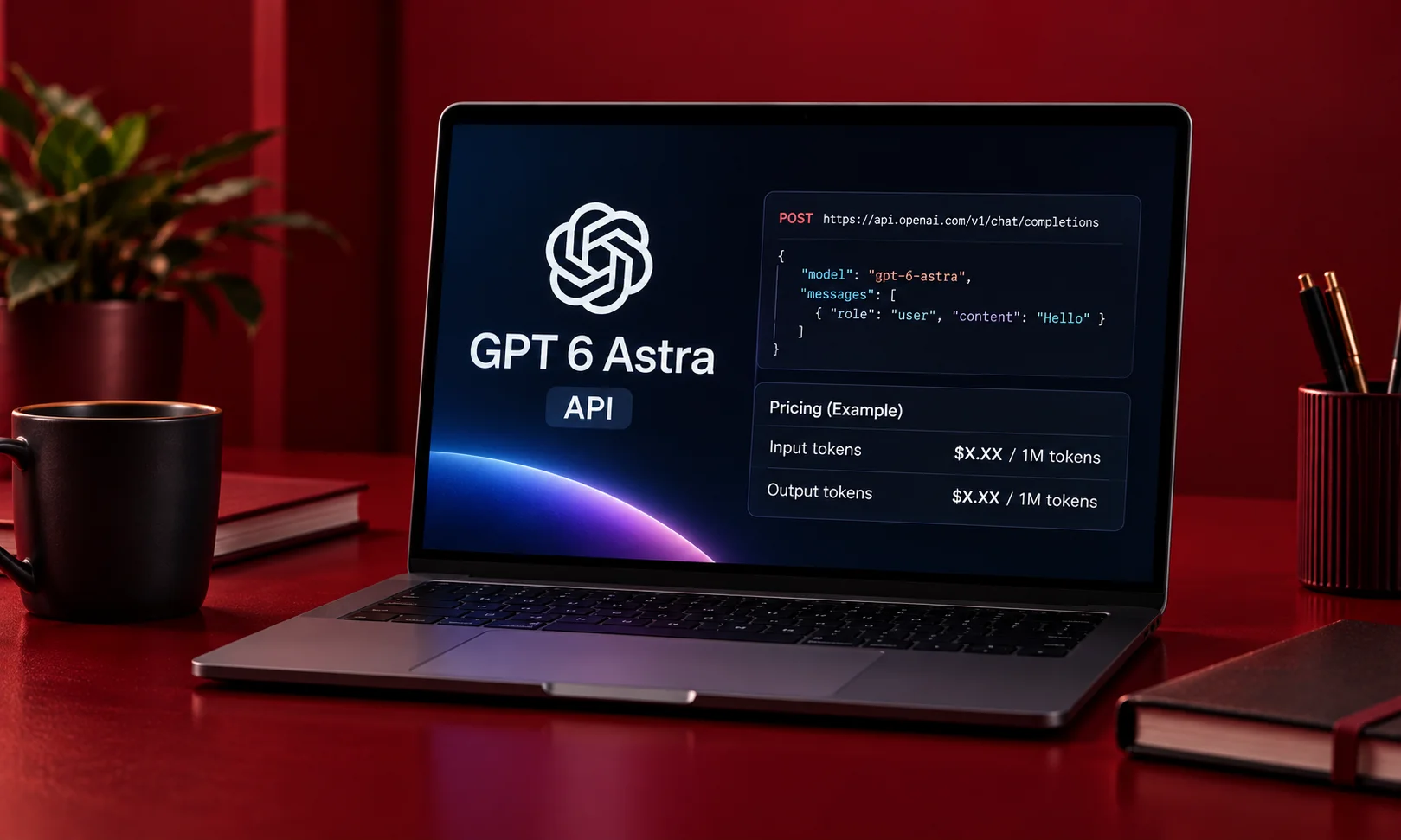
The standard GPT-6 Astra API price is $10 per million input tokens and $50 per million output tokens. Input is the information your application sends to the model.
This can include instructions, text, conversation history, documents, and other information included in the request. Output is what the model generates in response. The difference between the two prices is significant. Output costs five times as much as standard input.
That means developers should pay attention not only to how much information they send to Astra, but also to how much information they ask Astra to generate. For an application producing very long responses, output usage can become a major part of the total bill.
What Does 1 Million Tokens Actually Mean?
A token is a small unit of text processed by an AI model. It is not exactly the same thing as a word. A short word may be represented by one token, while a longer word can be divided into several tokens.
Punctuation and parts of words can also be represented as tokens. This is why API pricing is measured in tokens rather than words or characters. For example, if an application uses 100,000 input tokens, it has used one-tenth of 1 million input tokens. At the standard Astra input price:
100,000 ÷ 1,000,000 × $10 = $1
So 100,000 input tokens would cost approximately $1 at the standard input rate. You can use the same calculation for output, but output has the higher $50-per-million rate.
How Much Would 10,000 Output Tokens Cost?
Suppose Astra generates 10,000 output tokens. The calculation would be:
10,000 ÷ 1,000,000 × $50 = $0.50
So the output portion would cost about 50 cents at the standard rate. If the same request also contained 10,000 ordinary input tokens, the input would cost:
10,000 ÷ 1,000,000 × $10 = $0.10
The combined model-token cost would therefore be about $0.60. This simple example shows why you should not think of “$50 per million output tokens” as “$50 for one answer.” The actual cost depends on how many tokens the application processes.
What Are Input Tokens?
Input tokens are the information that goes into GPT-6 Astra. Imagine an application sends Astra a long report and asks it to analyze the report. The report becomes part of the model’s input.
The instructions asking Astra what to do are also part of the input. In a continuing conversation, previous conversation information that is included in the request can also contribute to the input. The more information an application sends, the more input tokens it may consume. At the standard rate, those input tokens are charged at $10 per million.
What Are Output Tokens?
Output tokens are the information GPT-6 Astra generates.
- If you ask Astra to write a report, the generated report contributes output tokens.
- If you ask it to generate code, the generated code contributes output tokens.
- If you ask for a very long explanation, the additional generated text also contributes output tokens.
Astra’s standard output rate is $50 per million tokens, making output considerably more expensive than ordinary input. This is why developers building large-scale applications need to control unnecessary output. A system that repeatedly generates extremely long answers can become much more expensive than one that produces concise responses.
What Is Cached Input?
Cached input is one of the most useful parts of Astra’s pricing system for applications that repeatedly use the same information. Imagine a company has a large set of instructions that it uses again and again. Instead of treating all of that repeated information as completely new input every time, eligible content can be cached.
GPT-6 Astra’s standard cached-input rate is currently $1 per million tokens. That is substantially lower than the normal $10-per-million input rate. The practical idea is simple: New input costs more.
Eligible repeated input can cost less when it is served from the cache. This can be particularly useful for applications that repeatedly work with large system instructions, common background information, or other reusable context.
What Are Cache Writes?
Cache writes are different from cached input. A cache write happens when eligible information is written into the cache so that it can be reused later. OpenAI currently lists the standard cache-write rate for GPT-6 Astra at $12.50 per million tokens. So there are effectively two different ideas:
- Cache write: putting eligible information into the cache.
- Cached input: using eligible information from the cache later.
The first has its own cost. The second is cheaper than ordinary input. For developers, the value comes from repeated use. If the same large information is used many times, caching may reduce the cost of repeatedly processing that information.
What Happens Above 272K Input Tokens?
GPT-6 Astra has a special pricing rule for very large requests. OpenAI states that prompts containing more than 272,000 input tokens are charged at 2× the input and cache rates and 1.5× the output rate for the full request. That changes the effective standard rates to:
| Usage | Standard | More than 272K input tokens |
| Input | $10/M | $20/M |
| Cached input | $1/M | $2/M |
| Cache writes | $12.50/M | $25/M |
| Output | $50/M | $75/M |
This is important for applications that regularly send extremely large prompts. A developer should therefore never estimate the cost of a very large request using only the ordinary $10 and $50 figures.
Why Does the 272K Rule Matter?
For a small application, this rule may never matter. For a system working with enormous documents, large collections of records, long conversations, or complex agent workflows, it can matter a lot.
The important part is that the higher pricing does not apply only to the tokens above 272K. OpenAI states that the adjusted rates apply to the full request once the request crosses the threshold.
That makes the threshold something developers should monitor carefully. If an application can divide work into sensible smaller requests without reducing quality, doing so may change the economics.
However, developers should not split information artificially just to avoid a pricing threshold if doing so makes the application less effective. Cost and performance have to be considered together.
Does Long Context Cost More?
Yes, when the request falls under the long-context pricing category. OpenAI’s current pricing information lists higher rates for long-context GPT-6 Astra requests than the standard rates. The long-context rates are:
| Long-context usage | Price per 1M tokens |
| Input | $20 |
| Cached input | $2 |
| Cache writes | $25 |
| Output | $75 |
This does not mean that simply having access to Astra’s large context capability automatically makes every request more expensive. The important point is that using very large amounts of context can move a request into a more expensive pricing category. For organizations working with huge amounts of information, this should be included in cost planning.
Is GPT-6 Astra More Expensive Than GPT-5.6 Sol?

Yes, on standard API token rates.
- GPT-6 Astra is currently priced at $10 per million input tokens and $50 per million output tokens.
- GPT-5.6 Sol is priced at $4 per million input tokens and $20 per million output tokens.
| Model | Input / 1M | Cached Input / 1M | Output / 1M |
| GPT-6 Astra | $10 | $1 | $50 |
| GPT-5.6 Sol | $4 | $0.40 | $20 |
This makes Astra 2.5 times more expensive per token than Sol at these standard rates. But there is an important difference between price per token and cost per completed task. A model that completes a difficult job with fewer tokens can sometimes narrow the real-world cost difference. That is why developers should not judge the economics of a model only by looking at the price per million tokens.
Can a More Expensive Model Actually Cost Less for Some Tasks?
Yes, potentially. Imagine two models are asked to complete the same complicated software task.
- Model A costs less for every token, but it needs many attempts, produces more intermediate output, and requires more interaction before the job is finished.
- Model B costs more per token but completes the task using fewer tokens and fewer steps.
- Model B can still have a competitive cost per completed task.
This is one reason independent testing of Astra’s token efficiency has attracted attention. Astra can use substantially fewer tokens than Sol on some coding-agent workloads. However, those are external measurements rather than OpenAI’s official pricing figures, so they should be treated as workload-specific evidence rather than a universal cost rule.
The lesson is simple: Price per token tells you what each unit costs. Cost per finished job tells you what the whole task costs.
Does Astra Have a Faster, More Expensive Mode?
OpenAI’s API documentation includes different processing options, and the price can vary depending on the mode used. The standard price is the normal reference point.
OpenAI also documents faster processing options that can cost more than standard processing. Developers therefore need to check the pricing for the specific processing mode they choose instead of assuming that every Astra request has exactly the same price.
This matters most for applications where response speed has direct business value. If a company is willing to pay more to reduce waiting time, the higher processing cost may be reasonable. If speed is not important, a lower-cost processing option can be more attractive.
What Was Daybreak Access?
GPT-6 Astra’s rollout began with a limited early-access program known as Daybreak Access. This was not the same thing as saying that everyone could immediately use Astra.
OpenAI announced that Astra would first roll out to a limited set of organizations before expanding access more broadly across ChatGPT plans and API/cloud channels.
This distinction is important when reading early September 2026 articles about Astra. Some early reports describe the first restricted rollout, while newer OpenAI documentation describes broader availability.
Therefore, an article published during the first days of the launch can become outdated quickly if it treats the initial Daybreak stage as the permanent access situation.
Who Can Access GPT-6 Astra Through ChatGPT?
Access has been changing during the rollout, so the exact product matters. OpenAI’s launch announcement said Astra would become available to ChatGPT Plus, Pro, Business, and Enterprise users as the rollout expanded. However, the current access structure is more specific.
Current information indicates that Astra-powered GPT-6 Pro in standard Chat is available to Pro $100, Pro $200, Business, and Enterprise plans, while Plus access is being provided through ChatGPT Work and Codex as the rollout progresses.
This is an important distinction. Saying simply “Plus gets Astra” does not tell the whole story. The user needs to know where Astra is available within the product.
GPT-6 Astra Access by ChatGPT Plan
The current rollout can be understood more clearly this way:
| ChatGPT plan/product | Current Astra access |
| Free | No Astra access listed in the current rollout |
| Plus | Astra available through Work and Codex as rollout progresses |
| Pro $100 | Astra-powered GPT-6 Pro in standard Chat, plus Work/Codex access |
| Pro $200 | Astra-powered GPT-6 Pro in standard Chat, plus Work/Codex access |
| Business | Astra-powered GPT-6 Pro in standard Chat and relevant Work access |
| Enterprise | Astra-powered GPT-6 Pro, subject to workspace availability/permissions |
Because OpenAI is actively rolling Astra out, users should check their own account for the latest availability rather than assuming that an older article’s access table remains current.
Does Plus Get GPT-6 Astra?
Yes, but the wording needs care. Current information indicates that Plus users can access GPT-6 Astra through Work and Codex as the rollout progresses. That is different from saying that the Astra-powered GPT-6 Pro model is available in the normal Chat experience for Plus users. Current information places GPT-6 Pro in standard Chat on Pro $100, Pro $200, Business, and Enterprise plans. So a Plus user may have access to Astra without having the same Astra experience as a higher-tier Pro user. This is exactly why access articles should name the product as well as the subscription plan.
Does Pro Get GPT-6 Astra?
Yes. The higher Pro plans are part of the current Astra-powered GPT-6 Pro rollout in standard Chat. Pro users are therefore in a different access position from Plus users because GPT-6 Pro is currently available to the Pro $100 and Pro $200 plans in standard Chat. The higher price of these plans is therefore not simply an API-style payment for tokens. It is a subscription that provides access to a broader set of ChatGPT capabilities and higher-level model access.
What About Business and Enterprise?
Business and Enterprise users are also included in the current Astra rollout. For organizations, however, availability is not just about the name of the plan. Administrators may control access within a workspace, and organizational users can have different permissions from individual consumers.
Enterprise customers should therefore consider both the plan and their organization’s workspace configuration when determining whether a particular user can access Astra. This is one reason a business should not rely on a simple consumer pricing table when planning a company-wide Astra deployment.
Is the ChatGPT Subscription the Same as API Access?
No. Think of them as two separate doors. The ChatGPT door gives people access to OpenAI’s conversational products according to their subscription and product permissions. The API door lets developers connect their own software to the model and pay for the processing their applications use.
A ChatGPT subscription should not automatically be interpreted as a bundle of API credits. Likewise, having an API account does not automatically mean that you have purchased a ChatGPT subscription. This distinction is essential for anyone planning to use Astra professionally.
Does Buying ChatGPT Give You Free API Credits?

You should not assume that it does. ChatGPT subscription billing and API billing are separate. If you build a website, application, automation, or other software that sends requests to GPT-6 Astra through the API, you need to use the API billing system. Your ChatGPT subscription does not simply turn into a pool of API tokens.
This separation also makes it easier to understand why an individual user might pay for ChatGPT while a company separately pays an API bill.
Can Developers Use Astra Without ChatGPT?
Yes. The API is designed for developers and organizations that want to integrate Astra into their own software and workflows. That means an application can use Astra without the end user ever opening the ChatGPT interface. For example, a company could build an internal research application around the API. Another company could create a customer-support system. A software developer could create a coding workflow. In each case, the company would be responsible for its API usage and the resulting costs.
What Other Access Routes Are Available?
OpenAI’s launch information says Astra is also becoming available through the OpenAI API, Microsoft Azure, and AWS Bedrock as the rollout expands. This matters mainly to businesses and developers. A company may already have an established cloud infrastructure and prefer to consume AI services through its existing cloud relationship rather than building everything directly around a consumer ChatGPT account. The exact commercial terms can differ by platform, so an organization should check the pricing and availability of the specific provider it intends to use.
Can Developers Reduce Their Astra Bill?
Yes, and this is where good engineering can make a major difference. The first method is to avoid sending unnecessary information. If an application repeatedly sends huge amounts of irrelevant context, it can increase input usage without improving the result. The second method is to use caching when repeated information qualifies for cached input.
The third is to control output length. Since Astra’s output rate is much higher than its standard input rate, unnecessarily long responses can increase costs quickly. The fourth is to use Astra only when the task justifies it. A cheaper model can be a better choice for straightforward work. Good cost management therefore starts before the API bill arrives.
Should Every Application Use GPT-6 Astra?
No. Astra sits at the high end of OpenAI’s model range, so using it for every tiny task may not be financially sensible. If an application only needs simple classification, basic rewriting, short summaries, or routine text generation, a less expensive model may be sufficient.
Astra makes more sense when the task is difficult enough that stronger reasoning, greater reliability, or better performance can create meaningful value. The correct question is not: “Is Astra the best model?” The better business question is: “Is Astra’s additional capability worth its additional cost for this particular job?”
Who Is Most Likely to Benefit From Astra?
Astra is most interesting for organizations and developers working on difficult tasks where model performance has a direct economic value. That can include complex software workflows, research systems, demanding professional applications, and agentic processes that require the model to work through multiple steps.
For these workloads, a more expensive model can potentially save human time or reduce the number of model interactions needed to finish a task. That does not guarantee that Astra will always be cheaper per completed job. It simply means the correct comparison should be based on the whole workflow, not only the token price.
When Might Astra Be Too Expensive?
Astra may be unnecessary when the task is simple. If a cheaper model can produce the required answer accurately and reliably, paying a premium for Astra provides little economic benefit. The same is true for applications running at enormous scale. Even a small difference in cost per request can become a large monthly expense when millions of requests are processed.
For that reason, large organizations often test multiple models before deciding which one should handle which type of task. The smartest architecture may use different models for different jobs rather than forcing every request through the most expensive model.
How Should a Company Calculate the Real Cost?
A company should start with four basic numbers:
- How many requests will the application make?
- How many input tokens will each request use?
- How many output tokens will each request generate?
- How often can caching reduce repeated input?
Then it should add any relevant tool, processing, or infrastructure charges. This produces a much more realistic estimate than simply multiplying the number of users by the $10 headline price. A company should also test the application with real workloads because theoretical token estimates can differ significantly from actual usage.
Why Token Price Is Not the Whole Story
This is one of the most important lessons when comparing AI models. Suppose Model A costs $4 per million output tokens and Model B costs $20. At first glance, Model A looks five times cheaper. But imagine Model A needs several attempts to complete a difficult job while Model B completes the same job in one successful workflow.
The real difference could be much smaller. Astra’s token efficiency can make its economics more competitive on some coding-agent tasks than the raw token price suggests. These results should not be treated as universal. Different prompts, workloads, reasoning settings, and applications can produce different results. The best measure is always the cost and quality of the actual work your application needs to perform.
GPT-6 Astra Pricing vs Access: What Is More Important?
For an individual user, access is usually the bigger question. You want to know: “Is Astra available on my plan, and where can I use it?” For a developer, pricing is usually the bigger question. You want to know: “How many tokens will my application use, and what will each completed task cost?” For a business, both questions matter.
A company needs to know which employees can access Astra, which products support it, how much usage will cost, and whether the additional performance creates enough value to justify the expense. That is why a complete pricing article needs to explain both sides rather than publishing only the $10/$50 figures.
Our Approach to GPT-6 Astra Pricing and Access
GPT-6 Astra pricing and access can change as OpenAI expands the model across ChatGPT plans, API services, and cloud platforms. This guide was researched by the BrandClickX editorial team to clearly explain API pricing, token costs, caching, long-context charges, ChatGPT plan access, and availability. It also distinguishes subscription pricing from usage-based API billing and explains why real-world AI costs depend on usage and workload rather than token price alone.
Conclusion
GPT-6 Astra pricing is easier to understand once you separate ChatGPT access from API billing. For ChatGPT users, the main question is which plan and product provide Astra access. The current rollout gives higher-tier plans access to Astra-powered GPT-6 Pro in standard Chat, while Plus users can access Astra through Work and Codex as the rollout progresses. For developers, the main question is usage.
The standard API rate is $10 per million input tokens and $50 per million output tokens, with cheaper cached input at $1 per million and cache writes at $12.50 per million. Requests exceeding 272K input tokens receive higher rates.
But the most useful lesson is not simply that Astra is expensive. The better lesson is that price per token is only one part of AI economics. The real cost depends on how much information an application sends, how much it generates, whether caching is used, how large the context becomes, what processing mode is selected, and how efficiently the model completes the actual task.
For a normal ChatGPT user, the decision is mostly about whether the available plan and Astra access are worth the subscription. For a developer, the decision is more technical: calculate expected token usage and compare the cost and quality of Astra against less expensive models.
For a business, the best choice is usually neither “always use Astra” nor “never pay for Astra.” The better strategy is to use the model where its additional capability creates enough value to justify the additional cost.
That is the simplest way to understand GPT-6 Astra pricing and access in 2026: ChatGPT is primarily about subscription and plan access, while the API is primarily about usage-based cost—and the best model is the one that delivers the right level of performance at the right cost for the job.
GPT-6 Astra Pricing & Access FAQs
How much does GPT-6 Astra cost?
The standard API price is currently $10 per 1 million input tokens and $50 per 1 million output tokens. Cached input costs $1 per million tokens, while cache writes cost $12.50 per million tokens.
Is $10 the monthly price of GPT-6 Astra?
No. It is the API price for 1 million input tokens. It is not a monthly ChatGPT subscription price.
Is GPT-6 Astra more expensive than GPT-5.6 Sol?
Yes. Astra’s standard API rates are $10/$50 per million input/output tokens, compared with $4/$20 for GPT-5.6 Sol.
What is cached input?
Cached input is eligible information that can be reused through the caching system at a lower input rate. Astra’s standard cached-input price is $1 per million tokens.
What happens above 272K input tokens?
The full request receives higher pricing: 2× the input and cache rates and 1.5× the output rate.
Does GPT-6 Astra cost more when processing very large contexts?
Yes. Long-context usage has higher listed rates than standard usage, so developers working with very large inputs should include those rates in their cost calculations.
Is GPT-6 Astra available in ChatGPT?
Yes, Astra access is being rolled out across eligible ChatGPT plans and products, but availability differs by plan and product.
Does ChatGPT Plus get GPT-6 Astra?
Current information indicates Plus users receive Astra through Work and Codex as rollout progresses, while Astra-powered GPT-6 Pro in standard Chat is currently available to higher-tier plans including Pro, Business, and Enterprise.
Does Pro get GPT-6 Astra?
Yes. Astra-powered GPT-6 Pro is currently available in standard Chat for Pro $100 and Pro $200 plans.
Can I use Astra through the API without ChatGPT?
Yes. API access is a separate route designed for applications and developers.
Does a ChatGPT subscription include API credits?
You should not assume that it does. ChatGPT subscriptions and API usage are separate billing systems.
Is there a free API tier for GPT-6 Astra?
OpenAI’s current Astra model documentation does not list the model as supported on the API Free tier.
Can Astra actually be cheaper than a less expensive model?
It can be for some tasks, but this is not guaranteed. A model’s token price and its total cost per completed task can be different. Independent testing has reported better token efficiency for Astra on some coding-agent workloads.
Who should use GPT-6 Astra?
Astra is most appropriate when its additional capability is valuable enough to justify its higher cost. Developers should compare it with less expensive models using their own real workloads.