

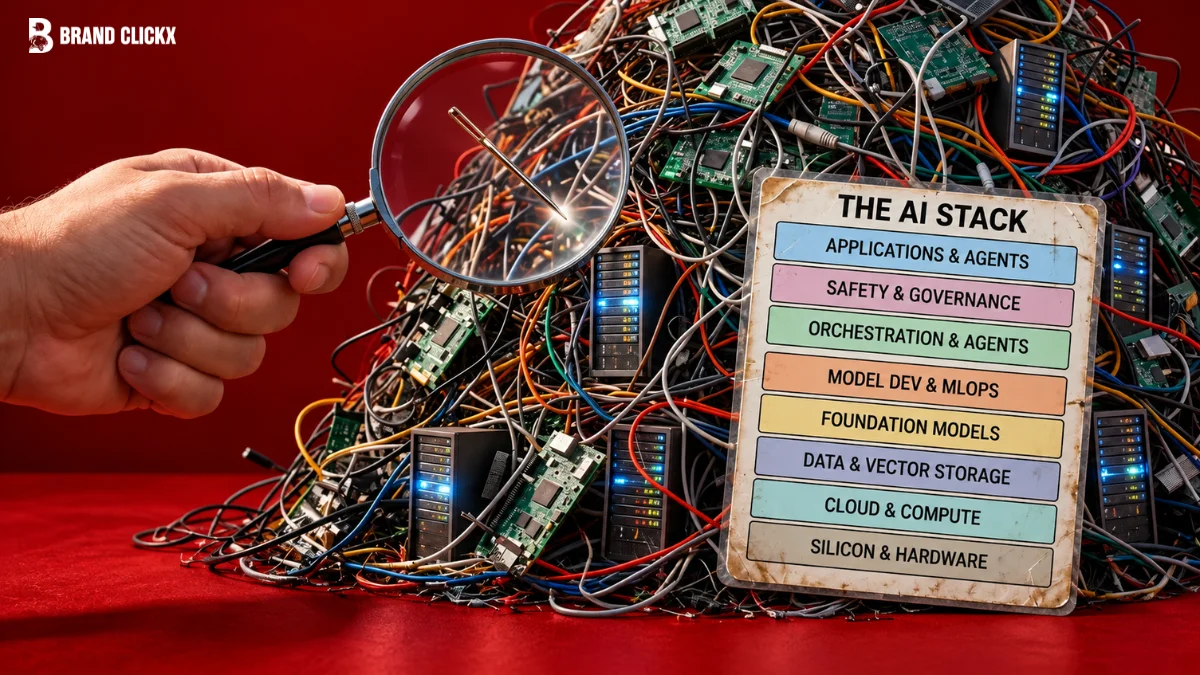
The first time you try to build AI for a real business, it looks pretty simple.
You pick a good model, connect it to your company data, add a few tools, and think you’re done. Then reality shows up.
The model needs access to the right data. Someone has to control what it can see. Your developers need a way to connect it with CRM, databases, email, internal apps, and other systems. Then there is security, monitoring, cost, permissions, and the small problem of knowing what the AI actually did after it took an action.
That is where the enterprise AI stack comes in.
It isn’t just an AI model or an API. It’s the collection of infrastructure, data systems, models, retrieval tools, agent frameworks, integrations, security controls, and monitoring services that make AI usable inside a real company.
And honestly, this is where many AI discussions become confusing. There are hundreds of tools now, and almost every vendor wants to become the “AI platform” for your business.
You don’t need all of them.
What you need is a stack that fits your data, your existing technology, your security requirements, and the work you actually want AI to perform.
That’s what we’ll map out here.
AI Overview
An enterprise AI stack is the combination of infrastructure, data, AI models, retrieval, agent tools, integrations, security, governance, and monitoring used to build and operate AI applications inside a business.
A simple stack may need only a model, company data, search, an application, and security.
A large enterprise may need multiple models, agent orchestration, data platforms, AI gateways, observability, strict identity controls, and approval workflows.
Key Takeaways
- The AI model is only one layer of an enterprise AI stack.
- Data quality and access controls are just as important as model quality.
- RAG connects AI with private company information.
- Agent orchestration lets AI perform multi-step work.
- Security and identity become critical when agents can take actions.
- Most businesses should start small instead of buying every AI platform.
- A multi-model architecture can reduce dependence on one provider.
What Is an Enterprise AI Stack?

Think of it as the technology underneath an AI-powered business process.
For example, imagine an AI customer-support system.
The customer sends a question. The application identifies the user, retrieves information from company systems, sends the relevant context to an AI model, decides what action is needed, calls the right business tool, and records what happened.
Every one of those steps can involve a different part of the stack.
That is why “Which AI model should we use?” is not enough anymore.
Forrester’s Q3 2026 AI Platforms research makes a similar point: agentic AI has changed what an AI platform needs to do, moving the focus from traditional data science toward context, workflows and completing enterprise processes.
The Main Layers of an Enterprise AI Stack
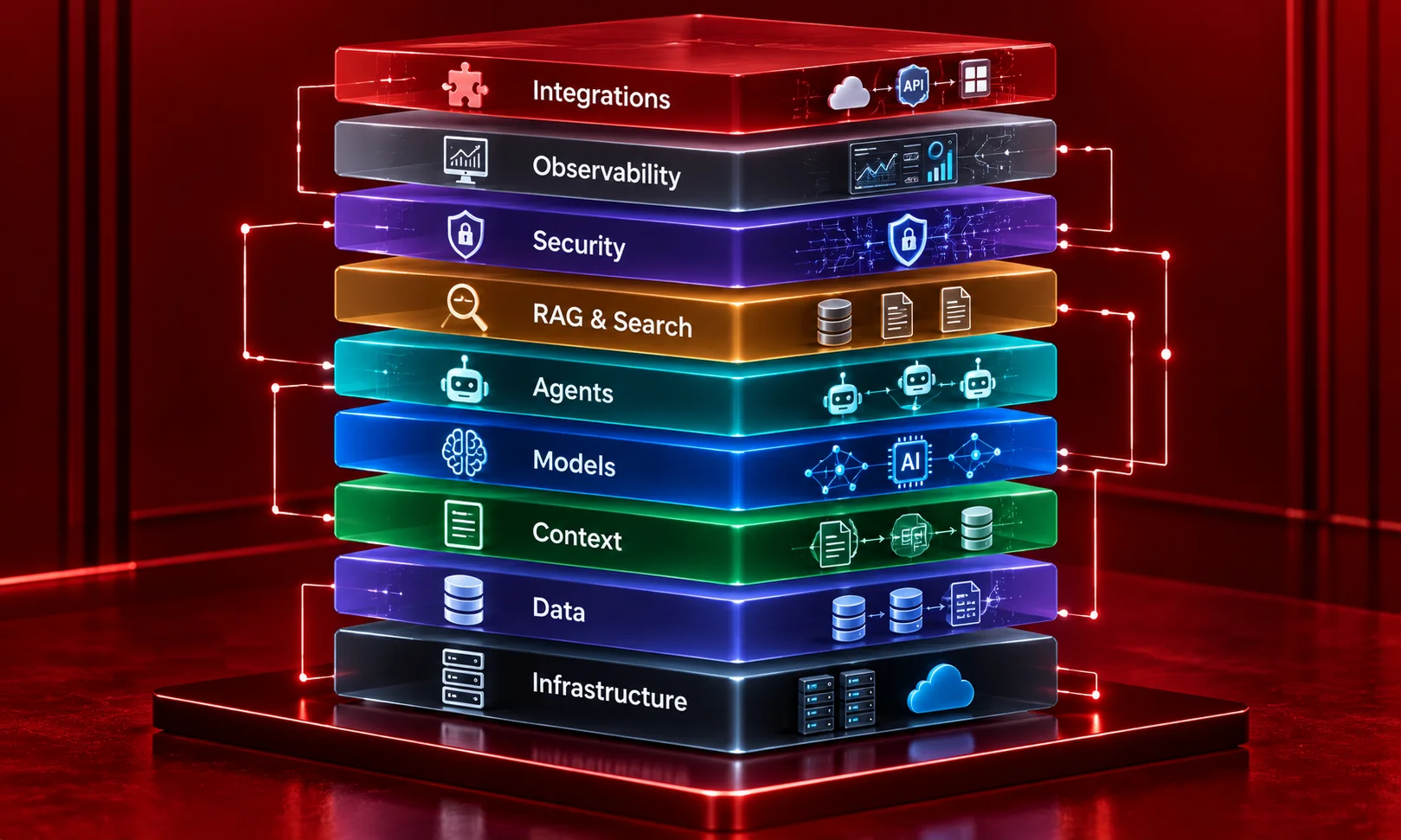
You will see different versions of the stack, but these are the layers most businesses should understand.
| Layer | Purpose | Examples |
| Infrastructure | Runs AI workloads | AWS, Azure, Google Cloud |
| Data | Stores business information | Snowflake, Databricks, BigQuery, Fabric |
| Context | Gives AI business meaning | Microsoft Graph, Unity Catalog |
| Models | Provides AI reasoning | OpenAI, Anthropic, Google, Meta, Mistral |
| Agents | Handles multi-step tasks | LangGraph, Foundry, Bedrock Agents |
| RAG & Search | Retrieves useful information | Azure AI Search, Pinecone, Weaviate, pgvector |
| Security | Controls access and risk | Entra, Purview, Guardrails, AI gateways |
| Observability | Tracks quality and cost | LangSmith, Arize, Langfuse, MLflow |
| Integrations | Connects business systems | APIs, MCP, SaaS tools |
You do not need a separate product for every row.
That is an important point.
1. Infrastructure
This is the computing foundation.
Most enterprises use cloud infrastructure from AWS, Microsoft Azure, or Google Cloud. Some also use specialized GPU infrastructure for demanding workloads.
You need to think about:
- Processing power
- Availability
- Latency
- Data location
- Security
- Scaling
- Cost
If you are using managed AI models, you may not need to manage GPUs yourself.
2. Enterprise Data
AI is only as useful as the information it can access.
Your stack may connect to:
- CRM systems
- ERP systems
- Databases
- Documents
- Data warehouses
- Customer records
- Internal knowledge bases
Databricks, Snowflake, BigQuery and Microsoft Fabric are examples of platforms that can provide important parts of this data foundation.
The goal is not simply to store data.
The goal is to make the right data available to AI safely and at the right time.
3. AI Models
This is the layer most people focus on first.
Enterprises can use models from providers such as OpenAI, Anthropic, Google, Meta and Mistral.
The best model depends on the task.
A simple classification job does not necessarily need the same model as a complex reasoning workflow.
This is why model routing is becoming useful. A company can choose a model based on cost, speed, accuracy, availability or data requirements.
Gartner forecasts that spending on AI models and platforms will reach $64.252 billion in 2026, up 63.4% from 2025. It also forecasts 117% growth in spending on generative AI models.
The market is growing quickly, but that does not mean every company should use the most expensive model.
4. RAG and Search
RAG stands for Retrieval-Augmented Generation.
It allows an AI model to retrieve relevant company information before generating an answer.
For example, instead of asking an AI model to guess your refund policy, the application can retrieve the actual policy and give it to the model.
Common technologies include:
- Azure AI Search
- Pinecone
- Weaviate
- Milvus
- pgvector
- Elasticsearch
- OpenSearch
For enterprise systems, retrieval also needs permission controls.
An employee should not receive confidential information simply because the AI found it in a database.
5. Agents and Orchestration
This is where the 2026 stack becomes more interesting.
An AI assistant can answer a question.
An AI agent can potentially do something.
For example:
A support agent can read a ticket, search customer information, check company policy, update the CRM and prepare a response.
That requires orchestration.
Popular options include LangGraph, Microsoft Foundry Agent Service, Amazon Bedrock Agents, Google agent tooling, Salesforce Agentforce and ServiceNow AI Agents.
The right choice depends on your existing systems and how much control your developers need.
Security Is Not an Extra Layer
Once AI can take actions, security cannot be added at the end.
You need to control:
- Who can use the AI
- What data it can access
- Which tools it can call
- Which actions need approval
- What gets logged
- How long information is retained
Agent identity is especially important.
An AI agent should not automatically receive unlimited access just because the employee using it has broad permissions.
Use the smallest permissions necessary for the task.
AI Gateways and the Control Plane
As companies use more models and agents, managing everything separately becomes difficult.
This is where an AI gateway or control plane can help.
It can provide centralized controls for things such as:
- Authentication
- Authorization
- Model routing
- Rate limits
- Token usage
- Monitoring
- Governance
Microsoft’s current AI Gateway documentation describes support for managing AI models, agents and tools, including centralized security, routing, monitoring and governance. Its dedicated AI Gateway tier is currently documented as public preview, so enterprises should check the maturity of individual features before depending on them in production.
The bigger trend matters even if you use another vendor:
Enterprise AI needs a control layer.
Which Enterprise AI Platform Should You Choose?

There is no single best platform.
Forrester evaluated 15 AI platform vendors in its Q3 2026 Wave, including AWS, C3 AI, Databricks, Google, IBM, Microsoft, Oracle, Salesforce, ServiceNow and UiPath. Its conclusion is especially useful: enterprises should think about platform fit and interoperability rather than forcing every AI use case into one system.
A simple way to compare them:
| Platform approach | Good for |
| Microsoft Foundry | Microsoft-heavy enterprises |
| AWS Bedrock | AWS-first companies |
| Google Vertex AI | Google Cloud and data-heavy teams |
| Databricks | Data and machine learning workloads |
| Snowflake | Organizations already centered on Snowflake |
| LangGraph | Teams wanting flexible agent development |
| ServiceNow / UiPath / Pega | Workflow-heavy businesses |
Your existing technology environment should influence the decision heavily.
If your company already runs most systems on Azure, moving everything to another ecosystem just because one AI feature looks attractive may create more problems than it solves.
Do You Need Every Layer?
No.
This is probably the most useful thing to remember.
Simple AI application
You may need:
Application + Model + Data + RAG + Security
Production AI workflow
Add:
Agents + Tools + Monitoring + Evaluation
Large enterprise AI environment
You may eventually need:
Multiple models + AI gateway + Agent orchestration + Governance + Observability + Centralized data
Build the stack around your actual workload.
Do not build it around a technology diagram.
Build vs. Buy
A good rule is simple.
Buy the commodity. Build the advantage.
Managed models, cloud infrastructure, databases and standard monitoring are usually easier to buy.
Your proprietary business logic, workflows, customer experience and specialized AI processes may deserve custom development.
Also think about vendor lock-in.
If replacing one model requires rewriting your entire application, your architecture is probably too tightly connected to that provider.
A flexible enterprise AI stack should make it possible to change important components without rebuilding everything.
What Does an Enterprise AI Stack Cost?
There is no single price.
Your cost depends on:
- Model usage
- Number of users
- Data volume
- RAG queries
- Agent execution
- Tool calls
- Storage
- Monitoring
- Infrastructure
- Human approvals
AI agents can also make costs harder to predict because one user request may trigger several model calls and tool calls.
Gartner says enterprise AI spending is increasingly being judged on usage efficiency, cost control and measurable outcomes.
So do not measure only cost per AI request.
Measure cost per successful business task.
That gives you a much clearer picture.
A Practical Enterprise AI Stack to Start With
If you are starting today, keep the first version simple.
Step 1: Choose one business problem
Do not start with “We need an AI strategy.”
Start with something measurable:
- Reduce support response time
- Search internal documents
- Classify leads
- Summarize meetings
- Automate a repetitive workflow
Step 2: Connect trusted data
Identify exactly where the information comes from.
Clean it before giving it to AI.
Step 3: Choose the model
Pick based on quality, cost, speed and requirements.
Do not automatically choose the biggest model.
Step 4: Add RAG if needed
Use retrieval when the AI needs private or frequently changing information.
Step 5: Add tools carefully
If the AI needs to perform actions, give it only the permissions required.
Step 6: Monitor everything
Track quality, failures, latency, usage and cost.
Then improve the system using real production data.
Common Enterprise AI Stack Mistakes
Starting with the model: The business problem should come first.
Ignoring data quality: Bad data produces bad AI results.
Giving agents too much access: Keep permissions narrow.
Skipping evaluation: A demo working once does not mean the system is reliable.
Building too much: Start with the smallest stack that solves the problem.
Ignoring costs: Monitor the full workflow, not just model pricing.
Creating heavy vendor lock-in: Keep important interfaces replaceable where practical.
What Will Matter Most Next?
The biggest change is that enterprise AI is moving from generating content to completing work.
That means data, context, identity, orchestration and governance will become increasingly important.
Gartner also identifies AI context platforms as an emerging category for delivering reusable, governed context to AI agents at runtime.
At the same time, AI infrastructure spending is growing rapidly. Gartner projects AI-optimized infrastructure-as-a-service spending to reach $42 billion in 2026, showing how much investment is going into the computing layer behind enterprise AI.
The future stack will probably not be one giant platform.
It will be a connected system of models, data, agents, tools and control layers.
Frequently Asked Questions
What is an enterprise AI stack?
An enterprise AI stack is the collection of technologies a company uses to build, deploy, secure and monitor AI applications. It can include data platforms, AI models, RAG, agents, APIs, security and observability.
What are the main layers of an enterprise AI stack?
The main layers are infrastructure, data, context, models, RAG/search, agents, integrations, security and monitoring. Larger companies may add dedicated governance and AI gateway layers.
Is RAG still important in 2026?
Yes. RAG remains useful when AI needs access to private, current or specialized company information. The important part is making sure retrieval respects data permissions.
Does every company need AI agents?
No. If your application only needs to generate or summarize information, a normal AI application may be enough. Agents make more sense when AI needs to perform multi-step tasks or interact with business systems.
What is the best enterprise AI platform?
There is no universal winner. Microsoft Foundry, AWS Bedrock, Google Vertex AI, Databricks, Snowflake and specialist platforms all have different strengths. Your existing cloud, data and workflow environment should guide the decision.
How can enterprises reduce AI costs?
Use the right model for each task, monitor usage, control agent actions, optimize retrieval and measure the cost of completing a real business task. Do not judge the entire system only by model token prices.
Final Takeaway
The best enterprise AI stack is not the one with the most tools.
It is the one that solves a real business problem without creating unnecessary complexity.
Start with the workflow. Connect trusted data. Choose the right model. Add RAG when you need private knowledge. Add agents only when AI needs to take action. Then put security, monitoring and cost controls around the whole system.
That approach is easier to build, easier to manage and much easier to improve.
And as enterprise AI moves further toward agents, the real competitive advantage will not simply come from having access to the newest model.
It will come from building a system that knows what information to use, what it is allowed to do, and when a human should still be in control.