
Claude and GPT-6 Astra are built for much more than answering simple questions. They can write, code, analyze documents, solve difficult problems, use tools, and handle tasks that can take many steps to complete.
But that does not mean they are equally good at everything. GPT-6 Astra is especially strong when an AI needs to work with computers, software, science, technical problems, and long multi-step tasks. Claude Fable 5.1 is also designed for demanding coding, research, and long-running work, and it performs better than Astra on some broad intelligence evaluations.
So which one should you use? The answer depends on what you expect from your AI. If you want an AI that can take action on a computer and handle difficult technical workflows, GPT-6 Astra has a strong advantage. If your work centers on long-running knowledge work, coding, research, and careful problem-solving, Claude remains a serious choice. Here is how the two models compare when we look beyond the headline scores.
Claude vs GPT-6 Astra at a Glance
| Area | Claude Fable 5.1 | GPT-6 Astra |
| Overall capability | Excellent | Excellent |
| Complex reasoning | Excellent | Excellent |
| Coding | Excellent | Excellent, with a stronger showing on several coding tests |
| Computer use | Strong | Major strength |
| Research | Strong | Strong |
| Science and mathematics | Strong | Major strength |
| Long documents | 1 million token context | Strong long-context retrieval |
| Agentic tasks | Major strength | Major strength |
| Professional work | Strong | Major strength |
| Writing | Excellent | Excellent |
| Best fit | Long-running knowledge and coding work | Technical, computer-use and multi-step work |
The important thing here is that there is no useful reason to call one model the winner in every row. The difference becomes clearer when you look at what the models actually do with those abilities.
What Makes Claude and GPT-6 Astra Different?

Claude Fable 5.1 is built for long-running work. It can handle large coding projects, research tasks, documents, spreadsheets and other jobs that may continue for hours. It can use tools, recover when a step fails, and continue working with relatively little supervision. Its 1 million token context window also gives it room to work with very large amounts of information.
GPT-6 Astra takes a somewhat different approach. It is designed not only to reason about a task but also to act on it. It can work with websites, applications, documents, spreadsheets and other computer environments. It is also trained for software engineering, science, professional work and agentic tasks.
That difference matters. Imagine asking an AI to explain how to complete a complicated spreadsheet task. A normal chatbot may give you instructions. A more capable computer-using model can potentially open the spreadsheet, inspect the information, make the changes and check the result. That is where Astra becomes particularly interesting.
Claude is not far behind in the agentic direction. Fable 5.1 is also designed to operate browsers, use tools, work across applications and run long tasks without constant supervision. The real comparison, therefore, is not simply which model knows more. It is also which model can turn that knowledge into useful work.
Claude vs GPT-6 Astra Benchmark Comparison
The benchmark results show a clear pattern, but not a one-sided victory. GPT-6 Astra scores higher than Claude Fable 5.1 on several demanding evaluations.
For example, Astra scores 57.9% versus 55.8% on Terminal-Bench 4.0, 74.1% versus 67.4% on DeepSWE, 97.6% versus 87.8% on FrontierMath Tier 4, and 96.0% versus 93.7% on GPQA Diamond. Astra also scores 64.6% versus 52.6% on Terminal-Bench Science.
But Claude has important wins too. On Humanity’s Last Exam with tools, Claude Fable 5.1 scores 65.0%, compared with 57.2% for Astra. On the Artificial Analysis Intelligence Index shown in the same comparison, Claude Fable 5.1 scores 65.7 while Astra scores 61.2. That is why saying “Astra wins the benchmarks” would be misleading.
It wins many important tests, especially in technical and scientific areas, but Claude remains ahead on some broader evaluations. Another detail readers should know is that benchmark results can depend on the tools, prompts, harnesses and settings used during testing.
The published Astra results specifically note that API or research evaluations can differ from the version people encounter inside a finished product. So the numbers are useful, but they are not the whole story.
Which Model Is Better at Reasoning?
Both models are capable of handling problems that require several steps rather than a quick answer. GPT-6 Astra has a particularly strong showing on difficult mathematical and scientific evaluations. Its FrontierMath Tier 4 result is 97.6%, while Claude Fable 5.1 scores 87.8%. Astra also reaches 96.0% on GPQA Diamond, compared with 93.7% for Fable 5.1. That suggests a strong advantage for Astra when the task involves difficult technical reasoning.
Claude should not be dismissed, though. Its higher result on Humanity’s Last Exam with tools shows why a single benchmark cannot settle the question. Different tests put different demands on a model, and Claude can still perform extremely well when the task requires broad knowledge, research and reasoning.
For a person choosing between the two, the practical difference is simple. If your difficult questions are mostly mathematical, scientific or technical, Astra looks like the stronger choice based on the current results. If your work involves broad research, analysis and long-running knowledge tasks, Claude remains highly competitive.
Claude vs GPT-6 Astra for Coding
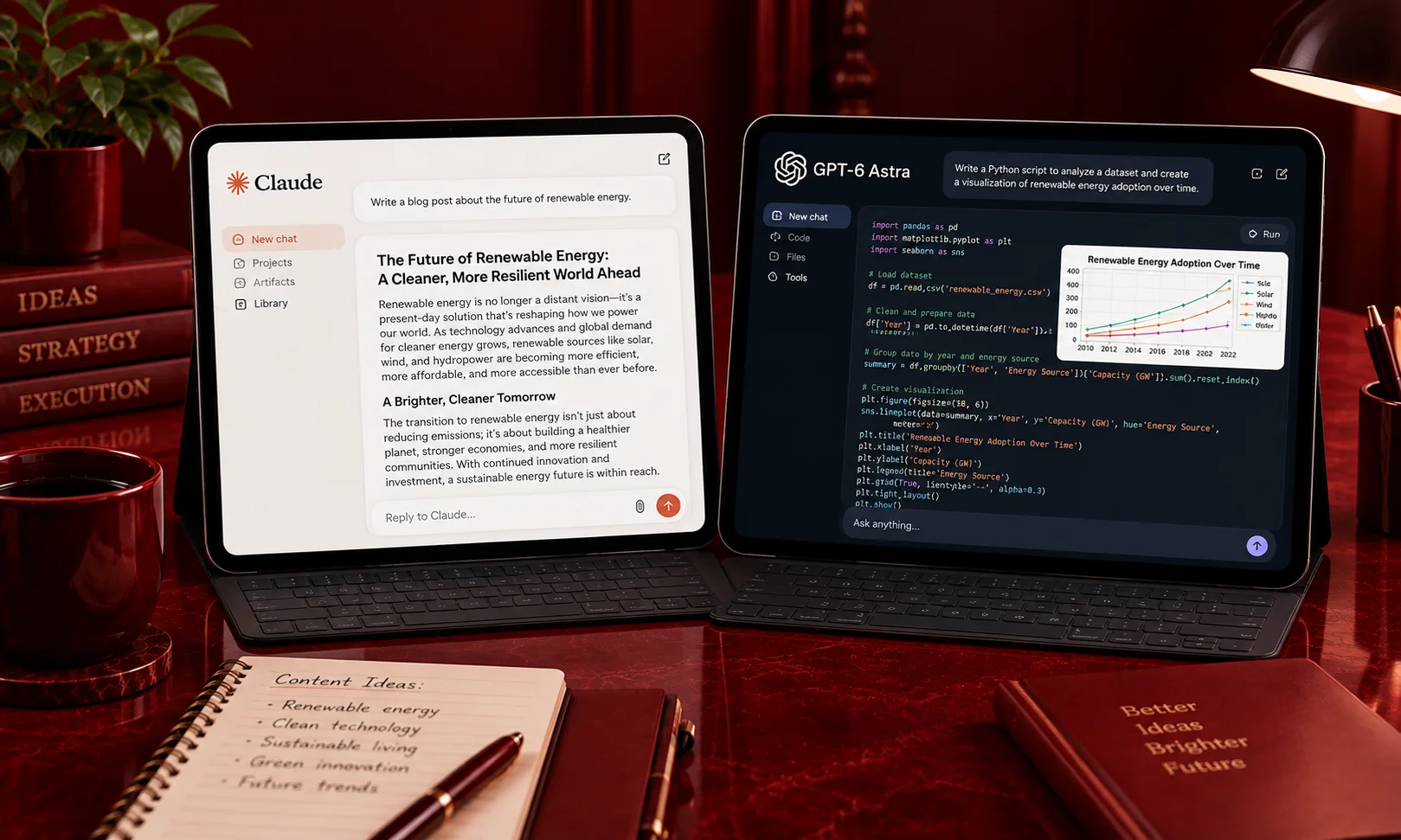
Coding is one of the closest parts of this comparison because both models are built for serious software work. Claude Fable 5.1 is designed for large codebases, code review, performance work and long autonomous coding sessions. It can write tests, inspect its own work and use vision to compare what it produces with the intended result.
Astra has a strong advantage in several current coding evaluations. On Terminal-Bench 4.0, Astra scores 57.9%, compared with 55.8% for Fable 5.1. On DeepSWE, Astra reaches 74.1% versus 67.4%. It also scores 63.9% on the internal database migration evaluation, compared with 57.8% for Fable 5.1.
The difference becomes more interesting in real development work. Astra is designed to keep track of requirements and test results across long coding sessions. Its Codex environment can preserve information from earlier context windows instead of repeatedly reducing everything to a summary.
Claude’s strength is also clear when a project becomes large and complicated. Fable 5.1 is built specifically for multi-day coding projects and can continue working through large tasks with less supervision. For difficult software engineering today, Astra gets the edge, but Claude is close enough that developers should judge both on their own codebase and workflow.
Which Model Is Better at Computer Use?
This is one of the clearest advantages for GPT-6 Astra. Astra is designed to interact with computers instead of simply describing what a person should do. It can fill forms, update records, organize information, conduct online research, work inside document editors, analyze data and test websites. Its current computer-use results are strong.
Astra scores 72.6% on OSWorld 2.0 and 59.3% on Agents’ Last Exam. It also reaches 92.7% on ScreenSpot-Pro. The same comparison lists Claude Opus 5 at 70.2% on OSWorld 2.0 and 55.5% on Agents’ Last Exam, while Fable 5.1 does not have a reported score for those particular tests in the table.
Astra also completed the OSWorld tasks in roughly 40 minutes in the reported latency simulation, compared with roughly 75 minutes for the previous model. Claude is still capable in this area. Fable 5.1 can operate browsers, work across applications and run unattended agent tasks. But if your main goal is to give an AI a computer-based job and let it carry out the work, GPT-6 Astra is the more convincing choice right now.
Which Is Better for Research and Science?
Research is no longer just about finding information. A strong research model needs to understand complicated material, compare evidence, reason through uncertainty and sometimes use software or other tools to investigate a problem. GPT-6 Astra has a major advantage on several scientific evaluations.
It scores 64.6% on Terminal-Bench Science, 97.6% on FrontierMath Tier 4 and 96.0% on GPQA Diamond. It also scores 63.4% on HealthBench Professional. Astra can also combine scientific reasoning with computer use. That means it can work with specialized software, inspect data and help explore results instead of stopping at a written explanation.
Claude Fable 5.1 takes a different but equally useful approach to research. It is built for long-running research and analysis, including projects where the AI may need to work through large collections of documents and produce a finished deliverable. So there is a useful split.
For technical and scientific problem-solving, Astra has the stronger evidence. For long-running knowledge work and document-heavy research, Claude remains a very strong option.
Which Model Is Better for Writing?
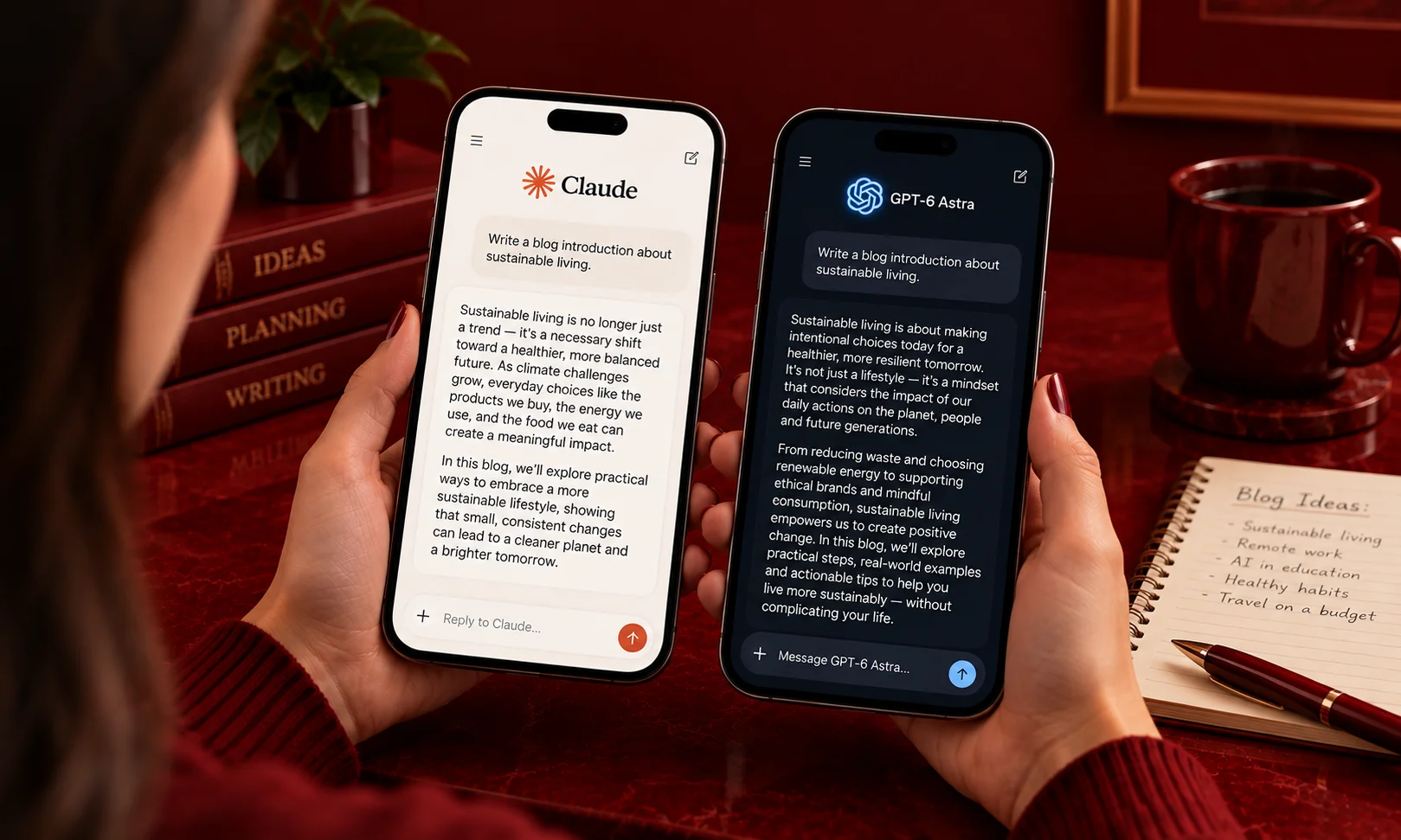
Writing is harder to judge with a benchmark because people do not choose a writing model based only on a score. They care about whether the text sounds natural, whether the AI follows the requested tone, whether it repeats itself, loses the point, changes important details or turns a simple answer into a long lecture.
Both Claude and Astra are capable writing models. Astra is specifically trained to produce polished documents, presentations, spreadsheets and analyses while following existing templates and styles. It is also designed to pull the information that matters instead of unnecessarily repeating everything it has been given.
Claude Fable 5.1 is built for long knowledge-work projects and can produce deliverables after working through a large task with relatively little supervision. For everyday writing, neither model has such a decisive advantage that every user should switch immediately.
If writing is your main job, the better choice may come down to which model better matches your preferred style and editing workflow. That is one area where trying the same real writing task in both models is more useful than looking at a benchmark table.
Which Model Handles Long Documents Better?
Large documents can expose a weakness that is easy to miss in a short conversation. An AI may understand a five-page document perfectly but lose important details when the material becomes hundreds of pages long.
Claude Fable 5.1 has a 1 million token context window and can produce up to 128,000 tokens in one response. It is specifically positioned for large documents and long-running work.
Astra also performs strongly on long-context retrieval. Its published MRCR v2 results show 100% on the 256K to 512K test and 96.3% on the 512K to 1M range. An important difference is present between having a large context window and using that information well.
A huge window is useful only if the model can find the right information when it needs it. Astra’s results suggest very strong retrieval across large contexts, while Claude’s 1 million token window makes it well suited to massive documents and long projects. For document-heavy work, both deserve serious consideration.
Which Is Better for AI Agents and Automation?
This is where AI starts to feel less like a chatbot and more like a worker. Instead of asking, “What should I do?”, you give the model a goal. It may need to research something, open several tools, inspect information, make decisions, complete several steps and return with a finished result.
Both models are designed for this kind of work. Claude Fable 5.1 is built for long-running agents that can operate browsers, use tools, recover from failed steps and continue working across applications.
Astra is also designed around multi-step computer work and professional workflows. Its AutomationBench score is 41.4%, compared with 31.4% for Claude Fable 5.1. It also scores 91.5% on BrowseComp, compared with 87.4% for the older Claude Fable 5 result listed in the same comparison.
This is one of the areas where Astra’s combination of reasoning and computer interaction becomes important. For automation that requires the AI to operate a computer and complete a workflow, Astra has the stronger current case. Claude remains attractive when the task is a long-running research or coding project that needs planning, persistence and careful execution.
Where Claude Has the Advantage
A good comparison should not hide the places where Claude wins. The clearest example is Humanity’s Last Exam with tools. Claude Fable 5.1 scores 65.0%, compared with 57.2% for Astra. Claude also scores higher on the Artificial Analysis Intelligence Index in the current comparison, at 65.7 versus 61.2.
Claude also has a strong practical identity around long-running knowledge work. It is designed to take on projects that may last hours or days, including research, coding, document work and other complicated tasks.
Its 1 million token context window is another major advantage when working with very large inputs. This matters because benchmark leadership is not the same thing as being the best assistant for every person. Someone working mostly with long documents, research and large coding projects may find Claude to be the better fit even if Astra leads on several technical benchmarks.
Where GPT-6 Astra Has the Advantage
Astra’s biggest strength is its combination of intelligence and action. It is not only strong at solving technical problems. It is designed to use computers, browse, work with applications and complete multi-step professional tasks.
Its benchmark results reinforce that position. Astra leads Fable 5.1 on Terminal-Bench 4.0, DeepSWE, FrontierMath Tier 4, GPQA Diamond, Terminal-Bench Science, AutomationBench, BenchCAD and several science and health evaluations. Its computer-use results are another major advantage. That combination makes Astra especially interesting for developers, technical professionals, researchers and businesses that want AI systems to perform tasks rather than simply provide instructions.
Does the Highest Benchmark Score Mean the Best AI Model?
Not necessarily. This is probably the most important thing to understand before choosing any AI model. Imagine two students. One scores higher on mathematics. The other writes better essays and performs better on research projects.
Calling the first student “better at everything” would make no sense. AI benchmarks work in much the same way. A model can dominate a difficult mathematics evaluation while another performs better on a broad knowledge test. One can be excellent at coding while another produces writing that a particular user prefers.
The testing setup matters too. The tools available to the model, the instructions it receives and the environment in which it operates can affect the result. The current Astra comparison specifically notes that research and API evaluations can differ from the version available in a production product. That does not make benchmarks useless. They are extremely helpful when used correctly. The mistake is treating one number as a complete description of an AI model.
Claude vs GPT-6 Astra for Different Users
For programmers
GPT-6 Astra gets the edge.
Its current coding results are stronger on several important evaluations, and its ability to work with computers and long-running coding tasks makes it particularly attractive for software development. Claude is still an excellent choice for large codebases, code review and long autonomous projects.
For writers
It is much closer.
Both can handle long-form writing, editing, rewriting and detailed instructions. The better choice may depend more on the style you prefer than on raw intelligence.
For researchers
It depends on the research.
Astra has a strong advantage for scientific and technical research, especially when tools and software are part of the job. Claude is especially attractive for long-running document-heavy research.
For students
Either can work well.
For mathematics, science and difficult technical questions, Astra has a strong case. For reading, writing and working through large amounts of material, Claude can be equally useful.
For business users
GPT-6 Astra has a strong advantage when the work involves computer actions. It can work with forms, spreadsheets, documents, websites and other professional tasks. Claude is attractive for long-running business research, analysis and project work.
For AI developers
Both are serious choices. The better option depends on the tools, API pricing, context requirements and workflow you are building.
For everyday users
There is no reason to choose based only on benchmark scores. If you mainly ask questions, write messages, summarize documents and brainstorm ideas, both models are more than capable. The interface, availability, speed and your preferred style may matter more.
Claude vs GPT-6 Astra: Pricing and Access
Pricing is surprisingly close at the API level. GPT-6 Astra is listed at $10 per million input tokens and $50 per million output tokens. Claude Fable 5.1 has the same standard input and output prices of $10 and $50 per million tokens.
Astra also offers a faster API mode at a higher price, while Fable 5.1 has lower cache-read pricing than its predecessor. For consumer access, Astra is being made available through ChatGPT Plus, Pro, Business and Enterprise plans, while Claude Fable 5.1 is available through Pro, Max, Team and Enterprise plans. This means price alone does not settle the comparison. The more useful question is:
Which model gives you more useful work for the money you spend? For someone who needs heavy computer automation, Astra’s capabilities may justify the cost. For someone running long research or coding projects, Claude’s long-context and agentic capabilities may be more valuable.
Which Is the Best AI Model in 2026?
If “best” means the strongest combination of technical reasoning, science, computer use and agentic capability, GPT-6 Astra has a very strong claim. Its current results are especially impressive in mathematics, science, coding, computer use and professional automation. But if “best” means the model that performs best across every possible type of AI task, the answer is less clear.
Claude Fable 5.1 beats Astra on some important broad evaluations and remains extremely strong for long-running research, coding and knowledge work. So the better answer is: GPT-6 Astra is the stronger overall choice for users who want advanced technical reasoning plus computer and agentic capabilities. Claude remains one of the best choices for long-running knowledge work, research and coding. That is a more useful answer than simply putting one model at number one.
Our Editorial Approach to Claude vs GPT-6 Astra
At BrandClickX, we approach Claude vs GPT-6 Astra by looking beyond a single benchmark score and examining how both models perform in real areas of AI work. Our Claude vs GPT-6 Astra comparison covers coding, reasoning, research, computer use, writing, long documents, AI agents, automation, pricing, and different user needs. We also examine the strengths and limitations of each model because Claude vs GPT-6 Astra cannot be judged fairly by one test or one number. Through our Claude vs GPT-6 Astra analysis, we aim to give readers clear and practical information that helps them understand which model better matches the work they actually need to complete.
Claude vs GPT-6 Astra: Final Verdict
Claude and GPT-6 Astra are no longer just competing to produce the better chatbot answer. They are competing to become systems that can take a complicated goal and help complete the work. GPT-6 Astra currently has the stronger position in computer use, difficult mathematics and science, several coding evaluations, professional automation and other tasks where the AI must reason and act. Claude Fable 5.1 remains a powerful alternative.
Its strengths in long-running work, large-context tasks, coding and broad knowledge evaluations make it a serious choice rather than a runner-up that should simply be ignored. So, which one should you choose? Choose GPT-6 Astra if you want an AI that can handle demanding technical work, coding, computer interaction, scientific problems and multi-step automation.
Choose Claude if your work revolves around long research projects, large documents, extended coding sessions and knowledge-heavy tasks where persistence and careful analysis matter most. And if you are simply looking for the best AI model in 2026, do not choose from a leaderboard alone. Choose the model that is best at the work you actually need to get done.
Frequently Asked Questions
Is GPT-6 Astra better than Claude?
GPT-6 Astra is stronger on many current technical, scientific, coding and computer-use evaluations, but Claude Fable 5.1 leads on some broader evaluations. There is no single benchmark that proves one model is better for every task.
Which is better for coding, Claude or GPT-6 Astra?
GPT-6 Astra has the stronger overall case based on the current coding results. It leads Claude Fable 5.1 on Terminal-Bench 4.0 and DeepSWE, while Claude remains highly capable for large codebases and long autonomous coding projects.
Which has better reasoning?
GPT-6 Astra has a clear advantage on several difficult mathematics and science evaluations, including FrontierMath Tier 4 and GPQA Diamond. Claude still performs strongly and leads Astra on some broader evaluations.
Which is better for writing?
Both are strong writing models. There is no major benchmark result that makes the decision obvious for every writer, so personal writing style and workflow should play a large role.
Which is better for research?
Astra is particularly strong for scientific and technical research that involves tools and computer work. Claude is particularly well suited to long-running research and large document-heavy projects.
Is GPT-6 Astra the best AI model in 2026?
GPT-6 Astra is one of the strongest AI models available in 2026 and has a particularly strong claim in technical reasoning, coding, science and computer use. But Claude Fable 5.1 leads on some evaluations, so “best” depends on the task.
Are AI benchmark scores reliable?
They are useful for comparing specific abilities, but they should not be treated as a complete measure of an AI model. Different benchmarks test different skills, and results can change depending on the tools, prompts and evaluation setup.