What Fortune 500 CEOs Post on LinkedIn: Here is a statistic that should end every boardroom argument about executive social media: in one analysis of 11,107 employee LinkedIn posts, 90 percent of the posts with the most reactions were written by the CEO. Not the company page. Not the marketing team. The CEO, who typically has about 1.67 percent of the followers the company page has, generates the same total reactions.
Jamie Dimon runs America’s biggest bank with essentially zero social presence. Jensen Huang gives interviews in a leather jacket but barely posts. Meanwhile a growing class of Fortune 500 chiefs has figured out that LinkedIn is not a resume site anymore. It is the largest business media channel on Earth, the algorithm favors humans over logos, and the corner office comes with the most powerful distribution in the building.
We pulled every major dataset on CEO social behavior, from Influential Executive’s annual Fortune 500 audit to H/Advisors Abernathy’s posting analysis and FTI Consulting’s trust research, to answer what the most powerful executives in the world actually post, what performs, and what it does to trust, recruiting, and stock price adjacent perception. This is the state of the social CEO heading into 2027.
Methodology. This report synthesizes Influential Executive’s 2023 to 2024 Fortune 500 CEO audits, H/Advisors Abernathy’s 2024 CEO posting benchmark, DSMN8’s employee post dataset (11,107 posts) and Executive Voice research, FTI Consulting’s 2022 to 2025 digital communications studies, Brunswick Group’s 2022 connected leadership research, Weber Shandwick’s Socializing Your CEO series (2010 to 2024), and Edelman’s 2024 to 2026 trust data. Where studies differ, we show both numbers. Sources at the end.
The State of Play: Who Is Actually Out There
The corner office has quietly gone social. 73 percent of Fortune 500 CEOs are now on at least one social platform, per Influential Executive’s audit, and 98 percent of those use LinkedIn specifically. Among CEOs who post at all, 48 percent publish at least monthly, according to H/Advisors Abernathy. Tech CEOs doubled their account counts year over year, and financial services leads sector adoption with 53 percent of CEOs on LinkedIn.
What Fortune 500 CEOs Post on LinkedIn: The historical arc is dramatic. When Weber Shandwick started tracking the world’s top 50 CEOs in 2010, just 36 percent engaged online at all, and 64 percent were invisible. By 2014 the number hit 80 percent.
The question is no longer whether CEOs should be present. It is why a quarter of the Fortune 500 still runs the most visible job in business with no public voice, especially when H/Advisors found that 53 percent of CEOs who are not on social media have inaccuracies in their online search profiles. Silence does not protect you. It just lets the internet write your biography for you.
The Five Archetypes: What CEOs Actually Post
Our synthesis of the posting data and top performing accounts breaks the social CEO population into five species.
The Employee Champion. The single best performing content type in the entire dataset: posts highlighting employee accomplishments, leadership changes, and employee led philanthropy were three times more likely to beat engagement benchmarks than any other topic, per H/Advisors. The CEO as chief recognition officer. It works because it converts corporate hierarchy into visible humanity, and because every featured employee becomes an amplifier.
The Town Crier. Earnings, launches, partnerships, milestones. The default mode of the median social CEO, and the weakest performer. Company news posted by the CEO consistently underperforms the same news told through a human angle. Executive statements shared online still outrun traditional press release reach, but the bar is the floor, not the ceiling.
The Thought Leader. Industry takes, future predictions, lessons from failure. This is where trust compounds: 64 percent of buyers say thought leadership is a more trustworthy basis for judging a company than its marketing materials, per LinkedIn’s research, and 35 percent of decision makers say an executive’s thought leadership made them consider a vendor. The rarest archetype, because it requires the one thing CEOs guard hardest: an actual opinion.
The Ghost Writer’s Feed. Perfectly polished, committee approved, obviously delegated. Audiences can smell it, and the data shows why comms teams do it anyway: delegate created executive posts reach 2.8 times further than self authored ones, according to DSMN8’s 2026 Executive Voice research. The professional ghostwriting of the CEO voice is now a mature industry, and the tension between scale and authenticity is the defining creative problem of the genre.
The Chaos Agent. One man, one phone, zero approvals, billions in market cap swinging on a post. The outlier that every comms team uses to justify the other four archetypes’ guardrails. Uninsurable, unreplicable, and permanently excluded from every best practice list, including this one.
What Actually Performs: The Format Data
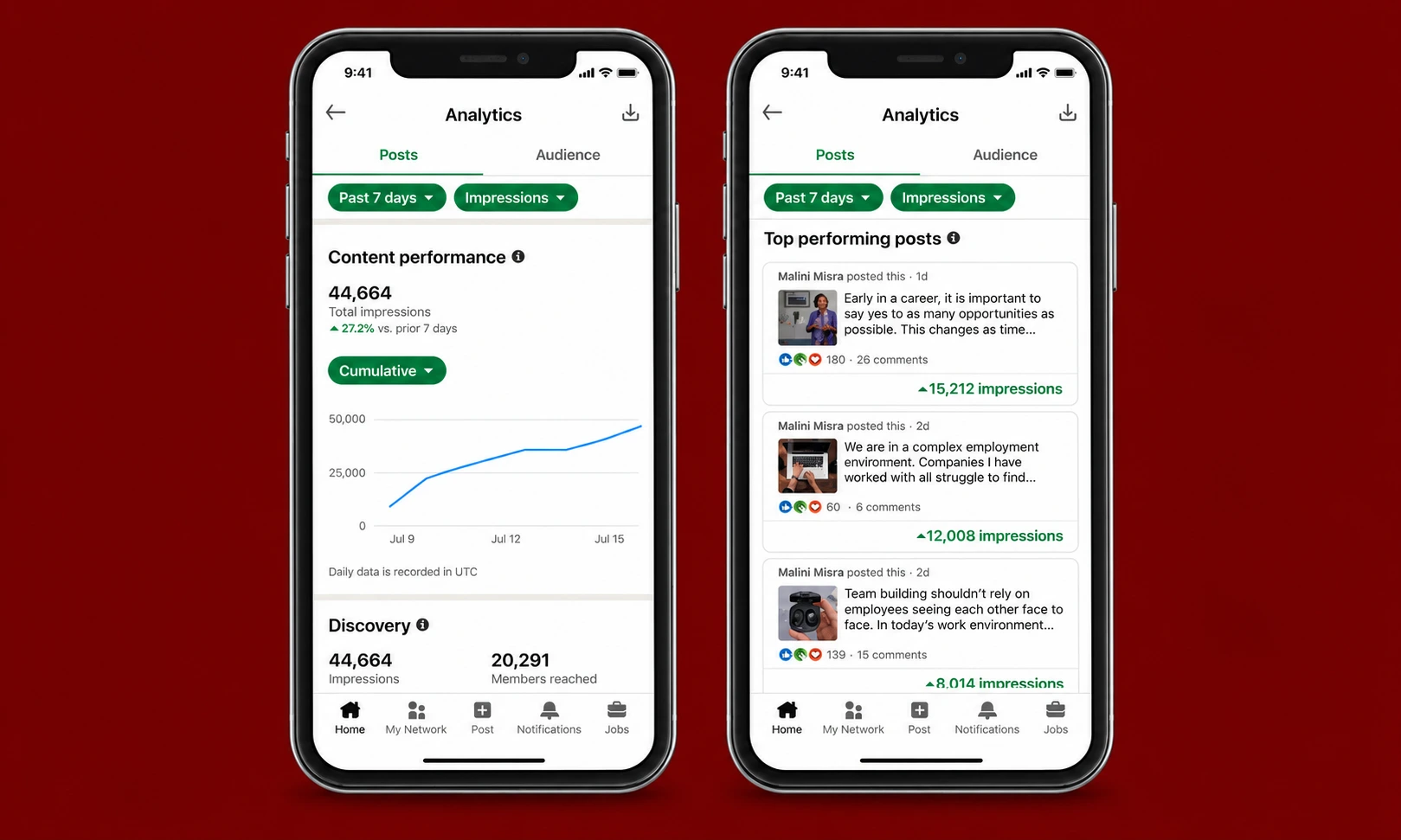
DSMN8’s 2026 LinkedIn research adds the mechanics. Text posts average 774 impressions, nearly five times link posts, despite making up half a percent of employee shares. Text also leads every format on comments, which makes it the conversation starter of choice.
Executives see 98 percent more reach per post than other employee advocates. And the CEO advantage compounds everything: same reactions as the entire company page, from a sliver of the audience.
The playbook writes itself. First person text, employee spotlights, genuine opinions, posted at least monthly. The CEOs winning LinkedIn are not producing content. They are publishing judgment, and recognizing people in public.
The Trust Math: Why This Is a Business Metric, Not a Vanity One
The research stack on outcomes is unusually consistent across firms and years:
Financial readers trust a CEO who uses social media up to nine times more than one who does not (FTI Consulting). 92 percent of professionals are more likely to trust a company whose senior executives are socially active (FTI). 71 percent of consumers say they are more likely to buy from a company whose CEO is active on social media (Edelman).
What Fortune 500 CEOs Post on LinkedIn: 49 percent of corporate reputation is attributed to how people view the CEO (Magnet Media Labs). And 74 percent of global investors say digital communications influence their investment decisions (FTI 2025).
Recruiting is where the numbers get personal. 82 percent of employees research a CEO’s online presence before joining a company, and people prefer to work for socially active leaders by a factor of four (Brunswick). Executives with social CEOs describe their leader as inspiring at nearly double the rate of those without, 43 percent to 26 percent (Weber Shandwick).
Then there is the 2026 trust gap, which frames the whole opportunity. Edelman found 73 percent of people believe CEOs are obligated to help bridge trust divides, while only 44 percent think they are doing it well. A 29 point expectation gap is a market inefficiency, and the CEOs who close it for their own stakeholders are collecting the difference in talent, trust, and pricing power.
The Honest Counterargument
Dimon is not wrong by default. The case against the social CEO is real: time is the scarcest resource in the building, one bad post is a news cycle, regulated industries carry genuine legal exposure, and a forced, miserable executive voice does more damage than silence.
The data also cuts one way the studies rarely advertise: the benefits concentrate in leaders who post with some regularity and something approaching a real voice. A quarterly compliance post from the CEO is not an asset. It is a screenshot waiting to happen.
The defensible middle path, and the one the highest rated programs use: monthly cadence minimum, employee spotlight content as the backbone, one genuine opinion piece per quarter, a professional editor who protects rather than manufactures the voice, and hard rules about what never gets posted.
For comms teams building that machine, our playbooks on LinkedIn for B2B marketing, social selling, and thought leadership content cover the operational layer, and AI powered LinkedIn content strategy covers the tooling.
Frequently Asked Questions
How many Fortune 500 CEOs use social media?
73 percent are on at least one platform, and 98 percent of those use LinkedIn, per Influential Executive’s audit. 48 percent of CEOs on social media post at least once a month.
What type of CEO content performs best on LinkedIn?
Posts spotlighting employee accomplishments were three times more likely to exceed engagement benchmarks than any other topic. On format, plain text posts average nearly five times the impressions of link posts.
Does CEO social media activity affect business results?
The research says yes across every measured dimension: financial readers trust social CEOs up to 9 times more, 71 percent of consumers are more likely to buy from companies with socially active CEOs, and 82 percent of job candidates research the CEO online before joining.
Should every CEO be on LinkedIn?
Not automatically. The benefits concentrate among CEOs who post at least monthly with an authentic voice. A silent CEO beats a miserable forced one, but a well run executive program outperforms both.