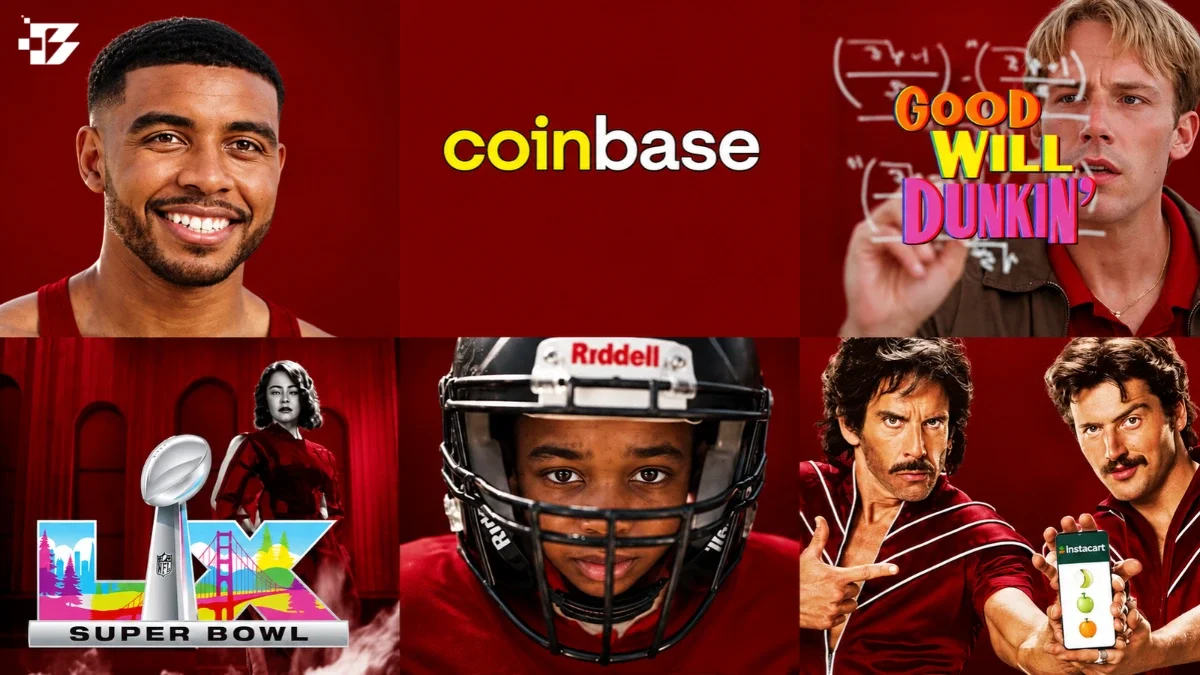
Super Bowl Ads: In February 2026, Coinbase spent roughly $8 million to show 125 million Americans a karaoke screen. For sixty seconds, the Backstreet Boys’ “Everybody” scrolled past with a bouncing ball. No product. No explanation. No mention of crypto, which is awkward when you are a crypto company. The Kellogg School’s annual advertising review gave it an F.
That same night, Anthropic spent its first ever Super Bowl budget on a young man asking an AI chatbot for workout advice, only to watch the bot pivot into selling him shoes. “Ads are coming to AI,” the spot warned. “But not to Claude.” Kellogg gave it an A, and Anthropic’s app shot up the download charts while its rival absorbed the punch on live television.
Thirty seconds of Super Bowl LX airtime cost an average of $8 million, with premium slots hitting a record $10 million. That is $267,000 per second, more than the median American house.
We pulled a decade of effectiveness research across more than 425 tested ads and 63,750 consumer responses, plus the full results from Super Bowl LX, to answer the only question that matters: what separates the brands that turn those seconds into sales from the ones that turn them into karaoke?
Methodology. This analysis synthesizes six years of System1 emotional response testing (425+ ads, 63,750 US respondents, benchmarked against 100,000+ global ads), the Kellogg School Super Bowl Advertising Review (2026 grades, ADPLAN framework), EDO TV Outcomes engagement data for Super Bowl LX, USA Today Ad Meter results, and Stanford GSB sales impact research (55 media markets, six years of Nielsen data). Cost figures from Statista and network rate cards. Sources listed at the end.
The Math of the Bet
Start with why anyone pays this at all. At $8 million against roughly 125 million viewers, the Super Bowl’s effective CPM lands near $64. Standard primetime runs $25. TikTok charges under $10. For the same money, Digiday calculated, an advertiser could buy 1.6 billion TikTok impressions or a primetime network spot every night for four months.
And yet the math keeps working, because the Super Bowl is the last monoculture event in American media. It is the only advertising environment where the ads are the product. People rewatch them, rank them, and argue about them at work on Monday.
EDO’s measurement found that a single Super Bowl ad generates the same brand search engagement as 1,056 primetime ads. Stanford’s sales analysis estimated Budweiser earns an extra $96 million from its Super Bowl presence, a 172 percent return on the investment.
But Stanford buried the catch in the fine print: those gains only materialize when the advertiser has the category to itself. When two major soda brands advertise in the same game, both lose their profit lift entirely. The Super Bowl rewards monopolists and punishes rivals who show up together.
Seven Rules From a Decade of Data
Rule 1: Fluent devices beat celebrities
System1’s six year dataset is unambiguous: ads built on consistent brand assets, recurring characters, owned slogans, and familiar scenarios outperform celebrity vehicles on average. Budweiser’s Clydesdales, deployed since the 1980s, scored a 4.5 star rating with a perfect 100 fluency score in 2025, meaning every single viewer knew whose ad they were watching.
Red Bull’s first ever Super Bowl ad hit 98 fluency because “gives you wings” needed no introduction. A famous face rents attention. A fluent device owns it. We covered the mechanics in our guide to distinctive brand assets, and the Super Bowl is where the principle gets its annual stress test.
Rule 2: Emotion only pays when it is chained to the product
Kellogg’s 2026 winner, Google’s “New Home” spot for Gemini, worked because the emotion was the demo. A mother and son imagine their new house, and Gemini paints the child’s bedroom and grows the garden.
Professor Tim Calkins’ verdict on the night applies to the whole decade: the most effective ads delivered an emotional or humorous punch while clearly conveying what the product does. Feeling without linkage is a short film with a logo at the end.
Rule 3: One in five ads is brandless entertainment
System1’s recall data is the industry’s dirtiest secret: 21 percent of viewers cannot name the brand behind the ad they just watched. That is roughly one in five Super Bowl budgets converted into anonymous entertainment. Coinbase’s karaoke screen was the 2026 case study, but every year produces new members of the club. The fix is boring and free: brand early, brand often, brand visually.
Rule 4: Debut brands must explain themselves
Two AI newcomers ran Super Bowl ads in 2026 with opposite outcomes. Anthropic’s first ever spot earned an A because it said one differentiated thing clearly: AI is about to get ads, Claude will not have them. Ai.com spent millions on a spot that left Kellogg’s panel unable to say what the product was, and earned an F. On the biggest stage, clarity is the entire game for unknown brands. Fame can be cryptic. Obscurity cannot.
Rule 5: Pre release is now half the strategy
The ads that win the internet are usually seen before kickoff. Teaser campaigns in January, full early releases on YouTube, and creator seeding mean the game itself has become the encore rather than the premiere.
Dunkin’s “Good Will Dunkin” spot with Tom Brady, Ben Affleck, and Jennifer Aniston topped EDO’s engagement index at 497, nearly five times the median ad’s performance, and its buzz was building for weeks before it aired.
Rule 6: Category exclusivity is worth more than creative
The Stanford finding deserves repeating because it rewrites media planning. The return on a Super Bowl ad is not primarily a creative question. It is a competitive one. Anheuser Busch has held national beer exclusivity for over two decades, and its ads compound. When rivals share the stage, both parties’ gains evaporate.
In 2026, seven AI companies advertised in one game, and the effectiveness data shows they mostly neutralized each other. The exceptions, Anthropic and Google, won by attacking differentiation rather than praising AI in general.
Rule 7: The game is the beginning, not the event
The brands earning full value treat February as month one. EDO’s tracking shows engagement effects persist for weeks, and System1’s work on extended impact shows consistent brand building after the game separates investments from stunts.
Pepsi’s polar bear spot, where Coke’s mascot defects in a blind taste test, was engineered for a year of social clip recycling, down to a kisscam gag referencing 2025’s most replayed viral moment.
Super Bowl LX: The Report Card
The A students. Google’s Gemini “New Home” took Kellogg’s top grade for fusing heartstrings with product demonstration. Anthropic’s Claude ambush ad defined a positioning war in sixty seconds. Bosch transformed Guy Fieri from “just a guy” into himself, which Adweek’s panel called perfectly timed for a room full of people reaching for more food.
Michelob Ultra’s Kurt Russell ski instructor spot landed in USA Today Ad Meter’s top five. The NFL’s own ad, an unknown child actor pep talking his action figures, proved no celebrities can beat the right nobody.
The F students. Coinbase’s wordless karaoke, graded F for failing to say what the company does. Ai.com’s debut, graded F for leaving viewers unsure the product existed. Two lessons, one theme: clarity is not optional at $267,000 per second.
The AI invasion. Super Bowl LX was the year AI companies bought the game: Claude, OpenAI’s Codex, Genspark, Base44, Salesforce’s Slackbot with MrBeast, Meta’s Oakley AI glasses, Ring’s AI pet finding cameras, and Svedka’s first primarily AI generated commercial in Super Bowl history.
Seven plus AI brands in one broadcast is precisely the category crowding Stanford’s research warns about, and most scored in EDO’s bottom half. The two winners won by fighting each other’s positioning, not by celebrating the category. For where these companies rank as businesses, see our Top 25 AI Companies ranking.
The machine still works. Dunkin’s sitcom reunion led EDO’s outcomes index. Cadillac’s Formula 1 debut announcement hit 429 on the index. Budweiser’s Clydesdale befriending a bald eagle to “Free Bird” reminded everyone why fluent devices rule this list.
What This Means for Your Brand
You will probably never buy a Super Bowl ad. The lessons scale anyway.
Own a distinctive asset and repeat it until it is yours. Chain every emotion to a product truth. Brand early enough that recall is never in doubt. If you are the challenger, say one differentiated thing with total clarity. Check whether your competitors share your stage before you pay for it. And treat launch day as the start of the campaign, because the brands winning the measurement reports are the ones still spending in March.
The karaoke screen is always an option. It just costs $8 million.
Frequently Asked Questions
How much does a Super Bowl ad cost in 2026?
An average of $8 million for 30 seconds at Super Bowl LX, with premium slots reaching a record $10 million. Production, celebrity fees, and pre game marketing typically add millions more.
Do Super Bowl ads actually work?
Yes, conditionally. Stanford research found Budweiser earns an estimated $96 million in extra sales from its Super Bowl presence, a 172 percent return. But when two competing brands in the same category advertise in the same game, the profit lift evaporates for both.
What was the best Super Bowl ad of 2026?
Google’s “New Home” spot for Gemini topped the Kellogg School’s 2026 Advertising Review. Dunkin’s “Good Will Dunkin” led EDO’s engagement index, and Michelob Ultra’s Kurt Russell spot made USA Today Ad Meter’s top five.
What was the worst Super Bowl ad of 2026?
Kellogg’s panel gave F grades to Coinbase’s wordless karaoke spot and ai.com’s debut, both for failing to communicate what the product does.
Disclaimer:
This article is for informational and educational purposes only. Advertising costs and performance figures are based on the research and sources cited in the article. Results may vary by campaign and audience. The analysis does not guarantee that any advertising strategy will produce similar outcomes.