

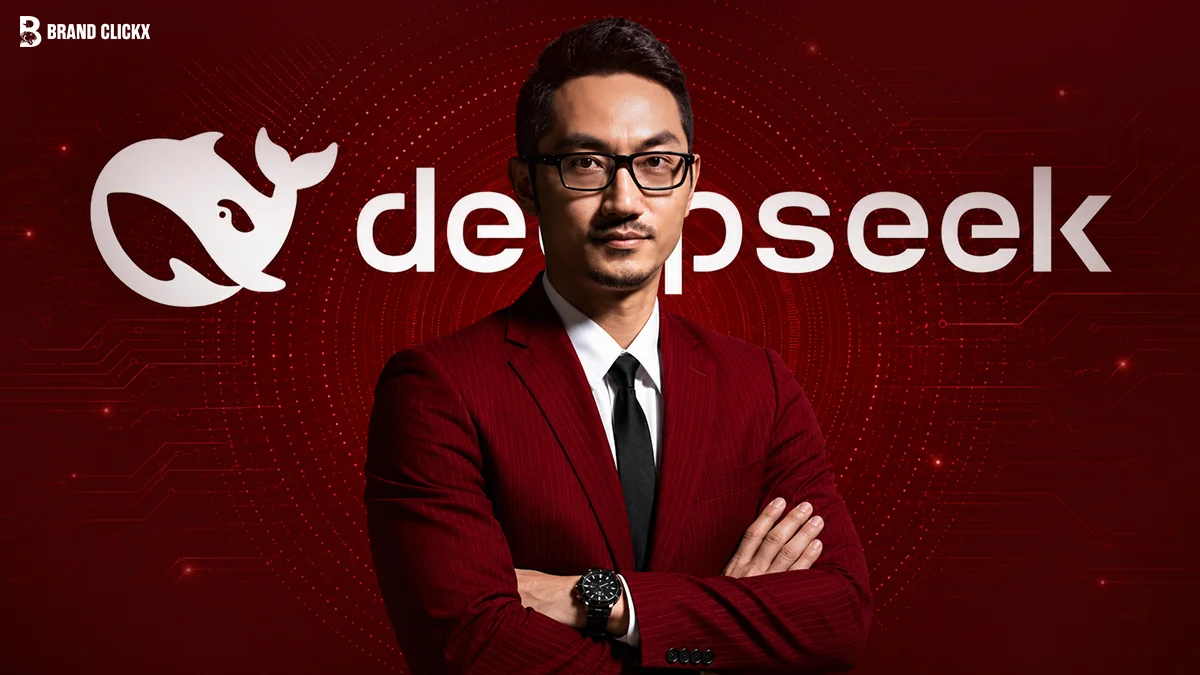
Liang Wenfeng told staff the company has no written vision, no monthly targets and no overtime. Silicon Valley is meanwhile drafting 996 clauses into employment contracts.
Published: Sunday, 2 August 2026 | BrandClickX News Desk
Sourcing note: These remarks come from a lengthy internal discussion session, transcribed by Tencent Technology and first reported in English by Fortune on 1 August 2026. BrandClickX has not independently verified the transcript. Quotations are as published.
Summary
DeepSeek founder Liang Wenfeng told employees his company operates without KPIs, monthly targets or overtime, and that formal work should occupy no more than half an employee’s time. The comments came in a nearly four-hour internal session transcribed by Tencent Technology. DeepSeek is valued at around $60 billion and has recorded roughly 173 million downloads since its public launch in January 2025.
What Liang Actually Said
The central claim is that DeepSeek has no management layer in the conventional sense.
Describing the company’s structure, Liang said management runs on two lines one top-down, one bottom-up. The bottom-up line is where the striking language sits: everyone decides what they want to do and does it. “No one manages them. No KPIs.”
On working hours: “We generally don’t work overtime.”
He gave two reasons. First, that research needs a relaxed environment and cannot be forced. Second, that the company is very focused, which means it does very few things.
On structure: “We don’t really have an organization we’re driven by a vision, organized by a vision.” He added that the vision is not written down anywhere, and never has been.
The most concrete claim concerns time allocation. Liang said the hope is that formal work does not take more than half an employee’s time, with the other half unallocated for people to use as they choose.
Employees are not given monthly targets. Liang has described himself as led by their consensus, and the company as “a bunch of very ordinary people.”
The Context: 996 Is Spreading, Not Receding
996 means 9am to 9pm, six days a week a 72-hour working week.
The term entered wide use after Jack Ma publicly endorsed it at Alibaba, saying the company did not need people looking forward to a typical eight-hour office lifestyle. It generated significant backlash in China, including the 996.ICU protest project on GitHub.
What makes Liang’s comments newsworthy now is the direction of travel elsewhere. Some technology companies are reportedly exploring adding 996 clauses into employment contracts contractually binding new hires to 72-hour weeks to compete in the AI race.
That is the contrast: as parts of Silicon Valley move toward China’s most demanding work culture, one of China’s most successful AI companies is publicly claiming the opposite.
The Numbers Behind the Claim
| Metric | Figure |
| DeepSeek valuation | Around $60 billion |
| Downloads since launch | ~173 million |
| Public launch | January 2025 |
| Founded | 2023 |
| Liang Wenfeng’s net worth | $37.9 billion |
DeepSeek came to international attention with DeepSeek-R1, which analysts described as achieving high-level performance using comparatively limited compute resources the detail that made it strategically significant given US export controls on advanced chips.
Liang co-founded the quantitative hedge fund High-Flyer, and built large-scale computing infrastructure there that later supported the AI research leading to DeepSeek.
He was named to Time’s 100 Most Influential People in AI and Fortune’s Most Powerful People in Business in 2025.
What Gets Lost in the Headline
The fuller transcript contains a line that reframes the whole claim.
Discussing DeepSeek’s technical roadmap, Liang reportedly said the company chose the easiest path and that it can follow that path without overtime. He contrasted it with alternatives such as pursuing embodied intelligence first, which he described as hard labour.
That is a significant qualification. The no-overtime culture is not presented purely as a management philosophy. It is presented as a consequence of choosing a research direction that does not require brute force.
Two related points from the same session support that reading:
- On chain-of-thought research: it does not burn GPUs, requiring only a small number of cards. What it needs is ideas
- On focus: doing very few things is given as one of the two reasons overtime is unnecessary
In other words, the model may be less “we treat people better” and more “we picked a problem that a small, focused team can solve without exhausting itself.” That is arguably a more useful lesson, and a harder one to copy.
Reasons for Caution
Three things temper this story, and none of them appear in most coverage.
It is the founder describing his own company. There is no independent verification of working hours at DeepSeek, no employee testimony in the reporting, and no external audit. A CEO saying nobody works overtime is a claim, not a finding.
The sourcing is a leaked internal transcript. Fortune describes the session as a discussion with staff, transcribed by Tencent Technology. At least one other publication has characterised the same material as an investor call. The distinction matters remarks aimed at investors and remarks aimed at employees serve different purposes.
“No KPIs” is not the same as “no pressure.” A company where half of formal time is unallocated and direction emerges from consensus can be intensely demanding in ways that do not appear on a timesheet. Research cultures with no formal targets often run on internal competition instead.
None of this makes the claims false. It means they should be reported as what a founder said, rather than as an established description of DeepSeek’s working conditions.
Why This Resonates Now
The AI industry is running two competing theories of productivity at once.
The intensity theory holds that the race is won by whoever puts in more hours. It underpins 996, the reported contract clauses, and much of the current Silicon Valley discourse about grinding.
The concentration theory holds that research output depends on the quality of thinking rather than the quantity of hours, and that exhausted researchers produce worse ideas.
DeepSeek is the most inconvenient data point available to the first camp. A company founded in 2023, reaching a roughly $60 billion valuation and 173 million downloads, whose founder attributes it partly to not working weekends.
That is why the story travels. It is not really about DeepSeek’s HR policy it is evidence in an argument the entire industry is currently having.
Frequently Asked Questions
What did Liang Wenfeng say about overtime?
He said DeepSeek generally does not work overtime, giving two reasons: research requires a relaxed environment and cannot be forced, and the company is highly focused, meaning it does very few things at once.
Does DeepSeek really have no KPIs?
That is what its founder says. Liang described a bottom-up management line in which employees decide what to work on themselves, stating “No one manages them. No KPIs.” There is no independent verification of this.
What is 996 culture?
Working 9am to 9pm, six days a week a 72-hour week. It became widely discussed after Jack Ma endorsed it at Alibaba, and prompted significant backlash in China including the 996.ICU protest project.
How much is DeepSeek worth?
Around $60 billion, having been founded in 2023. It has recorded roughly 173 million downloads since launching publicly in January 2025, and its founder’s net worth is reported at $37.9 billion.
Where did these comments come from?
A nearly four-hour internal discussion session, obtained and transcribed by Tencent Technology, and first reported in English by Fortune on 1 August 2026. Some outlets have described the same session as an investor call.
Who is Liang Wenfeng?
A Chinese entrepreneur born in 1985 who co-founded the quantitative hedge fund High-Flyer before founding DeepSeek in 2023. He attended Zhejiang University and began his career applying machine learning to quantitative finance.
Are US companies adopting 996?
Some technology companies are reportedly exploring 996 clauses in employment contracts, which would contractually commit new hires to 72-hour weeks. The trend has drawn attention precisely because it imports a practice facing backlash in China.
Is DeepSeek’s approach replicable?
Unclear. Liang linked the absence of overtime to DeepSeek’s specific technical roadmap, which he said could be followed without it, contrasting it with harder paths such as embodied intelligence. That suggests the culture depends on the problem chosen.
Conclusion
The quotable version of this story is that a $60 billion AI company has no KPIs and nobody works late. That is accurate as far as it goes.
The more useful version is buried in the same transcript. Liang says DeepSeek picked a research direction it could pursue without overtime, and does very few things. The relaxed culture is downstream of a strategic choice about scope.
Companies hoping to copy the first part without the second will find it does not work. And it remains, for now, a founder’s account of his own company rather than anything independently established.