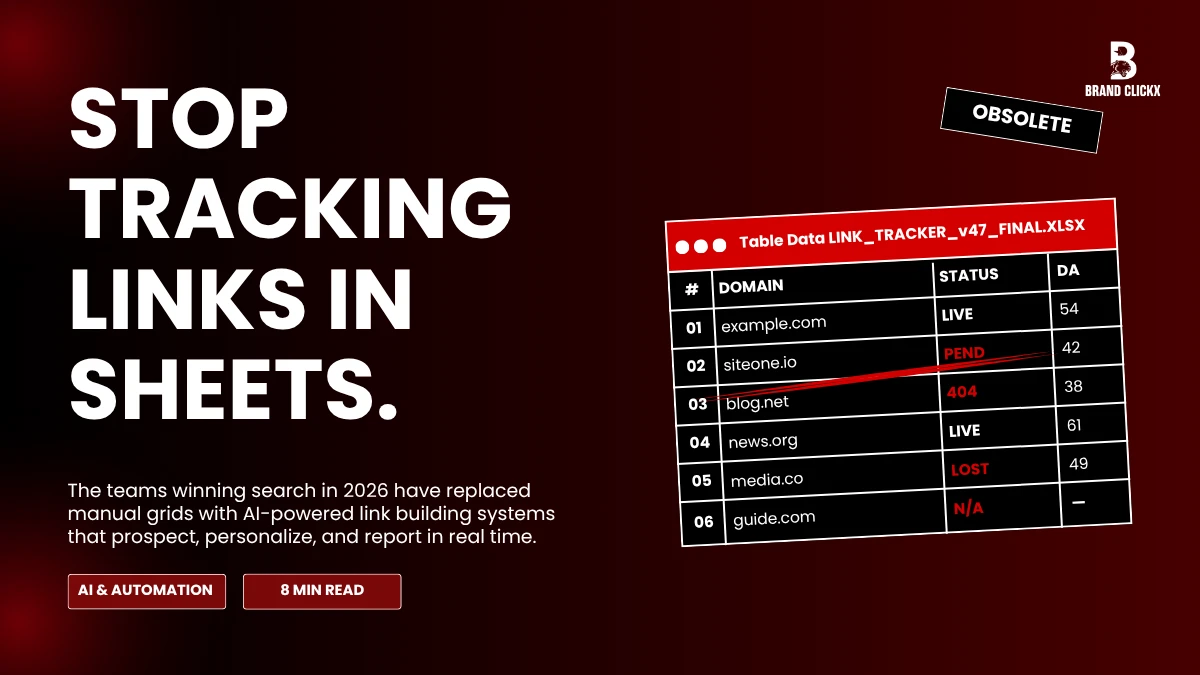
A hard operational reality faces modern SEO teams: link building has simply grown far beyond what shared spreadsheets can handle. The teams winning the search game are the ones who have replaced manual tracking with purpose-built AI systems. This shift is totally changing how teams manage their campaigns, structure their workflows, and track their success. You no longer need a massive engineering budget to get these capabilities.
TL;DR:
Link building has grown too complex for basic spreadsheets to handle. Today, the most successful SEO teams are switching to purpose-built, AI-driven applications to manage outreach and track performance. By adopting these flexible systems, you can automate your workflow, ditch the manual updates, and focus on securing great links.
Why Spreadsheets Became the Bottleneck in Modern Link Building
Spreadsheets were never built for the collaboration, automation, or massive data volume that serious link building demands. While they work fine for a handful of contacts, they quickly break down when you try to scale. You run into constant version conflicts, have to rely on manual status updates, and struggle with zero integration between your tracking docs and your actual outreach tools.
Furthermore, flat rows and columns offer almost no ability to surface patterns across multiple campaigns. You cannot easily see which email templates perform best or which industries yield the highest response rates without running complex, manual data pivots. The problem here is structural, not a matter of effort. Your team is working hard, but the tools are holding you back. This is exactly why agencies turn to a platform like Base44 to deploy a no code app builder when they outgrow those basic grids. You need a system that actively helps you manage the work, rather than just passively storing data.
The New Stack: How AI Systems Are Restructuring Link Building Operations
So, what does a modern AI-powered link building system actually look like in practice? It starts with prospect discovery. AI scraping tools can evaluate thousands of websites, scoring them for relevance and authority in minutes. From there, these systems power the automated personalization of your outreach sequences. You are no longer blasting generic emails; the AI helps tailor the message to the specific prospect.
Once the emails go out, the pipeline tracking happens in real-time. Status dashboards update automatically as prospects open emails, click links, or reply. Finally, performance attribution connects directly to your ranking outcomes, letting you see exactly which links move the needle. This new stack explains how both agencies and in-house teams are operationalizing scalable white label link building at volumes that would have required twice the headcount just two years ago. The technology handles the heavy lifting, letting your team focus on strategy and relationship building.
Cutting Through the Tool Clutter: What a Real SEO Stack Needs to Deliver
Many SEO teams feel an intense sense of tool fatigue. You face an endless sea of platforms, all promising to fix every problem, often with overlapping features and mounting subscription costs. It is easy to end up paying for five different tools that all essentially do the same thing. To build a stack that actually works, you need to cut through the noise.
Evaluate every piece of software against three simple criteria. First, does it save measurable time? Second, does it surface actionable data? Third, does it integrate smoothly with the rest of your workflow? You are looking for a reliable SEO tool that actually solves problems rather than just adding another tab to your browser. A single, well-integrated system is worth infinitely more than a dozen disconnected apps that each do one minor thing adequately.
Building Your Own Link Building App Without Writing a Single Line of Code
We are seeing a massive shift toward SEO teams building internal tools tailored to their exact workflows. Off-the-shelf tools rarely map perfectly to the unique way a specific team operates. You might have a specific approval process, a unique way of grading prospects, or a proprietary reporting format.
Using no-code platforms allows non-developers to create custom tools easily. These custom builds typically include centralized prospect databases, Kanban-style outreach tracking boards, automated link status monitors, and custom reporting views for clients or stakeholders. Building these lightweight apps is more accessible than ever. You get a system that fits your process like a glove, allowing your team to work faster and with fewer errors.
The Overlooked Conversion Layer: Why Outreach Clicks and Landing Pages Matter More Than You Think
Even the most sophisticated AI system eventually depends on a real person at the other end reading an email, clicking a link, and saying yes. This human side of link building is an often-overlooked conversion layer. Teams that optimize purely for volume tend to ignore the conversion variables that actually lift their placement rates.
Your outreach email design, the clarity of your landing pages, and how you frame your calls-to-action profoundly affect your response rates. Understanding what is the right button to get clicks is not just a basic UX question; it is a fundamental outreach strategy question. The easier you make it for a site owner to understand your value and take action, the more links you will acquire. You must optimize the human experience just as rigorously as you optimize your data scraping.
Putting It All Together
The teams building the most durable, powerful link profiles right now are not just working harder; they are working inside significantly better systems. Moving away from spreadsheets is about removing the friction that slows down every step of your process, from initial prospecting to final placement. By embracing AI and no-code applications, you take control of your data and your workflow. Take a moment to audit your current operations against the stages we covered here. Identify your biggest bottleneck and take the first step toward building a system that actually supports your goals.
FAQs
How much do AI-powered link building systems cost to implement?
Costs vary depending on the platform, but they are generally very accessible. Many no-code builders offer tiered pricing starting around $30 to $50 per month. When you factor in the time saved on manual data entry, the return on investment usually covers the software cost within the first week.
Does Google penalize AI-assisted outreach?
Google cares about the quality and relevance of the links, not necessarily the software used to manage the outreach process. As long as your AI tools are helping you find relevant prospects and you maintain a natural, high-quality approach to relationship building, you remain well within acceptable practices. Avoid spamming and focus on value.
How do I measure link building ROI without a full analytics stack?
You can start by tracking basic metrics like the cost per acquired link and the organic traffic growth to the specific pages you are building links for. Many custom apps let you pull in simple ranking data directly. Keep your focus on whether the pages receiving links are seeing a lift in search visibility.
Are no-code tools reliable enough for agency-scale operations?
Yes, modern no-code platforms are built on robust, enterprise-grade infrastructure. They easily handle thousands of records, complex automations, and multiple team members working simultaneously. Many large agencies use them to run their entire backend operations securely and reliably.
What is the difference between link prospecting and link outreach?
Link prospecting is the research phase where you identify relevant websites, score their authority, and find the right contact information. Link outreach is the execution phase where you actually contact those website owners, pitch your content, and negotiate the link placement. A good system handles both phases in one place.