


Search engine optimization is no longer just about traditional Google rankings and keyword lists. The rapid rise of AI-powered search, generative engines, and language model responses is transforming the way users discover information online. In this new era, simply tracking rankings or backlinks isn’t enough. Brands and SEO marketers must ask themselves: how can an AI search monitoring platform improve SEO strategy? And what does it really mean for businesses of all sizes?
In this article, we explore this question with real data, expert examples, tools, and actionable takeaways. You will understand why AI search monitoring isn’t a futuristic idea, it’s a present-day requirement for smart SEO strategy. For businesses building a long-term organic growth plan, understanding how to create an SEO strategy is the foundation before layering advanced AI monitoring tools.
What Is an AI Search Monitoring Platform?
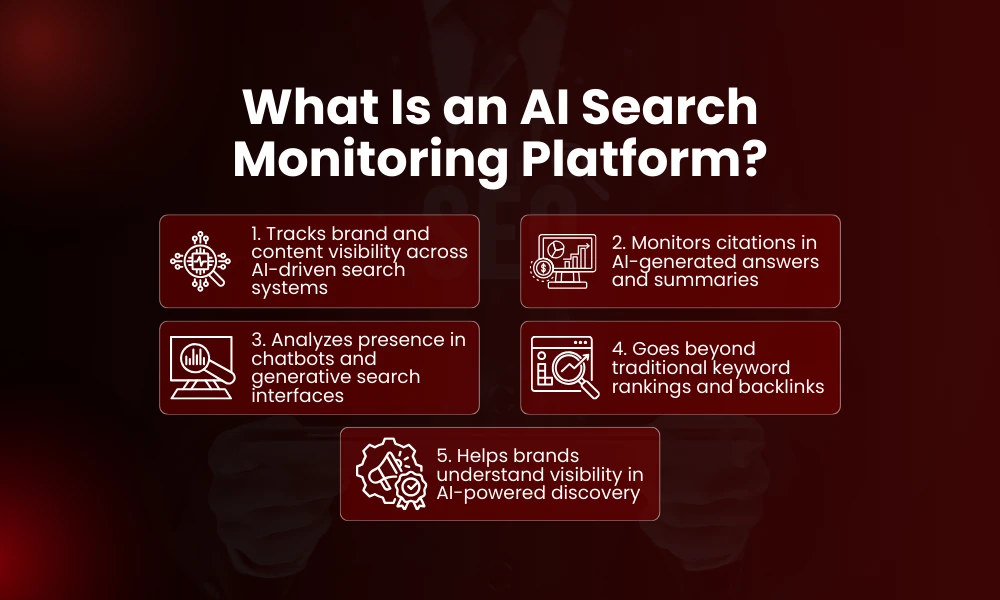
First, let’s define our terms. An AI search monitoring platform is software that tracks how your brand, content, and keywords perform not just in traditional search engines like Google and Bing, but across AI-driven search interfaces and generative response systems.
These platforms can track:
- how often your content is cited in AI-generated answers
- how users interact with your brand via large language models
- whether your website appears in AI snippets and summaries
- how competitors perform across different AI search outputs
Unlike traditional rank trackers, AI search monitoring platforms look at visibility in generative search results and AI recommendations, which are increasingly replacing classic search clicks. To understand how this differs from traditional tracking methods, it helps to revisit the fundamentals of SEO analytics tools and how they measure performance.
Why This Matters Today
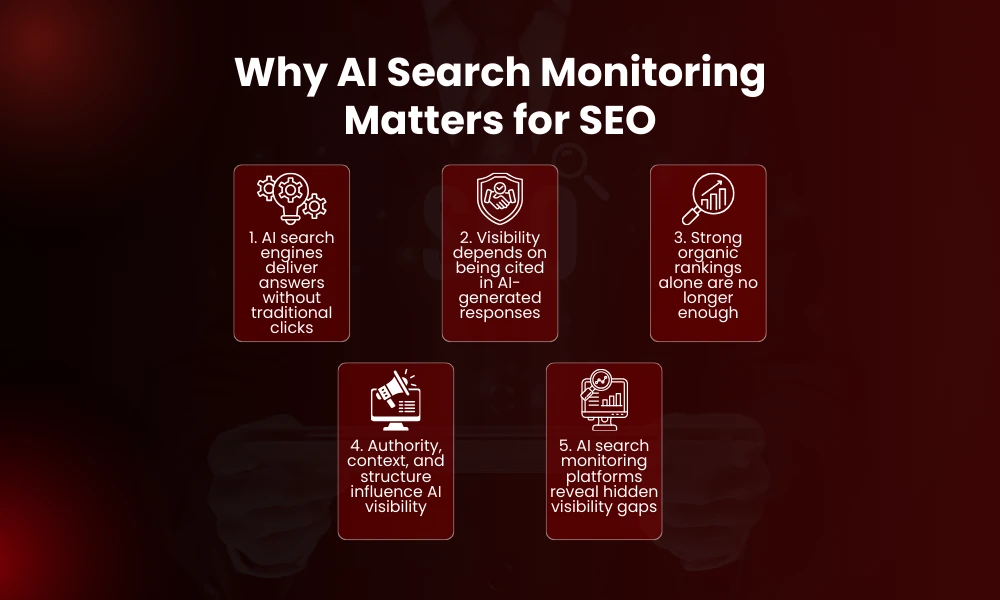
SEO used to be about keywords, backlinks, and on-page signals that mattered most to Google’s algorithm. That is still true. But now, AI assistants and chatbot search interfaces are reshaping the journey. Studies show that AI search engines synthesize answers directly in-platform, often without sending users to sites unless they are cited or linked in those responses. This is the core of why many marketers are asking how can an AI search monitoring platform improve SEO strategy instead of just “how to rank on Google.” Modern optimization now extends beyond rankings into SEO for voice search optimization, conversational queries, and AI-generated answers.
Research published on generative engine models highlights that AI systems rely heavily on authority signals, contextual relevance, and real-time data trends, and they may penalize articles that lack machine-readable structure or clear semantic depth.
In plain language, if your content isn’t showing up in AI-driven search results or harvested answers, you could lose visibility even if your traditional rankings are strong.
The Key Ways AI Search Monitoring Improves SEO
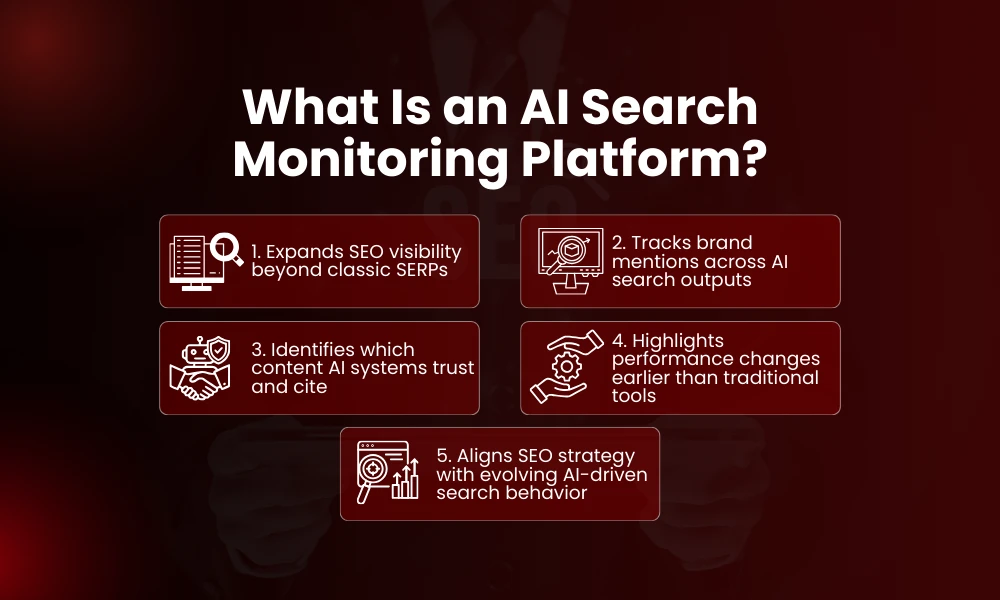
Let’s break down how exactly an AI search monitoring platform supports a stronger SEO strategy.
1. Holistic Visibility Across Search Channels
You probably already use tools like Moz, Ahrefs, or Semrush for keyword rankings and backlink tracking. Those are still critical for traditional search visibility. But AI search monitoring platforms go a step further by showing where your brand and content are mentioned in AI-powered answers.
For example, a tool like Ranketta (an AI visibility platform) actively queries large language models such as ChatGPT, Gemini, and Perplexity to simulate search interactions and track brand presence.
This gives you a broader picture of your online footprint, not just traditional SERP rankings but AI search citations, context, and patterns. This broader visibility works even better when structured under a clear SEO content strategy that aligns with AI retrieval patterns.
2. Faster Detection of Performance Changes
One challenge for SEO teams is rapidly responding to changes in user intent and algorithm shifts. Traditional analytics tools often lag, by the time you see a drop in traffic, the problem has already happened.
AI search monitoring platforms can highlight changes much earlier by tracking real-time mentions or visibility fluctuations. Practitioners report that AI monitoring tools can catch ranking volatility and search intent shifts earlier than Google Analytics or Search Console alone.
This lets teams react quickly, refreshing content, fixing technical issues, or re-optimizing pages while competitors are still waiting for manual reports. Regular technical reviews supported by a strong SEO audit checklist can amplify these early-warning insights.
3. Insights Into AI-User Search Behavior
All SEO is ultimately about serving user intent. AI search engines are designed to understand human conversation, context, and intent deeper than keyword matching. So AI search monitoring helps answer a crucial question: what real users are asking and how they expect answers.
By analyzing large datasets of AI prompts and queries, platforms can show patterns in emerging user questions or search trends. Deloitte research found that companies using AI for analytics improved decision-making accuracy by up to 48% compared to teams relying solely on traditional tools.
This data is gold for SEO strategy because it helps marketers optimize content for actual search demand, not just guessed intent.
4. Better Competitive Benchmarking
Knowing where you stand is important. But knowing where your competitors are showing up in AI search results is equally important.
AI search monitoring platforms can track share of voice, frequency of AI citations, and context of competitor mentions. With this, you can identify content gaps, topic clusters competitors are winning at, and areas where you aren’t getting cited.
This competitive intelligence can inform:
- what topics to create next
- which pages need refreshes
- where to prioritize SEO investments
For deeper insights into how competitors dominate AI responses, explore structured SEO competitor analysis methods.
5. Content Optimization for AI-Driven Search
AI search tools often favor content structures that are clear, authoritative, and easy to synthesize. That means content formats like FAQs, summaries, and structured data often get more visibility.
Monitoring platforms can show which content gets cited most frequently in AI responses so you know what works. For example, several SEO teams reported that adding structured FAQ sections boosted AI visibility, and that insight came directly from AI monitoring data.
This feedback loop allows SEO teams to tailor content for both humans and AI retrieval patterns. Implementing strong schema markup for SEO can significantly improve how AI systems interpret and cite your content.
6. Enhanced Brand Authority Signals
Being cited in AI search results is a form of earned visibility, similar to backlinks but potentially more influential because AI answers directly affect user perception and trust.
AI models often draw from authoritative content when generating answers. If your site is cited frequently in AI responses, that implicitly signals relevance and expertise, which can positively influence traditional SEO rankings as well.
In fact, research suggests that AI search’s reliance on authority signals is even stronger than traditional search, meaning your visibility in AI responses can ripple back into organic search benefits.
Case Examples and Data Insights
It helps to see concrete examples of how AI tools and monitoring have impacted performance.
Example 1: AI-Driven Content Growth
In a detailed case cited by EchoBase, a company called Tomorrow Sleep used an AI content intelligence platform to identify high-value topics and benchmark competitive content. The result? A 60% increase in organic traffic from improved topic targeting and content optimization.
Example 2: AI Monitoring and Organic Gains
Another example included a product discovery platform that used AI tools to improve content efficiency and saw a 20% growth in organic outcomes just by refining content decision workflows based on machine analytics.
These aren’t isolated anecdotes. Brands that leverage AI search insights often report higher engagement, better keyword discovery, and improved traffic growth, especially when AI monitoring is part of the process rather than an afterthought.
Top AI Search Monitoring Platforms to Consider
Here are a few types of platforms that help answer how can an AI search monitoring platform improve SEO strategy:
AI Visibility & Monitoring Tools
- Ranketta – tracks brand presence across AI models and analyzes citations.
- Writesonic (SEO Agent) – integrates SEO workflows with AI insights and audit data.
- BrightEdge (AI Monitoring Module) – extends traditional SEO data to AI search visibility.
- Semrush AI Toolkit – combines AI visibility with traditional SEO metrics.
Rank Tracking and Brand Monitoring Platforms
- Various user-reported trackers like AI Rank Checker, Otterly.ai, and Peec AI appear in SEO community discussions as tools that help monitor AI model output mentions.
Choosing the right tool depends on your needs, whether you want simple AI citation tracking, deep competitive insights, or combined traditional/Ai SEO reporting.
Implementing This Strategy Step By Step
Now that we understand the why, here’s a practical way to integrate AI search monitoring into your SEO strategy:
- Define your goals: Do you want more AI citations, better topic coverage, or deeper competitor insights?
- Choose the right platform: Pick a tool based on whether you need comprehensive monitoring or specific visibility metrics.
- Integrate with existing analytics: Use Google Search Console, traditional rank tracking, and analytics dashboards along with AI monitoring data.
- Analyze and act: Use insights to refine content, update pages, optimize for intent, add structured data, or expand topical clusters.
- Monitor performance continually: Adjust strategy based on real-time AI search visibility changes.
This kind of iterative approach answers the central question of how can an AI search monitoring platform improve SEO strategy: by making your optimization smarter, faster, and more aligned with actual search patterns.
Frequently Asked Questions
Q1: What does an AI search monitoring platform do?
A: It tracks how your content and brand are referenced across AI-powered search and generative responses, helping you optimize SEO and content strategy based on visibility patterns, mentions, and emerging trends.
Q2: Is this different from traditional rank tracking?
A: Yes. Traditional tools focus on keyword positions and backlinks. AI monitoring tools report on AI citations, contextual mentions, and visibility across language-model interfaces as well.
Q3: Do AI search monitoring platforms help traditional SEO rankings too?
A: They can. Improved content relevance and authority signals in AI search often translate into better traditional ranking outcomes, especially as search engines increasingly integrate AI-driven relevance signals.
Q4: Can small businesses benefit, or is this just for enterprise teams?
A: Businesses of all sizes can benefit. Smaller sites can use AI monitoring to identify niche opportunities or topic gaps faster, while larger teams can gain competitive benchmarking at scale.
Conclusion
Understanding how can an AI search monitoring platform improve SEO strategy isn’t about chasing trends, it’s about recognizing where search behavior is headed. As search becomes more conversational, AI-powered, and intent-driven, brands that adapt will see better visibility, smarter content planning, and sustainable SEO growth.
AI search monitoring platforms offer a competitive edge by bridging the gap between human search behavior and machine-driven discovery. When combined with conversion-focused tactics like conversion-driven SEO tactics, AI monitoring becomes a powerful revenue growth engine. Used correctly, they enhance your SEO strategy with deeper insights, faster reaction times, and richer data than traditional tools alone.
If your SEO approach still revolves solely around classic rankings, now is the time to explore how AI monitoring can expand your visibility and value in the digital ecosystem.