Search engine positioning in 2026 looks nothing like it did even two years ago. Ranking is no longer about fighting for a place among ten blue links. Today’s search results are dominated by AI Overviews, featured snippets, People Also Ask boxes, videos, images, local packs, and product grids. In many cases, users get their answers without clicking anything at all.
This shift has forced businesses, SEO teams, and content creators to rethink what “ranking” actually means. Visibility now depends on where your page appears, how it appears, and whether users trust it enough to click or reference it, even when AI-generated answers sit above traditional results.
This shift has forced businesses, SEO teams, and content creators to rethink what “ranking” actually means. Visibility now depends on where your page appears, how it appears, and whether users trust it enough to click or reference it, even when AI-generated answers sit above traditional results.
To stay competitive in this evolving landscape, brands are increasingly focusing on holistic strategies like search engine optimization in New York, where local authority, semantic relevance, and AI-friendly content structures play a major role in modern search positioning.
This guide is the perfect solution for businesses stuck on page two, SEO teams optimizing individual pages rather than entire websites, and brands that are slowly losing organic traffic to AI summaries and zero-click searches.
What Is Search Engine Positioning?

Search engine positioning is the ongoing process of optimizing specific URLs to improve their rankings, visibility, and click performance within search engine results pages. It is not a one-time task, and it is not the same thing as general SEO.
Where SEO looks at the overall health of a website, positioning zooms in on how a single page performs for a defined set of queries.
This distinction matters because most ranking issues today are not site-wide problems. They are page-level mismatches between intent, content structure, and SERP expectations.
Definition vs SEO & SERP Visibility
SEO focuses on the entire website, including technical health, backlinks, and content coverage. Search engine positioning focuses on improving how one page performs for its target queries. SERP visibility measures how often and where your brand appears across search features, not just rankings.
Understanding this difference allows teams to diagnose problems accurately. A site can be technically healthy and still suffer from poor positioning if individual pages fail to meet intent or SERP format expectations.
Why Search Engine Positioning Matters for Organic Traffic and Brand Trust
High positioning does more than increase traffic numbers. It shapes perception. Users subconsciously trust pages that consistently appear near the top of search results. Over time, repeated exposure builds brand recall, even when users don’t click immediately.
Strong positioning brings more qualified traffic, reduces customer acquisition costs, and increases perceived authority. From an E-E-A-T perspective, consistent top-page visibility reinforces experience and trustworthiness. Google doesn’t just reward good content once, it rewards reliability over time.
How Search Engine Positioning Impacts Conversion Rates
Ranking alone does not equal revenue. Pages that rank for the wrong intent attract the wrong visitors, leading to high bounce rates and low conversions.
Effective positioning aligns user intent with messaging and calls to action. Informational pages should educate and build trust, not push aggressive sales. Commercial pages should guide comparisons and reduce friction. Transactional pages should focus on clarity and confidence. When positioning matches intent, conversions improve naturally.
Search Intent and Its Role in Positioning
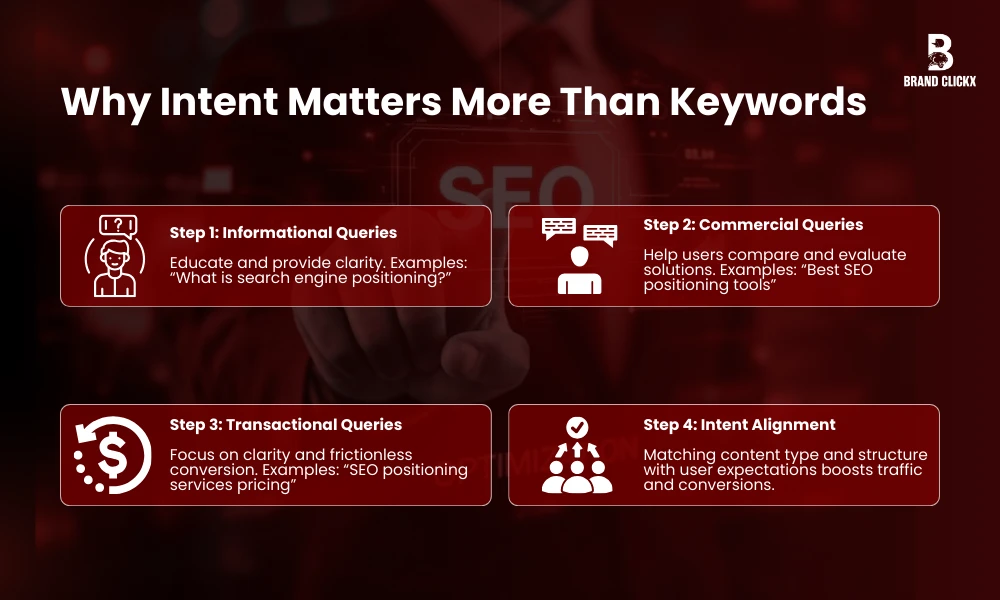
Search intent is the foundation of modern positioning. Google’s algorithms are designed to satisfy intent first and keywords second.
Understanding Informational, Navigational, Commercial, and Transactional Intent
Informational intent involves learning or understanding a topic. Queries like “what is search engine positioning” signal a need for education. Google prefers long-form guides, blogs, and explanatory content for these searches.
Commercial intent appears when users are comparing options or researching solutions. Searches like “best SEO positioning tools” typically surface comparison pages, service overviews, and detailed evaluations.
Transactional intent signals readiness to act. Queries such as “SEO positioning services pricing” trigger product pages, pricing pages, and conversion-focused landing pages.
Google evaluates page format, structure, depth, and tone to confirm intent alignment. Simply using the right keywords is not enough.
Mapping Content to Intent for Better Rankings
Many pages fail to rank not because they lack backlinks or authority, but because they target the wrong intent. A blog post trying to rank for a transactional query will struggle, just as a sales page targeting informational searches will underperform.
Google reassesses intent alignment during core updates. When intent shifts and content doesn’t adapt, rankings drop even if nothing technical changes. Auditing intent requires analyzing the top results for your target queries and identifying dominant content types, structures, and angles.
When intent changes, pages must be restructured. This may involve changing headings, rewriting introductions, adjusting CTAs, or expanding or narrowing content depth. Positioning improves when content evolves with user expectations.
The Search Engine Positioning Framework

This framework is where theory becomes execution. Most people explain what positioning is but fail to show how to do it consistently.
Step 1: Keyword Research for Positioning
Keyword research for positioning focuses on opportunity, not volume. Instead of chasing new keywords, it prioritizes terms where pages already rank between positions five and twenty. These keywords have proven relevance and require refinement rather than reinvention.
Long-tail variations that show readiness, such as comparison or intent modifiers, are especially valuable. Ranking potential matters more than raw search volume because it determines how efficiently a page can be repositioned.
Step 2: Competitor Gap and SERP Feature Analysis
Positioning is not just about beating competitors, it’s about matching Google’s expectations. SERP feature analysis reveals what formats Google prefers for a query. Featured snippets, People Also Ask boxes, videos, and AI Overviews all signal how information should be presented.
Gap analysis involves identifying missing subtopics, weak explanations, structural flaws, and poor readability in both your content and competing pages. Google rewards clarity and usefulness more than length.
Step 3: Content Optimization Workflow
A strong positioning workflow starts with reorganizing content based on intent. Missing subtopics are expanded, explanations are clarified, and internal links are strengthened to reinforce topical authority. Titles are optimized for click-through rate, and content is refined for readability rather than keyword density.
This repeatable process turns positioning into a system instead of a guessing game.
Technical SEO Tactics That Support Positioning
Technical SEO supports positioning by improving crawlability, clarity, and user experience. It does not replace content quality. Implementing proper technical SEO ensures that search engines can crawl, index, and interpret your content efficiently, which directly supports page-level positioning.
Schema Markup and Rich Snippets
Schema markup enhances how pages appear in search results. FAQ, HowTo, Article, and Product schema improve visibility and click-through rates by expanding SERP real estate. Schema helps AI systems extract accurate information, but should be used to improve clarity, not manipulate rankings.
XML Sitemaps and Crawl Efficiency
Clean sitemaps improve crawl efficiency and content freshness. Bloated or outdated sitemaps slow indexing and delay positioning improvements. Faster crawling allows teams to test optimizations and see results sooner.
Mobile-First Indexing and Core Web Vitals
Core Web Vitals matter most when performance issues affect usability. Metrics like Largest Contentful Paint and Interaction to Next Paint influence positioning when poor UX blocks engagement. However, performance fixes alone won’t compensate for weak content or intent mismatch.
On-Page Signals That Boost Search Engine Positioning

Title Tags, Headers, and Meta Descriptions
Titles are one of the strongest click-through rate levers. Effective titles align with intent, communicate value clearly, and avoid generic phrasing. Headers improve relevance, clarity, and guide both users and search engines. Meta descriptions influence clicks by reinforcing trust and expectations.
Using specialized on-page SEO services can help small businesses optimize titles, headers, meta descriptions, and internal links for maximum SERP visibility.
Internal Linking and Content Clusters
Internal linking distributes authority across related pages and helps Google understand topical depth. Content clusters strengthen subject matter expertise when links are natural, contextual, and logically structured.
Multimedia and Engagement Signals
Original visuals and videos increase dwell time and improve SERP eligibility by addressing key quality ranking factors. While engagement metrics are not direct ranking factors, they support positioning by signaling usefulness and relevance.
Off-Page Signals That Influence Positioning
Backlinks and Authority Reinforcement
Backlinks reinforce existing rankings rather than creating them instantly. Relevance and context matter more than raw domain metrics. A small number of high-quality, topically aligned links often outperform large volumes of generic ones.
Social Signals and Brand Mentions
Social signals are not direct ranking factors, but brand mentions contribute to entity recognition and trust. They also increase the likelihood of being referenced in AI-generated answers.
Measuring Search Engine Positioning Performance
CTR, Impressions, and Average Position
Average position alone is misleading. Meaningful improvements appear through higher CTR, increased impressions, and stable rankings across variations. Google Search Console should be used for trend analysis rather than for daily fluctuations.
Tracking metrics like CTR, impressions, and engagement through robust content marketing analytics allows you to refine positioning strategies and align content with user intent.
Tools for Positioning Analysis
Google Search Console provides real-world performance data. Semrush offers competitive insights. Ahrefs excels at link analysis. Tools support decisions but should never replace strategic thinking.
Advanced Metrics for AI Search Visibility
Modern positioning includes AI citations, brand mentions in AI answers, zero-click visibility, and passage-level indexing. These signals matter more as generative search expands.
AI Search and Generative Positioning (AEO/GEO)

What Is Generative Search Positioning?
Generative search prioritizes clarity, structure, authority, and factual accuracy. AI systems extract concise, well-structured answers rather than keyword-stuffed content.
Traditional SEO vs AI Search
Traditional SEO focuses on keywords and page-level optimization. AI search prioritizes entities, passage-level clarity, and citations. Understanding this shift is critical for long-term visibility.
Real-World Strategies for AI SERP Dominance
Answer-first formatting, clear subheadings, credible authorship, and fact-backed explanations increase the likelihood of being referenced by AI systems.
Industry-Specific Search Engine Positioning Tactics
Let’s explore them one by one:
E-Commerce Positioning
Category pages must align with commercial intent, offer intuitive filters, and reduce friction throughout the buying journey.
SaaS and B2B Positioning
Use-case pages, comparison content, and feature-to-benefit alignment help SaaS brands position effectively across research and evaluation stages.
Local Business Positioning
Local intent signals, Google Business Profile consistency, and location-based internal linking strengthen visibility for local searches. Local businesses benefit greatly from targeted local SEO strategies to improve visibility in Google Maps, local packs, and area-specific search results.
Common Search Engine Positioning Mistakes to Avoid

- Over-optimizing keywords instead of improving clarity
Repeating keywords excessively, forcing them into headings, or writing unnaturally optimized sentences reduces readability and trust. Modern search systems prioritize clear explanations and natural language over keyword density. - Targeting the wrong search intent
Many pages fail because they don’t match what users actually want. Informational pages pushing sales messaging, or transactional pages overloaded with explanations, create friction. - Ignoring SERP format expectations
Pages that ignore how Google presents results for a query struggle to compete, even if the content is high quality. - Poor user experience despite strong content
Slow loading times, cluttered layouts, intrusive pop-ups, and weak mobile usability reduce engagement. - Treating positioning as a one-time optimization
Pages that are never revisited fall behind as intent shifts, competitors improve, and SERP features change.
Future Trends in Search Engine Positioning

- Growth of voice search and conversational queries
Voice searches are longer, more natural, and more intent-driven. Pages that use conversational language and provide direct, concise answers are more likely to surface for voice-based results. - AI summarization reshaping visibility
AI Overviews and generative answers favor content that is structured, factual, and easy to extract from. Clear explanations and well-organized sections outperform creative but vague writing styles. Just as AI in app development is revolutionizing software creation, AI-driven search is reshaping how content is extracted, summarized, and displayed to users. - Shift from keywords to entities and meaning
Search engines increasingly evaluate context, relationships, and topic coverage rather than exact keyword matches. Pages that explain concepts holistically perform better across multiple query variations. - Greater emphasis on passage-level relevance
Individual sections of a page can now rank or be cited independently. Clear subheadings, focused paragraphs, and direct answers improve visibility at the passage level. - Intent mapping replacing static optimization
Successful positioning will rely on understanding how intent evolves over time and adjusting content accordingly, rather than relying on fixed keyword targets.
Final Thoughts
Search engine positioning is not something you complete and move on from. It is an ongoing process that evolves alongside user behavior, search technology, and SERP layouts. A page that ranks well today can lose visibility tomorrow if intent shifts, competitors improve, or AI-driven results change how information is displayed.
Sustainable positioning requires constant alignment between search intent, content clarity, user experience, and trust signals. It means revisiting pages, refining messaging, improving structure, and adapting to new SERP features rather than chasing shortcuts or algorithm rumors.
Brands that treat positioning as a living strategy, rather than a one-time SEO task, will consistently outperform those focused only on rankings.
In 2026 and beyond, the winners in search will not be the loudest or the most optimized. They will be the clearest, most useful, and most adaptable.