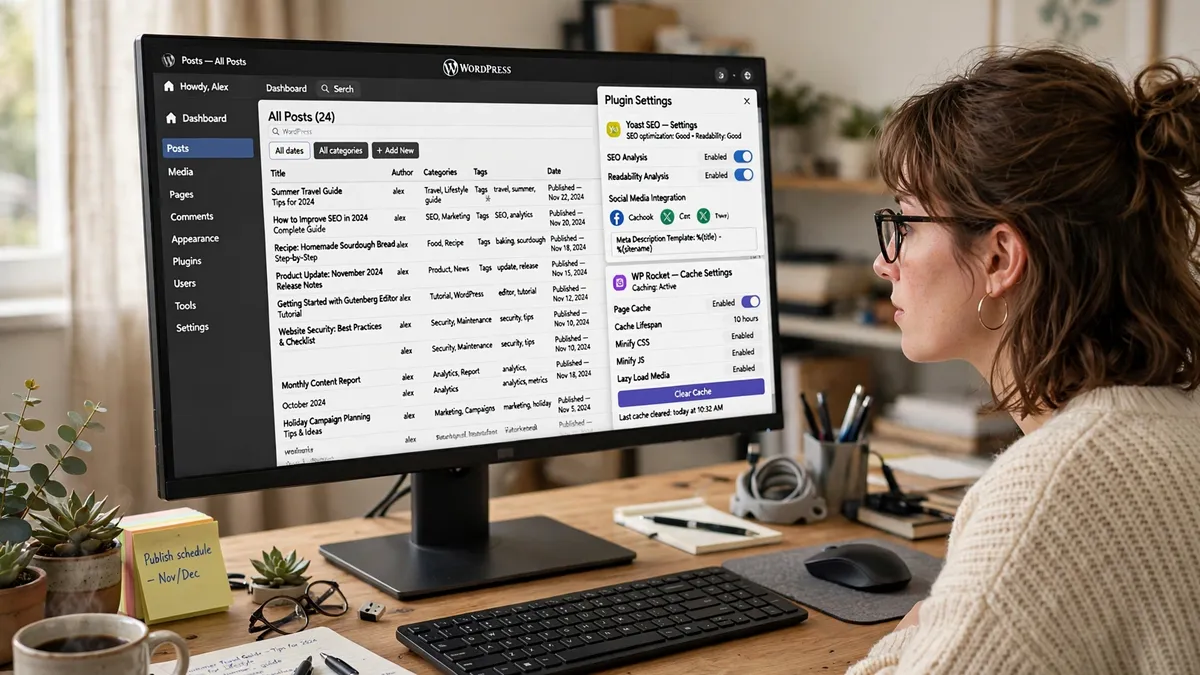
Rank Math vs Yoast is a familiar debate, but it changes completely at the scale of a 1,500-post site. With a handful of posts, either plugin does the job; with fifteen hundred, bulk editing, sitemaps, redirects and switching costs matter far more than any single feature.
So which one should a large site choose? There is no universal winner. The honest answer depends on what your site already runs, how your team works, and how much disruption a switch would cause.
This comparison is grounded in real experience: BrandClickX runs Rank Math Free on WordPress 7.1.5, with 1,530 posts, 8,545 tags and 95 categories. It has not used Yoast, and nothing here should be read as a claim that it has.
Key takeaways
- At 1,500 posts, bulk editing, sitemap control, redirects and migration effort matter more than headline features.
- BrandClickX runs Rank Math Free, including its titles and meta settings, sitemap, redirection manager and Local SEO organisation schema.
- Rank Math Free includes several tools that Yoast reserves for its paid version, which matters on a tight budget.
- Switching plugins at this scale is a project, not a click: test on a staging copy first and check every post type, redirect and schema output.
Why 1,500 Posts Changes the Decision
A small blog can change SEO plugins in an afternoon. The owner checks a few pages, fixes a few titles, and moves on. A site with 1,500 posts cannot do that.
Every setting touches hundreds of pages, every mistake repeats itself at scale, and every hour of manual fixing costs far more. Scale also changes what “good” looks like.
A plugin that is pleasant on ten posts can become slow or awkward managing thousands of titles, a large sitemap and years of redirects. The question is which one a team can actually run, day after day, on a site of this size.
Rank Math vs Yoast at a Glance
The table below compares the two plugins on the areas that matter most at scale. Details vary by version, so treat it as a starting point for your own test, not as a final verdict.
| Area | Rank Math Free | Yoast (free and paid) |
|---|---|---|
| Bulk title and meta editing | Bulk editor included in the free version | Bulk editor available; check which tier your plan includes |
| XML sitemap | Included, with control over post types and taxonomies | Included, with sitemap controls in settings |
| Redirections | Redirection manager included free | Redirect manager is a paid feature in Yoast Premium |
| Schema markup | Built-in schema types and Local SEO module in the free version | Schema output included; advanced controls vary by plan |
| Free vs paid | Many advanced tools free; paid version adds more | Core tools free; several advanced tools need Premium |
| Switching at 1,500 posts | Import tools available; test on staging first | Import tools available; test on staging first |
Bulk Editing: The Feature That Saves Days
On a 1,500-post site, bulk editing is not a convenience. It is the difference between a job that takes an afternoon and a job that takes a month.
Changing a title pattern, fixing a batch of meta descriptions or updating a category template should be possible from one screen, without opening posts individually. Rank Math Free includes a bulk editor, and on BrandClickX it is one of the tools that makes managing 1,530 posts practical.
Title and meta patterns can be set by post type, and individual posts can be adjusted in bulk where needed. For a site with 95 categories and thousands of tags, that central control matters: a single pattern change reaches every matching post at once.
Yoast also offers bulk editing, and its interface is familiar to many WordPress users. Check which tier includes the bulk tools you need, and try the exact edits on a staging copy.

Sitemap Control
A sitemap tells search engines which pages exist and which ones matter. On a small site, almost any sitemap will do. On a site with 1,500 posts, 8,545 tags and 95 categories, the sitemap needs careful control.
A sitemap that lists everything — including thin tag pages and empty categories — can waste the attention search engines give your site. Rank Math gives fine-grained control over which post types and taxonomies appear in the sitemap, and on BrandClickX that control keeps the sitemap focused on real content.
Both plugins generate sitemaps automatically and let you exclude content types. Open the sitemap regularly and ask whether each section earns its place.
Redirections: Where the Free Versions Differ Most
Redirects are the clearest practical difference between the two free versions. When a post moves, merges or is removed, a redirect sends visitors and search engines to the right place.
On a site with 1,500 posts, redirects are a weekly reality: slugs change, duplicate posts are consolidated, and old URLs need handling. Rank Math Free includes a redirection manager, and BrandClickX uses it as part of ordinary site maintenance.
Yoast’s redirect manager is a paid feature, available in Yoast Premium. The free version of Yoast does not include it, so a site running Yoast Free needs either the paid upgrade or a separate redirect plugin. That is not a deal-breaker, but it is a real cost and a real extra dependency to weigh.
Our own fixes on SEO versus paid ads in New York and SEO services in New York show why this matters: improving a large site is a steady programme of small corrections, and the tools that make those corrections quick are the tools that get used.
Schema and Structured Data
Schema markup helps search engines understand what a page is: an article, a review, a business, an organisation. Both plugins generate schema automatically, and both cover the common types a blog or content site needs.
Rank Math Free includes a Local SEO module, which BrandClickX uses to describe the site as an organisation in its schema. Yoast also outputs schema, including organisation and website data, and its implementation is well established.
At this scale, the practical difference is less about which schema types exist and more about how easily you can check the output. Pick a few representative pages — a standard post, a category page, the homepage — and inspect the structured data each plugin produces.
Look for duplicate blocks and missing organisation details, and check on a staging copy first.
Speed and Weight
Both plugins add code to every page they touch, and on a large site that weight adds up. Rank Math is often described as the lighter of the two, partly because it bundles several tools — redirects, schema, sitemap controls — into one plugin.
A Yoast setup may need additional plugins to match the same coverage. Even so, speed depends on your whole setup: hosting, theme, caching and image sizes.
Measure before and after on a staging copy, and keep the plugin count low whichever tool you choose.
Free Versus Paid
Cost matters, and the two plugins draw the free-versus-paid line in different places. Rank Math Free includes several tools that Yoast reserves for its paid version, most notably the redirection manager. For a site on a tight budget, that is a genuine saving.
Yoast Premium adds its redirect manager, internal linking suggestions, extra schema controls and support, among other features. For a team that values those tools and the support that comes with them, the price may be justified.
Before paying for either premium version, list the features you would actually use each month. A short list means the free version is probably enough.
Switching Costs at 1,500 Posts
Switching SEO plugins on a large site is a project, not a click. Titles, meta descriptions, redirects, schema settings and sitemap rules all need to move across, and each one can go wrong in a way that affects hundreds of pages at once.
Both plugins offer import tools that can carry settings across from the other, and in principle the move is well supported. In practice, test it on a staging copy first, with a full copy of your content.
Check a sample of posts across every post type and category, verify that titles and meta descriptions survived, and confirm that redirects still work. The switching cost is also a reason to choose carefully in the first place.
Stability and a workflow your team already knows are worth more than a marginal feature advantage.
Our guide to semantic SEO makes a related point: search systems increasingly reward topical depth and clear relationships between pages, and that depth is built by steady publishing and linking, not by changing tools.
Decision Checklist: Choose Before You Switch
- List the jobs you do monthly: bulk title edits, redirects, sitemap checks, schema reviews.
- Check which of those jobs each free version covers, and what the paid version would add.
- Count your redirects and confirm how each plugin would manage them.
- Inspect the sitemap output for tag and category bloat on your own site.
- Test the switch on a staging copy with real content, not on the live site.
- Verify titles, meta descriptions, redirects and schema on a sample of posts from every post type.
- Measure page speed before and after, with the same theme and content.
- Ask who on your team will use the plugin daily, and whether they prefer its workflow.
Frequently Asked Questions
Is Rank Math or Yoast better for a large site?
Neither is better for every large site. Rank Math Free covers more advanced tools without payment, including redirects, which suits a large site on a tight budget. Yoast is long-established, widely supported and familiar to many teams.
Can I switch from one to the other without losing SEO settings?
Both plugins provide import tools, and in most cases titles and meta data carry over. Even so, test the move on a staging copy first and check a sample of posts, redirects and schema output.
Does Yoast Free include a redirect manager?
No, as generally documented, the redirect manager is a Yoast Premium feature. A site on Yoast Free needs the paid upgrade or a separate redirect plugin. Check the current pricing page to confirm, as features and tiers can change.
Does Rank Math slow down a large site?
Rank Math is generally described as lightweight, partly because it bundles several tools into one plugin. Even so, speed depends on hosting, theme, caching and the full plugin set, so measure on a staging copy with your own content.
Which plugin is easier for a team to learn?
That depends on what the team already knows: Yoast has been around longer and many WordPress users know its interface. Rank Math’s interface is modern and its settings are grouped in modules. Familiarity is worth more than a small feature difference.
Should a 1,500-post site pay for a premium SEO plugin?
Only if the paid features solve real, regular problems. List the jobs you do each month and check whether the free version covers them. On BrandClickX, Rank Math Free covers the work required, which is why the site runs it without a premium upgrade.
Choose the Tool You Can Run for Years
Rank Math vs Yoast for a 1,500-post site is ultimately a question about maintenance, not marketing. The plugin you choose will manage thousands of titles, hundreds of redirects and a sitemap that never stops growing.
For BrandClickX, that plugin is Rank Math Free: it covers bulk editing, sitemaps, redirects and organisation schema without payment, and it fits a large, tag-heavy site. For another site, with a different team and a different budget, Yoast may be the better fit.
Your next step is practical rather than theoretical. Take the checklist above, run it against a staging copy of your own site, and let the results decide. A week of testing on staging is far cheaper than a year of living with the wrong choice on 1,500 live posts.