
Ever sit back and wonder what’s actually happening when you type a prompt into an AI? It feels like pure magic when you ask for a picture of a cat riding a skateboard on Mars and it pops up on your screen in two seconds. It feels totally weightless, almost like it’s just floating out there in some distant digital cloud.
But here is the crazy thing that nobody really talks about when using these tools daily. Behind that silly generated cat picture is a massive, noisy warehouse somewhere filled with glowing metal. That room is constantly burning through enough electricity to power an entire small town.
It turns out that training artificial intelligence isn’t just about clever lines of code written by engineers. It is completely tied down by the brutal physical laws of our universe. Things like heat, electricity, light speed, and how fast electrons zip through tiny copper wires dictate everything.
Understanding the physics of ai training shows us why GPUs became the undisputed champions of modern machine learning. It also explains why tech companies are hitting a massive physical wall right now as chips hit atomic limits. We at BrandClickX love pulling back the curtain on this stuff because the hardware mechanics are genuinely fascinating.
AI Overview
The physics of ai training refers to how physical laws like thermodynamics, electrical resistance, and memory bandwidth govern machine learning speed. Generative AI models rely on GPUs to process billions of simultaneous matrix operations. As physical limits on silicon chips approach, artificial intelligence hardware is shifting toward optical, analog, and neuromorphic computing solutions.
What Does Physics Have to Do with AI Anyway?
When you chat with a generative AI tool, you aren’t talking to a magical digital brain in a jar. You are basically running a trillion math problems all at the exact same instant inside a machine. And guess what? Math doesn’t happen in spirit; it happens on physical silicon chips under real-world rules.
The Problem with Moving Electrons
Think about your smartphone when you play a high-end mobile game for an hour straight. It gets super hot in your hand because of physical resistance inside the processor. When you push electrons through microscopic wires, they bump into atoms and create wasted thermal energy.
Now multiply your hot phone by a million to match a machine learning data center. If you don’t dump that heat out into the air insanely fast, the chips cook themselves. To prevent total hardware meltdown, the system automatically slows down in a process called thermal throttling.
Light Speed Is Surprisingly Slow
You know how fast light travels through space? It feels completely instantaneous to us in daily life. But inside a computer chip, electricity moves at about one foot per nanosecond along tiny paths.
When a chip is trying to do billions of things a second, a foot is an absolute eternity. The physical distance between where data is stored and calculated creates real delays called latency. If data travels even a few millimeters extra, your whole machine learning process bogs down completely.
| Physical Constraint | Direct Impact on AI Training | Hardware Solution |
| Electrical Resistance | High power draw and extreme heat | Advanced liquid cooling systems |
| Speed of Light / Distance | Memory retrieval delays (latency) | High-Bandwidth Memory (HBM) stacks |
| Thermal Limits | Hardware performance throttling | Dynamic clock scaling & lower voltages |
Why GPUs Beat the Absolute Breaks Off CPUs
So why did everyone start buying Nvidia graphics cards instead of standard computer processors? I used to think a processor was just a processor, but their structures are totally different. It comes down to how their physical architecture handles different types of mathematical workloads.
The Genius vs. The Army
Think of a standard central processing unit, or CPU, as a single world-class math genius. This genius can solve super complex algebra, calculus, and logic problems effortlessly one by one. They do task A, finish it completely, and then move directly to task B.
A GPU, or graphics processing unit, is more like ten thousand elementary school kids working together. They aren’t smart enough to solve advanced calculus, but they all know basic addition. If you give them ten thousand simple math problems at once, they finish instantly using parallel processing.
Video Games Accidentally Saved AI
Here is a fun piece of tech trivia for your next conversation with friends. GPUs were never originally built to run artificial intelligence or complex neural networks. They were designed so video gamers could render 3D graphics with high frame rates on screen.
To draw a 3D scene, a computer calculates millions of tiny screen pixels simultaneously. Around 2012, smart researchers realized the math used for video game lighting is identical to machine learning math. Overnight, gaming hardware became the most valuable technology assets on the entire planet.
The Von Neumann Traffic Jam
In older computer setups, the processor sits in one physical spot while memory sits in another. Every time the processor needs data, it sends a request down a copper wire path. That creates a massive bottleneck where moving data wastes more energy than calculating the actual math.
Modern GPUs fix this physical traffic jam by stacking memory directly on top of the processor. They use super-thin silicon connectors so data only travels a fraction of a millimeter. At BrandClickX, we track these hardware shifts because they dictate which computational platforms will scale effectively.
The Physical Limits Wall We Are Hitting Right Now
For decades, technology got faster because engineers kept making transistors smaller following Moore’s Law. If you make transistors smaller, you fit more on a single chip, and software runs faster. But today, we are officially running out of physical room on standard silicon wafers.
We are making transistors so tiny now that they are literally the width of a few atoms. When you shrink components down to the atomic level, normal rules break down and quantum physics takes over.
- Quantum Tunneling: Transistor walls are so thin that electrons teleport right through solid physical barriers like water leaking through a thin pipe.
- The Power Wall: Pushing more electricity through microscopic chips generates so much intense heat that the silicon would melt into a liquid puddle.
- Thermal Throttling: Stacked chips trap high heat in middle layers where air fans cannot reach, forcing companies to invent complex liquid cooling systems.
- Interconnect Bottlenecks: Tiny copper wires get congested easily, creating massive electrical traffic jams during heavy machine learning model training sessions.
What Comes Next? The Mind-Blowing Future of Hardware
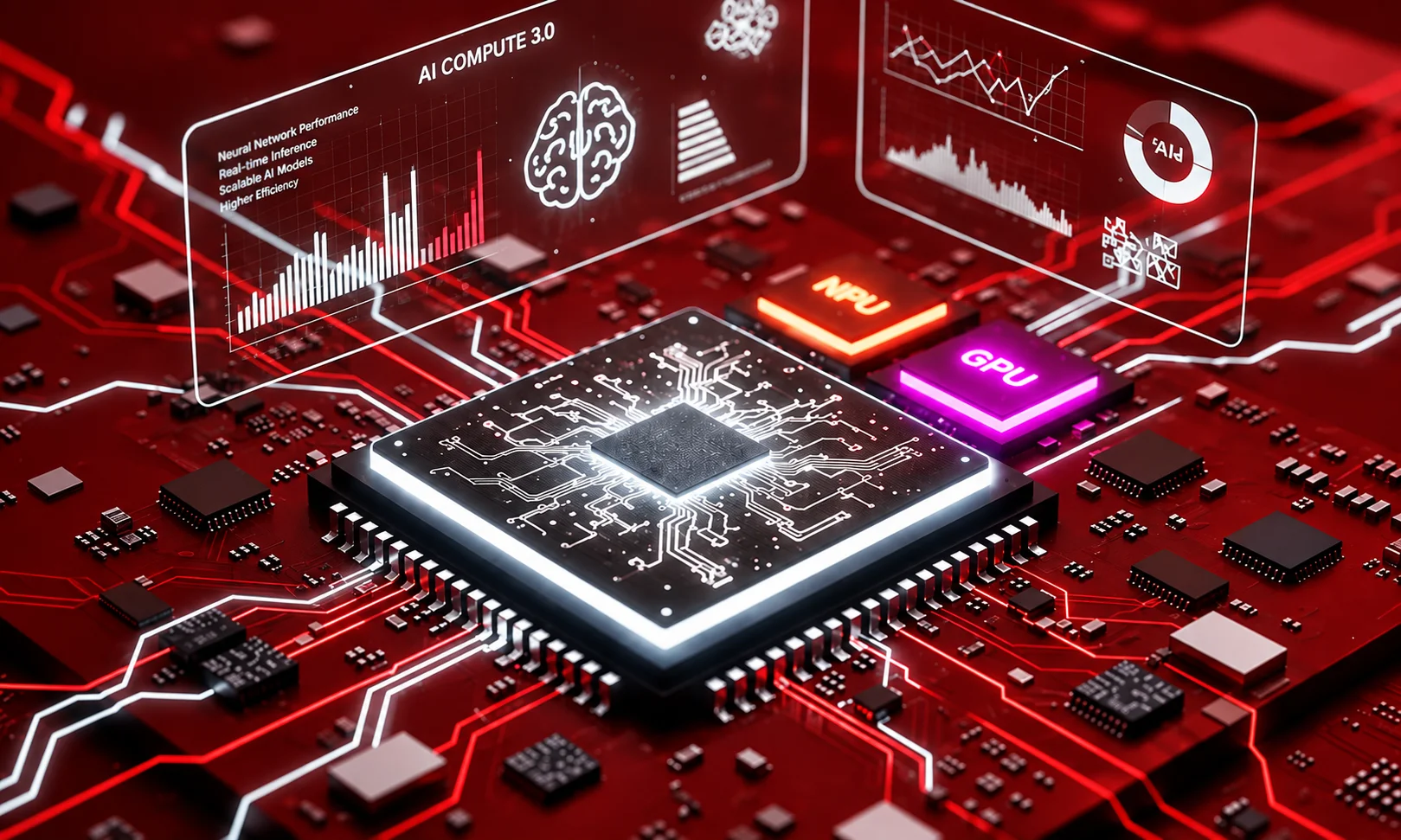
If silicon chips are hitting a hard physical wall, how will we build better generative AI in five years? We have to throw out traditional computing altogether and use weird new physics tricks. Scientists are currently building hardware solutions that sound like pure science fiction today.
Photonic Computing: Running Math on Light
What if we stopped using electricity to move data inside our computers entirely? That is the core idea behind photonic computing systems currently under active development. Instead of pushing electrons down copper wires, you fire beams of light through glass channels.
Light generates almost zero heat from physical friction as it moves through microscopic fiber paths. Oh, and photons travel at the speed of light, so that means optical chips can do matrix math in a split second. Compared to the energy consumption of traditional systems, these light-based systems can handle complex generative AI models with significantly reduced electricity usage.
Neuromorphic Chips: Stealing Ideas from Biological Brains
Your brain is the most powerful computer in the universe that exists today. It reads languages, draws art, recalls memories, drives roads and runs on only twenty watts. This is about the same amount of energy that a small light bulb in your kitchen refrigerator consumes!
At the same time, a super-computer with artificial intelligence models would need millions of watts of electricity to keep going. Why is your brain so much better at saving energy than modern silicon supercomputers? Because your brain uses analog signals and only consumes energy when a neuron actually fires.
| Emerging Technology | How It Operates | Primary Advantage | Main Barrier to Adoption |
| Photonic Computing | Uses light particles instead of electrons | Extreme speed, low heat generation | Hard to miniaturize and manufacture |
| Neuromorphic Chips | Mimics physical biological neural networks | Massive energy efficiency | Difficult to program with current software |
| Quantum AI | Uses quantum bits (qubits) for state superposition | Solves complex probability matrices instantly | Requires near-absolute-zero cooling |
How Smart Engineers Trick Physics Today
While we wait for optical supercomputers and brain-like circuits to mature, engineers must trick current GPUs. Since they cannot break physical laws, they play clever tricks with how software interacts with hardware. They optimize code structures to get every drop of performance out of physical silicon components.
- Dumbing Down the Math: Engineers swap ultra-precise 32-bit numbers for simple 8-bit numbers, dropping memory traffic by 75% without losing model accuracy.
- Spreading the Work: Models get sliced up into smaller pieces across thousands of connected GPUs so no single chip overheats and throttles.
- Dipping Chips in Oil: Big data centers submerge server racks directly into non-conductive liquid baths to pull intense heat away instantly without fans.
- Giant Wafer Chips: Some manufacturers build giant single chips the size of a dinner plate, eliminating slow external copper wiring bottlenecks completely.
As we frequently point out at BrandClickX, software optimization is really just making code polite to hardware.
Conclusion
At the end of the day, understanding the physics of ai training grounds us in physical reality. Digital tools feel magical on screen, but every line of code is bound by physics, resistance, and heat. GPUs took over because their design matched parallel math better than anything else available on earth.
As silicon reaches its atomic limits, the future belongs to radical ideas like photonic chips and neuromorphic networks. The next big jump in artificial intelligence won’t come from software tricks alone, it will come from mastering physics.
Frequently Asked Questions
Why are GPUs better than CPUs for AI training?
GPUs contain thousands of smaller cores designed for simultaneous matrix math, making them ideal for processing parallel machine learning workloads efficiently.
What is the main physical limit of current AI chips?
Heat dissipation and resistance are the main limits; tiny copper wires generate extreme heat, causing performance throttling at high power levels.
Will optical computing replace silicon GPUs for AI?
Optical computing shows great promise for speeding up matrix math, but manufacturing challenges mean hybrid optical-silicon systems will likely arrive first.
How much power does training a large AI model consume?
Training a large model generally consumes gigawatt-hours of electricity, which is roughly equivalent to the energy used by hundreds of average homes annually.