A brand positioning template should leave your team with fewer unresolved decisions, not simply fewer blank boxes.
The familiar workshop scene is easy to imagine: customer notes on the wall, competing descriptions of the business and a sentence everyone is trying to improve. The words begin to sound better. But nobody has resolved whether the promise is supported, whether buyers care or what the service team must do differently on Monday.
That is where a worksheet needs to earn its place.
A useful brand positioning template records the buying situation, competitive alternatives, relevant value, supporting evidence and business commitments behind a position. The final statement is a summary. The work underneath it determines whether the summary deserves approval.
The template below is an editorial working tool. It is not a validated scoring model or a substitute for customer research. Use it to organize evidence, identify disagreement and decide what must happen next.
Key Takeaways
- Bring evidence into the workshop rather than expecting discussion to produce it.
- Record what customers currently do, including the option of making no change.
- Separate the proposed value from the proof needed to support it.
- Include delivery costs, service limits and decision ownership.
- Approve unresolved ideas for testing rather than treating them as established facts.
- Keep the working record alongside the positioning statement so future teams understand the decisions.
What Should You Prepare Before the Workshop?

Begin with the decision the team needs to make. Perhaps the offer is attracting poorly matched inquiries. Perhaps a new product changes the comparison buyers should make. Perhaps sales and marketing describe different benefits.
Gather evidence relevant to that decision: recent customer accounts, lost-deal notes, product information, service records, comparable competitor offers and current pricing conditions.
Include sources and dates. Mark the difference between customer observations, company claims and internal interpretations. A useful brand positioning strategy needs more than agreement among colleagues.
Positioning specialist April Dunford has criticized using a fill-in-the-blank statement as the method for discovering a position. Her guidance directs attention toward the underlying components and alternatives. The worksheet here follows the practical distinction between investigating decisions and recording them clearly; it is not a reproduction of her methodology.
What if the evidence is missing?
Hold a planning session, but call the output a research brief or positioning hypothesis.
Do not turn an internal guess into a customer finding because it receives several votes. Record what is unknown, who will investigate it and what evidence could change the direction.
A workshop can produce an honest and useful outcome without approving a new public promise.
Who Should Take Part?
Include people who understand the customer decision and people responsible for delivering the offer.
Depending on the business, that may mean marketing, sales, product, service operations and finance. Use a facilitator to keep observations separate from interpretations, a recorder to preserve decisions and a named owner responsible for the final direction.
Roles can be combined in a small company. What matters is that delivery implications do not disappear because only the communications team attends.
Ask participants to review the evidence before the session and note where they disagree. This helps the meeting begin with actual uncertainty rather than a competition to produce the most appealing line.
What Does the Brand Positioning Template Include?
Use the following worksheet as the main working record.
The completed column describes a fictional home-textiles business called Alder House. All capabilities, customer situations and proposed decisions in the example are invented for demonstration. They are not findings about a real company or market.
| Field | What to record | Fictional worked example: Alder House |
| Decision | The choice the workshop must resolve | Whether to emphasize decorative styling or practical product selection for online curtain buyers |
| Buying situation | What makes the category relevant now | Furnishing a room and needing to judge curtain size, appearance and light control online |
| Intended customer | A relevant group in that situation | Buyers considering ready-made curtains who want clearer selection guidance |
| Alternatives | What they currently use or consider | Other ready-made suppliers, a local shop, made-to-measure services or postponing the purchase |
| Category | A recognizable description of the offer | Ready-made curtains with product-selection guidance |
| Relevant value | The outcome worth investigating | Greater confidence in choosing a suitable size and fabric before ordering |
| Supporting capability | What the offer can actually provide | Assume measuring instructions, dimensions, fabric samples and defined advice are available |
| Evidence required | What must support the promise | Review product accuracy, sample consistency, advice quality and relevant customer task tests |
| Boundaries | What the offer does not include | No assumed installation, bespoke sizing or guarantee that every fabric suits every room |
| Delivery commitment | What the business must maintain | Accurate information, sample fulfillment and advice within stated service limits |
| Commercial check | Costs and conditions affecting feasibility | Sample costs, handling, support time, returns and margin under the proposed package |
| Next decision | What can be approved and what remains unresolved | Approve the concept for research; do not claim it reduces returns without evidence |
The most important cell may be the last one. The worksheet can be complete while the proposition still needs testing.
How Should You Run the Positioning Workshop?

A suggested format is a two-hour decision session after the preparation work. Adjust the timing to the complexity of the business. The timetable is an organizational aid, not a claim that research and strategy can be completed in two hours.
First 20 minutes: agree on the decision and evidence
State the question in one sentence. Review the strongest relevant evidence and identify important missing perspectives.
For Alder House, the choice concerns the value the offer should emphasize. It is not initially a decision about colors, typography or campaign headlines.
Confirm which items are observations and which are proposed interpretations. If participants disagree about what the evidence means, preserve that disagreement rather than averaging it into a vague phrase.
Next 35 minutes: work through the customer and alternatives
Describe a relevant buying situation and how people currently handle it. Investigate alternatives beyond companies selling apparently similar products.
In the fictional example, a buyer considering ready-made curtains might also visit a local shop or defer the decision. Those possibilities change the questions the business should investigate about reassurance, convenience and effort.
Do not assume that a detailed description proves a large market exists. The workshop is deciding which proposition merits further evidence, not estimating demand from imagination.
Next 35 minutes: connect value with proof and delivery
Identify the proposed benefit, the capabilities supporting it and the evidence still needed.
For Alder House, clearer product selection is different from guaranteed satisfaction or fewer returns. Product guidance could be understandable yet fail to address the uncertainty customers find most important.
Bring operational questions into the same discussion. Who maintains dimensions? How quickly are samples supplied? What does advice cover? How will unusual requests be handled?
Use the value proposition to keep the benefit connected to the actual offer. A benefit without a delivery mechanism belongs in the hypothesis record.
Final 30 minutes: draft, challenge and assign
Write a concise working statement, test it against realistic decisions and assign the next actions.
The facilitator should ask what would make the team reject the direction. If no possible evidence could change the answer, the session is recording a commitment rather than investigating a strategy.
End with a status: ready for limited testing, ready for wider use under defined conditions, or unresolved pending specific research. Avoid the ambiguous outcome “everyone broadly agrees.”
How Do You Turn the Worksheet Into a Positioning Statement?
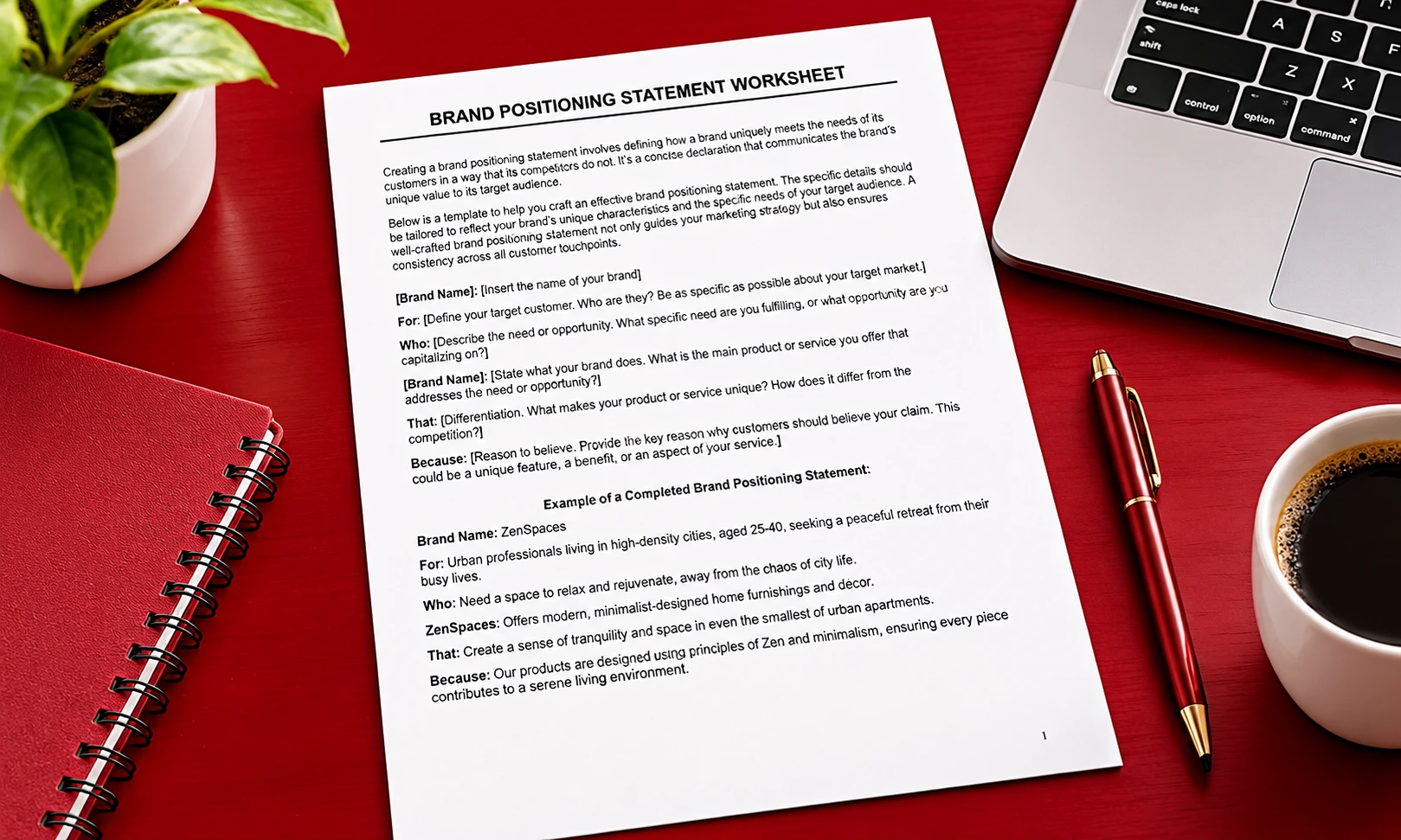
Use a straightforward structure:
For [customers in a relevant situation], [brand] is a [recognizable category] that provides [important value], supported by [capabilities and evidence].
Treat the structure as optional. Clear meaning matters more than fitting every element into a single sentence.
For the fictional Alder House example, a working draft could read:
For people choosing ready-made curtains online, Alder House combines curtains with clear measuring guidance, fabric samples and product advice to support a more informed purchase.
This describes an assumed offer. It does not establish that the company is better than competitors or that the guidance improves purchase outcomes.
An accompanying note should state that the capabilities are fictional assumptions in this example and that a real business would need to verify them. Any stronger comparison would require a defined competitor set and appropriate evidence.
Keep the public headline separate
The internal statement records strategic choices. A customer-facing page needs an accessible explanation of the offer and evidence relevant to the visitor’s questions.
The headline might emphasize choosing curtains for a room, while the page explains dimensions, samples and service scope. That public explanation must remain accurate; it does not need to reproduce every clause of the workshop document.
How Can You Challenge the Draft Before Approving It?
Use concrete requests that put pressure on the proposed position.
For the fictional business, ask what happens when a customer requests a custom size, needs an exact color match from a screen image or wants installation advice outside the service scope.
Have participants explain independently what the business should say and which part of the offer supports that answer. Compare the responses.
If sales promises something operations cannot provide, the draft has exposed a decision the team still needs to resolve. If the worksheet cannot guide the answer, add the missing boundary or evidence requirement.
This exercise tests internal usefulness. It does not prove customer demand or validate the position commercially.
Test with customers after internal review
Investigate whether relevant people understand the offer, find it useful and believe the supporting evidence. Where feasible, evaluate behavior under actual price and purchase conditions.
For Alder House, a research plan might include observing whether participants can select an appropriate size using the guidance. A real study would need defined tasks, criteria and participant selection. Do not claim fewer returns simply because people say the instructions look helpful.
That distinction protects the business from turning a promising resource into an unsupported outcome promise.
What Should Happen After the Workshop?
Give the decisions an owner and a place in everyday work.
Update the relevant product descriptions, sales materials and service instructions only after the necessary claims and capabilities are checked. Identify which materials depend on each decision so a later change can be applied consistently.
The IPA’s briefing guidance emphasizes the relationship between marketing strategy, written briefs and the briefing process. A workshop output needs that next step: a clear assignment for the people producing and delivering the work.
BrandClickX’s article on creative brief ownership explains how strategic requirements and factual boundaries can coexist with creative freedom.
Keep a decision record
Record the date, owner, evidence reviewed, chosen direction, rejected options and reasons. Include unresolved issues and the conditions that would trigger reconsideration.
This is useful when a new employee asks why the business made a choice, or when a campaign team proposes wording that extends beyond the approved evidence.
The objective is continuity of judgment. It is not to preserve the statement indefinitely after the offer or customer situation changes.
What Is the Workshop Completion Checklist?
Before closing the session, confirm:
- The business decision is explicit and has a named owner.
- Customer evidence is distinguishable from internal hypotheses.
- Actual alternatives, including delay or existing workarounds, have been considered.
- The category description is understandable.
- The proposed benefit is connected to a capability the business can provide.
- Important claims have evidence or a clear testing requirement.
- Service boundaries and exception ownership are documented.
- Delivery costs and practical constraints have been reviewed.
- The draft has been challenged with realistic decisions.
- The next actions have owners, dates and review criteria.
The workshop has done its job when the next person knows what to do, what to investigate and what they are not yet entitled to promise.
Frequently Asked Questions
Is a brand positioning template the same as a creative brief?
No. The positioning template records choices about the customer, alternatives, value and evidence. A creative brief translates relevant strategy into a defined communication task.
Can you complete positioning in one workshop?
A workshop can organize existing evidence and resolve decisions. It cannot replace missing customer research, product tests or commercial analysis. An honest outcome may be a clear research plan.
Should the team vote on the best positioning statement?
Voting can reveal preferences, but does not establish which position is supported by evidence. Ask participants to explain their reasoning, inspect conflicting facts and assign a decision owner.
How often should the template be reviewed?
Review it when the offer, buyer situation, competitive context or supporting evidence changes materially. A scheduled accuracy check can help, but does not require rewriting the position each time.