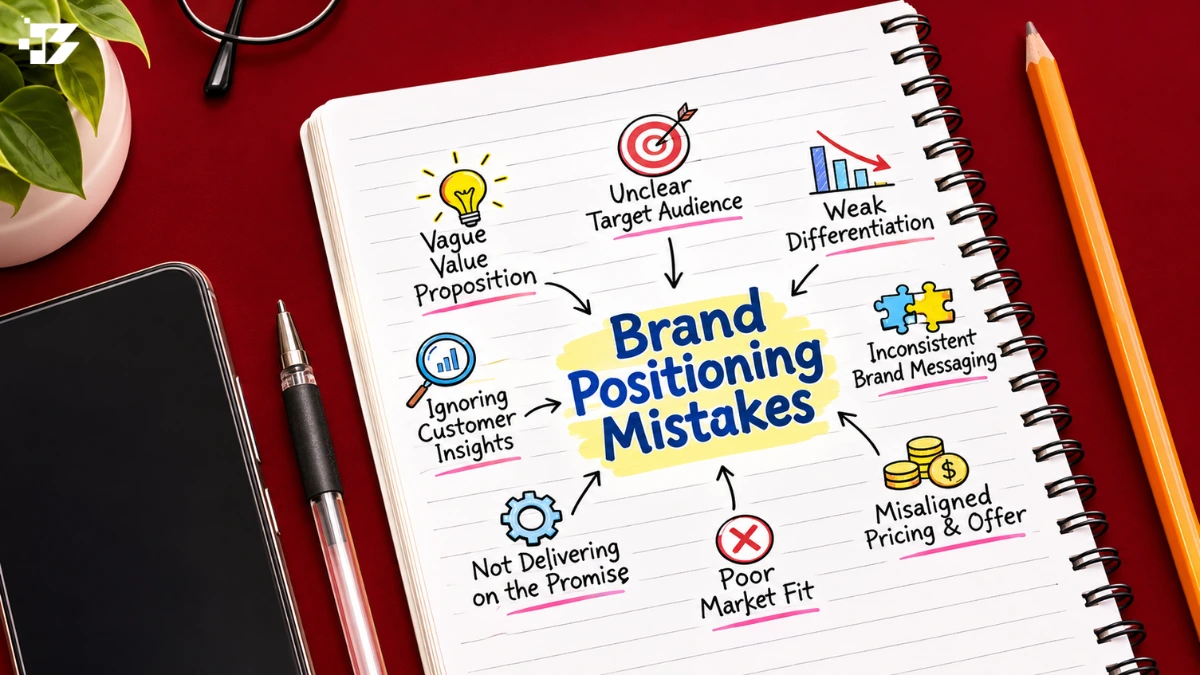
Brand positioning mistakes are easy to blame when sales disappoint. The message feels tired. Competitors seem louder. Someone suggests a sharper promise, a narrower audience or a completely new identity.
But what if customers understand the offer and cannot buy it in the format they need? What if they believe the promise until the first support request? What if the message is attracting the intended buyer, but the price and package no longer fit the decision?
Rewriting the headline may leave the real problem untouched.
Brand positioning mistakes occur when the intended place of a brand is poorly chosen, weakly supported or inconsistently delivered. Diagnosing them requires evidence about the customer’s decision and the business’s behavior. A disappointing outcome alone does not identify which part failed.
The useful question is precise: where does the connection between intended customer, promised value and actual offer break down?
Key Takeaways
- Investigate the failure before assuming a new position is necessary.
- Compare the brand with alternatives buyers actually consider.
- Use a category description that helps customers understand the offer.
- Separate an unclear message from an unavailable, unsuitable or unreliable offer.
- Audit what sales and service teams promise, not just the approved brand document.
- Define the evidence that would justify a change and the measures that would reveal whether it helped.
How Can You Tell Whether Positioning Is the Problem?

Look for specific evidence of a mismatch.
Customers may repeatedly misunderstand what the business sells. The offer may be associated with a benefit it cannot deliver. The brand may be framed against alternatives its intended buyers do not consider.
Those are plausible positioning issues. Even then, investigate the pattern rather than treating one conversation as a market-wide finding.
A useful brand positioning strategy connects the offer with a relevant reason to choose it. When that connection appears weak, identify whether the difficulty concerns understanding, relevance, credibility, purchase feasibility or the experience after buying.
| Observed symptom | Possible explanation | Evidence to inspect before changing strategy |
| Buyers cannot explain what the company provides | Unclear category or explanation | Comprehension research with relevant prospective buyers |
| People understand the offer but decline it | Price, timing, fit or switching barriers | Recent decision accounts and comparable offer conditions |
| Qualified buyers abandon the purchase | Buying friction or availability | Task observations, stock records, checkout or procurement requirements |
| Sales promises vary widely | Unclear boundaries or incentives | Proposals, call records and approved service scope |
| Customers are disappointed after purchase | Promise–delivery mismatch | Complaints, service records, returns and product behavior |
| A campaign generates attention but little qualified demand | Audience, offer, measurement or execution issues | Traffic quality, inquiries, qualification and actual purchase paths |
The table is a diagnostic aid. The symptoms can have several causes, and more than one may be present at once.
Mistake 1: Defining Competition From a Desk Research List
A team can produce a thorough competitor presentation and still misunderstand the buyer’s choice.
Other companies offering similar products are worth monitoring. For positioning, however, the decisive alternatives are the ones buyers actually use or consider. A manual process, an existing supplier or a decision to postpone can matter more than an unfamiliar startup with a similar feature list.
April Dunford’s positioning guidance puts competitive alternatives at the start of the analysis. The practical lesson is to investigate the customer’s existing situation before choosing the comparison you want to win.
For a hypothetical scheduling tool, the main obstacle might be the effort of moving a working team away from a shared calendar. Advertising advanced features against another paid platform would leave that obstacle largely unanswered.
What to change: Reconstruct recent buying decisions. Record which alternatives appeared spontaneously, which were actively evaluated and what customers used when no purchase followed.
Do not promote every theoretically possible rival into an equally important positioning target.
Mistake 2: Choosing a Category Customers Cannot Decode
A new category description may sound exciting inside the business while creating extra work for the buyer.
“Workplace intelligence infrastructure” could describe several different products. A customer may need to know whether it is an employee survey tool, a scheduling system, an analytics service or something else before evaluating its relevance.
Dunford’s guidance also highlights the explanatory work required when a company introduces an unfamiliar category. Familiar contexts and newly created ones involve different communication requirements.
What to change: Test whether prospective buyers can describe the offer, identify a relevant use and explain what they would compare it with.
If an unfamiliar category is strategically necessary, plan for the education it requires. Do not assume confusion will disappear because the wording sounds more distinctive than a familiar category name.
Mistake 3: Treating Broad Adjectives as Evidence
“Premium,” “innovative” and “customer-first” leave important questions unanswered.
What can the product do? Which part of the service is different? Under what conditions does the promise hold? What can a buyer inspect before paying?
The problem is not that adjectives are forbidden. It is that they can replace the decision and proof the business needs to supply.
What to change: Attach important claims to appropriate evidence: relevant tests, documented specifications, clear service commitments or carefully described customer outcomes.
Keep the limits visible. One positive testimonial illustrates an experience; it does not establish a typical result. A pilot demonstrates what happened under its conditions, not what every future customer should expect.
Mistake 4: Mistaking Purchase Friction for Weak Desire

A buyer can prefer the offer and still be unable to complete the transaction.
The product may be unavailable locally. The service may require a commitment the buyer cannot approve. The package may omit a necessary integration. A procurement process may prevent the supplier from entering consideration.
Ehrenberg-Bass research distinguishes mental availability, being readily thought of in buying situations, from physical availability, being easy to find and buy. That distinction is useful when a team assumes every commercial problem is a communication problem.
What to change: Observe how qualified customers try to buy. Check access, stock, eligibility, terms, purchase channels and implementation requirements.
A clearer promise can help people understand an offer. It does not automatically repair a broken payment step or make an unsuitable contract acceptable.
Mistake 5: Letting Sales Exceptions Become the Real Position
A strategy document may describe a focused service while proposals promise almost anything needed to close a deal.
One salesperson offers unlimited revisions. Another includes specialist support. A third promises an implementation schedule the delivery team has not approved.
Over time, customers experience several different versions of the business. The approved statement becomes a poor description of what is being sold.
What to change: Audit recent proposals and exceptions against the standard offer. Identify who approved each commitment, what it cost and whether the customer understood the boundary.
An exception can be commercially sensible. Repeated exceptions may indicate that the standard package needs revision—or that sales incentives reward commitments the organization cannot sustain.
Both possibilities deserve operational review before a new brand campaign.
Mistake 6: Interpreting More Inquiries as Better Positioning
A more ambitious promise can attract additional demand and still make the business harder to run.
Consider a fictional agency. Before a message change, it receives 100 inquiries, of which 30 meet its defined qualification criteria. After the change, it receives 160 inquiries, of which 32 qualify.
Total inquiries rise by 60%. Qualified inquiries increase by two, while the qualification rate falls from 30% to 20%.
These invented figures do not establish whether the change helped. The agency also needs to examine sales effort, customer acquisition costs, project conversion and contribution. They show why a headline lead count can hide a different business result.
What to change: Define useful demand before evaluating the campaign. Track qualification and downstream economics alongside volume, using consistent criteria.
Do not automatically reject lower qualification rates either. Additional profitable business may justify the extra effort. Make that calculation rather than assuming the answer.
Mistake 7: Calling a Price Problem a Copy Problem
A customer can understand the value and still find the package unsuitable at its current price.
Perhaps the buyer needs fewer services. Perhaps the price comparison excludes implementation charges. Perhaps an expected benefit does not justify the premium for this particular task.
What to change: Investigate actual purchase conditions and relevant alternatives. Test price alongside the offer rather than presenting benefits as though they carried no additional cost.
BrandClickX’s guide to brand pricing power examines how perceived value relates to the price a brand can sustain. More confident language does not, on its own, establish willingness to pay.
Review margin as well as demand. A package that wins customers through expensive promises may create a different problem from one that simply needs a clearer explanation.
Mistake 8: Changing the Identity Before Understanding the Failure
A visual refresh is tangible. It creates deadlines, designs and a visible result. That can make it appealing when the underlying commercial issue remains uncertain.
But a new identity may leave service inconsistency, unclear packaging or weak product performance unresolved. It also introduces decisions about how existing customers will recognize the brand.
What to change: State the specific problem the proposed work should solve. Gather evidence that expression or recognition is part of that problem before committing to extensive changes.
The distinction between a brand refresh and a full rebrand is useful here. Match the scope of the intervention to the evidence, rather than allowing the most visible project to define the diagnosis.
Mistake 9: Trying to Sound Consistent Instead of Acting Consistently
A language guide can keep the tone tidy while the actual experience contradicts the promise.
A business promising simplicity may use a confusing contract. A brand emphasizing personal care may provide no clear route to a person when a problem occurs. A specialist company may publish advice outside the expertise it can demonstrate.
What to change: Follow the promise through the buying and ownership experience. Ask where customers must rely on it, what happens at that point and who is responsible for delivery.
Consistency does not mean repeating identical wording in every channel. It means that different communications and experiences support compatible expectations.
Mistake 10: Declaring Success Without a Useful Comparison

A new position launches, sales rise and the presentation credits the strategy. At the same time, distribution expands, the product improves and the advertising budget increases.
The observed growth may be real. The claim about what caused it requires more evidence.
What to change: Define the measurement plan before launch. Where feasible, use an appropriate controlled comparison. Otherwise, document the conditions that changed and limit the conclusion accordingly.
Track whether the intervention addressed the diagnosed problem. Better comprehension, improved qualification and stronger contribution answer different questions. Avoid treating one favorable movement as proof that the entire strategy worked.
How Should You Prioritize the Fixes?
Start with failures that make the offer misleading, unbuyable or undeliverable. Then examine understanding, relevance and competitive context using the evidence available.
This is a practical review sequence, not a universal ranking of causes. A business facing serious category confusion may need positioning work immediately; another may primarily need reliable stock information or a clearer service package.
Assign each finding an owner, evidence source, proposed action and review measure. Keep unresolved hypotheses separate from confirmed issues so they do not acquire certainty simply by appearing in the same action list.
What Is a Useful Brand Positioning Audit Checklist?
Before approving a repositioning project, ask:
- What specific failure have we observed, and among which customers?
- Have we investigated the alternatives in actual buying decisions?
- Can intended buyers explain the offer without assistance?
- Are important claims supported by relevant evidence?
- Can qualified customers find, approve and purchase the offer?
- Do proposals match the standard package and delivery capacity?
- Are qualified demand and contribution visible alongside headline leads?
- Have pricing and purchase conditions been tested honestly?
- Does the proposed intervention address the diagnosed cause?
- Have we defined what would support, weaken or reverse the decision?
A positioning review is valuable when it makes the business more precise about the problem. The result may be a new message. It may also be a better offer—or a decision to keep the position and repair how it is delivered.
Frequently Asked Questions
What is the biggest brand positioning mistake?
There is no single mistake that explains every case. A damaging starting error is choosing a solution before establishing whether the problem concerns understanding, relevance, credibility, purchase feasibility or delivery.
Can clear positioning still fail commercially?
Yes. Customers may understand an offer while rejecting its price, finding it unavailable or choosing an alternative that fits their circumstances better. Clear communication is one part of the commercial system.
Should positioning change after a bad quarter?
A weak period is a reason to investigate, not automatic proof that the position is wrong. Review category demand, execution, availability, price and other relevant changes before deciding.
How can a small business audit its positioning?
Start with recent inquiries, proposals, lost decisions, support cases and purchase paths. Use those records to identify specific questions, then collect customer and operational evidence before making broader claims.