Brand architecture becomes visible when a customer asks a simple question: “Are these all part of the same company?”
The answer might reassure them. It might confuse them. It might make no difference at all. Your job is to decide which relationships deserve attention—and make those relationships useful when someone chooses what to buy.
Brand architecture is the system that defines how a company’s brands, products and services relate in the marketplace. It establishes which name leads, which names describe individual offers and how visibly the parent supports them.
The most useful architecture makes the portfolio easier to understand while giving the business enough room to grow. Getting there requires more than drawing a neat hierarchy of logos.
Key Takeaways
- Brand architecture defines customer-facing relationships across a portfolio.
- A legal ownership chart and a brand architecture serve different purposes.
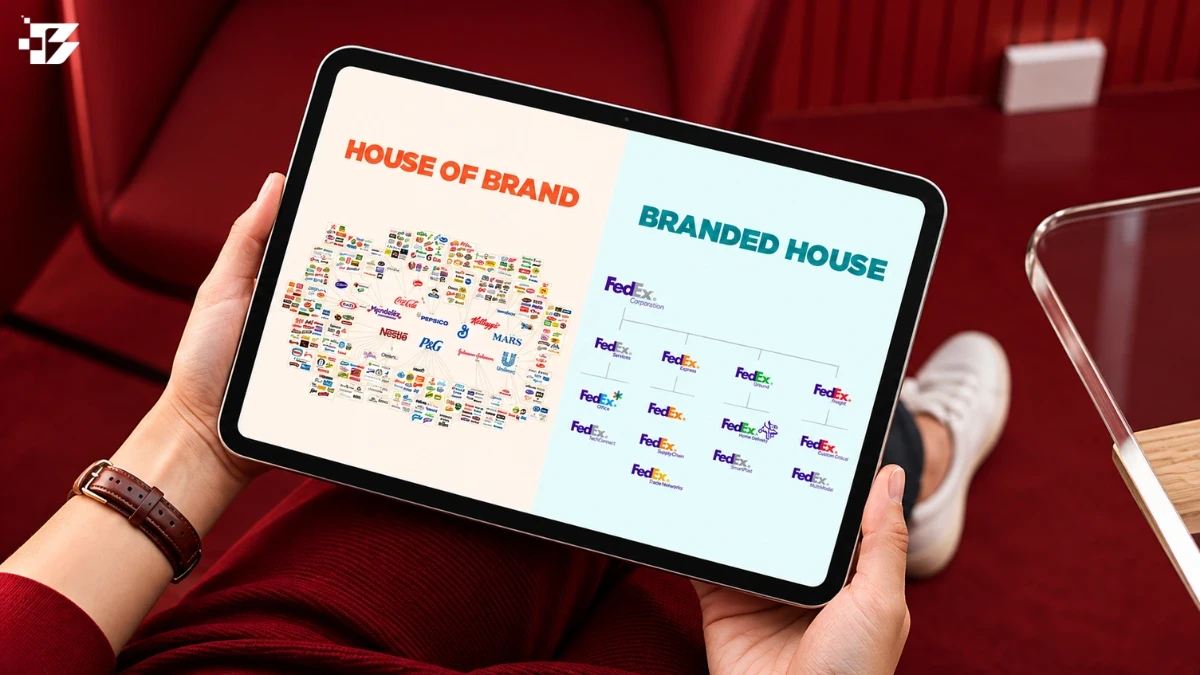
- The main approaches include a branded house, a house of brands, endorsed brands and hybrids.
- A separate product name does not automatically need a separate brand.
- Evaluate customer understanding, transferable trust, meaningful differences and operating capacity.
- Test the proposed system across buying, billing, support and renewal before rolling it out.
What Does Brand Architecture Actually Decide?

It decides whose reputation carries the offer and how customers navigate the relationship.
Imagine a business with an advisory service, a reporting platform and a training programme. It could sell everything under one masterbrand with descriptive labels. It could give the platform a distinct name while keeping the parent visible. It could build three independent brands.
Each option changes what the customer has to learn. It also changes what the company has to explain, promote and maintain.
Architecture therefore reaches into naming, websites, packaging, sales conversations, partnerships and customer service. A system that looks clear on a presentation slide can still fail when a customer receives an invoice from an unfamiliar name.
Start with the portfolio’s brand positioning. If you have not decided what the company should mean to buyers, it is difficult to judge which products can credibly share its name.
How Is Brand Architecture Different From Company Structure?
Company structure concerns ownership, legal entities and management. Brand architecture concerns how the portfolio is presented and understood.
One legal entity can operate several brands. Several legal entities can use a shared customer-facing identity. A corporate name might matter to investors and suppliers while receiving little prominence in everyday consumer choice.
Likewise, changing a division’s reporting line does not necessarily justify renaming its products. Customers rarely need to learn an internal reorganisation just to continue buying the same service.
Map both systems when planning a change, but do not assume the customer-facing hierarchy should reproduce the organisation chart.
What Are the Main Brand Architecture Models?
The categories are useful reference points. Their boundaries vary in practice, and a large portfolio may use several arrangements.
| Model | Customer-facing relationship | Potential advantage | Main tradeoff |
| Branded house | One masterbrand leads across offers | Shared recognition and a consistent story | Offers must fit a credible shared promise |
| House of brands | Distinct brands lead individual businesses or categories | Different identities can serve different markets | Each identity needs sustained support |
| Endorsed brands | A distinct brand receives visible parent support | Individual meaning with an explicit relationship | Customers must understand both names |
| Sub-brands | A named offer remains closely tied to the masterbrand | Differentiation within a recognisable family | Too many layers can complicate choice |
| Hybrid | Different arrangements coexist | Flexibility across a varied portfolio | Exceptions need clear governance |
What does a branded house look like?
A masterbrand takes a prominent role across the portfolio. Individual names explain the service, audience or product rather than carrying the whole identity independently.
FedEx’s official shipping materials include names such as FedEx International Priority and FedEx International Priority Express. These illustrate how a shared name can organise related services with different specifications.
That is an observation about the visible naming relationship, not a claim that every part of FedEx follows one pure model.
What does a house of brands look like?
Distinct names lead in their own markets, with the corporate relationship less central to the immediate purchase presentation.
P&G’s official brand directory includes Tide and Pampers across different product categories. The portfolio illustrates how a company can support recognisable product brands without making the corporate name the main name of each offer.
This arrangement creates room for distinct positioning. It also creates more identities to steward. Shared ownership does not remove the work of building demand and maintaining a clear role for each brand.
What is an endorsed brand?
An endorsed brand makes the supporting relationship explicit while preserving a distinct identity. Courtyard by Marriott is a visible naming example listed in Marriott’s official portfolio.
The endorsement can help explain who stands behind the offer. Whether that relationship increases trust for a particular audience is a research question, rather than something the architecture diagram proves.
A sub-brand usually keeps a closer connection to the masterbrand in the overall buying experience. Because organisations use these terms differently, document how your own system handles name prominence, positioning and customer expectations.
When Is a Shared Masterbrand the Better Starting Point?
Consider it when customers buy related offers, the parent promise remains credible and the business can deliver a sufficiently coherent experience.
Shared identity can make cross-selling easier to explain: the customer encounters another offer from a company they already recognise. That potential depends on whether their previous experience is relevant and positive.
An accounting firm adding financial reporting software may have a plausible connection to explore. The firm’s reputation might reassure buyers, while buyers could also question its software capability. The name alone cannot answer that concern.
Ask what trust actually transfers. Competence in one field does not establish competence in another. A broad masterbrand promise that sounds impressive internally can become vague when applied to very different products.
When Does a Separate Brand Earn Its Place?

A separate brand deserves consideration when an offer needs a meaning the parent cannot credibly carry, serves a materially different buying context or brings established recognition worth retaining.
The difference should be more substantial than a new feature or a team’s preference for its own logo.
Examine the customer’s value proposition. Are the benefit, alternatives, purchase criteria and expected experience meaningfully different? Would a shared name create a misleading expectation?
Then examine the capacity to support separation. A distinct identity may require its own content, customer communications, distribution materials, campaign assets and governance. It may share infrastructure, but someone still has to maintain its meaning.
A second brand without a sustained reason to exist can become an expensive label attached to the same offer.
What Questions Should Guide the Decision?
Use five practical questions. This is an editorial decision framework, not a validated scoring model.
- What relationship helps the buyer? Determine whether people need to recognise a family of offers, distinguish genuinely different propositions or understand the supplier behind a service.
- What reputation can transfer? Identify what the parent is trusted to do, by whom, and whether that trust is relevant to the proposed offer.
- What difference needs explaining? Separate important differences in audience, promise and experience from differences that a descriptor or plan name could handle.
- What can the organisation maintain? Account for people, channels, content, support and decision rights. A portfolio needs operating discipline after the naming presentation ends.
- What happens if the choice is wrong? Consider migration costs, customer confusion and the difficulty of reversing the decision. A cautious endorsement may offer a transition where immediate consolidation would discard useful recognition.
Write the evidence and uncertainty beside each answer. Do not turn weak assumptions into precise-looking totals just because a spreadsheet can calculate them.
How Would This Work for a Growing Business?
Consider the fictional company Alder, which currently provides business advisory services. It plans to launch reporting software and an executive education programme.
The following example demonstrates the framework. It contains no findings from real customer research.
Establish the decision
Alder must choose whether the two new offers should use its existing name, distinct endorsed identities or independent brands.
The advisory team wants everything unified. The software team wants a separate identity. Neither preference establishes what buyers need.
Document the working assumptions
Assume Alder’s advisory clients recognise the company, the reporting platform initially serves a similar audience and the education programme teaches related management skills. Assume the company has a small central marketing team.
These conditions make a shared identity a reasonable starting hypothesis. They do not establish that new buyers will see Alder as a credible software provider.
Compare the options
Under a shared architecture, Alder could use descriptive names such as Alder Reporting and Alder Executive Education. Customers would encounter one main identity, with the offers explained underneath it.
An endorsed arrangement could give the software a distinct identity supported by Alder. That might become useful if research shows the product needs a different market meaning while the parent relationship still helps.
Independent brands would give each offer more freedom. On the stated assumptions, the team has not yet identified a customer benefit sufficient to justify supporting three separate identities.
Make a provisional choice
The initial recommendation is a shared masterbrand with descriptive offer names, subject to testing. The reason is the apparent connection between audiences and promises, combined with limited capacity to support multiple brands.
Before committing, Alder should investigate whether target buyers understand the offers, distinguish advisory work from software and interpret the shared name as intended.
Define what would change the recommendation
If software buyers consistently mistake the platform for a consulting engagement, clearer descriptions might solve the problem. If the product needs a fundamentally different promise and buying experience, the architecture deserves another review.
That distinction matters. A navigation problem does not automatically require a new brand. A genuine strategic conflict may require more than clearer copy.
How Should You Test a Proposed Architecture?

Show realistic buying situations rather than asking people which diagram they prefer.
Present a search result, landing page, product comparison, proposal, invoice or support message. Ask participants to explain what they think is being offered, who provides it and how the offers relate.
Watch for mistaken assumptions about price, service level, compatibility or accountability. Investigate whether the naming helps customers find the right option and recognise what they already use.
Qualitative work can reveal misunderstandings and suggest improvements. It does not, by itself, establish market-wide preference or forecast the commercial effect of a new architecture.
Test content and presentation as well as names. An unclear description can make a sensible relationship appear confusing. Conversely, polished design can conceal a structural problem during a presentation.
What Do Architecture Projects Commonly Miss?
The experience after purchase
Customers may recognise the sales brand but encounter another name on payment records, login screens or renewal emails. Make necessary relationships clear at those moments.
Do not assume hiding corporate complexity makes it disappear. The customer may still need to understand who handles the account or provides support.
The cost of transition
Consolidation affects more than logos. Review domains, redirects, account access, contracts, packaging, directories, partner listings and customer communications as applicable.
Changing a domain does not guarantee that search visibility will transfer without disruption. Plan the technical migration separately and assess its risks with the relevant specialists.
The limits of reputational separation
Separate names may give offers distinct meanings, but visible ownership can still connect them in public discussion. A house of brands is not a guarantee that reputational problems remain isolated.
Rules for the next launch
Without governance, a portfolio can become complicated again as teams invent new names. Establish who can approve a brand, what evidence is required and when an existing descriptor is enough.
Translate those rules into the creative brief so agencies and internal teams understand which relationships they must preserve.
What Should You Check Before Approving the Architecture?
- Can customers explain the relationship between the main offers?
- Does each brand have a distinct, defensible role?
- Is the parent promise credible across the offers using its name?
- Have you distinguished product descriptors from independent brands?
- Can the business maintain the proposed identities?
- Have acquired or established names been assessed for existing recognition?
- Does the system work across purchase, payment, support and renewal?
- Are migration dependencies and customer communications documented?
- Is someone responsible for approving future exceptions?
- Have you recorded what evidence would trigger a review?
The right architecture helps customers make sense of the business as it grows. Sometimes that means bringing offers closer together. Sometimes it means preserving a meaningful difference. The decision should be visible in a clearer buying experience long after the logo presentation is forgotten.
Frequently Asked Questions
Does every product need its own brand?
No. A descriptive product name, feature label or service tier may provide enough distinction. A separate brand needs a strategic role and sustained support.
Is one model best for small businesses?
There is no universal winner. A shared masterbrand can be practical for related offers with limited resources, but audience differences and incompatible promises can justify another arrangement.
Can a company use more than one model?
Yes. Hybrid portfolios combine arrangements. Document why each exception exists and how customers should understand the relationships.
Should you rename a company immediately after an acquisition?
Assess recognition, customer expectations, strategic fit and migration costs first. Ownership change alone does not establish the best customer-facing name.
Is brand architecture the same as visual identity?
No. Architecture defines relationships and roles. Visual identity expresses those decisions through elements such as names, typography, colour and logo prominence.