


A company can have thousands of customers and still know surprisingly little about them.
The problem is usually not a lack of data. It is that the data is sitting in different places: website activity in one system, purchases in another, email engagement somewhere else, and customer support records somewhere nobody in marketing checks.
That is where first party data becomes important.
First-party data is information a business collects directly from its own customers or visitors through channels it controls, such as its website, app, CRM, email program, loyalty program, purchases, or customer support.
But collecting it is only the beginning.
The real value comes when a business can understand that information, keep it accurate, use it responsibly, and turn it into better customer experiences and better marketing decisions.
AI Overview
First-party data is customer or visitor information collected directly by a company through its own channels. Examples include purchase history, website behavior, CRM records, email engagement, loyalty activity, app usage and customer support interactions. Unlike third-party data bought from outside providers, it comes from a direct relationship with the customer.
Key Takeaways
- First-party data comes directly from your own customer interactions.
- Common sources include websites, apps, CRM systems, purchases, email and loyalty programs.
- It can support segmentation, personalization, advertising and measurement.
- It is not automatically privacy-compliant just because you collected it yourself.
- Poor-quality data can be almost as problematic as having no data.
- The biggest challenge is often connecting data from different systems.
- For AI, clean and well-governed customer data is becoming especially important.
What Is First-Party Data?

The simple definition is easy:
First-party data is information a company collects directly from its own audience through its own channels.
Think about an online store.
Someone visits the website, creates an account, looks at several products, buys one, joins the email list and later contacts customer support. Those interactions can create a useful customer record.
The important part is the relationship. The company is collecting information from an interaction with its own customer or visitor rather than purchasing an audience profile from an outside data broker.
Common examples include website behavior, purchase history, CRM records, email engagement, loyalty activity, app behavior and customer support interactions.
There is also a related category called zero-party data. This is information a customer intentionally gives you, such as their preferred products, interests or answers to a quiz.
So, if a customer tells a beauty brand, “I have dry skin,” that is different from the brand simply observing which products the customer viewed.
Both can be useful. The source and how the information was provided are what matter.
What Counts as First-Party Data?
A lot of businesses already have more first-party customer data than they realize.
The problem is that it may not be organized as one useful customer view.
Behavioral Data
This includes actions such as pages viewed, clicks, session activity, content consumed and events inside a mobile app.
It tells you what people actually do, rather than only what they say they will do.
Transactional Data
Purchase history is one of the most valuable forms.
It can include products purchased, order value, purchase frequency, returns and subscription status.
Identity and Profile Data
This can include information such as name, email, phone number, account details, loyalty tier and other profile attributes.
It is often what allows different customer interactions to be connected.
Engagement Data
Email clicks, campaign responses and push notification interactions can also become first-party signals.
They can help a marketer understand whether a customer is actually engaging with a message.
Customer Support Data
Support tickets, chats, call records, survey answers and feedback can reveal things that website analytics cannot.
This is one area that marketers sometimes overlook.
First-Party Data Examples in Marketing
Here are some easy examples.
An ecommerce company can use purchase history to identify repeat buyers and send them relevant product recommendations.
An email team can use previous engagement to separate active subscribers from people who rarely interact with messages.
A SaaS company can combine product usage, demo requests, email engagement and CRM information to understand which accounts are showing buying intent.
A loyalty program can connect purchases and customer preferences to create more relevant offers.
A publisher can use logged-in reader behavior, newsletter engagement and subscription activity to understand its audience.
These are not exotic examples. They are normal customer interactions. The difficult part is making those interactions useful together.
First-Party vs. Second-, Third- and Zero-Party Data
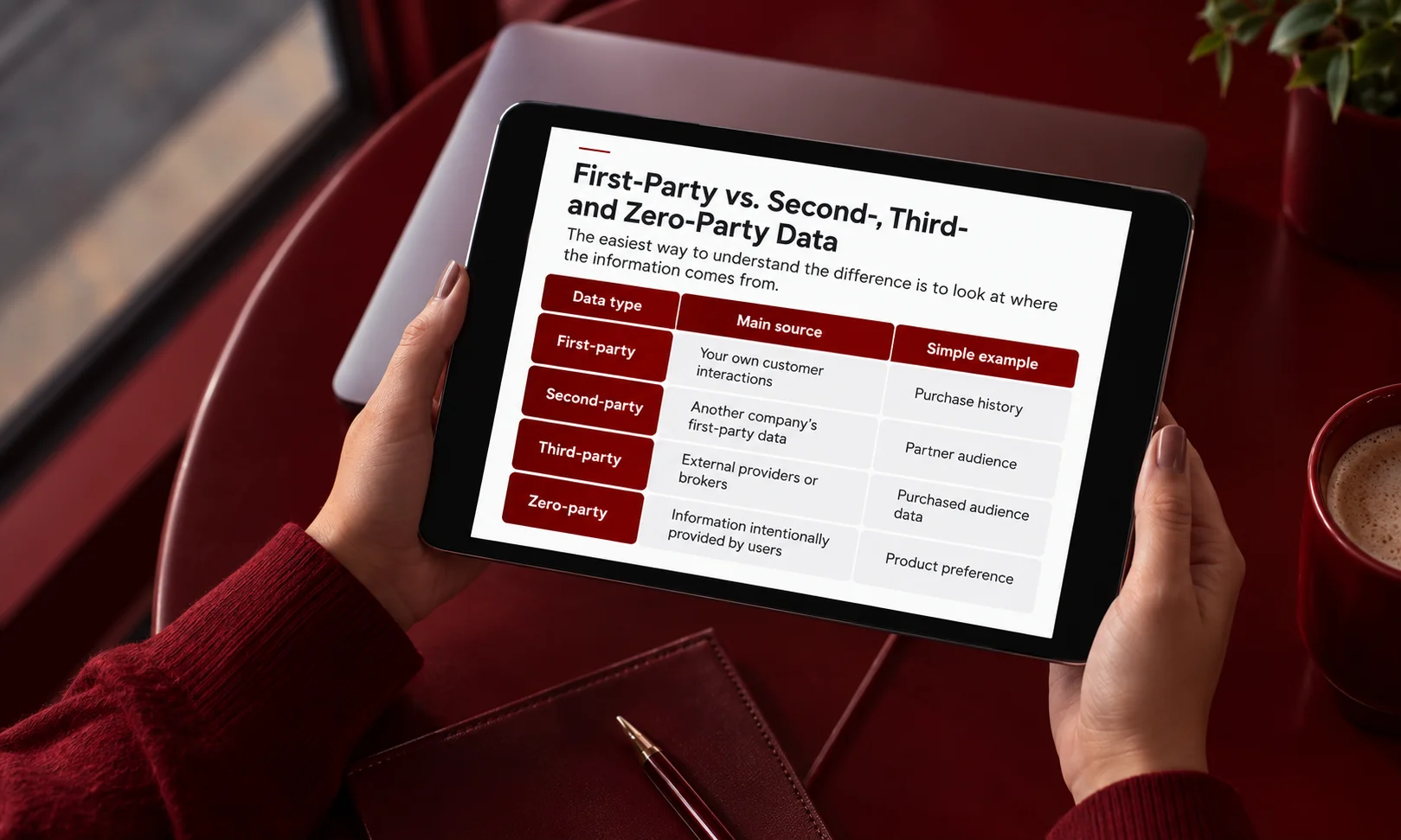
The easiest way to understand the difference is to look at where the information comes from.
| Data type | Main source | Simple example |
| First-party | Your own customer interactions | Purchase history |
| Second-party | Another company’s first-party data | Partner audience |
| Third-party | External providers or brokers | Purchased audience data |
| Zero-party | Information intentionally provided by users | Product preference |
First-party data comes from your own relationship with the customer.
Second-party data is essentially another company’s first-party data that is shared with you through a partnership.
Third-party data is collected and supplied by outside providers, often without the direct customer relationship you have with first-party data.
Zero-party data is information the customer deliberately provides, such as preferences or purchase intentions.
First-Party vs. Third-Party Data
This is usually the comparison marketers care about most.
First-party data gives a company information from its own customer relationship. Third-party data can provide broader audience reach, but the business has less direct connection to where the information came from.
That does not mean third-party data has no use. It can still have a role in prospecting and enrichment. The point is that it should not be confused with information you collected directly.
First-Party vs. Zero-Party Data
The difference is mainly how the information is obtained.
If someone visits a product page, their behavior can become first-party data.
If that person fills out a preference form saying, “I want running shoes for long-distance training,” that is zero-party information because the customer intentionally told you.
Why Is First-Party Data Important?
There is a simple reason businesses care about this:
You can make better decisions when you understand your own customers.
First-party data can help marketers see what customers bought, what they interacted with, which messages they responded to and where they are in the customer journey.
It can then support audience segmentation, personalization, retention, advertising and measurement.
The research provided for this article reports that 87% of organizations prioritize first-party data. It also reports benefits including a 2.9x revenue lift in a Google/BCG study and, in Experian’s 2026 analysis, potential acquisition-cost reductions of up to 50% alongside a 10–15% revenue lift. These figures are reported claims, not guarantees for every business.
That last point matters.
I would be careful with anyone promising that simply collecting first-party data will automatically increase revenue. Data itself does not create value. What you do with it does.
How to Collect First-Party Data
You do not need a giant enterprise data platform to start.
Most businesses already have several collection points.
1. Start With Your Existing Channels
Look at your website, app, CRM, email platform, ecommerce system, customer support software and loyalty program.
Before adding another tracking tool, understand what you already collect.
2. Give People a Reason to Share Information
People generally do not want to fill in another pointless form.
The exchange needs to make sense.
A useful preference center, loyalty benefit, better product recommendation or more relevant communication can give customers a reason to provide information.
3. Make Consent Part of the Process
First-party does not mean “anything goes.”
Collection and activation still need appropriate consent, transparency and governance. The research specifically identifies consent management, lawful basis and consent-signal propagation as important parts of the current first-party data process.
4. Capture Useful Events
Depending on the business, these might include:
- Product views
- Searches
- Add-to-cart events
- Purchases
- Email engagement
- Account activity
- App interactions
- Support requests
Do not collect an event just because your analytics system lets you collect it.
Ask what decision that event will help you make.
5. Bring the Pieces Together
This is where many first-party data projects become difficult.
A customer may have one record in the CRM, another in the email system and another identity in the advertising platform.
Identity resolution and customer data platforms can help connect those records into a more useful customer profile.
How to Build a First-Party Data Strategy

A first party data strategy does not need to start with expensive technology.
Start with the business problem.
Step 1: Decide What You Want to Improve
Maybe you want to increase customer lifetime value.
Maybe your problem is poor retention.
Maybe paid advertising is wasting money on people who already bought.
The goal changes what data you actually need.
Step 2: Audit What You Already Have
List your existing data sources.
Website. CRM. Email. Purchases. App. Support. Events.
Then ask a slightly uncomfortable question: Can these systems actually talk to each other?
If not, you probably have a data problem before you have a collection problem.
Step 3: Fix Collection and Consent
Make collection points clear and useful.
Document what you collect, why you collect it and what permissions apply.
Step 4: Unify Customer Information
A CDP or other customer data infrastructure can help combine information from different systems and resolve identities.
For smaller businesses, this can be much simpler. An email list, purchase history and CRM may be enough to start.
Step 5: Create Useful Segments
Instead of treating every customer the same, create groups based on real behavior.
For example:
- New customers
- Repeat buyers
- High-value customers
- Customers at risk of leaving
- People who viewed but did not purchase
RFM segmentation can also group customers by recency, frequency and monetary value.
Step 6: Activate and Measure
Send the right audience to the channel where you can actually do something with it.
That could be email, website personalization, paid advertising, sales or customer support.
Then measure the business result.
Without this last step, you may simply have a very expensive customer database.
How Businesses Use First-Party Data
The practical uses are fairly broad.
Audience Segmentation
First-party customer data can divide an audience based on behavior, purchases, engagement or customer value.
This usually makes campaigns more useful than sending exactly the same message to everybody.
Personalization
Purchase history and stated preferences can help businesses recommend products or change messaging.
The important thing is not to confuse personalization with showing someone’s name in an email. Good personalization changes the experience in a useful way.
Advertising
First-party audiences can be activated in paid media environments for targeting, suppression and measurement.
The research identifies email, paid media, programmatic advertising and CTV among the channels where these audiences can be activated.
Customer Retention
A customer who has already purchased gives you signals that a completely new visitor does not.
That can help businesses focus on repeat purchases, retention and customer lifetime value instead of always chasing new traffic.
First-Party Data, Privacy and Consent
One common mistake is thinking that first-party data is automatically safe because the company collected it itself.
It is not.
A business still needs to think about lawful processing, transparency, consent where required, security, access and deletion rights, data minimization and retention.
The research describes first-party data as easier to govern than many external data sources, but clearly notes that it is not automatically exempt from GDPR or CCPA requirements.
That is an important distinction.
Privacy should not be something added after the marketing system is already running. It should be part of the collection and activation design.
What Happened to Third-Party Cookies?
This topic gets confusing very quickly.
You will still see articles saying that Google “killed third-party cookies.” That is too simple for the current situation.
Google moved away from its planned full Chrome third-party cookie deprecation and instead retained a user-choice approach. At the same time, browsers such as Safari and Firefox have their own tracking restrictions, and privacy regulation continues to affect how companies collect and use data.
So the reason to build first-party data is not simply “cookies are disappearing.”
The bigger reason is control.
A direct customer relationship is generally more useful to a business than depending completely on an external audience that can change because of a browser update, platform policy or vendor decision.
First-Party Data and AI Marketing
This is where the subject gets more interesting in 2026.
AI can help with personalization, customer scoring, recommendations and prediction.
But AI does not magically fix bad customer data.
If your CRM says one thing, your email platform says another and your purchase system has duplicate customer records, adding an AI layer on top does not solve the underlying problem.
It may actually make the problem bigger because the system can use the messy information at a much larger scale.
The research highlights this as a growing concern and points to unified, consented and higher-quality first-party data as an important foundation for AI-driven marketing.
This is one reason I would put data quality before AI.
Clean the foundation first.
Then automate.
A Practical First-Party Data Plan for a Small Business
You do not need a McDonald’s-sized loyalty program to make use of first-party data.
A small business can start with much less.
Week 1: Find Your Data
Make a simple list of where customer information currently lives.
Check your website, CRM, email platform, ecommerce system and customer support records.
Week 2: Remove the Mess
Look for duplicate contacts, missing information and outdated records.
You do not need to fix everything at once. Start with the data you actually plan to use.
Week 3: Build Two or Three Useful Segments
For example, create one segment for recent customers and another for customers who have not purchased for a while.
Keep it simple.
A small number of useful segments is better than 50 segments nobody uses.
Week 4: Run One Campaign
Take one segment and use it somewhere.
Send a relevant email. Change an offer. Suppress existing customers from an acquisition campaign. Test a recommendation.
Then look at the result.
That first small use case will teach you more about your data than another spreadsheet full of unused fields.
What Are the Biggest First-Party Data Problems?
First-party data has real limitations.
The first is data silos. Customer information can remain split between CRM, email, commerce and support systems.
The second is stale information. Email addresses change. Customer preferences change. Old behavior becomes less useful.
The third is identity fragmentation. Different platforms can identify the same person differently.
There is also a scale problem. Your own customer audience is limited, so first-party data alone may not solve every prospecting requirement.
And then there is consent and compliance, which adds operational work.
These problems are repeatedly identified in the 2026 research material provided for this article.
So, no, first-party data is not a magic bullet.
It is simply a stronger foundation when you actually manage it properly.
How to Measure First-Party Data Success
Do not judge the program by the number of customer records sitting in your database.
That number can look impressive and still mean very little.
Start with data quality:
- Are records complete?
- Are there duplicates?
- Is the information fresh?
- Can identities be matched?
Then look at marketing results:
- Conversion rate
- Customer retention
- Customer lifetime value
- Campaign engagement
- ROAS
For more mature programs, incrementality and broader attribution can help answer the harder question: Did the first-party data actually change the business result?
That is a much better question than “How many records did we collect?”
First-Party Data at a Glance
Definition: First-party data is information collected directly from customers or visitors through a company’s own channels.
Examples: Website behavior, purchase history, CRM records, email engagement, app activity, loyalty data and customer support interactions.
How to collect it: Use websites, forms, logins, purchases, apps, email programs, loyalty programs and other owned customer touchpoints.
How to use it: Segment customers, personalize experiences, improve advertising, support retention and measure marketing performance.
Important warning: First-party data still requires responsible privacy, consent and governance practices.
Final Takeaway
Remember the business with customer information scattered across different systems?
That is the real first-party data problem.
Collecting more information is not always the answer. Sometimes the better move is to take the data you already have, clean it up, connect it properly and use one small part of it to improve a real customer or marketing decision.
That is why I see first party data as more than a privacy trend.
It is a way for a business to build a better understanding of the people it already has a relationship with.
And when that data is accurate, consented, useful and actually activated, it becomes much more valuable than another unused database.
Frequently Asked Questions About First-Party Data
What is first-party data in simple terms?
First-party data is information a business collects directly from its own customers or visitors. A purchase record, email interaction, website behavior or loyalty activity can all be examples. The key is that the information comes through the company’s own relationship with the user.
What are common examples of first-party data?
Common examples include purchase history, website visits, clicks, CRM information, email engagement, loyalty activity, mobile app usage and customer support interactions. Survey answers and preference information can also be collected directly.
How do companies collect first-party data?
Companies collect it through websites, account registration, forms, ecommerce checkouts, mobile apps, email subscriptions, loyalty programs, preference centers and customer support systems. More advanced setups can also use server-side tracking and customer data platforms to collect and connect events.
Is CRM data first-party data?
Usually, yes, when the CRM information was collected directly through the company’s own relationship with its customers or prospects. Customer details, sales activity, purchase information and interactions can all form part of a first-party customer record.
What is the difference between first-party and third-party data?
First-party data comes directly from your own customer interactions. Third-party data comes from external providers that collect, aggregate or sell information outside your direct customer relationship. First-party data generally gives the business more direct context and control over the customer relationship.
Is first-party data better than third-party data?
It depends on what you are trying to do. First-party data is especially useful for understanding and activating your existing customers, but its scale is naturally limited to people who interact with your business. Third-party data can still have uses in prospecting and enrichment, so it should not be treated as completely useless.
What is zero-party data?
Zero-party data is information a customer intentionally gives to a business, such as preferences, interests, survey responses or purchase intentions. It is closely related to first-party data but is more explicit because the customer actively provides the information.
Is first-party data compliant with GDPR and CCPA?
Not automatically. A company still needs an appropriate legal basis, transparent privacy practices and suitable processes for consent, access, deletion, security and data governance. First-party collection can make compliance easier to manage, but it does not remove privacy obligations.
Can small businesses use first-party data?
Yes. A small business can start with an email list, customer purchases, web forms, CRM records and simple customer segments. The research specifically notes that smaller companies can build useful first-party programs without having the huge loyalty infrastructure of companies such as McDonald’s.
How does first-party data help with AI?
It gives AI systems more direct customer context, such as behavior, transactions and preferences. But the data needs to be accurate, unified and properly governed first. Otherwise, AI can scale the same data-quality problems instead of solving them.