


The AI marketing stack becomes interesting when it can connect customer actions and recognize what those actions may mean. Imagine a customer visits an online store three times in one week.
They look at the same product, read a few details, check the price, and leave. The next day, they open an email from the brand but do not buy. A traditional marketing system may simply record these actions.
A smarter system can connect them and recognize that this person may be much closer to buying than someone who visited the site once.
The real advantage is not having an AI tool for writing, another for advertising, and another for analytics. The advantage comes when customer data, artificial intelligence, machine learning, generative AI, automation, personalization, and measurement work together.
The result is a marketing system that can notice what customers are doing, understand useful signals, choose an appropriate response, and learn from what happens next. That is how advanced marketing teams use AI to handle more customers and more decisions without turning every task into manual work.
What Is an AI Marketing Stack?

An AI marketing stack is a connected set of marketing technologies that use customer data and AI capabilities to understand customers, make better decisions, automate selected actions, and measure results.
A normal marketing stack may already contain systems for email, customer management, advertising, analytics, content, and sales. Adding AI does not automatically make that stack better. The real change happens when you add intelligence to the process and let useful information move between parts of the system.
Think about a simple customer journey. Someone discovers a product, visits the website, reads several pages, returns later, and eventually buys. Each action creates information. AI can help identify patterns in those actions.
Marketing automation can then use the information to decide what happens next. The stack therefore becomes more than a collection of software. It becomes a system for turning customer behavior into marketing action.
Traditional Marketing vs. AI Marketing
| Traditional Marketing | AI Marketing Stack |
| People manually review large amounts of information | AI helps identify useful patterns |
| Customer groups may remain fixed | Customer groups can change with behavior |
| Many repetitive tasks are manual | Repetitive workflows can be automated |
| Content is created individually | Generative AI can support content production |
| Reports mainly explain what happened | AI can also help predict what may happen |
| Marketing systems can work separately | Connected systems can share useful signals |
Why the AI Marketing Stack Matters
Modern customers rarely follow one clean path. Someone may discover a product through search, watch a video, visit the website, leave, return through an advertisement, read reviews, open an email, and finally make a purchase days later. For a human marketer, tracking every signal across thousands or millions of customers is almost impossible.
AI changes the scale of that problem. It can process large amounts of information much faster than a person can. It can help identify patterns, group similar behaviors, predict possible outcomes, and support actions based on those signals.
But there is a more important benefit. A connected AI marketing stack can help a business respond to customers when the signal matters, rather than treating every customer the same way.
That is the real shift. Marketing moves from simply asking, “What campaign should we send?” to asking, “What does this customer appear to need next?”
The Simple AI Marketing Stack: From Signal to Action
The easiest way to understand the entire system is to follow one customer signal through the stack.
Customer behavior → Data → AI insight → Marketing decision → Action → Customer response → Measurement
Imagine a customer repeatedly looking at a particular product. The behavior becomes data. AI helps identify that the behavior may indicate stronger purchase interest.
The marketing system decides that showing related information may be useful. The customer receives a relevant message or recommendation. The customer either responds or does not. That response becomes new data.
Now the system has more information for the next decision. This creates a loop rather than a one-time campaign. The more useful the system becomes at understanding these signals, the less marketing has to depend on treating everyone the same.
How AI Turns Customer Data Into Useful Signals
Data is where the AI marketing stack begins, but data by itself is not the advantage. A company may have information about purchases, website visits, email activity, product views, advertising interactions, customer support conversations, and many other behaviors. The difficult part is turning all of that activity into something the marketing team can actually use.
This is where AI and machine learning become useful. Suppose 100,000 people visit a website. Most of them will not behave in the same way. Some are just browsing. Some are comparing products. Some are returning customers. Others may be very close to purchasing.
A marketer could create broad groups, but AI can help find more detailed patterns across the available information. It may identify signals associated with stronger purchase intent, higher customer value, or a greater chance of leaving.
That changes the question from: “What happened?” to: “What does this behavior tell us about what may happen next?” That is one of the most useful roles of machine learning in marketing.
Understanding What Customers May Want Next
Good marketing is not simply about knowing what a customer did yesterday. It is about using what you know to make the next interaction more useful. Consider two customers who visit the same product page.
The first person arrives once, looks around for a minute, and leaves. The second person visits four times, compares two products, reads reviews, checks delivery information, and returns the next morning. Both customers viewed the product.
But their behavior tells very different stories. AI can help identify these differences at scale. This can support lead scoring, purchase predictions, customer segmentation, churn detection, recommendations, and customer lifetime value estimates.
The important point is that AI does not need to know exactly what a customer is thinking. It needs to help marketers make a better-informed decision from the signals available. That distinction keeps AI marketing useful without turning it into a guessing game.
Where Generative AI Fits Into the Marketing Stack
Generative AI is probably the part of AI marketing most people notice first. It can help create article drafts, email ideas, product descriptions, social posts, advertisement variations, campaign concepts, summaries, and many other types of marketing content. But the biggest opportunity is not simply producing more words. Imagine a marketing team has one strong campaign idea.
Without AI, the team may need to create separate versions for email, social media, paid advertising, product pages, and other channels. Generative AI can help turn the original idea into different formats much faster. That saves time.
But speed alone does not make the content good. A brand can produce hundreds of pieces of generic content and still fail to connect with customers. The difficult part of marketing is often knowing what should be said, who should hear it, why it matters, and when it should appear.
That is why human judgment remains important. Generative AI can help with production. People still need to provide the strategy, context, creativity, and final judgment.
How AI Makes Personalization More Useful
Personalization used to mean simple things such as putting someone’s first name into an email. Today, it can mean changing the experience based on what the customer has actually done.
Imagine two people visiting the same online store. One person has never purchased before and keeps reading beginner guides. The other has already bought several advanced products and is now looking at accessories. Sending both customers the same message wastes useful information.
An AI-powered system can help recognize the difference. The first customer might receive educational content that makes the purchase easier. The second might see relevant accessories or advanced recommendations.
The experience becomes more useful because it responds to behavior rather than relying only on a broad customer category. This is what good personalization should do. It should not make customers feel watched. It should make the information they receive feel more relevant.
How an AI Insight Becomes a Marketing Action
Finding an interesting customer signal is not enough. Imagine an AI system identifies 50,000 customers who appear more likely to purchase a particular product. If that information stays inside an analytics dashboard, it has not created much value. Something needs to happen next. The system might use the signal to:
- Recommend a relevant product
- Trigger an email
- Adjust a customer journey
- Notify a sales team
- Change an advertising audience
- Show different website content
- Offer useful educational information
The exact action depends on the situation. This is an important part of the AI marketing stack because it connects intelligence with execution. AI can help answer: “What is happening?” It can also help answer: “What might happen next?” Marketing automation then helps answer: “What should we do about it?” That is where the technology starts becoming a working marketing system instead of another analytics feature.
From Simple Automation to AI-Powered Workflows
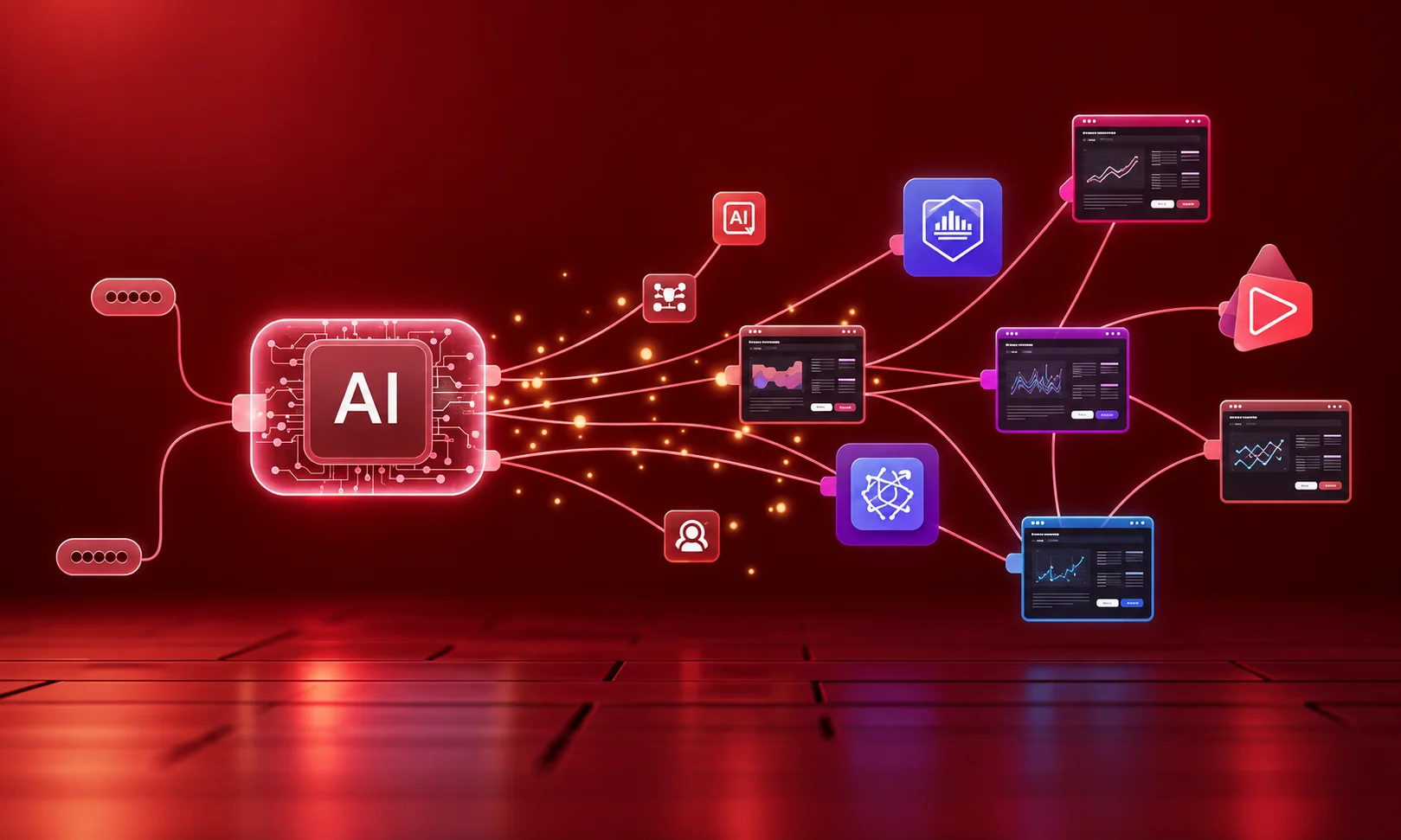
Traditional automation usually follows a clear rule. If this happens, do that. A customer abandons a cart, so an email is sent. A person fills out a form, so a follow-up message is triggered.
A customer makes a purchase, so a confirmation is sent. These workflows remain useful, but AI can make them more flexible. Instead of looking at only one event, a system can consider several signals before deciding what should happen.
For example, an abandoned cart does not always mean the same thing. One customer may have added the product by mistake. Another may have spent 30 minutes comparing products before leaving. Another may have abandoned the cart because the shipping cost appeared at checkout. A smarter system can consider more context instead of treating all three situations the same way.
This is where AI agents become interesting. An AI agent can potentially handle several connected steps instead of performing only one isolated task. It may gather information, interpret a situation, select an action, and continue a workflow within defined limits.
But more automation is not always better. Important decisions still need human control, especially when they involve sensitive customers, major spending decisions, brand reputation, or situations where an incorrect action could cause real harm. The smartest system is sometimes the one that knows when not to automate.
How to Know Whether AI Is Actually Improving Marketing
AI can make a marketing team look busy very quickly. More content can be created. More reports can be generated. More campaigns can be automated. More customer segments can be produced. None of those things automatically mean the business is doing better. The real test is what happens to business outcomes.
| Metric | What It Helps Show |
| Conversion rate | Whether more visitors become customers |
| Customer acquisition cost | How efficiently new customers are gained |
| Customer lifetime value | How much value customers create over time |
| Retention rate | Whether customers continue returning |
| Revenue per campaign | Whether marketing activity produces financial results |
| Time saved | Whether automation reduces repetitive work |
A company should therefore avoid asking: “How much AI are we using?” A better question is: “What improved because we used AI?” Maybe the sales team spends fewer hours qualifying leads. Maybe customers receive more relevant recommendations. Maybe marketing costs fall. Maybe a campaign becomes more effective. Maybe employees spend less time preparing reports and more time planning campaigns. Those are meaningful outcomes.
What an AI Marketing Stack Looks Like in Real Life
Let’s put all the pieces together. Imagine an online retailer notices that a customer has visited the same product several times. That behavior enters the customer data layer. The intelligence system recognizes that repeated visits, product comparisons, and recent email activity may indicate stronger interest. The marketing system now has a useful signal. Instead of sending the same general newsletter that everyone receives, the customer could receive information related to the product they are considering.
Generative AI might help create different versions of that message. Personalization can make the content more relevant. Automation can deliver it at the appropriate point in the customer journey. The customer either buys, ignores the message, returns later, or does something else. That result is measured. Now the business has another piece of information. The next decision can be slightly better because the system has learned something from the previous interaction. The complete process looks like this:
Behavior → Data → Insight → Decision → Message → Response → Measurement → Learning
That is the heart of an AI marketing stack. It is not one magical AI system. It is a connected process.
What Top 1% Marketing Teams Do Differently
The phrase “top 1%” should not mean companies that simply buy the most expensive technology. The real difference is how mature teams think about AI.
An average approach might be: “We need an AI tool for email.” A more advanced approach is: “We need to identify which customers need a different email and determine what information would be most useful to them.” That difference sounds small, but it changes everything. Advanced marketing teams tend to start with customer problems instead of software.
They improve their data before expecting AI to solve everything. They connect useful systems instead of creating isolated technology islands. They use AI for prediction and decision support rather than limiting it to content generation.
They automate repetitive work while keeping people involved in decisions that require judgment. Most importantly, they measure the result. Their question is not: “What can this AI tool do?” It is: “What valuable marketing problem can this system solve?” That is a much better question.
What Should You Automate With AI First?
The best place to start is usually not the most exciting part of marketing. It is the work people repeat again and again. Reporting is a good example.
If employees spend hours collecting numbers and formatting the same report every week, automation can remove much of that work. Email workflows, lead qualification, customer segmentation, content repurposing, routine campaign analysis, and product recommendations can also be strong candidates.
But strategy is different. A machine can help analyze a market, but deciding how a brand should position itself still requires human understanding. A system can create ten campaign ideas, but someone should decide whether any of them are actually worth using.
| Good Starting Points for Automation | Keep Strong Human Control |
| Repetitive reporting | Brand strategy |
| Routine email workflows | Positioning |
| Lead qualification | Major customer decisions |
| Content repurposing | Sensitive communication |
| Basic campaign analysis | Creative direction |
| Product recommendations | Important business decisions |
The goal is not to make humans unnecessary. The goal is to stop using humans for work that a system can handle reliably, so people have more time for work that needs actual thinking.
How to Build an AI Marketing Stack Without Creating a Mess
The easiest way to create a complicated marketing stack is to start buying tools before deciding what problem you are trying to solve.
- Start with the problem.
- Maybe your team is spending too much time creating reports.
- Maybe leads are not followed up quickly enough.
- Maybe customers receive irrelevant emails.
- Maybe marketers have plenty of data but cannot turn it into useful insights.
- Choose one problem.
- Then map the customer journey around it.
- Find out what information already exists and where it is stored. Look for missing data, duplicated records, disconnected systems, and unnecessary manual steps.
- After that, improve the basic process before adding advanced AI.
- Then introduce AI where it has a clear job.
Finally, measure what changed. A practical path looks like this:
- Define the problem
- Map the customer journey
- Audit the data
- Remove unnecessary manual work
- Improve the existing workflow
- Add AI where it creates value
- Connect the systems
- Measure the result
- Expand what works
This approach is less exciting than buying ten new AI tools. It is also much more likely to produce something useful.
What an AI Marketing Stack Should Look Like at Different Business Sizes
A small company does not need the same system as a global enterprise. For a small business, the priority may be customer data, email, analytics, simple automation, and AI assistance for content and everyday marketing work.
A growing company may benefit from stronger segmentation, personalization, lead scoring, predictive analytics, and more connected customer journeys.
A large organization may need advanced customer data systems, machine learning models, multiple AI agents, cross-channel orchestration, and stronger governance.
\The mistake is building according to what looks impressive instead of what the business actually needs. A company with 500 customers does not need the same level of complexity as a company serving millions. The best stack grows with the business.
The Biggest AI Marketing Stack Mistakes
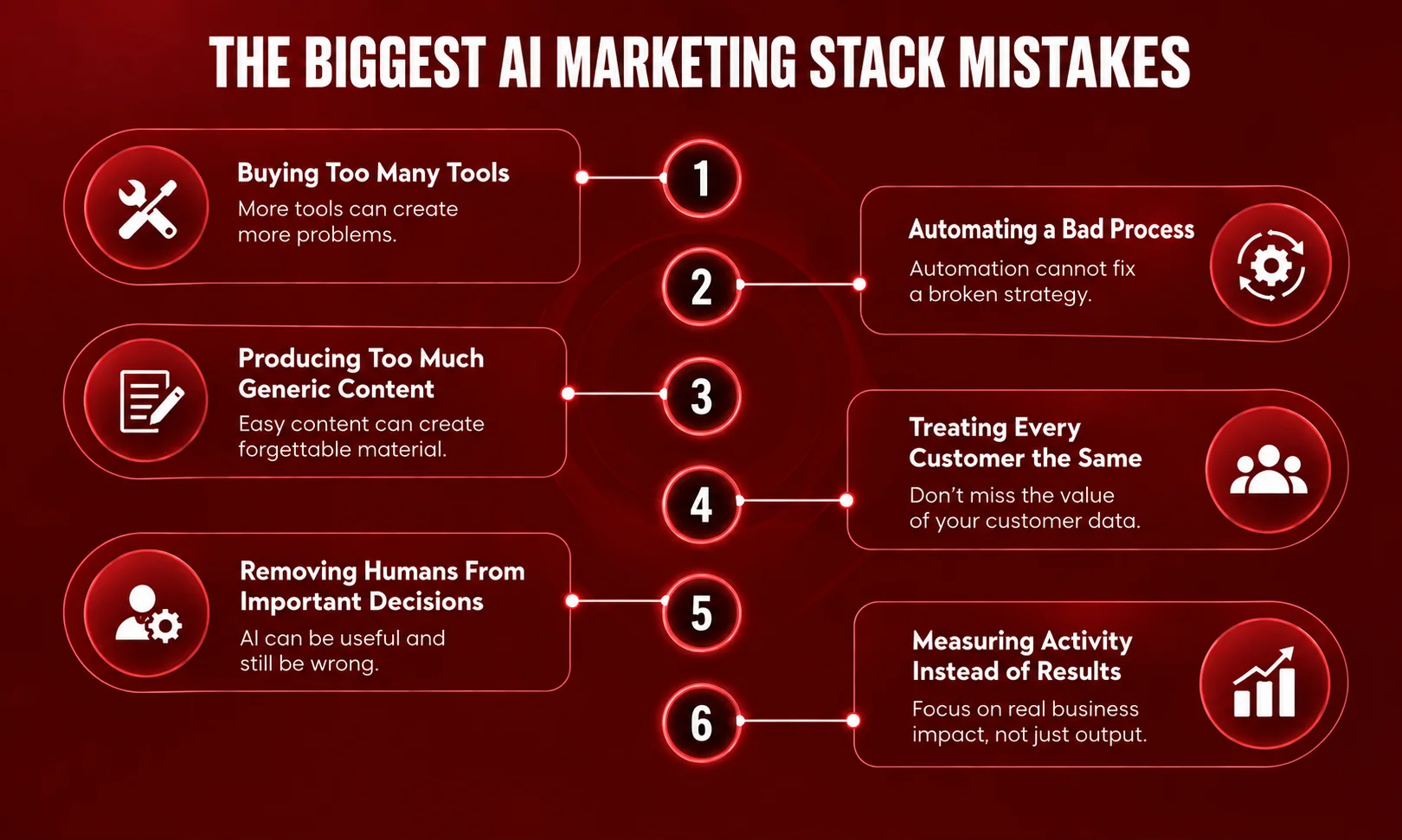
Buying Too Many Tools
More tools can create more problems. If employees need to move information between five different AI systems to complete one task, the technology may be making the process harder rather than easier.
Automating a Bad Process
Automation cannot fix a broken strategy. If the original workflow is confusing, automating it may simply make the confusion happen faster.
Producing Too Much Generic Content
Generative AI makes content production easier, but easy production can create a flood of forgettable material. Customers still want useful answers, interesting ideas, and information that fits their situation.
Treating Every Customer the Same
A business can collect enormous amounts of customer information and still send everyone the same message. That misses one of the biggest advantages of having the data in the first place.
Removing Humans From Important Decisions
AI can be very useful and still be wrong. Human review matters when decisions involve sensitive customers, important spending, brand reputation, or situations where context matters.
Measuring Activity Instead of Results
A company can celebrate producing 10,000 AI-generated pieces of content. That number means very little if customers do not find the content useful and the business does not improve. The technology should serve the result, not become the result.
How Much AI Does a Marketing Team Really Need?
There is no perfect number. A small business may need only a few connected systems. A growing business may need more advanced customer intelligence and personalization. An enterprise may require a much larger architecture. The important question is not: “How much AI should we buy?” It is: “Where is our marketing team losing time, information, or opportunities?” That question usually produces a better answer.
- If marketers spend six hours every week preparing a report, automation may be useful.
- If sales teams cannot identify their most promising leads, machine learning may help.
- If customers receive irrelevant recommendations, personalization may be worth investing in.
- If a new AI tool does not solve a meaningful problem, there may be no reason to add it.
The strongest marketing stack is not the biggest one. It is the one where every important part has a clear job.
What Comes Next for the AI Marketing Stack?
The next stage of AI marketing is likely to involve systems that do more than provide suggestions. AI agents are moving toward workflows where systems can monitor information, make decisions within defined limits, and complete several connected actions.
That could change the daily work of marketers. Instead of spending hours collecting information and moving it from one platform to another, a marketer could spend more time setting goals, defining rules, reviewing important decisions, and improving strategy.
Personalization can also become more responsive. Instead of assigning a customer to one fixed group and leaving them there, marketing systems can respond to changing behavior. Generative AI will continue to make content production easier, which means originality and quality will matter even more.
And as AI gains more control over marketing actions, trust and oversight will become more important. The future is therefore not simply more AI. It is: better systems that know what to do, when to do it, and when a human should take over.
Our Editorial Approach
BrandClickX created this guide to explain how an AI marketing stack can connect customer data, machine learning, generative AI, personalization, automation, and measurement to improve marketing decisions.
The article focuses on practical use cases such as customer segmentation, lead qualification, personalization, automated workflows, content production, and performance measurement while also explaining the importance of human oversight. It takes a results-focused approach by showing readers how to evaluate AI based on business outcomes rather than simply counting tools or automated tasks.
Conclusion:
The biggest mistake in AI marketing is thinking that growth comes from collecting more technology. It does not. A customer creates a signal. Data captures it. AI helps make sense of it.
Marketing decides what to do. Automation helps take action. The customer responds. Measurement shows what happened. That result becomes information for the next decision.
That is the real AI marketing stack. The competitive advantage will not necessarily belong to the company with the most AI tools. It will belong to the company that builds the better system for turning customer signals into useful action.
Generative AI can help create the message. Machine learning can help find the opportunity. Automation can help deliver the action. Analytics can show whether it worked.
And people still decide what the business should stand for. The best AI marketing stack is not the one with the most technology. It is the one where every important piece has a purpose and the whole system helps the business serve customers better.
Frequently Asked Questions
What is an AI marketing stack?
An AI marketing stack is a connected group of tools powered by data, machine learning, and automation. It helps businesses understand customer behavior, personalize experiences, automate routine tasks, and make smarter marketing decisions.
Do I need every AI marketing tool available?
No. The right stack depends entirely on your business goals, budget, and workflows. A small business might only need a couple of connected systems, while a large enterprise requires a more advanced setup.
How is AI marketing different from traditional automation?
Traditional automation strictly follows rigid, predefined rules (like “if X happens, do Y”). AI marketing goes a step further by analyzing multiple data signals in real-time to make predictive decisions and adapt dynamically.
What is the role of Generative AI in the stack?
Generative AI acts as a creative assistant. It helps draft marketing copy, emails, social posts, ad variations, and campaign ideas quickly, though human review is still essential to protect your brand voice and accuracy.
How can a small business start building an AI stack?
Start small. Pick one specific challenge to solve first such as organizing customer data or automating follow-up emails. Once that single workflow proves successful, you can gradually add more tools to your stack.