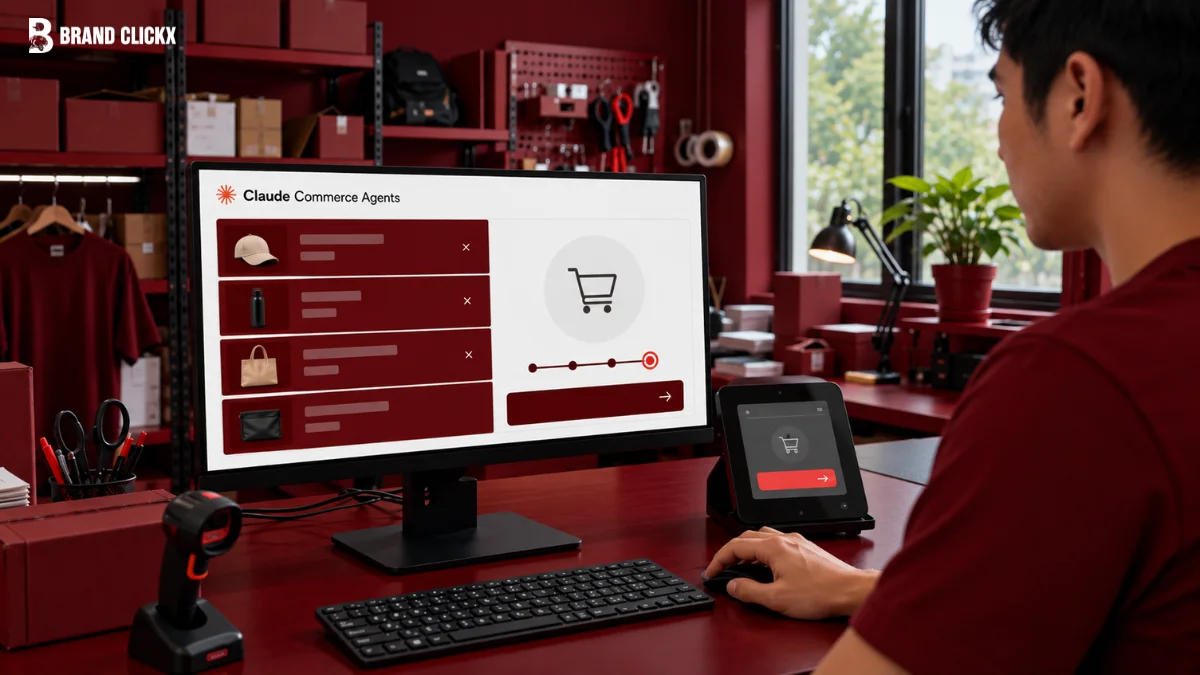
Shopping online is usually simple when you already know what you want. The harder part starts when you have a goal but do not know which products fit it. You may need to compare several products, check prices, look at reviews, stay within a budget, and then figure out what else you need.
Claude shopping agents are designed to handle more of that work through a conversation. Instead of only showing search results, the agent can understand the shopper’s goal, search a store’s catalog, compare products, plan a multi-product purchase, build a cart, and help with questions about orders and policies.
The Claude Commerce Agents Blueprint gives businesses a starting point for building this type of experience. It includes reference implementations for both shoppers and merchants, along with tools, skills, safety rules, and ways to connect the agents to existing business systems.
The important part is understanding what the blueprint actually does today. It does not replace a store, payment system, catalog, or checkout. It provides the agent layer that can work with those systems while the business keeps control of the actual commerce process.
What Is the Claude Commerce Agents Blueprint?
The Claude Commerce Agents Blueprint is a reference implementation for businesses that want to build commerce agents with Claude. It includes two main agents: a shopping agent for customers and a merchant agent for store operators.
The shopping agent is designed to work inside a company’s own app or website. It can search products, compare options, help plan purchases, fill a cart, answer customer service questions, and remember information a customer provides during the shopping experience.
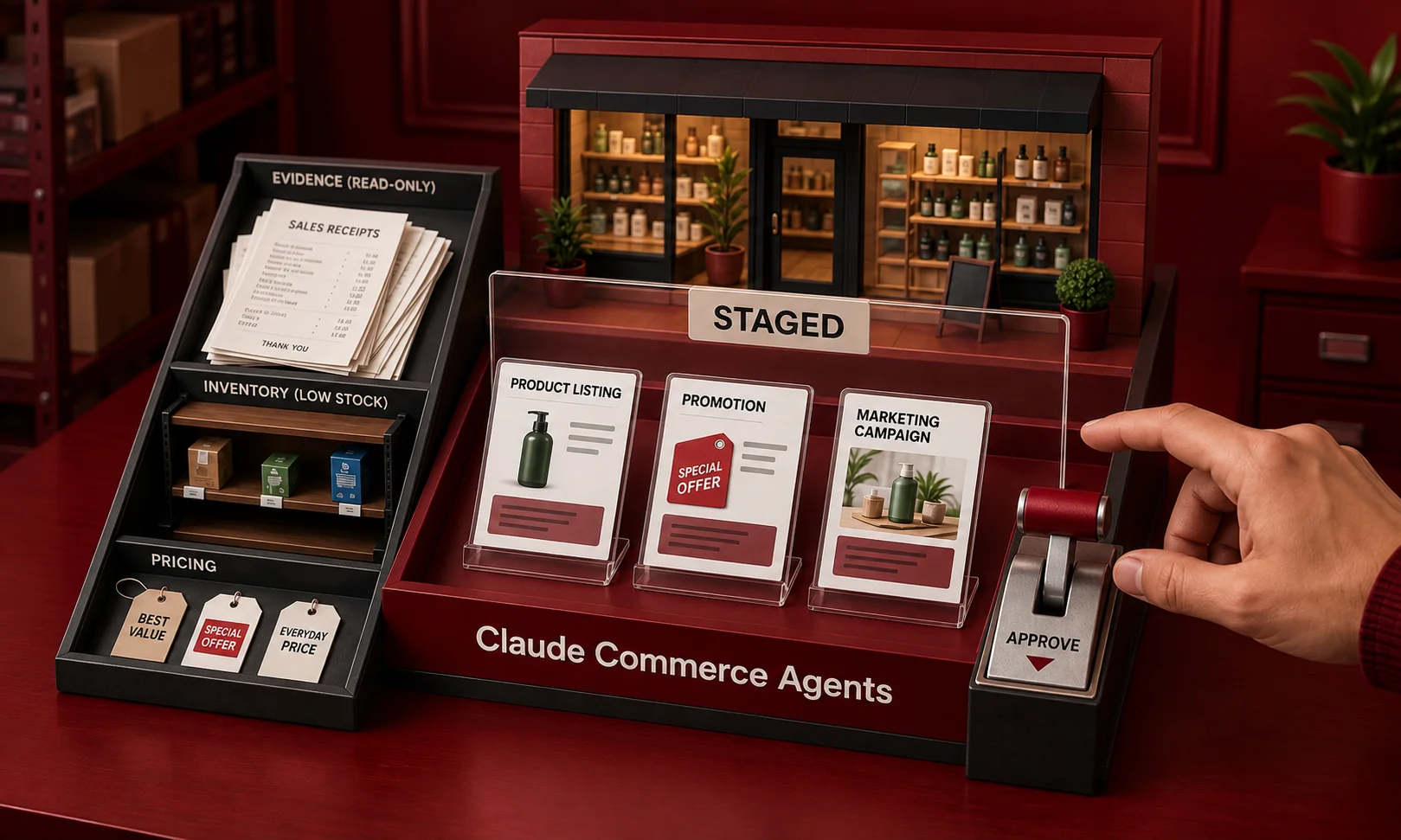
The merchant agent works on the other side of the business. It can help staff understand sales performance, inventory, product listings, pricing, promotions, and other store operations.
The blueprint is not a finished ecommerce service that a merchant simply turns on. Businesses use the reference code, connect it to their own systems, and decide what the agent is allowed to read or change. That distinction matters because Claude is being used as the intelligence layer. The merchant still controls the catalog, inventory, pricing, policies, checkout, payment process, and other business rules.
What Are Claude Shopping Agents?
A Claude shopping agent is a conversational shopping assistant that can perform several steps instead of giving one answer and stopping. Imagine someone says: “I need a lightweight laptop for university, preferably under $900. I travel often, so battery life matters more than gaming performance.” A normal search system may turn that sentence into keywords and show products. A shopping agent can treat the request as a goal.
It can look through the available catalog, identify products that fit the budget and requirements, compare important specifications, explain the differences, and help the shopper choose. The same approach works for more complicated requests.
A shopper could ask for a complete camping setup, a gift for several people, office equipment for a small team, or clothing that works together. This is where Claude shopping agents become more interesting than a simple chatbot. The agent is not only answering questions. It is working through a shopping task using the store’s actual systems.
How Claude Shopping Agents Actually Work
The process can look simple from the customer’s side, but several systems work together behind the conversation.
Step 1: The shopper explains the goal
The customer starts with normal language rather than a strict search query. They can describe a product, budget, use case, preferences, or complete shopping goal. For example, someone might say they need running shoes for long-distance training and do not want to spend more than $150. The agent needs to understand the important parts of that request before searching.
Budget, intended use, size, preferences, and other requirements can change which products are suitable. The customer does not have to know the exact product name or technical specification. That makes the first step closer to talking to a knowledgeable store assistant than filling out a traditional search box.
Step 2: The agent searches the catalog
The agent then uses the store’s connected commerce systems to find products. This is an important safety point. The agent should not simply invent a product, price, or availability status from its general knowledge.
The commerce tools provide the information that the agent uses for the current shopping session. This allows the response to stay connected to the merchant’s actual catalog. If a product is unavailable, the agent can work with the products the store actually has instead of recommending something that cannot be purchased.
Step 3: Claude compares the options
After finding relevant products, the agent can narrow the list and explain why certain options fit the shopper’s request. It can compare factors such as price, features, product type, available options, and other information returned by the store. The useful part is that the comparison can be connected to the shopper’s original goal.
Instead of simply saying that Product A has a faster processor, the agent can explain that this may matter for the customer’s workload while Product B may be a better choice if battery life and lower cost are more important.
Step 4: The agent can plan a larger purchase
This is one of the more useful parts of the blueprint. A shopping request does not have to involve one product. The agent can help plan a group of products around a goal or budget.
For example: “I already have a tent. Help me build a three-day camping setup for under $300.” The agent can identify the missing items, search the catalog, consider the budget, and organize the choices. This makes the shopping agent closer to a planning assistant. It is not just finding products. It is helping the shopper decide what products are needed together.
Step 5: The agent builds the cart
Once the shopper makes a decision, the agent can add suitable products to the cart. The system can keep the conversation and cart connected, so the shopper can continue asking questions without starting over.
For example, the shopper might first choose a laptop, then ask which carrying case fits it, and then ask whether the selected products stay within the original budget. The agent can use the connected commerce systems to keep the shopping task grounded in the actual products and cart.
Step 6: The shopper completes checkout
The important boundary comes here. The blueprint can prepare the cart and hand the customer to the merchant’s checkout. It does not mean Claude automatically takes payment or completes the transaction.
The merchant’s existing checkout can remain responsible for payment, shipping, final confirmation, and other transaction steps. That separation gives merchants more control over the most sensitive part of the purchase.
Claude Shopping Agents vs Traditional Online Shopping
Traditional ecommerce normally makes the customer do most of the work. The shopper searches, opens product pages, reads specifications, compares products, checks shipping information, adds products to the cart, and then moves through checkout.
That model works well when the customer already knows what they want. It becomes slower when the customer has a complicated goal. A shopping agent changes the interaction from product search to conversation.
The shopper can explain what they need, ask follow-up questions, change the budget, remove products, add new requirements, and continue from the same conversation. The biggest difference is not that the agent can “talk.” It is that the agent can connect the conversation to commerce actions such as catalog search, product comparison, planning, cart management, and customer care.
What Is the Claude Merchant Agent?
The merchant agent is the business-side part of the blueprint. Instead of helping customers choose products, it helps store teams understand and manage the operation behind those products. It can work with information such as sales performance, inventory, product listings, pricing, promotions, campaigns, and order issues. For example, a merchant could ask: “Which products are selling slowly and also have high inventory?”
The agent can use connected business data to help answer that question. It can also help identify low-stock items, explain performance changes, draft promotions, or prepare other recommendations for staff. The important difference is that merchant actions are not supposed to happen silently. Changes can be staged for approval before they affect the live store. That gives businesses a human checkpoint for important changes.
Shopping Agent vs Merchant Agent
| Feature | Shopping Agent | Merchant Agent |
| Main user | Customer | Store staff |
| Main goal | Help complete a purchase | Help operate the store |
| Product search | Yes | Yes |
| Product comparison | Yes | Not the main purpose |
| Cart actions | Yes | No |
| Customer questions | Yes | No |
| Sales analysis | Limited | Yes |
| Inventory monitoring | Customer-facing availability | Store-level management |
| Pricing and promotions | Uses current store rules | Can recommend changes |
| Changes to business systems | Limited and controlled | Staged for approval |
The two agents are connected by the same basic idea: Claude handles reasoning and conversation while the business systems remain the source of commerce information. This creates a useful separation. Customers get an intelligent shopping experience, while employees get an assistant for the operational side of ecommerce.
How Shopify Fits Into Claude Commerce Agents?

Shopify is a useful example because the commerce agent can connect to an actual store rather than using a completely separate shopping database. A Shopify implementation of the blueprint can search a live catalog, build a real cart, answer questions from store policies and FAQs, and then hand the customer to the store’s own checkout.
The checkout, shipping, and payment process remains on the store’s commerce infrastructure rather than being completed by the conversational agent itself. This shows how the architecture can work in practice.
The agent sits between the shopper and the store’s existing systems. It makes those systems easier to use through conversation without requiring the merchant to replace the entire ecommerce stack. For merchants, this is an important point. Adding an agent does not necessarily mean rebuilding the store from zero.
What Actually Happens When a Shopper Uses Claude With Shopify?
A simple shopping session could work like this. The shopper asks for a product with a particular budget and set of requirements. The agent searches the store catalog and returns suitable options. The shopper asks follow-up questions and selects a product. The agent adds the selected item to the cart. The shopper can then review the cart and continue to checkout.
At checkout, the customer moves to the store’s hosted checkout experience where shipping and payment are handled. The reference implementation does not complete the order or take payment on the agent’s behalf. That makes the current setup easier to understand: Claude helps with shopping, while the merchant’s commerce system remains responsible for completing the transaction.
Can Claude Shopping Agents Actually Buy Products?
Not by themselves in the basic blueprint. This is one of the easiest points to misunderstand when talking about agentic commerce. A shopping agent can search products, compare them, prepare a cart, and send the shopper to checkout. But preparing a cart is different from charging a payment method.
The reference implementation deliberately keeps checkout and payment outside the agent’s direct transaction authority. That does not mean agentic purchasing cannot become more automated. It means the commerce blueprint itself does not give the model unrestricted permission to move money. For now, the merchant can keep its existing checkout and payment process while using Claude to improve the earlier parts of the shopping journey.
Why the Checkout Handoff Matters?
The checkout handoff may look like a small technical detail, but it solves an important business problem. Merchants already have systems for payment, shipping, taxes, fraud controls, order confirmation, refunds, and other transaction processes. Replacing all of those systems just to add an AI shopping assistant would create unnecessary complexity.
Keeping checkout under the merchant’s control allows the agent to focus on helping customers before the transaction, while the existing commerce infrastructure handles the sensitive final step.
It also makes the role of Claude easier to understand. Claude is not becoming the store. It is becoming a conversational layer connected to the store. That distinction will matter as more businesses experiment with agentic commerce.
What Role Do Visa and Mastercard Play?
Visa and Mastercard are relevant to the broader agentic commerce story, but they should not be confused with the Claude Commerce Agents Blueprint itself. Claude’s blueprint focuses mainly on building the shopping and merchant agent experience. Visa and Mastercard are working on a different part of the problem: how payment networks and other systems can identify and verify AI agents that may eventually make purchases for users.
On September 10, 2026, Visa, Mastercard, and Ant International announced work on a shared framework intended to help different payment and commerce systems recognize trusted AI agents while keeping their own approval and risk controls. This matters because an agent that can recommend a product is much easier to manage than an agent that can actually spend someone’s money. Identity, authorization, limits, fraud controls, and user approval become much more important when AI can act on a customer’s behalf. So the simple picture is:
- Claude handles the shopping intelligence.
- The merchant controls the store and checkout.
- Payment networks are working on the trust and transaction layer needed for more automated agentic purchasing.
What Makes Claude Commerce Agents Different From a Normal AI Chatbot?
A normal chatbot can answer questions about products, but that does not automatically make it a commerce agent. The important difference is the connection to business tools. A commerce agent can search the catalog, retrieve current product information, interact with a cart, use store policies, answer order questions, and work toward a defined shopping goal. The agent also has skills designed for different types of commerce tasks.
The shopping blueprint includes flows for discovery, purchase research, planning, customer care, and memory or personalization. That structure is important because the agent does not need to treat every shopping question as the same task. Someone looking for one product needs a different process from someone planning a complete purchase or asking where an existing order is.
How Claude Shopping Agents Use Skills?
Skills are one of the less visible but important parts of the blueprint. Instead of putting every possible commerce instruction into one huge prompt, the system can load the relevant skill for the task. A customer looking for a product may need search and discovery. Someone comparing several products may need purchase research. A customer planning a complete setup may need the planning flow.
After the purchase, customer care becomes more important. This approach helps keep the agent focused on the task instead of giving every conversation the same generic response. It also makes the architecture easier for a business to adapt because different industries can require different commerce workflows.
How Claude Shopping Agents Use Memory?
Memory can make an agent more useful when a customer provides preferences that matter later. For example, a shopper might say: “I prefer lightweight products and usually avoid leather.” Later in the shopping experience, that information can help narrow recommendations. The blueprint also includes memory and personalization as part of its commerce architecture.
The important point is that personalization should not mean the agent invents a customer profile or makes assumptions without a reason. Useful memory should come from information the customer provides or data the business is authorized to use. This can make the conversation feel more natural because the shopper does not have to repeat the same preference at every step.
How Claude Shopping Agents Stay Grounded in Real Store Data?
One of the biggest risks with AI shopping is getting confident answers that are simply wrong. A product may cost $80 in the real catalog while an AI incorrectly says $60. A product may be out of stock while the assistant says it is available. The blueprint addresses this by connecting the agent to commerce backends that return the actual records the agent needs.
Product information, prices, availability, policies, carts, and orders come from the connected commerce systems rather than being treated as general model knowledge. There are also controls around what the agent can write. For example, cart actions are constrained by product information returned through the current commerce tools. This is important because an AI shopping agent needs to be helpful and accurate. A clever recommendation is useless if the product cannot actually be purchased.
What Happens After the Purchase?
The shopping agent is not limited to the moment before checkout. Customer care is another part of the design. A shopper may ask where an order is, what the return policy says, whether an item can be exchanged, or what happened to a delivery. Those questions can be handled through the same conversational experience when the required commerce systems are connected.
This makes the agent useful across more of the customer journey. Instead of having one chatbot for product questions, another page for order tracking, and another process for policy questions, a business can bring more of those interactions into one conversation.
What Benefits Do Claude Shopping Agents Offer Shoppers?

The main benefit is reducing the amount of work the customer has to do. A shopper can explain the goal in normal language rather than learning the exact search terms used by a store. The agent can then narrow choices, explain differences, and continue working as the shopper changes their requirements.
It can also help with larger shopping tasks where choosing one product is only part of the problem. For example, someone moving into a new apartment may need kitchen equipment, storage products, lighting, and other items. A useful agent can help organize that task around a budget rather than treating every item as a completely separate search. The result is less time spent jumping between product pages and more time making the actual decision.
What Benefits Do Claude Shopping Agents Offer Merchants?
For merchants, the value is not only better product discovery. A conversational agent can help customers understand products, find suitable options, build carts, and get answers without requiring a member of the sales team to handle every question. The merchant agent adds another layer by helping employees work with store data. It can highlight inventory issues, explain performance, help review listings, and prepare recommendations for pricing or promotions.
Anthropic has reported that retailers running shopping agents on Claude have seen carts up to 35% larger and shoppers 60% more likely to complete a purchase. These are reported results from existing deployments, not a guarantee that every business using the blueprint will see the same outcome. That distinction is important. The blueprint provides the technology and patterns, but results still depend on the store, catalog quality, customer experience, implementation, and many other factors.
What Could Go Wrong?
The biggest risk is giving an AI agent too much authority without enough control. A shopping agent could recommend the wrong product, misunderstand a requirement, use outdated information, or create an unexpected cart if the connected systems and rules are poorly designed. There is also a risk of unwanted selling behavior.
A customer who asks for a simple product should not be pushed toward expensive alternatives simply because the system wants a larger order. Commerce agents therefore need clear rules around pricing, product information, cart actions, refunds, and escalation to humans. The blueprint includes guardrails designed to keep commerce actions tied to real store data and limit sensitive actions.
What the Merchant Agent Does About Risk?
The merchant side uses a similar principle. An AI system may be able to identify a problem, but identifying a problem is different from making a live business change. For example, the agent could notice that a product’s price may need attention. It can prepare a proposed change, but the merchant can review that change before it is applied.
The reference implementation uses staged merchant changes rather than allowing every recommendation to immediately modify the live store. This creates a useful human approval layer. It means the agent can handle analysis and preparation while the business keeps control over decisions that affect customers, prices, inventory, or promotions.
Agentic Does Not Always Mean Fully Autonomous
The word “agentic” can make the technology sound more independent than it actually is. An agent can perform several connected steps without being given unlimited authority. A shopping agent may search products, compare them, build a cart, and prepare checkout while still requiring the customer to confirm the final purchase.
Likewise, a merchant agent may analyze data and prepare a pricing change while requiring a staff member to approve it. This is an important distinction because useful agents do not necessarily need complete autonomy. In many commerce situations, controlled automation is more valuable than giving an AI unlimited freedom.
Claude Commerce Agents and Agentic Commerce in 2026
Agentic commerce is moving beyond the idea of AI simply recommending products. The bigger idea is that an AI system can understand a customer’s goal, use commerce tools, take several actions, and eventually participate in the transaction itself. The Claude Commerce Agents Blueprint is an important step in that direction because it provides working patterns for both sides of the market.
But the complete agentic commerce system requires more than a language model. It needs accurate product data, identity, permissions, inventory, checkout, payment infrastructure, fraud controls, customer policies, and clear rules about what an agent can do. That is why the development of AI shopping agents and the development of agent payment standards are happening alongside each other.
What This Means for Shopify Merchants?
For Shopify merchants, the main lesson is that product data is becoming even more important. An AI agent needs clear information about products, variants, prices, availability, policies, and other store details. If that information is incomplete or inconsistent, the agent has less reliable material to work with. Merchants therefore need to think beyond how a product page looks to a human shopper.
The product information also needs to be structured well enough for software systems to retrieve and understand it. The Shopify reference implementation shows how a storefront agent can connect to a real store catalog and cart while leaving checkout and payment on the store’s existing system. That gives merchants a practical model for adding conversational shopping without handing the entire store to an AI system.
What This Means for Shoppers?
For shoppers, the biggest change could be the way they describe what they want. Instead of starting with a product keyword, people can start with a goal.
- “I need a birthday gift for my brother under $100.”
- “I need a laptop for college and travel.”
- “I need everything for a three-day camping trip.”
- “I need a sofa that fits this room and stays under my budget.”
The agent can turn those requests into a shopping process. That does not remove the customer’s choice. It can reduce the amount of searching and comparing required before making that choice. The best experience is therefore not one where AI makes every decision. It is one where AI handles the boring work and leaves the important decision with the shopper.
What Claude Commerce Agents Can and Cannot Do Today?
| Can Do | Cannot Do Automatically in the Basic Blueprint |
| Search a connected catalog | Freely invent products or prices |
| Compare products | Ignore merchant rules |
| Plan multi-product purchases | Automatically charge a card |
| Use customer preferences | Make unrestricted live store changes |
| Build a cart | Replace the merchant’s entire checkout |
| Answer order and policy questions | Operate without business permissions |
| Help merchants analyze store data | Apply every merchant recommendation automatically |
| Prepare merchant changes | Bypass human approval for sensitive writes |
This table is the easiest way to understand the current boundary. Claude shopping agents can perform meaningful commerce work, but the merchant still controls the systems that determine what can be sold, what can be changed, and how the transaction is completed. That controlled approach is important as AI moves closer to real purchasing activity.
What Happens Next With Claude Shopping Agents?
The next stage will likely depend less on whether AI can recommend products and more on how well it can operate inside real commerce systems. Better product data will make agents more useful. Better identity and permission systems will make them safer. Better payment infrastructure can make more automated purchases possible. Businesses will also need to decide how much control they want to give agents.
Some may use AI only for product discovery and customer service. Others may allow it to manage carts, handle more customer tasks, or assist employees with pricing and inventory. The Claude blueprint gives developers a starting point rather than forcing every company into one model. That flexibility may be one of its most useful features because commerce businesses have very different products, policies, systems, and risk levels.
Our Editorial Approach
At BrandClickX, we explain AI and ecommerce technologies by focusing on how they work, what they can actually do, and where their limits are. For Claude Commerce Agents, we examine the shopping and merchant workflows, product data, cart building, checkout boundaries, and human approval controls. We separate current capabilities from future possibilities so readers can understand the technology without confusing it with fully autonomous shopping. This practical approach helps readers understand how AI shopping agents could affect both shoppers and ecommerce businesses.
Conclusion
Claude Commerce Agents shows where AI shopping is heading: away from simple product recommendations and toward systems that can understand a shopping goal and work through several steps to help complete it. The shopping agent can search products, compare choices, plan larger purchases, remember relevant preferences, build carts, and answer customer-service questions. The merchant agent works on the other side by helping businesses analyze performance, inventory, products, pricing, and promotions.
But the blueprint is not an AI replacement for the entire ecommerce stack. The merchant still owns its catalog, business rules, checkout, payment process, and important decisions. That may actually be the most practical part of the approach. Businesses can add an intelligent conversational layer without giving an AI unrestricted control over commerce.
As payment networks build better ways to identify and verify purchasing agents, and merchants improve the data those agents depend on, Claude shopping agents could become a much more important part of online shopping. For now, the key idea is simple: the agent helps the customer decide and prepare the purchase, while the merchant remains in control of the store and transaction.
FAQs About Claude Shopping Agents
What are Claude shopping agents?
Claude shopping agents are AI-powered commerce assistants that can help customers search products, compare options, plan purchases, build carts, and handle customer-service questions. They connect Claude to a business’s commerce systems so the conversation can work with real product and store information.
Is the Claude Commerce Agents Blueprint a finished product?
No. It is a reference implementation that businesses can use as a starting point for building their own commerce agents. The company using it remains responsible for connecting its systems, defining permissions, managing the deployment, and operating the resulting agent.
Can Claude shopping agents complete payments?
The basic blueprint does not directly place orders or take payment. It can prepare a cart and hand the shopper to the merchant’s checkout, where the transaction can be completed through the merchant’s existing payment process.
What is the Claude merchant agent?
The merchant agent is designed for store operators rather than shoppers. It can help analyze sales, monitor inventory, work with product listings, and prepare pricing, promotion, or campaign recommendations. Sensitive changes can be staged for approval instead of being applied automatically.
How does Shopify fit into Claude shopping agents?
Shopify can provide the commerce systems behind the shopping experience. A reference implementation connects a shopping agent to a live Shopify store so it can search products, build a cart, answer store questions, and send the shopper to the store’s checkout.
Do Visa and Mastercard power Claude shopping agents?
Not directly. Their role is related to the broader payment and trust infrastructure needed for agentic commerce. Visa, Mastercard, and Ant International are working on standards for identifying and verifying AI agents that may make purchases on behalf of users.
Are Claude shopping agents fully autonomous?
No. Agentic does not automatically mean unrestricted autonomy. The blueprint uses permissions, tool boundaries, business rules, and approval steps to control what agents can do. The exact level of automation depends on how a business builds and deploys the system.
Why is product data important for AI shopping agents?
An agent needs accurate product information to give reliable answers. Prices, availability, product specifications, variants, policies, and other details need to come from trustworthy commerce systems. Poor product data can lead to poor recommendations and a frustrating shopping experience.