

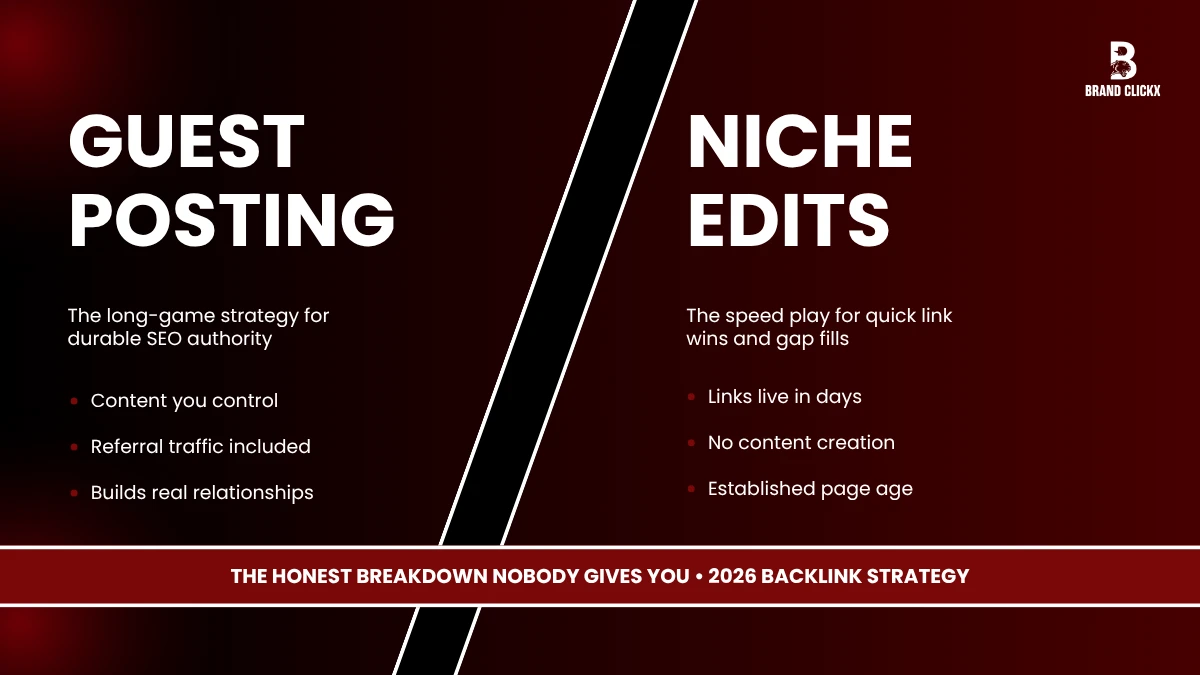
I have spent way too much money on both of these strategies: Guest posting vs niche edits.
Like, embarrassing amounts. The kind of money where you look at your credit card statement and think, “Did I really spend that much on backlinks?” Yes. Yes I did. And I am going to tell you exactly what worked, what flopped, and what made me want to throw my laptop out the window.
Here is the thing about guest posting vs niche edits. Every SEO blog has an opinion. Most of them are selling one or the other. So their “comparison” is basically a sales pitch with a fancy chart. I am not selling you anything. I have bought both. I have tracked the results. I have been burned by shady vendors. And I have seen genuinely impressive results from both approaches.
So let us talk about it like real people.
The Real Problem: You Need Backlinks, But Everything Feels Like a Scam
If you are reading this, you already know backlinks matter. Google still uses them. Probably always will in some form. The 2024 leak confirmed what we all suspected: links are not going anywhere. Guest posting vs niche edits are just getting harder to earn.
But here is where it gets messy.
You open your inbox and see 47 emails from people offering “high DA guest posts” for 50. You scroll LinkedIn and some agency is promising “niche edit backlinks on real sites with organic traffic” for 30 a pop. You know half of it is garbage. But which half?
That is the pain point. Not knowing. Wasting money. Getting a backlink that looks fine on the surface but does absolutely nothing for your rankings. Or worse, gets you penalized six months later.
I have been there. Let me walk you through what actually happens when you choose guest posting vs niche edits.
What Is Guest Posting, Really?
Guest posting sounds simple. You write an article. You pitch it to a website in your niche. They publish it. You get a backlink in your author bio or within the content. Everyone wins.
In theory.
In practice, guest posting in 2026 looks nothing like it did in 2016. Back then, you could email a blog owner, offer a 500-word generic post, and get published. Today? Most decent sites get 50-100 guest post pitches per week. They ignore almost all of them.
The game has changed. Here is what guest posting actually looks like now.
Why People Still Do It
Despite the hassle, guest posting works. Here is why.
The link is contextual. It sits inside relevant content on a relevant site. Google loves that. A backlink from a gardening blog inside a post about composting, pointing to your composting guide, carries weight.
You get referral traffic. Real people read the post. Some click your link. If your content is good, they stick around. That traffic signals to Google that your site is worth visiting.
You build relationships. The editor remembers you. Maybe they invite you back. Maybe they share your stuff on social. These relationships compound over time.
Brand exposure matters. Even if someone does not click, they see your name. They associate you with expertise. That trust translates into conversions later.
The Hidden Costs Nobody Talks About
Here is where guest posting gets expensive in ways people do not expect.
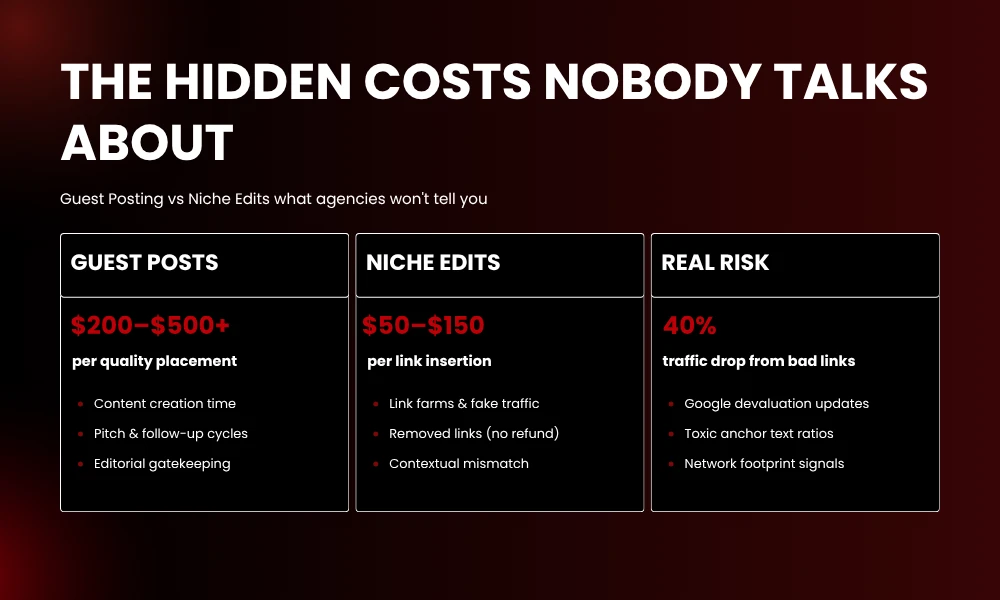
Content quality demands are higher than ever. In 2026, a 500-word surface-level post gets rejected or buried where nobody sees it. You need original research, data, case studies, or unique angles. That level of content costs money to produce.
Good sites are picky. A DA 50+ site in a competitive niche will not publish just anyone. They want established voices. If you are new, you are starting from the bottom and working up.
The time sink is real. I tracked my hours once. For one guest post on a decent marketing blog, I spent 6 hours researching and writing, 2 hours pitching and following up, and 3 weeks waiting for a response. That is one backlink. Scale that to 10 links per month and you need a full-time person.
Outsourced guest posts are hit or miss. Plenty of agencies sell “guest posting services” where they write a mediocre article, publish it on a site they own or control, and charge you 200. The site might have decent metrics but zero real audience. You get a link that looks good on paper but does nothing.
What Are Niche Edits, Really?
Niche edits go by a few names. Curated links. Link insertions. Contextual backlinks. The idea is the same: you pay someone to add your link to an existing, already-published article on an established website.
No new content needed. No pitching. No waiting for editorial calendars. You find a relevant post, pay the site owner or a broker, and your link goes live in 24-72 hours.
Sounds amazing, right? That is the pitch. Here is the reality.
Why Niche Edits Are Tempting
Speed. A guest post takes weeks or months. A niche edit takes days. If you need links fast for a new page or a client breathing down your neck, niche edits feel like magic.
No content creation. You do not write anything. The article already exists. You just pay and move on.
The link is on an established page. That post might already have backlinks of its own, traffic, and age. Google trusts older content. A link from a 2-year-old post with organic traffic can carry serious weight.
Cost can be lower. A 100 niche edit on a real site with traffic sometimes outperforms a 300 guest post on a site nobody reads.
The Risks Nobody Wants to Admit
This is where I got burned. Multiple times.
The site might be part of a link farm. Some brokers build or buy networks of sites that look legitimate. They have articles. They have traffic (sometimes fake). They accept paid links from anyone. Google is getting better at identifying these. One algorithm update and those links become toxic. I had a client drop 40% in traffic after a core update because their previous agency bought links from a network that got devalued.
The content might get edited later. You pay for a link in a post. Three months later, the site owner updates the article and removes your link. Or they change the anchor text to something useless like “click here.” Your investment evaporates.
The link placement is often awkward. A good niche edit fits naturally. A bad one looks like this: “Email marketing is important. [Your site] sells great shoes.” The context does not match. Readers do not click. Google notices the mismatch.
You do not control the surrounding content. With guest posting, you write the article. You control the narrative. With niche edits, you are shoved into someone else’s work. If that article is outdated, poorly written, or surrounded by other paid links, your link suffers by association with Guest posting vs niche edits.
Guest Posting vs Niche Edits: The Real Comparison
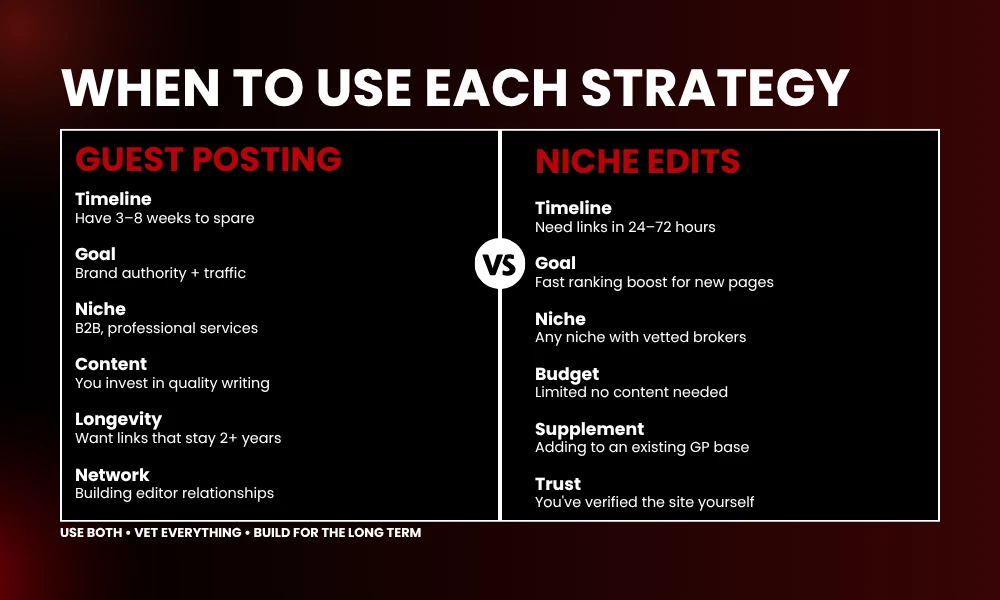
When Guest Posting Makes Sense
– You have the time or budget to create genuinely good content
– You want referral traffic and brand building, not just a link
– You are in a niche where relationships matter (B2B, professional services)
– You want links that will still be there in two years
– You are building a long-term SEO strategy, not chasing quick wins
When Niche Edits Make Sense
– You need links fast for a time-sensitive campaign or launch
– You have a limited budget and need volume
– The niche edit is on a site you trust, with real traffic and editorial standards
– You are supplementing a guest posting strategy, not replacing it
– You found a genuinely relevant, high-quality post where your link adds value
My Honest Take: Use Both, But Differently
After spending too much money and tracking results for three years, here is what I actually do.
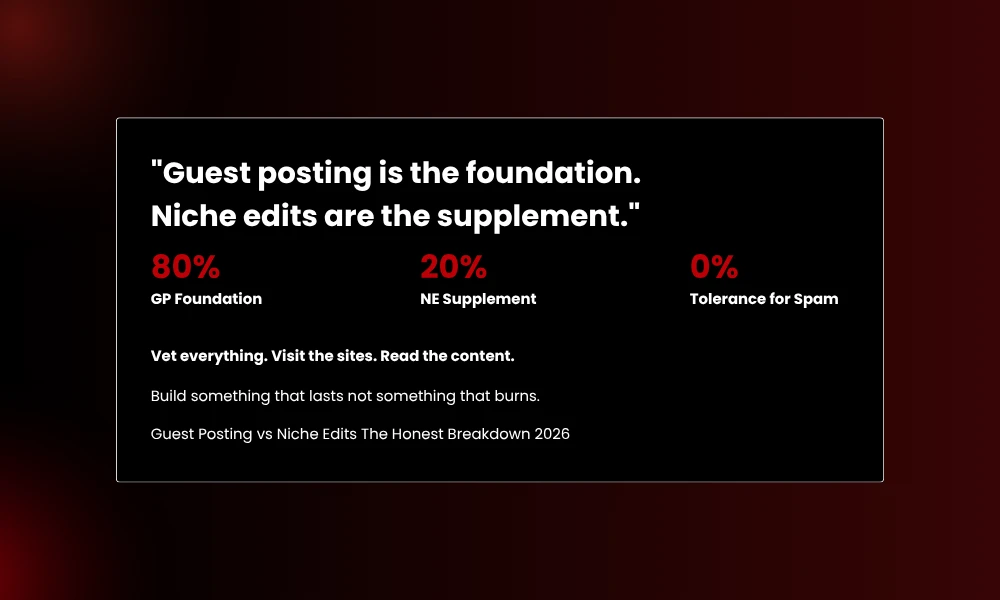
Guest posting is my foundation. I aim for 2-4 high-quality guest posts per month on real sites with real audiences. These take time but compound. The referral traffic alone pays for the effort. The brand exposure is bonus.
Niche edits are my supplement. I might buy 1-2 per month, but only from brokers I have vetted personally. I check the site myself. I read the article. I make sure my link fits naturally and adds value. If it feels forced, I walk away.
The ratio matters. If 80% of your backlink profile is paid niche edits, you are asking for trouble. If 80% is guest posts on legitimate sites, you are building something durable.
How to Vet a Guest Post Opportunity
Do not trust the metrics alone. Do this:
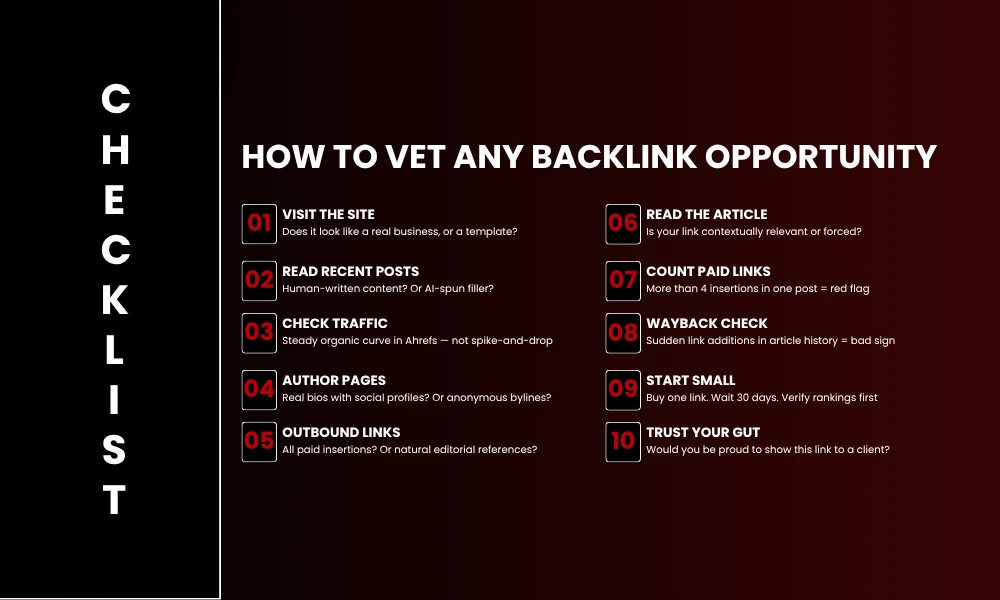
– Visit the site. Does it look like a real business or a template?
– Read recent posts. Are they written by humans or AI-spun garbage?
– Check traffic in Ahrefs or SimilarWeb. Is it steady or a spike-and-drop pattern?
– Look at the author pages. Do they have real bios and social profiles?
– Check the outbound links. Are they all paid insertions or natural references?
– Search the site on Google. Does it rank for anything real, or just its own name?
If a site passes all of these, it is probably worth a guest post.
How to Vet a Niche Edit Opportunity
Same process, but with extra caution:
– Read the specific article where your link will go. Is it good? Relevant? Recently updated?
– Check how many other paid links are in that article. If there are 8 links and they all look like insertions, run.
– Ask the broker for the site’s history. Have they sold links before? How many?
– Use the Wayback Machine to see if the article changed recently. Sudden link additions are a red flag.
– Start small. Buy one link. Wait 30 days. Check if your rankings moved. Then scale if it worked.
Final Thoughts
Guest posting vs niche edits is not a religious debate. Both can work. Both can fail. The difference is in the execution.
If you are building something long-term, invest in guest posting. Build relationships with Guest posting vs niche edits. Create content worth reading. Earn links that actually mean something.
If you need quick wins and understand the risks, niche edits can fill gaps. But do not make them your entire strategy. That is how sites get burned.
And whatever you do, vet everything yourself. Do not trust a spreadsheet of metrics. Visit the sites. Read the content. Ask yourself: would I be proud to have my brand associated with this?
If the answer is no, keep looking. Good links are out there. They just take more work than the spammy ones.
Now go build something that lasts for Guest posting vs niche edits.
If you want a deeper dive into guest posting strategy, check out BrandClickX complete guide to guest posting](https://brandclickx.com/guest-post/). We break down the outreach process, pitch templates, and how to land placements on sites that actually move the needle.
Frequently Asked Questions
Is guest posting still effective in 2026?
Yes, but only if you do it right. Low-quality guest posts on spammy sites are worthless or harmful. High-quality posts on real sites still drive rankings, traffic, and brand authority. The bar is just higher now.
Are niche edit backlinks safe?
They exist in a gray area. A genuinely helpful link insertion on a relevant, high-quality site is low risk. A paid link on a link farm is high risk. The safety depends entirely on execution and site quality.
Which is better for SEO: guest posting or niche edits?
Guest posting vs niche edits generally produces stronger, more stable results because you control the content and context. Niche edits can work faster but carry more risk. For most sites, a mix with guest posting as the foundation is optimal.


