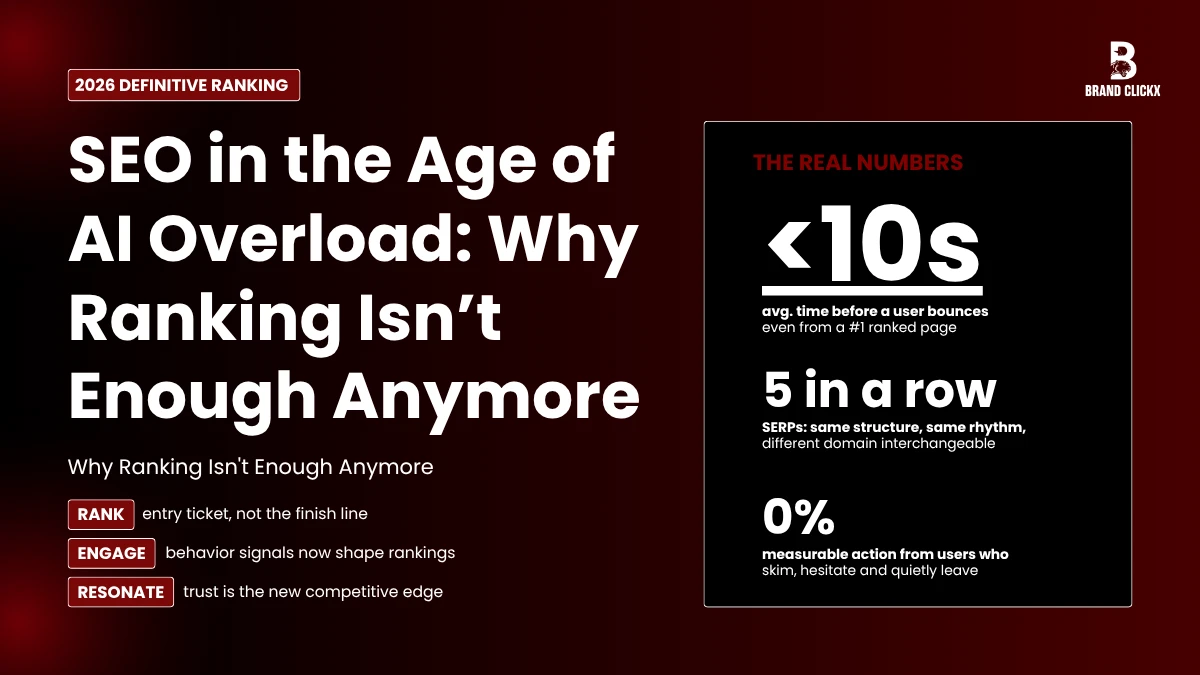
There was a time not even that long ago when ranking felt like the finish line. You hit page one, traffic came in, and the rest kind of… took care of itself. Not perfectly, sure, but predictably enough. That doesn’t really hold anymore with AI SEO strategy.
Now you can rank, get the click, and still watch users bounce in under 10 seconds. Or worse they skim, hesitate, and quietly leave without doing anything measurable. No sign-up, no scroll depth, nothing that suggests the content actually landed.
And if you’ve been publishing consistently over the last year or two, you’ve probably felt this shift without fully naming it. Traffic might still be there. But the quality of that traffic? A bit harder to trust.
When “Good Enough for Google” Stops Being Good Enough for AI SEO strategy
A lot of content today technically does everything right. It’s optimized, structured, readable, and even “humanized” after running through two or three rewriting tools.
And yet it all feels oddly similar for AI SEO strategy.
Part of that comes down to how content is being produced. Teams are scaling output using AI, which makes sense from a workflow perspective. But when everyone is pulling from similar prompts, similar datasets, and similar optimization checklists, the end result starts to blur together.
You can see it in SERPs. Five articles in a row, different domains, same rhythm. Same subheadings. Same phrasing, just slightly rearranged.
It’s not that the information is wrong it’s that it’s interchangeable.
Even outside AI SEO strategy circles, user behavior is shifting in response. People are becoming more selective about what they actually engage with. They skim harder. They trust less. They click, but they don’t commit.
You can even trace this through how users move across content globally jumping between regions, comparing perspectives, often influenced by things like network access or browsing routes tied to different server locations. The exposure isn’t linear anymore. And neither is attention.
The Quiet Rise of the “Trust Gap”
What’s happening now isn’t just content fatigue. It’s closer to a trust gap for AI SEO strategy.
Users aren’t necessarily rejecting AI-written content outright. Most don’t even consciously think about it. But they feel when something lacks friction, or when it’s been over-smoothed into generic clarity.
Ironically, that polished, perfectly structured tone once considered “professional” can now work against you.
Because real expertise rarely sounds that clean.
It has edges. It hesitates. It occasionally contradicts itself before landing on a point. And most importantly, it reflects actual experience rather than a synthesized consensus.
When content lacks that, it creates a subtle disconnect. Readers stay just long enough to realize there’s nothing new here, then move on. No frustration, no strong reaction just quiet disengagement.
And from a metrics standpoint, that’s brutal. Because it’s hard to diagnose.
Ranking vs. Resonance (They’re Not the Same Thing)
Search visibility is still critical. Obviously. But it’s starting to behave more like an entry ticket than a win condition.
Once the click happens, everything changes.
This is where plenty of SEO strategies still fall short they optimize for discoverability but not for stickiness. They assume that ranking implies value when, in reality, it just guarantees exposure.
And exposure without differentiation is well, noisy.
There’s a growing body of evidence suggesting that behavioral signals click-through rate, dwell time, return visits are playing a bigger role in how content performs long-term. Not in a simplistic, one-to-one way, but enough to matter.
Even Google’s own documentation leans in that direction. Their focus on “helpful content with AI SEO strategy” and experience-based signals isn’t subtle anymore. It’s a response to saturation.
If you’re curious how that plays out in practice, this breakdown from Google Search Central on helpful content is worth reading:
It doesn’t give you a formula. But it does make one thing clear—content that exists purely to rank isn’t the goal anymore.
Where Most AI-Assisted Content Quietly Falls Apart
It’s not the use of AI SEO strategy that’s the issue. It’s how predictable the output becomes when there’s no strong editorial direction behind it.
A few patterns show up again and again:
- Everything is evenly structured
- Every section resolves cleanly
- Tone stays consistent (almost too consistent)
- There’s no real tension or opinion
Which sounds fine with AI SEO strategy… until you read three articles in a row like that.
Then it starts to feel flat.
Human readers don’t just process information—they respond to nuance, to pacing, to small deviations that signal someone actually thought through the material instead of assembling it.
That doesn’t mean content needs to be messy. But it probably shouldn’t feel machine-balanced either.
What Actually Keeps People Reading Now
This is the part that’s harder to systematize, which is why it often gets overlooked.
But if you step back and look at content that does perform well—not just in rankings, but in engagement—it tends to share a few traits for AI SEO strategy.
- It introduces ideas that aren’t immediately obvious
- It takes a stance (even a mild one)
- AI SEO strategy allows for uneven pacing—short bursts, longer reflections
- It occasionally breaks its own structure
Not constantly. Just enough to feel real AI SEO strategy.
There’s also a noticeable shift toward content that reflects lived experience. Not in a dramatic storytelling sense, but in small details—phrasing choices, examples, even slight inconsistencies that suggest the writer isn’t just compiling information.
That kind of signal is hard to fake. And even harder to scale.
A Better Way to Think About AI SEO strategy in 2026
Instead of asking “Will this rank?”, the more useful question might be:
Would someone actually stay here if they had other options?
Because they always do.
A practical way to approach this especially if you’re still using AI in your workflow is to rethink where automation fits and where it doesn’t.
Here’s a simple (and slightly imperfect) split:
- Use AI for structure, drafts, and idea expansion
- Use human input for direction, tone shifts, and final shaping
That last part matters more than most people expect.
If the final pass is just light editing, the content will still carry that underlying sameness. But if it’s treated as a rewrite—not in terms of words, but in terms of intent—you start to see a difference.
This is also where internal content ecosystems start to matter more. If your blog actually builds on itself—connecting ideas, revisiting themes—it creates depth that standalone AI-generated posts rarely achieve.
For example, we’ve already touched on long-form strategy and SEO structuring in ways that naturally extend this conversation. Our piece on long-form blogs fits neatly here—not as a tactic, but as part of a broader shift toward content that earns attention rather than just attracting it.
The Slightly Uncomfortable Reality
There isn’t a clean shortcut here.
You can’t fully automate differentiation. You can’t template originality. And you definitely can’t “optimize” your way into trust.
What you can do is stop treating ranking as the endpoint.
Think of it more like visibility in a crowded room. Getting seen matters, but what happens next depends on whether anyone actually wants to listen.
And right now, most content—especially in competitive niches—sounds like it’s trying just a bit too hard to be correct, polished, and complete.
That’s not always what people respond to.
Sometimes they respond to something that feels… slightly off-pattern. A sentence that runs longer than expected. A point that isn’t fully resolved. A tone that shifts just enough to suggest there’s a real person behind it.
Not perfect. Just believable AI SEO strategy.
And in a landscape flooded with content that technically “works,” that might be the edge that actually counts.