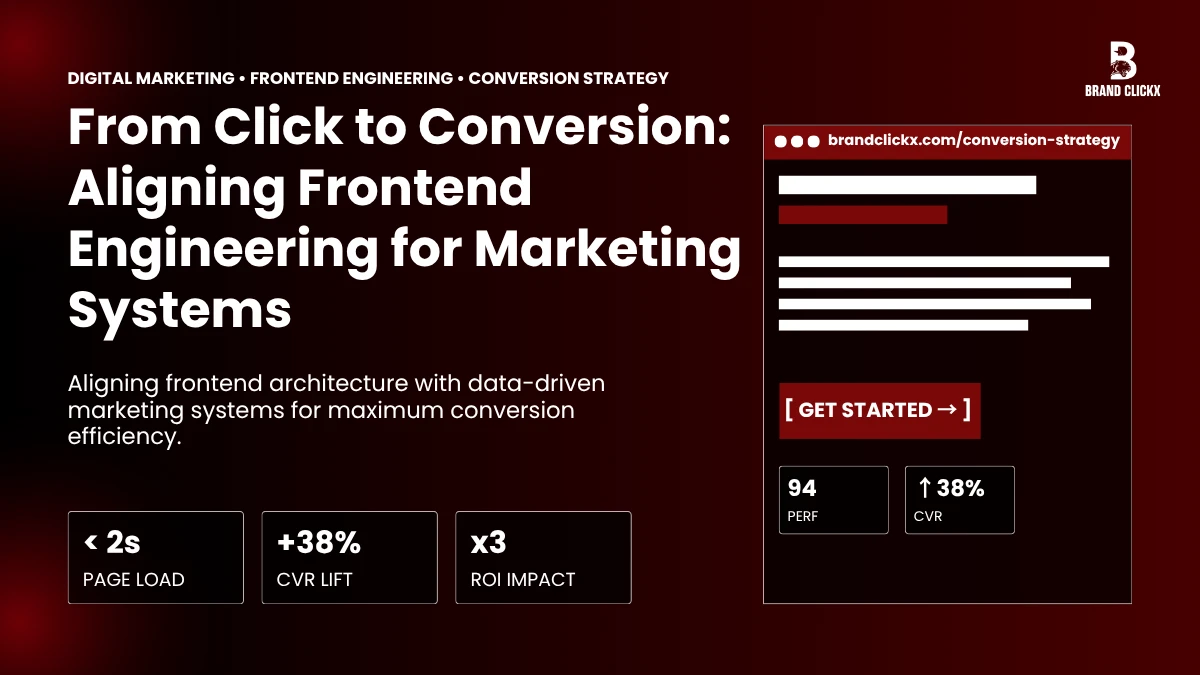
Marketing teams invest heavily in acquisition channels, analytics, and optimization frameworks, yet conversion outcomes often depend on a layer they do not fully control: frontend engineering. The moment a user lands on a page, performance, responsiveness, and interface logic determine whether attention turns into action. This creates a structural dependency on frontend engineering for marketing and development that many organizations underestimate, leading to fragmented systems where traffic grows but conversion efficiency stagnates.
Modern digital environments operate under strict user expectations. Pages must load instantly. Interfaces must respond without delay. Navigation must feel intuitive. When these conditions are not met, even the most effective campaigns lose impact because users disengage before completing meaningful actions. Decision-makers who understand this dynamic can shift focus from isolated channel optimization to integrated system design, where frontend architecture becomes a core driver of marketing performance rather than a supporting component.
How Frontend Engineering for Marketing Shapes User Behavior and Conversion
Frontend architecture defines how users experience a digital product, which directly influences how they move through a conversion funnel. Every interaction, from page load speed to button responsiveness, affects decision-making in real time. When systems are slow or inconsistent, users hesitate, which increases drop-off rates and reduces overall efficiency of marketing spend.
High-performing frontend engineering for marketing are designed to minimize friction. This includes reducing load times, optimizing rendering processes, and structuring interfaces so that users can complete actions without confusion. For example, a landing page that loads in under two seconds and presents a clear value proposition will consistently outperform a slower alternative, even if both receive identical traffic volumes. This demonstrates that conversion is not solely a function of messaging but also of execution.
A critical component of this execution is the underlying technology stack. Modern frontend frameworks allow developers to create dynamic interfaces that update instantly without requiring full page reloads, which improves both speed and usability. Solutions built around javascript apps highlight how scalable frontend systems can support complex user interactions while maintaining performance stability. These applications often rely on modular architectures, component-based design, and efficient state management, which enable rapid updates and consistent behavior across different devices and environments. For marketing teams, this means that user journeys can be optimized continuously without introducing instability, ensuring that improvements in acquisition are matched by improvements in conversion.
Speed as a Conversion Multiplier
Speed influences perception. Users associate fast interfaces with reliability and trust, which increases the likelihood of engagement. Even small delays can create uncertainty, leading users to abandon a session before completing an action. Optimizing speed is therefore not a technical detail but a strategic priority.
Interface Clarity and Decision Flow
Users do not analyze interfaces in depth. They scan, interpret, and act quickly. When interfaces are cluttered or unclear, users expend more cognitive effort, which reduces conversion probability. Clear visual hierarchy, consistent navigation, and predictable interactions allow users to move through a funnel with minimal friction.
Real-Time Feedback and Engagement
Interfaces that provide immediate feedback reinforce user actions and maintain engagement. This includes confirming inputs, updating content dynamically, and guiding users toward the next step. Without feedback, users may hesitate or abandon the process entirely.
Consistency Across Devices
Modern users interact with platforms across multiple devices. Inconsistent performance or design between devices creates friction and reduces trust. Frontend systems must therefore ensure uniform behavior and appearance regardless of screen size or platform.
Building Scalable Marketing Systems on Top of High-Performance Interfaces
Once frontend engineering for marketing supports efficient interaction, organizations can build systems that scale without losing performance or clarity. This requires integrating analytics, personalization, and automation directly into the user experience rather than treating them as separate layers.
Scalable systems rely on structured data flows. Every interaction generates data that can be analyzed to improve future performance. When this data is connected to frontend systems, organizations can adapt interfaces in real time based on user behavior, which increases relevance and engagement. For example, dynamic content can be adjusted based on user preferences, previous interactions, or campaign source, creating a more personalized experience.
- track user behavior at each stage of the funnel
- identify friction points where users drop off
- test interface variations to improve performance
- implement changes based on measurable outcomes
This iterative process ensures that systems evolve based on evidence rather than assumptions.
Another key factor is alignment between frontend engineering for marketing objectives and technical implementation. Marketing teams often define goals in terms of traffic, engagement, and conversion, while engineering teams focus on performance, scalability, and maintainability. Bridging this gap requires shared metrics and collaborative processes, ensuring that both teams work toward the same outcomes.
- conversion rate optimization through interface improvements
- personalization driven by real-time data
- automation of user journeys based on behavior
- continuous testing and iteration
These elements form the foundation of a system that can grow without losing efficiency.
Integrating Personalization Without Complexity
Personalization increases relevance but can introduce complexity if not managed carefully. Effective systems deliver personalized experiences without compromising performance, ensuring that users receive relevant content without delays or errors.
Maintaining Performance at Scale
As traffic increases, systems must handle higher loads without degrading performance. This requires efficient infrastructure, optimized code, and proactive monitoring to ensure stability.
Aligning Teams Around Shared Metrics
When marketing and engineering teams operate with different priorities, systems become fragmented. Aligning both teams around shared metrics such as conversion rate and user engagement ensures that efforts are coordinated and effective.
Continuous Optimization as a Core Process
Optimization should not be treated as a one-time effort but as an ongoing process. Systems must be designed to support continuous improvement, allowing organizations to adapt to changing user behavior and market conditions.
Strategic Implications for Decision-Makers
Decision-makers must recognize that frontend engineering is not a secondary concern but a central component of marketing performance. Investments in acquisition channels will not yield optimal results if the underlying systems fail to convert users efficiently. This requires a shift in perspective, where technical architecture is evaluated based on its impact on business outcomes rather than solely on technical criteria.
Organizations should prioritize integration between marketing and engineering functions, ensuring that systems are designed with both performance and user experience in mind. This includes investing in scalable technologies, establishing clear communication channels between teams, and adopting data-driven approaches to optimization.
Conclusion
Conversion is the result of a system, not a single action. Traffic generation, user experience, and technical execution must work together to produce meaningful outcomes. Frontend architecture plays a critical role in this process by shaping how users interact with a platform and how easily they can complete desired actions.
Organizations that align frontend engineering for marketing strategy create systems that not only attract users but also convert them efficiently, leading to sustainable growth and improved return on investment.