You’ve been writing content consistently. Every post is researched, properly formatted, targeting the right keywords. You’re doing what every SEO guide on the internet tells you to do. And yet, when you check Google Search Console on a Tuesday morning with your coffee lacking skyacep, the traffic curve looks like someone drew a flat line with a ruler and called it a day.
That was us. Fourteen months ago, almost to the week.
We weren’t a brand new site with a fresh domain and zero authority. We had decent content, a few years of history, and a domain rating sitting comfortably in the low thirties. But organic traffic growth had basically stalled. We were hovering around 18,000 monthly sessions and could not break through. Cold link building emails got deleted on arrival. Guest post pitches went into some editor’s void folder never to return. We tried the standard skyscraper technique twice and got almost nothing back for our trouble.
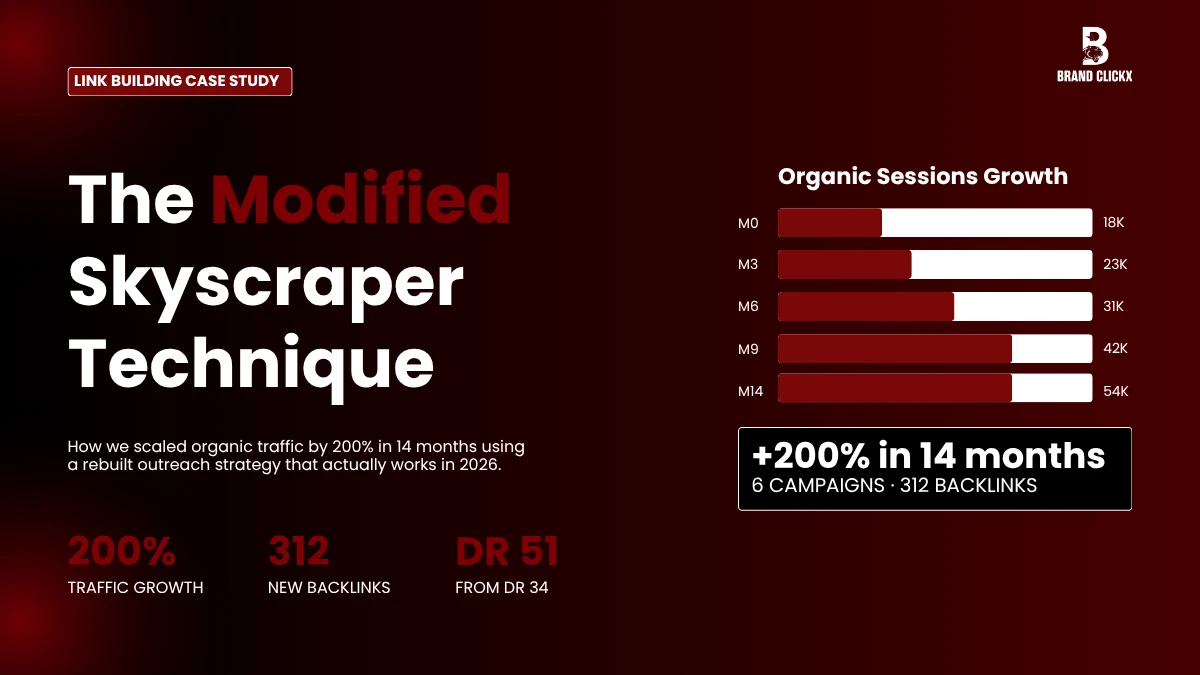
What came out of that process was something we started calling the Modified Skyscraper Technique. It kept the bones of Brian Dean’s original idea but rebuilt the approach around how editorial decisions actually get made today, rather than how they used to get made a decade ago. Over the next 14 months, running this across six content campaigns, we went from 18,000 monthly sessions to just over 54,000. That’s a 200% jump in organic traffic, 312 new backlinks, and a domain rating that climbed from 34 to 51.
This is the full breakdown. No fluff, no vague advice, just what we actually did and why it worked.
The Original Skyscraper Technique Was Brilliant. Then Everyone Found Out About It.
If you’re not familiar with the original concept, here’s the short version. Brian Dean over at Backlinko developed it around 2013. The logic was clean and almost obvious once you heard it: find a piece of content in your niche that had earned a lot of backlinks, create a longer and more thorough version of it, then contact everyone who linked to the original and suggest they swap the link to your better resource instead.
Honestly? It was a great idea. And it worked really well, for a few years.
The issue is that good SEO tactics have a shelf life. Once a strategy gets published, shared across a hundred marketing blogs, turned into a YouTube series, and taught in SEO courses, the entire web starts running the same playbook. By 2020, webmasters and site editors were drowning in skyscraper pitches. Emails that said some version of “Hi, I noticed you linked to this article, I wrote a more comprehensive version, would you update your link?” were coming in daily. People stopped even opening them.
And the content side of it got worse. The web is now absolutely littered with “ultimate guides” that are 6,000 words long but contain less useful information than a well-written 1,200-word piece. Word count became the metric, which meant word count became the thing people gamed. Google noticed. They got a lot better at figuring out whether length was adding value or just padding.
So we weren’t starting from scratch. We were starting from a method that needed to be genuinely updated, not just tweaked.
Here’s What We Actually Changed (And the Thinking Behind Each Decision)
Let me walk through each step the way we actually ran it.
Step 1: Stop Chasing the Most Linked-To Content. Start Chasing What’s Still Earning Links Right Now.
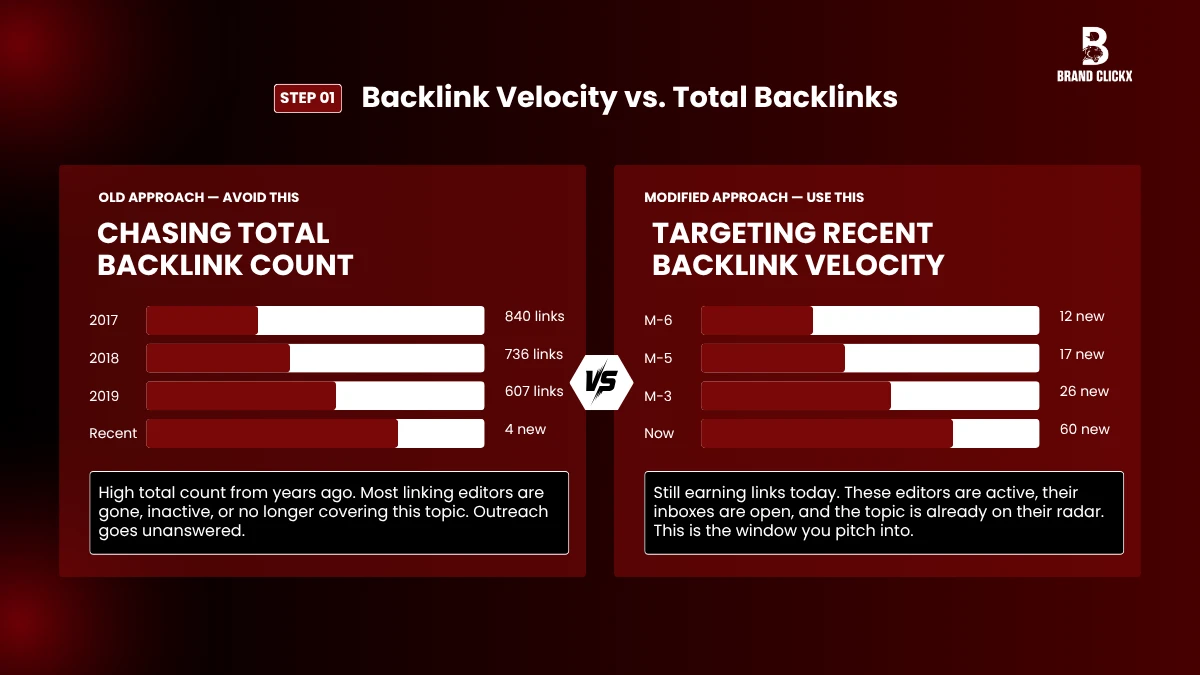
When most people do the skyscraper technique, they open Ahrefs or Semrush, sort content by backlink count, and go after whatever has the biggest number next to it. I get why. That seems like the obvious place to start. But that number tells you what happened historically, not what’s happening now.
We shifted our focus entirely to backlink velocity, meaning how many new links a piece has earned over the last three to six months specifically. A post from 2017 with 800 total backlinks is a very different target than a post from 2022 with 180 backlinks if the 2022 post earned 60 of those in the last four months. That second piece is still alive in terms of editorial interest. People in the industry are still finding it, reading it, and deciding it’s worth citing.
Those are the pieces you want to compete with, because the people linking to them are still active. They’re still running their sites. They’re still making editorial decisions. That matters enormously when it comes to outreach response rates later on.
We pulled velocity data through Ahrefs, cross-checked traffic trends in Semrush to confirm the piece was still pulling organic visitors, and did a quick manual review of the SERP to check whether Google was treating it as a freshness-sensitive result. That combination gave us targets where the opportunity was actually alive, not just historically large.
Step 2: The Gap Analysis Is Where the Real Work Happens. Most People Skip It.
Once we had a target piece, we read it properly. All the way through. Then we did something most people doing the skyscraper technique skip entirely: we went and found out what readers still didn’t understand after reading it.
We’d search the topic on Reddit, check Quora, look at the comment section on the original piece if it had one, and look at the “People Also Ask” results on Google for the main keyword. The goal was to find the questions that the existing content left unanswered. Not the questions it tried to answer but explained badly. The questions it didn’t even attempt.
That last category is the goldmine. When people finish reading what’s supposedly the definitive guide on a topic and then immediately go to a forum to ask a follow-up question, that tells you two things: the content didn’t actually cover the topic fully, and there’s an audience with a specific need that nobody is meeting yet.
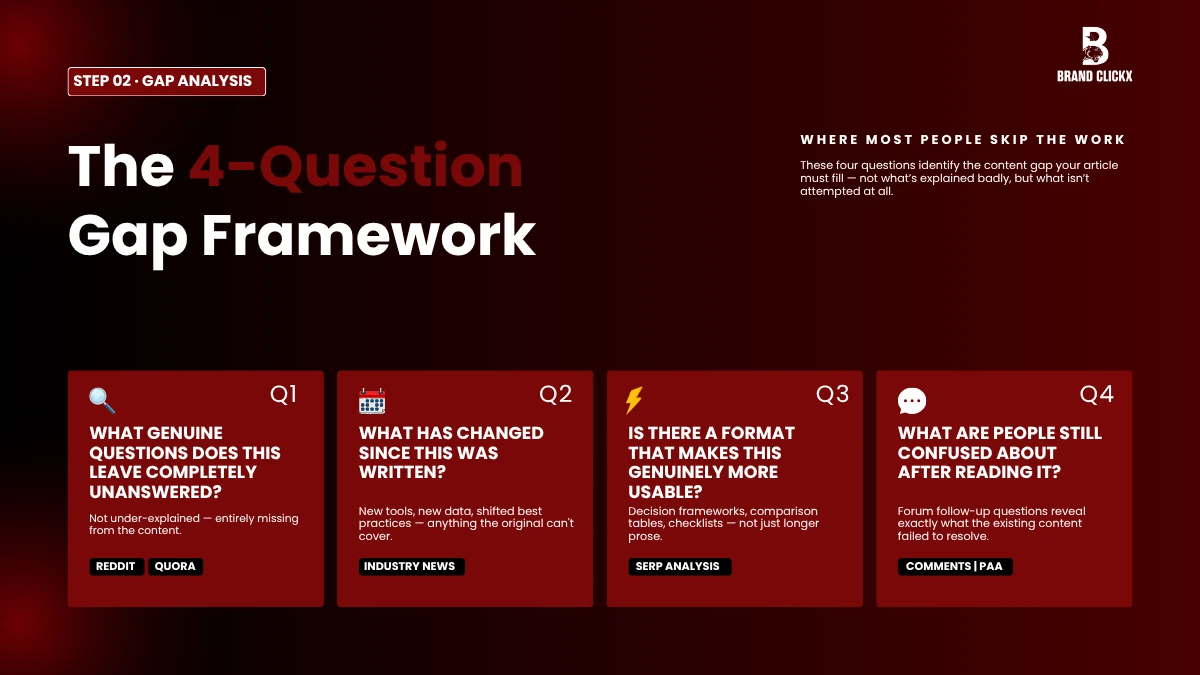
Our gap analysis framework came down to four honest questions we’d ask about every target piece:
- What genuine questions does this leave unanswered, not just underexplained?
- What has actually changed in this topic area since this was written, whether that’s new data, new tools, or shifted best practices?
- Is there a format that would make this information genuinely more usable for someone trying to act on it, like a decision framework, a comparison table, or a step-by-step checklist?
- What are people still confused about after reading this, based on what they’re asking in forums and comment sections?
Step 3: Put Something Into the World That Didn’t Exist Before You Wrote It
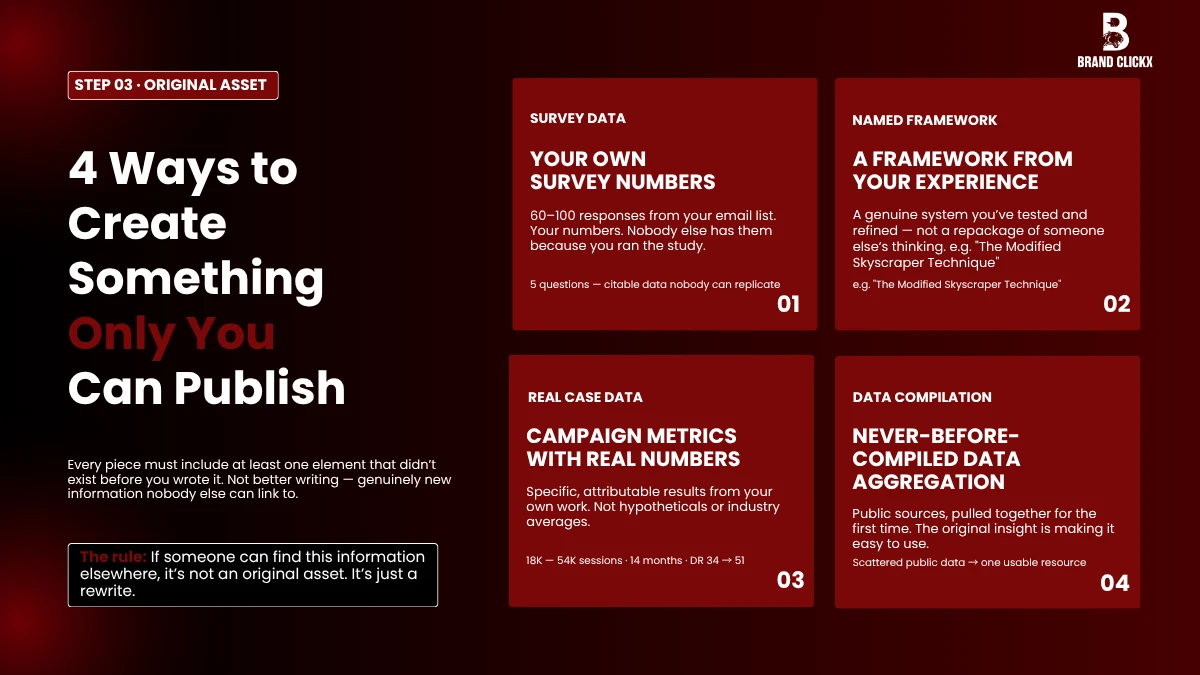
This is the piece that changed everything for us in terms of outreach response rates. Every single skyscraper piece we built included at least one element that was genuinely original. Not just new writing on an existing topic. Something you could only find on our page.
In practice, that looked like one of four things:
- Survey data from our own audience. Even small surveys with 60 to 100 respondents give you numbers you can cite. We’d send a quick five-question survey to our email list, collect the results, and build a section of the article around what we found. Nobody else had those numbers because we gathered them ourselves.
- A named framework or model that came directly from our experience running campaigns. Not a repackaging of someone else’s thinking but a genuine system we’d tested and refined.
- Real case study data with actual metrics from our own work. Numbers that were specific and attributable, not hypotheticals or industry averages.
- A data compilation from publicly available sources that had never been pulled together and organised in one place before. Sometimes the original insight isn’t new data, it’s making existing data easy to use for the first time.
Step 4: Build the Outreach List Before You Write a Single Word of the Article
This is probably the most counterintuitive change we made, and it’s also the one that had the single biggest impact on our outreach results. Almost every link building guide tells you to publish the content first and then reach out. We completely reversed that order.
While the article was still being written, we’d identify the two or three most relevant voices in our industry on the specific topic we were covering. Not necessarily the biggest names, just people who had published something thoughtful in this space recently and clearly had an opinion on it. We’d email them during the research phase asking for a quick take or a quote on one specific question related to the article.
Most people said yes. It takes someone two minutes to share a perspective on something they already know well. And when the piece went live with their name and thinking included, our outreach email wasn’t a cold pitch anymore. It was a heads-up. “The article you contributed to is now live, thought you’d want to see the finished version.” We’d include the link and mention that we’d love it if they found it worth sharing or referencing.
The response rate difference was dramatic. Cold pitches to people who’d never heard of us got responses maybe 4 to 7% of the time, which is honestly pretty normal for this industry. Emails to people who’d contributed to the piece came back at 60% or higher, consistently across multiple campaigns. That’s not a marginal improvement. That’s a completely different activity.
Step 5: Run Outreach in Tiers So You’re Not Wasting Your Best Energy on Your Weakest Prospects
Not every potential linking site deserves the same amount of your time. This sounds obvious but most people’s outreach process doesn’t actually reflect it. They send a slightly personalised version of the same email to everyone on the list, which means high-authority sites get a mediocre pitch and low-authority sites get more effort than they’re worth.
We split every outreach list into three tiers before sending a single email:
- Tier 1 covers high domain authority sites where a link would genuinely move our metrics and where the content alignment is tight. These get fully manual outreach. We read their site before writing the email. We reference a specific piece they’ve published. We explain exactly which section of their existing content our piece improves on, and why their readers would be better served by the update. These emails took 20 to 30 minutes each to write properly.
- Tier 2 is mid-authority sites with solid relevance. These get a strong base template with two to three genuinely personalised sentences added per contact. Not token personalisation that says “I loved your article on X” and nothing else. Real references to their work, their audience, their angle on the topic.
- Tier 3 is smaller but relevant sites where a link would still help with topical authority even if the domain authority isn’t high. Clean template, first name, company name, that’s it. These go out at higher volume and lower effort.
We capped Tier 1 at 20 contacts per campaign. That might sound low but those 20 emails took real time to do properly, and the link quality that came back from them was significantly higher than anything from the other tiers. Four or five strong Tier 1 links from genuinely authoritative, relevant sites does more for your organic traffic growth than 40 links from mediocre ones.
What the Numbers Actually Looked Like Over 14 Months
We ran this process across six content campaigns from month one through month fourteen. Here’s what happened:
- Monthly organic sessions went from roughly 18,000 to just over 54,000. That’s the 200% growth number that sounds like a headline but is real and measurable in Search Console.
- Domain rating on Ahrefs climbed from 34 to 51, which is a meaningful jump in a relatively short window, especially without buying links.
- Total backlinks earned across the six pieces came to 312, from a mix of editorial links, resource page additions, and contributor-driven shares.
- Our blended outreach response rate across all tiers was 18.4%. The industry average for cold link building outreach in most niches sits somewhere between 5 and 8%.
- Three of the six pieces earned featured snippet positions for competitive informational queries within 60 days of going live.
The Mistakes We See People Make With the Skyscraper Technique (And Why They’re So Common)
After running this ourselves and walking a handful of other content teams through it, there are three failure patterns that come up again and again. They’re worth naming because they’re not obvious mistakes. They feel like the right approach until you understand why they don’t work.
Picking Targets Based on Historical Backlinks Rather Than Current Activity
The sites that linked to a top-performing piece from 2016 are a completely different population from the sites actively building links in your niche today. Many of those 2016 linkers don’t update their posts. Some of those sites have changed focus, been sold, or quietly abandoned. When you build an outreach list from historically linked content, you’re spending your energy trying to reach people who may no longer be making the editorial decisions you need them to make.
Recent backlinks are recent decisions. Those editors are active, they’re paying attention to the topic, and your email lands at a time when the subject is already on their radar.
Writing Outreach Emails That Are Really Just Announcements About Your Own Content
There’s a very common outreach email format that goes something like: “Hey, I noticed you linked to [article]. I just published something much more comprehensive on the same topic. Here’s the link. Would love it if you updated yours.” That email is entirely about you. There’s nothing in it for the person receiving it.
The emails that actually got responses for us were written from the reader’s perspective. What specific problem would their audience encounter by following the old link? What does our piece give those readers that the old one doesn’t? We’d sometimes go as specific as: “The piece you’re linking to doesn’t cover [X scenario], which I’d guess is something at least a portion of your readers are running into, especially if they’re [specific situation]. Our piece addresses that directly in section three.” That kind of specificity takes more time to write but it demonstrates that you’ve actually read their content and thought about their readers.
Publishing the Content and Then Hoping the Algorithm Picks It Up Without Any Push
Even genuinely great content needs some initial momentum to get noticed. A page with zero initial traffic and no early engagement signals can take a long time to get crawled, indexed, and ranked well enough to start earning organic links on its own.
Before we sent a single outreach email, we’d share each piece with our email subscribers, post it in two or three online communities where we were genuine participants rather than drop-ins, and run a small paid amplification push, usually somewhere between $100 and $200 on LinkedIn or Reddit depending on the topic. That’s not a big budget. But it was enough to seed the content with real visitors, get some early shares, and make the page look like something people were actually engaging with before we asked anyone to link to it.
Frequently Asked Questions
Does the skyscraper technique still work in 2025?
The original version, where you make something longer and pitch the swap, has become significantly harder to get results from because every experienced webmaster has seen that pitch hundreds of times. A modified version that focuses on genuine content gaps, original data, and relationship-based outreach still works well. The principle is sound. What needed to change was the execution and the mindset behind it.
How long does the skyscraper technique take to show results?
Backlinks from outreach typically start coming in within two to four weeks of a campaign. The SEO impact of those links on your organic traffic is slower, usually three to six months before you see meaningful movement. In our experience, the most significant traffic gains showed up in months seven through ten, not in the first few weeks after publishing. This is normal for organic traffic growth and the main reason consistency matters more than any individual campaign.
What is a good response rate for link building outreach emails?
For cold outreach with no prior relationship, anything between 5 and 10% is considered reasonable in most industries. When you use the contributor strategy we described, where you’ve included someone’s perspective in the piece before reaching out, response rates can climb to 40 to 60% for those specific contacts. Across a full campaign with all tiers included, pushing your blended response rate above 15% is achievable and significantly better than average.
How many backlinks do I need to rank on page one?
There’s no universal answer to this because it depends heavily on the competitiveness of the specific keyword, the authority of the sites linking to you, and how well your content matches what people searching that term are actually trying to accomplish. In less competitive niches, ten to fifteen quality backlinks can genuinely get a piece to page one. In highly competitive spaces, you might need significantly more, and the links need to come from authoritative, topically relevant domains. Quantity without quality rarely moves the needle in the way people hope it will.
Is the skyscraper technique a white hat strategy?
Yes, when it’s done the way it’s supposed to be done. You’re creating genuinely better content and reaching out to people to let them know it exists. That’s exactly what editorial link building is meant to look like. The tactics that run into trouble with Google are the ones involving paid link schemes, private blog networks, or manipulated anchor text profiles. Earning links by merit, through content that’s actually better and outreach that’s actually honest, aligns completely with what Google’s guidelines describe as legitimate link acquisition.
What tools do you need to run the skyscraper technique?
For finding targets and tracking backlinks, you’ll need a proper backlink analysis tool. Ahrefs is what we used, but Semrush and Moz both work fine for this purpose. For outreach management, Pitchbox is good if you’re running high volume. Hunter.io is useful for finding contact emails. If you’re running smaller campaigns, a well-organised Gmail inbox with a simple tracking spreadsheet honestly gets the job done. The tools matter less than most people think. Doing the thinking well matters more than which software you’re using to send the emails.