
If you have ever wondered how your competitors are ranking high on Google while your site sits on page two of search results you are not alone. Many website owners and digital marketers struggle to understand how to find competitors’ keywords and uncover the areas where they can improve. The good news is that with the right strategy and tools you can discover your competitors’ best keywords and use that knowledge to close ranking gaps and drive more traffic.
In this article we will break down step by step exactly how to find competitors’ keywords. We will also walk through specific methods to uncover keyword gaps and capitalize on them. I will share research data and links to reputable studies so you can see what works in the real world. By the end you will have a practical roadmap for improving your SEO using competitor insights.
This article is perfect if you are new to keyword research or if you want to refine your current process.
Why Competitor Keyword Research Matters
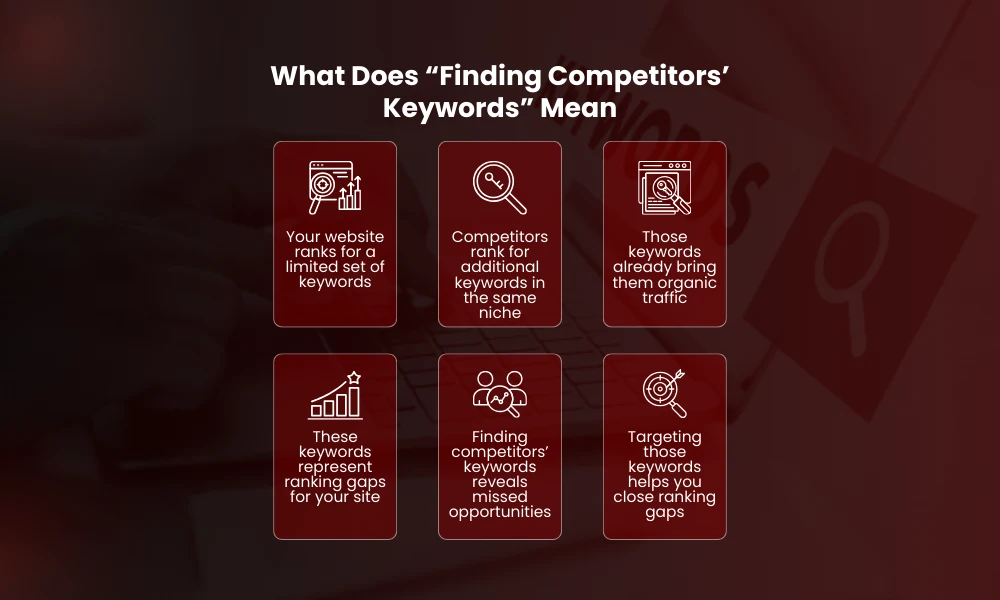
Before we talk about how to find competitors’ keywords it is important to understand why this type of research matters.
When you target the same keywords as your competitors you are essentially competing directly for the same search traffic. If your competitors already rank above you they likely have stronger signals and more optimized content for those terms. However that does not mean those keywords are out of reach. It simply means you need to understand what your competitors are doing so you can do it better.
Moz calls this approach content gap analysis and it is a powerful SEO strategy. A gap analysis helps you identify opportunities where you can create or optimize content to capture traffic your competitors are already getting. If you want to take this process further, conducting a structured SEO competitor analysis can help you clearly map out where your competitors are outperforming you.
So let us get practical and walk through how to find competitors’ keywords and uncover ranking gaps.
Step 1 Identify Who Your True Competitors Are

When people hear the word competitor they often think only of direct business competitors. But in SEO there are two types of competitors:
- Business competitors these are companies that sell similar products or services.
- Search competitors these are sites that rank for the same keywords even if they do not sell the same product.
For example if you sell running shoes your business competitors are other running shoe stores. But your search competitors might include general sports blogs that rank for running shoe reviews. These second type of competitors can take traffic away from you even though they are not selling shoes directly.
To get a complete view of your SEO landscape you need to identify both.
How to Find Search Competitors
There are a few ways to find search competitors:
Use Google Search Results
Search Google for one of your target keywords and note which sites appear on the first page. These are your search competitors for that term.
Use SEO Tools
SEO software like Ahrefs, SEMrush, and Moz can automatically identify competitors based on overlapping keywords. Combining these tools with advanced keyword research methods and advanced keyword research techniques allows you to uncover deeper competitive gaps that are not obvious at first glance.
For example in SEMrush you can use the Organic Competitors report which shows sites that rank for many of the same keywords as you
Once you have a list of true competitors you can begin analyzing their keywords.
Step 2 Use SEO Tools to Analyze Competitor Keywords
There are many SEO tools that let you see what keywords your competitors rank for. Each tool has strengths and weaknesses. The most common ones include:
SEMrush
SEMrush is one of the most popular SEO platforms. It provides a Domain Overview where you can enter a competitor’s domain and see the keywords they rank for, their estimated traffic, and how keyword rankings have changed over time.
Here is how to use SEMrush:
- Go to https www.semrush.com and enter your competitor’s website in the search bar.
- Click Organic Research.
- Review the list of organic keywords.
You will see:
- Keywords the competitor ranks for
- Their position in search results
- Estimated monthly search volume
- Estimated traffic
You can export this data and compare it to your own keywords.
Ahrefs
Ahrefs has a Site Explorer tool that works similarly. You enter a competitor’s domain and see the Organic Keywords report. This report shows exactly which keywords the competitor ranks for and how much traffic each keyword brings.
According to Ahrefs data the higher the number of clicks a keyword gets the more valuable it is for SEO. This means you should pay attention not just to search volume but to estimated clicks.
Google Search Console
If you already run a website you can use Google Search Console to find your own keyword performance. While it does not show competitor keywords it helps you understand where your site is currently strong or weak.
Go to Performance and look at the list of queries your site appears for. You can download this and compare it to your competitors’ keywords from tools like SEMrush and Ahrefs.
Ubersuggest
Ubersuggest is a more budget friendly option created by Neil Patel. It gives you an overview of competitor keywords along with estimated difficulty scores and search volumes. These can help you decide which gaps are worth pursuing.
All of these platforms fall under powerful SEO analytics tools that help you monitor keyword performance, competitor visibility, and traffic trends more accurately.
Step 3 Create a Keyword Matrix
Once you have gathered keyword data from your competitors the next step is to organize it in a spreadsheet. This is sometimes called a keyword matrix.
Here is a simple way to structure it:
| Keyword | Competitor A Rank | Competitor B Rank | Your Rank | Search Volume | Keyword Difficulty | Traffic Potential |
This matrix helps you see:
- Which keywords your competitors rank for that you do not.
- Which keywords both you and your competitors rank for.
- Which keywords you rank above competitors.
- Where the biggest opportunities exist.
Next you will use this matrix to identify ranking gaps.
Step 4 Identify Ranking Gaps
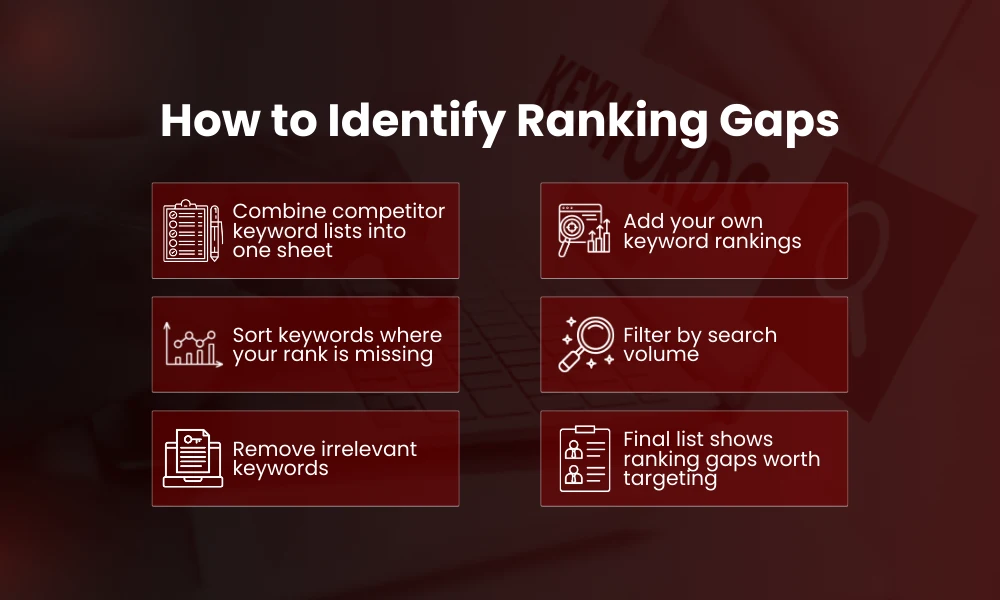
Ranking gaps are keywords your competitors are ranking for but you are not. These are opportunities to create content or optimize your existing pages.
To find gaps:
- Sort your keyword matrix by keywords you do not rank for.
- Filter for keywords with decent search volume.
- Remove irrelevant or non converting terms.
Now you have a list of actionable keywords.
The next step is understanding what to do after keyword research, because collecting keyword data without execution will not improve rankings.
Let us look at an example.
Suppose your competitor ranks for the keyword best running shoes for flat feet on page one. Your site currently does not rank for that term. The search volume for that term is 8,000 searches per month.
This is a gap. You can create a page or blog post optimized for this keyword to capture traffic.
But do not stop there. Watch out for long tail keywords. These are phrases with lower search volume but higher conversion potential because they are more specific.
For example best trail running shoes for beginners might only have 2,400 searches per month but are less competitive and easier to rank for.
According to research published by HubSpot long tail keywords make up over 70 percent of all web searches. That means optimizing for long tail terms can be a huge opportunity.
So your keyword gap list should include a mix of high volume and long tail terms.
Step 5 Analyze Why Competitors Rank for These Keywords
Once you have a list of competitor keywords that you do not yet rank for you need to understand why your competitors rank for them.
There are four major factors that influence ranking:
- Content Quality
- Backlinks
- User Experience
- Page Optimization
Let us briefly look at each.
Content Quality
Google ranks content that it believes satisfies the user’s search intent. If your competitor has a longer more in depth or better written article that answers the searcher’s question they are more likely to rank. That is why truly improving rankings begins with understanding human search intent, not just inserting keywords into headings.
A study by Content Marketing Institute shows that content with higher word count tends to rank better in search results. This does not mean you should write long content for the sake of length. You should focus on comprehensiveness and usefulness.
Ask yourself:
- Does your competitor article cover topics you do not?
- Do they use examples or statistics that make their article more authoritative?
- Is their page structure easier to read?
These are things you should analyze when deciding how to create your own content.
Backlinks
Backlinks are another huge factor in SEO. According to a study by Backlinko the number of domains linking to a page correlated strongly with ranking position (source: https www.backlinko.com backlinks-study). This means if your competitor has more websites linking to their keyword page they are more likely to rank. If there is a large authority gap, investing in ethical link building services can help strengthen your domain and compete more effectively.
You can use tools like Ahrefs or SEMrush to see how many backlinks competitor pages have and which sites link to them. If you want to outrank that page you might need to build more backlinks.
User Experience
Google looks at how users interact with a page. If users click on the search result then quickly go back to the results this sends a signal to Google that the page did not satisfy the user.
This is called bounce rate and dwell time. Pages that keep people engaged often perform better.
So when you analyze competitor keyword pages ask:
- Is their content easier to scan with bullet points and subheadings?
- Do they use images or videos?
- Is the page faster to load?
These are user experience factors that influence ranking.
Page Optimization
Finally there is on page SEO. This includes title tags meta descriptions header tags keyword usage and internal linking. A page that is better optimized for a keyword will generally perform better.
Tools like Yoast SEO or Rank Math can help you optimize your own content once you know what competitor pages are doing.
Step 6 Create or Optimize Your Pages
Now that you know what keywords you are missing and why your competitors rank for them it is time to act.
Here is how to approach it.
Create New High Quality Content
If you do not have a page that matches a high value competitor keyword you should create one. Follow these steps:
- Look at the top 3 competitor pages for that keyword.
- Identify what they cover.
- Write a more comprehensive and useful article.
- Use subheadings to break up sections.
- Include examples and statistics.
- Add internal links to other relevant pages on your site.
Before writing, make sure it aligns with a well defined SEO content strategy so every new page supports your overall ranking goals. A study by SEMrush found that top ranking pages often satisfy user intent better than lower ranking ones. That means if you can write content that better matches what users are searching for you have a strong chance to outrank your competitors.
Update Existing Pages
Sometimes you already have a page that is close to a competitor keyword but is not ranking well. In this case you can optimize the page.
Here are things to review:
- Does the title contain the target keyword?
- Does the meta description clearly describe what the page is about?
- Are subheadings optimized with variations of the keyword?
- Does the content answer the searcher’s query fully?
- Does the page contain relevant internal and external links?
Updating content is often easier than building a new page and can yield quick results.
Step 7 Track Your Results and Adjust

Once you publish new content or optimize existing content you need to track results. SEO is not a one time task. It takes time for changes to show up in search engines.
Use Google Search Console to track:
- Keyword rankings
- Impressions
- Click through rates
You can also use tools like SEMrush or Ahrefs to track keyword movements over time.
If certain keywords are still not performing you might need to adjust your content or build more backlinks.
Pro Strategies for Finding Keyword Insights
Here are a few additional tactics that can help you find competitors’ keywords:
Reverse Engineer Featured Snippets
Featured snippets are the boxes that appear above organic listings in Google. If your competitors have featured snippets you can create content that is better formatted to earn those snippets.
Tools like SEMrush and Ahrefs have reports that show which keywords trigger featured snippets. Use these to optimize your content.
Use Related Searches and People Also Ask
When you search in Google you will often see Related Searches and People Also Ask sections. These provide real user questions that you can target in your content.
This method helps you find long tail keywords that may not show up in other tools.
Common Mistakes to Avoid
Finding competitors’ keywords is powerful but only if done right. Here are mistakes to avoid:
Targeting Only High Volume Keywords
High search volume keywords can take years to rank for. While you should target some of them you should also focus on easier long tail keywords that you can win quickly.
Ignoring Search Intent
Not all keywords are created equal. Two users searching for the same keyword might have different intentions. Always ask:
- Are they looking to buy?
- Are they looking to learn?
- Are they looking for a specific answer?
Match your content to the intent.
Forgetting Backlinks
You can optimize your content perfectly but still not rank if your competitor has a much stronger backlink profile. Do not ignore building links to your pages.
Final Thoughts
Competitor keyword research is not a luxury. It is a necessity if you want to succeed in SEO. By learning how to find competitors’ keywords and uncover ranking gaps you can build a smart SEO strategy that drives real results.
Here is a quick recap of what we covered:
- Why competitor keyword research is important
- How to identify true search competitors
- Tools you can use to collect competitor keywords
- How to build a keyword matrix
- How to find ranking gaps
- How to analyze why competitors rank
- How to create or optimize pages to fill gaps
- Tracking and adjusting your SEO efforts
- Extra strategies and common mistakes
Remember SEO is a long term process. The work you put in today will pay off in higher rankings traffic and sales over time.
If you apply these tactics consistently you will see improvements. Keep learning, adapt to changes and refine your keyword strategy as your industry evolves. Continuously refining your keyword research strategies ensures you stay ahead of competitors even as search behavior shifts.
Good luck on how to find competitors’ keywords and happy optimizing.
FAQs
How to find competitors’ keywords for SEO?
To learn how to find competitors’ keywords for SEO, start by identifying websites that rank for the same topics as yours. Use tools like SEMrush, Ahrefs, or Ubersuggest to analyze their domains and export the keywords they rank for organically. Compare this data with your own keyword list to see which terms you are missing. Focus on keywords that have steady search volume and clear search intent, especially those your competitors rank for on the first page.
How to find competitors’ keywords without paid tools?
If you want to know how to find competitors’ keywords without paid tools, Google itself is a good starting point. Search for your main keyword and note which websites appear on page one. Explore their content, headings, and blog topics to identify repeated keyword themes. Google Search Console can also help by showing keywords you already rank for, which you can compare manually against competitor content. While this method is slower, it still reveals useful keyword opportunities.
Why is it important to learn how to find competitors’ keywords?
Understanding how to find competitors’ keywords helps you uncover ranking gaps where your website is missing traffic opportunities. Competitor keywords reveal what Google already considers relevant and valuable in your niche. By targeting these terms with better content and optimization, you can compete more effectively in search results and attract visitors who are already interested in your products or services.