If you search “Who Owns Microsoft?”, the simplest answer is also the one most often misunderstood: Microsoft is owned by its shareholders, not by one person or another company.
Microsoft Corporation trades publicly on Nasdaq under the ticker MSFT, so ownership is divided among institutional investors, individual shareholders, executives, and other investors. Microsoft’s own investor materials continue to identify the company as a publicly traded corporation, while its shareholder records show major institutional holders such as Vanguard and BlackRock.
That does not mean Bill Gates or Steve Ballmer are irrelevant. Both helped shape Microsoft’s history, and Ballmer remains a major individual shareholder. But owning a large number of shares is different from owning the company outright.
Here is the ownership picture, how it developed from Microsoft’s early years, and what the latest public information tells us about who actually holds Microsoft stock.
AI Overview: Who Owns Microsoft?
Microsoft is a publicly traded company, so it is owned collectively by its shareholders rather than by one individual or parent company. Large institutional investors, including Vanguard and BlackRock, are among its largest disclosed shareholders. Former CEO Steve Ballmer is also a major individual shareholder, while Bill Gates retains a much smaller personal connection to Microsoft than he had during the company’s early decades.
Key Takeaways
- Microsoft is a publicly traded company listed on Nasdaq as MSFT.
- No single person or parent company owns Microsoft outright.
- Vanguard and BlackRock were the two entities above 5% disclosed in Microsoft’s 2025 proxy statement.
- Former CEO Steve Ballmer is a major individual Microsoft shareholder.
- Bill Gates remains historically important to Microsoft, but his personal ownership is far smaller than it was decades ago.
- Satya Nadella is Microsoft’s chairman and CEO, but being CEO does not mean he owns Microsoft.
- Microsoft shareholders vote on matters such as director elections and executive compensation.
Featured Snippet: Who Owns Microsoft?
Microsoft is owned by its shareholders because Microsoft Corporation is a publicly traded company. Major institutional shareholders include Vanguard and BlackRock, while former CEO Steve Ballmer is a major individual shareholder. Bill Gates, Microsoft’s co-founder, no longer controls the company, and Microsoft has no parent company that owns it outright.
Who Owns Microsoft Today?
The important distinction is between ownership of shares and control of the business.
When you buy Microsoft stock, you become a shareholder. The same principle applies to large investment firms that hold Microsoft shares through investment funds and other managed portfolios.
Microsoft’s 2025 proxy statement identifies The Vanguard Group and BlackRock as the entities that beneficially owned more than 5% of Microsoft’s common stock in the disclosure cited in that filing. Vanguard was listed with 664,882,153 shares, or 8.95%, while BlackRock was listed with 540,020,228 shares, or 7.30%.
| Shareholder | Publicly disclosed stake | What it means |
|---|---|---|
| Vanguard | 8.95% | Major institutional shareholder |
| BlackRock | 7.30% | Major institutional shareholder |
| Steve Ballmer | Major individual stake | Former Microsoft CEO and large shareholder |
| Bill Gates | Much smaller personal stake than historically | Microsoft co-founder |
| Other investors | Remaining shares | Institutions, individuals and other shareholders |
The percentages above should not be treated as a live ownership dashboard. Public ownership disclosures have reporting dates, and holdings can change afterward.
That distinction matters because a company’s ownership can look slightly different depending on which filing date or data source you use.
Who Is the Largest Microsoft Shareholder?
The answer depends on what you mean by “largest.”
If you mean the largest institutional shareholder disclosed by Microsoft, Vanguard is the clearest answer from Microsoft’s 2025 proxy statement, with 8.95% reported in that filing. BlackRock followed with 7.30%.
If you mean the largest individual shareholder, Steve Ballmer is the name most commonly associated with that position.
Ballmer joined Microsoft in its early years, eventually became CEO, and later left the CEO role in 2014. Historical SEC filings show how substantial his Microsoft holding has been for many years. For example, a 2011 Microsoft filing listed Ballmer with 333,252,990 shares, equal to 3.95% at that time.
His percentage and share count should not be presented as a permanently fixed number, however. Share counts change through sales, transfers, and Microsoft’s own share-count changes.
Vanguard and BlackRock Do Not “Own Microsoft”
This is where many explanations become misleading.
Vanguard and BlackRock can be described as major shareholders because shares are registered in their names or associated entities. However, these firms manage money and investment products for clients.
So saying that Vanguard “owns Microsoft” can create the wrong impression if the reader thinks Vanguard bought Microsoft as a private acquisition.
The more accurate explanation is that Vanguard and BlackRock are major institutional holders of Microsoft stock. Microsoft’s proxy statement also provides details about their voting and dispositive powers, showing why the legal meaning of ownership can be more complicated than a simple percentage.
Does Bill Gates Still Own Microsoft?
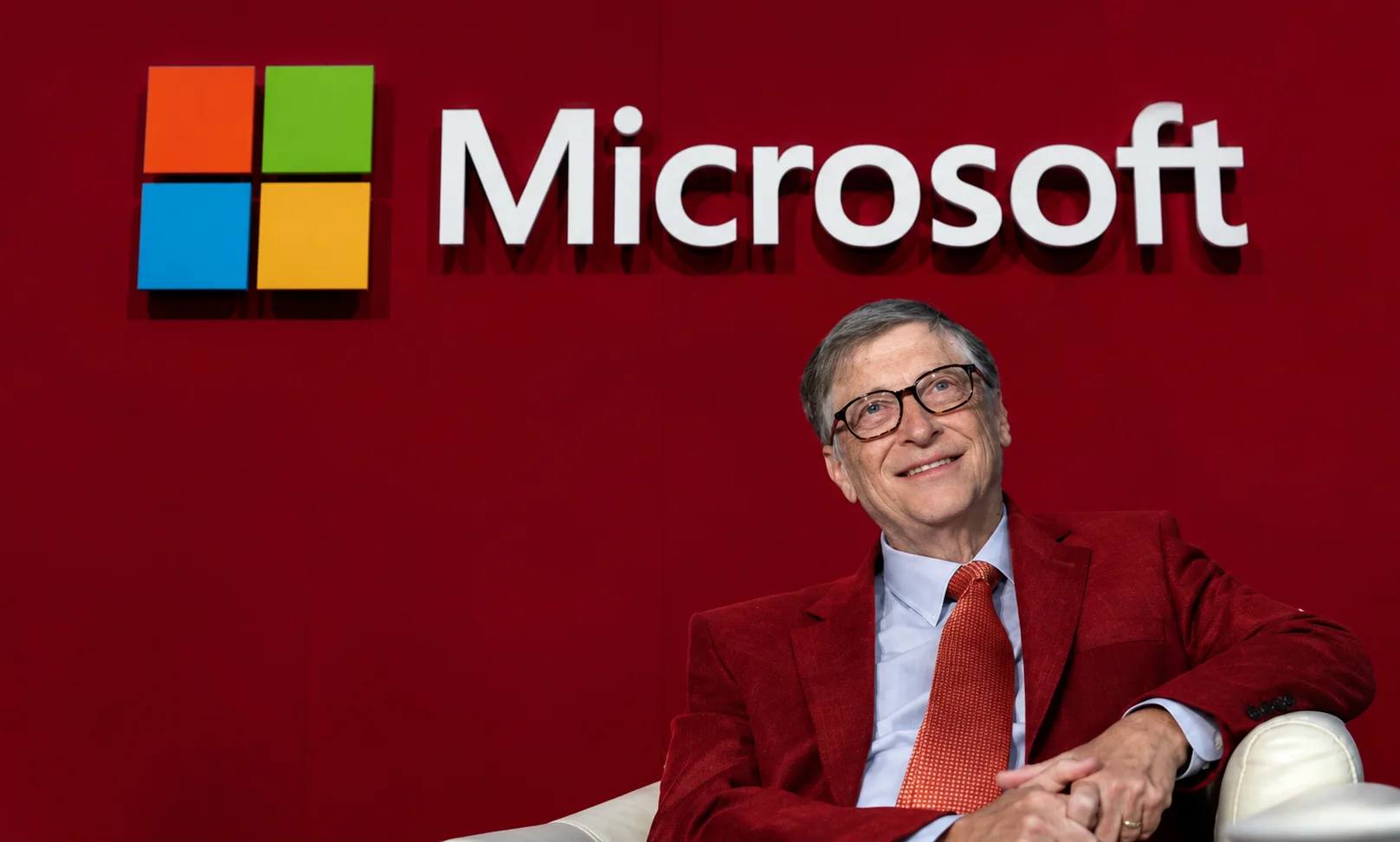
Yes, the answer requires some historical context.
Bill Gates co-founded Microsoft with Paul Allen in 1975. During Microsoft’s early growth, Gates owned a substantial portion of the company. His ownership gradually declined as he sold or transferred shares over the decades.
That change is easy to understand when you compare Microsoft’s history with its present structure. Gates was once central to Microsoft’s ownership; today, Microsoft is a massive public corporation with ownership spread across a much wider shareholder base.
Microsoft’s own materials still identify Gates as its co-founder, while current corporate leadership is headed by Satya Nadella.
One detail also deserves careful treatment: Bill Gates’ personal Microsoft shares should not automatically be combined with shares once associated with the Gates Foundation. They are separate holdings and should be discussed separately.
How Microsoft Ownership Changed After the 1986 IPO
Microsoft was founded in 1975 by Bill Gates and Paul Allen.
For its first years, Microsoft was a private company. That changed dramatically when Microsoft became publicly traded in 1986.
The IPO transformed Microsoft from a company whose ownership was concentrated among founders and early participants into a corporation whose shares could be bought and sold by public investors.
From there, the ownership story became less about two founders and more about millions of investors, investment funds, employees, executives and institutions.
That is the key reason the answer to Who Owns Microsoft? looks completely different today than it would have looked in the 1970s or 1980s.
Microsoft Ownership: Then vs. Now
| Period | Ownership picture |
|---|---|
| 1975 | Microsoft began as a privately held company founded by Gates and Allen |
| 1986 | Microsoft became publicly traded |
| Following decades | Founder ownership declined as shares were sold or transferred |
| Modern era | Ownership is spread among institutional and individual shareholders |
| 2026 | Microsoft remains an independent publicly traded corporation |
The transition was gradual rather than a single event.
Microsoft’s public-market structure also means ownership information is continually changing. A shareholder who owns millions of shares today may hold fewer shares later.
How Does Microsoft Ownership Actually Work?
You do not need to be a billionaire or investment firm to understand the basic structure.
Microsoft issues shares of common stock. Those shares trade publicly under MSFT.
When an investor buys MSFT through a brokerage account, that investor owns a financial interest in Microsoft. Large investment managers can hold substantial positions because their funds invest money belonging to their clients.
The ownership process therefore looks something like this in practical terms:
- Microsoft has publicly traded shares.
- Investors purchase those shares.
- Shareholders receive rights associated with their shares.
- Shareholders can vote on certain corporate matters.
- Investors can sell their shares later.
- Microsoft can return capital to shareholders through dividends and share repurchases.
Microsoft’s shareholder voting results demonstrate that this ownership structure is not merely theoretical. At its 2025 annual meeting, shareholders voted on director elections, executive compensation, the company’s stock plan and shareholder proposals.
Who Controls Microsoft If Nobody Owns It Outright?
Ownership and management are two different things.
Satya Nadella is Microsoft’s Chairman and Chief Executive Officer, but that does not make him the owner of Microsoft.
The company’s board oversees corporate governance, while shareholders have voting rights on matters presented to them.
Microsoft’s 2025 annual meeting, for example, included the election of directors and a vote on executive compensation. Shareholders approved the election of the nominated directors and approved the company’s 2026 stock plan.
So, if you are asking who “runs” Microsoft, the answer is different from who “owns” Microsoft.
Satya Nadella leads the company as CEO. Shareholders own shares in the company. The board provides governance and oversight.
What About Microsoft Azure and Xbox?
Searches for Microsoft ownership often lead to another question: Who owns Xbox or Azure?
The answer is straightforward.
Xbox and Azure are part of Microsoft’s broader business rather than independent publicly traded companies with separate shareholders.
That means you should not think of Microsoft Azure as having one owner and Microsoft Corporation as having another.
The same publicly traded Microsoft corporation sits at the top of that structure.
Microsoft’s business has also expanded through major acquisitions over the years, which has brought businesses and products into Microsoft’s corporate structure.
For example, Microsoft acquired Mojang, the company behind Minecraft, in 2014. It later acquired ZeniMax Media, bringing Bethesda into Microsoft, and completed its acquisition of Activision Blizzard in 2023.
Those transactions changed what Microsoft owned as a business. They did not change the basic answer to Who Owns Microsoft?
Microsoft itself remains the publicly traded parent corporation.
Does the Gates Foundation Own Microsoft?
This is one area where older articles can become outdated quickly.
The Gates Foundation and Bill Gates personally are not the same shareholder.
A foundation’s investment holdings should not automatically be described as Bill Gates’ personal stock.
The Gates Foundation has also changed its investment position over time. Its own current public materials focus on its philanthropic work and long-term financial plans, so older articles that describe foundation holdings should be checked against newer records before being treated as current.
That is why a responsible Microsoft ownership article should always attach a date to ownership figures.
Why Ownership Percentages Can Look Different Online
If you search for Microsoft institutional ownership, you may see different percentages on different websites.
That does not automatically mean one source is wrong.
Ownership databases can use different reporting dates, definitions and data sets. Some figures may reflect institutional filings, while others may combine different categories of shareholders.
The SEC’s disclosure system also means institutional ownership information is not necessarily a real-time picture of every position.
For that reason, the safest approach is to identify the source, the filing date and what the percentage actually measures.
Microsoft itself provides investor materials, annual reports, proxy statements and SEC filing information through its investor-relations resources.
Three Things You Should Not Confuse With Microsoft Ownership
Being CEO does not mean owning Microsoft
Satya Nadella leads Microsoft, but his job title does not make him the company’s owner.
Corporate leadership and share ownership are separate concepts.
Owning a large stake does not mean owning the whole company
Steve Ballmer’s large individual holding makes him an important shareholder, but that is not the same as owning Microsoft outright.
The same principle applies to Vanguard and BlackRock.
Founding a company does not mean permanently owning it
Bill Gates and Paul Allen founded Microsoft, but Microsoft’s public listing changed its ownership structure.
That is one of the most important pieces of context when answering this question.
A Better Way to Read Microsoft Ownership Data
If you are checking Microsoft shareholders yourself, do not focus only on the biggest percentage displayed in a search result.
Instead, check four things:
- Who is being listed? Is it a person, investment manager, fund or another entity?
- What is the reporting date? A percentage from an older filing may no longer represent the current holding.
- What type of ownership is being reported? Institutional ownership, insider ownership and beneficial ownership are not interchangeable terms.
- What does the filing say about voting power? A shareholder’s voting power and investment-management role can be more complicated than the headline percentage suggests.
This approach is particularly useful when comparing Microsoft with other technology companies.
Microsoft vs. Founder-Controlled Tech Companies
Microsoft’s ownership model is easier to understand when you compare it with companies where founders retain special voting rights.
| Feature | Microsoft | Founder-controlled structure |
|---|---|---|
| Publicly traded | Yes | Often yes |
| Single owner | No | Sometimes a founder has effective control |
| Institutional shareholders | Yes | Yes |
| Founder influence | Historical and financial | Can remain dominant |
| Voting structure | Microsoft has publicly disclosed common-stock voting arrangements | Some companies use multiple share classes |
| CEO automatically owns company | No | No |
The important lesson is that public ownership does not always mean identical control structures.
Microsoft’s structure should therefore be evaluated on its own filings rather than by assuming every major technology company operates the same way.
What Microsoft Ownership Means for Investors
For an ordinary investor, the most useful takeaway is simple: buying Microsoft stock means buying a small ownership interest in a publicly traded company.
You do not become Microsoft’s manager.
You do not receive control over Xbox or Azure.
Instead, you become a shareholder with the rights attached to the shares you own.
Microsoft’s shareholder structure also explains why corporate decisions can involve large institutional investors and thousands of other shareholders.
At the 2025 annual meeting, more than 7.43 billion shares were entitled to vote, while more than 6.32 billion shares were voted in person or by proxy.
That gives you a clearer picture of how large Microsoft’s shareholder base is.
What Recent Microsoft Results Tell Us About the Company
Ownership is only one side of Microsoft’s story.
Microsoft reported $90.0 billion in revenue for the quarter ended June 30, 2026, with net income of $35.8 billion. For fiscal 2026 as a whole, Microsoft reported $331.8 billion in revenue and $133.7 billion in net income.
The company also said it returned $10.2 billion to shareholders through dividends and share repurchases during the fourth quarter of fiscal 2026.
These figures do not tell you who owns Microsoft.
They do, however, explain why Microsoft stock is so widely held: the company remains one of the world’s largest publicly traded technology businesses.
Common Mistakes When Searching “Who Owns Microsoft?”
The biggest mistake is giving one person’s name as the complete answer.
Microsoft is not Steve Ballmer’s private company, and it is not Bill Gates’ company anymore.
Another mistake is treating Vanguard or BlackRock as if either investment firm purchased Microsoft outright.
Finally, be careful with ownership percentages copied from old articles. Microsoft’s shareholder base changes, and public filings are tied to specific reporting dates.
A reliable answer should always tell you who the shareholder is, how much was reported, and when that information was reported.
Practical Application: How to Verify Microsoft Ownership Yourself
If you want to check the answer rather than simply trust an article, use a simple verification process.
Start with Microsoft’s investor-relations page. Microsoft publishes its annual reports, proxy statements, earnings information and other shareholder materials there.
Next, look for the latest proxy statement and SEC filings. These documents provide considerably more useful information than a generic “top shareholders” list.
Then check the reporting date attached to each ownership figure.
Finally, compare the current filing with an older filing if you want to understand whether a shareholder’s position has increased or decreased.
This method takes a little longer than reading a search snippet, but it prevents one of the most common problems with ownership articles: presenting an old number as though it were today’s exact figure.
Who Should Use This Information?
This explanation is useful if you want to understand:
- Who owns Microsoft stock
- Whether Bill Gates still owns Microsoft
- Whether Steve Ballmer owns Microsoft
- Why Vanguard and BlackRock appear among Microsoft’s largest shareholders
- How public-company ownership works
- The difference between Microsoft ownership and Microsoft management
It is especially useful when you see conflicting shareholder percentages online and want to understand why they differ.
Who Should Avoid Taking a Single Ownership Percentage as Absolute?
You should be cautious with any article that gives one exact ownership percentage without providing a reporting date.
You should also be careful when a website mixes personal holdings, institutional holdings, fund holdings and historical figures into one number.
For Microsoft, the date and definition behind the number matter.
Frequently Asked Questions
Who owns Microsoft?
Microsoft is owned by its shareholders because it is a publicly traded company. No single individual or parent company owns Microsoft outright. Major disclosed institutional shareholders include Vanguard and BlackRock, while Steve Ballmer is a major individual shareholder.
Who is the largest shareholder of Microsoft?
Vanguard was listed as Microsoft’s largest disclosed institutional shareholder in the company’s 2025 proxy statement, with 664,882,153 shares representing 8.95% of the class reported there. BlackRock was listed next with 540,020,228 shares, or 7.30%.
Does Bill Gates still own Microsoft?
Bill Gates is still closely associated with Microsoft as its co-founder, but his ownership is far smaller than it was during Microsoft’s early years. The important distinction is between Gates’ personal holdings and investments historically associated with philanthropic entities.
Does Steve Ballmer own Microsoft?
Yes, Steve Ballmer has historically held a substantial personal Microsoft position and remains one of the company’s most prominent individual shareholders. However, owning a large stake does not mean that Ballmer owns or controls Microsoft as a whole. Historical SEC records show that he held more than 333 million Microsoft shares in 2011.
Does Vanguard own Microsoft?
Vanguard is a major institutional shareholder of Microsoft, but saying that Vanguard “owns Microsoft” without context can be misleading. Microsoft’s 2025 proxy statement reported Vanguard with 8.95% of the relevant common-stock class, making it the largest disclosed institutional holder in that filing.
Does BlackRock own Microsoft?
BlackRock is also a major Microsoft shareholder. Microsoft’s 2025 proxy statement listed BlackRock with 540,020,228 shares, representing 7.30% of the class reported in the filing.
Who is the CEO of Microsoft?
Satya Nadella is Microsoft’s Chairman and Chief Executive Officer. His position gives him responsibility for leading the company, but being CEO does not mean he personally owns Microsoft.
Who owns Microsoft Azure and Xbox?
Azure and Xbox belong within Microsoft’s corporate business rather than being separate publicly traded companies with their own independent shareholders. Therefore, the ownership question ultimately leads back to Microsoft Corporation and its shareholders.
Can regular people own Microsoft stock?
Yes. Microsoft is publicly traded under the ticker MSFT, so investors can purchase its shares through a brokerage account. Buying shares gives an investor an ownership interest in Microsoft rather than direct control over the company’s operations.
Is Microsoft owned by another company?
No parent company is identified as owning Microsoft Corporation. Microsoft is itself a publicly traded corporation, with its shares held by institutional and individual investors.
How do Microsoft shareholders influence the company?
Shareholders can vote on matters submitted for shareholder approval, including director elections and certain compensation or corporate proposals. Microsoft’s 2025 annual meeting demonstrates this process, with shareholders voting on directors, executive compensation, the 2026 stock plan and other proposals.
Final Answer: Who Owns Microsoft?
So, who owns Microsoft?
The honest answer is that Microsoft is owned collectively by its shareholders. There is no single person sitting behind the company with complete ownership.
Vanguard and BlackRock are among the largest disclosed institutional shareholders, while Steve Ballmer remains an important individual shareholder. Bill Gates remains part of Microsoft’s history and retains a much smaller connection to the company than he once had.
At the same time, Satya Nadella runs Microsoft as its Chairman and CEO. That distinction between ownership, voting rights and management is the part many quick answers leave out.
The next time you see someone ask who owns Microsoft, the most accurate short answer is not a person’s name. It is simply this: Microsoft belongs to its shareholders.