

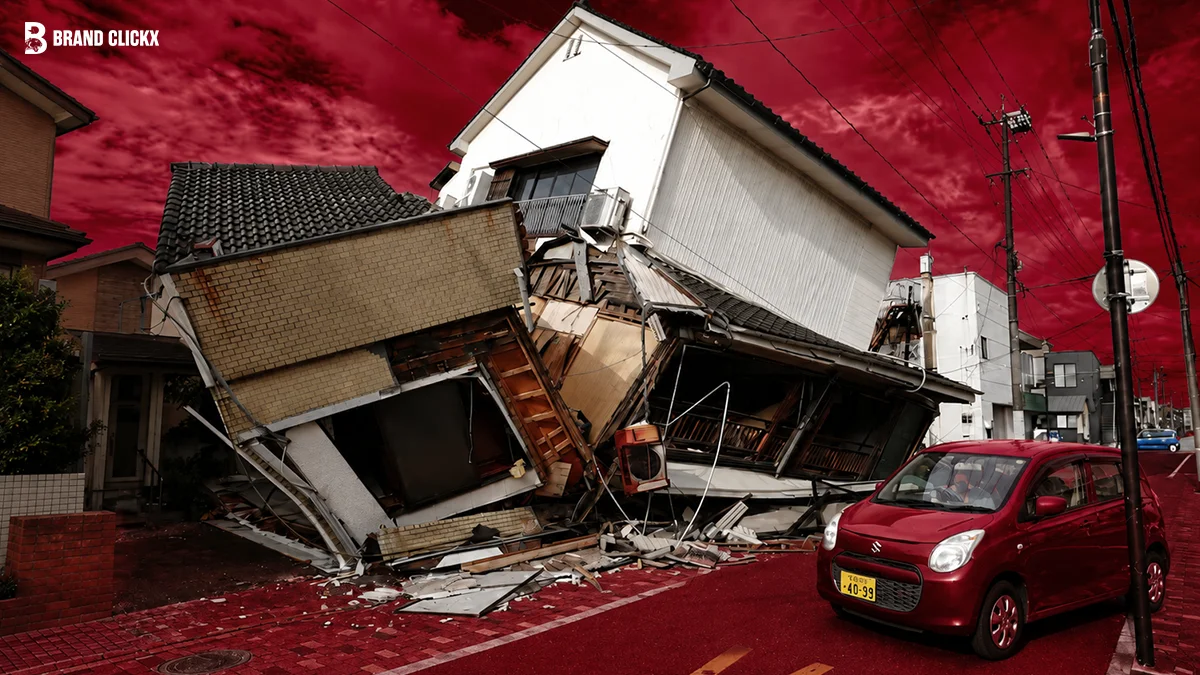
A magnitude 6.8 quake struck Kyushu on Tuesday afternoon. Thousands of troops are searching a shopping centre where a suspected gas explosion brought down the second floor.
Published: Wednesday, 29 July 2026 | BrandClickX News Desk
⚠ DEVELOPING STORY. Casualty figures are rising and rescue operations are ongoing. Numbers below were accurate at the time of writing. For real-time information, use the Japan Meteorological Agency (jma.go.jp), the USGS (earthquake.usgs.gov) or the EMSC (emsc-csem.org). This page is not a live alert service.
Summary
A magnitude 6.8 earthquake struck Kumamoto Prefecture on Japan’s southwestern island of Kyushu at 4:27 p.m. local time on Tuesday 28 July 2026. At least 13 people are confirmed dead, Prime Minister Sanae Takaichi said on Wednesday morning. Rescue teams are still searching a partially collapsed shopping mall in Kashima. Thousands of military personnel have been mobilised, and the toll is expected to change.
Key Takeaways
- Magnitude 6.8 struck Kumamoto Prefecture at 4:27 p.m. JST on 28 July 2026
- At least 13 confirmed dead; missing and injured totals not yet clear
- The quake was shallow about 10 km deep and close to a city of 700,000
- A tsunami advisory for the Ariake and Yatsushiro seas was issued and lifted
- An Aeon Mall in Kashima partially collapsed after a suspected gas explosion
- Kyushu Expressway sections, bridges and a historic castle were damaged
- The JMA warns further significant quakes are possible in the coming days
- Figures are changing; check the JMA or USGS for current information
What Happened?
A shallow, magnitude 6.8 earthquake hit Kumamoto Prefecture on Tuesday afternoon, causing severe shaking close to a major population centre.
The USGS recorded it at magnitude 6.8, revising down an initial reading of 7.1. The Japan Meteorological Agency lists it as Mj 7.1 on its own scale — the two agencies use different measurements, which is why you will see both figures reported.
| Detail | |
| Magnitude | 6.8 (USGS) / 7.1 (JMA) |
| Date and time | 28 July 2026, 4:27 p.m. JST |
| Depth | About 10 km (6.2 miles) |
| Epicentre | Roughly 19 km (12 miles) south of Kumamoto city |
| Aftershocks | At least six recorded by the USGS |
The JMA rated the shaking at the highest end of its seismic intensity scale.
Depth is the critical detail. At 10 kilometres this was a shallow inland quake rather than a deep offshore subduction event. Shallow quakes release less total energy than the great subduction earthquakes, but they do it directly beneath populated areas — which is why a 6.8 has caused this level of damage.
Kumamoto city has a population of around 700,000.
Was There a Tsunami Warning?
A tsunami advisory was issued for the Ariake and Yatsushiro seas within minutes, then lifted.
Reporting differs slightly on terminology. NBC News and ABC News both report that the JMA issued and subsequently lifted a tsunami advisory for those two coastlines. CNN reports no tsunami warning or threat was issued.
Both can be accurate. An advisory is a lower tier than a warning, and it was withdrawn. No broader tsunami threat materialised.
The Mall Collapse
Rescue crews have been working through the night at an Aeon Mall in Kashima, where the second floor came down after what officials suspect was a gas explosion.
The building had been evacuated when the quake struck. The blast appears to have followed. A woman living opposite told CNN the explosion was “terrifyingly loud,” and police bodycam footage from inside the complex has since been released.
At least two of the confirmed dead — both women in their twenties — were at the shopping centre. An unknown number of people remain trapped.
Several people are also unaccounted for at a paper factory where a chimney collapsed.
What Else Was Damaged?
- The Kyushu Expressway — a section damaged near Yatsushiro
- Bridges buckled across the affected area
- A historic castle damaged again, in a region still repairing from the 2016 Kumamoto earthquakes
- Hundreds of thousands of people forced to evacuate
Aftershocks have spread along roughly a 50-kilometre stretch running from the coastline south of Yatsushiro up towards Kumamoto, which gives seismologists an early indication of where the fault ruptured.
The Official Response
Prime Minister Sanae Takaichi confirmed the death toll on Wednesday morning and said “every second counts” as thousands of Self-Defense Force personnel were deployed to the region.
She noted the confirmed total includes deaths where the link to the earthquake and its aftershocks is still being investigated. The number of missing and injured is not yet clear.
The JMA has warned that further significant quakes are possible in the coming days, citing the shallow depth of the initial rupture.
Why This Region Keeps Being Hit
Japan sits on the Pacific Ring of Fire, where several tectonic plates converge. Kumamoto in particular has a dense network of active faults running through it.
Two types of earthquake affect Japan, and the distinction matters:
Offshore subduction quakes can reach extreme magnitudes and generate large tsunamis — the 2011 magnitude 9.1 Tōhoku-Oki disaster being the reference case. Distance from land reduces the shaking.
Shallow inland quakes, like Tuesday’s, are smaller but strike directly beneath towns and cities. The 2024 Noto earthquake, a magnitude 7.5, killed more than 700 people. The 2016 Kumamoto sequence hit this same prefecture.
There is also a historical coincidence worth noting rather than reading into. The 1889 Kumamoto earthquake, a magnitude 6.3 that killed 20 people, also struck on 28 July — 137 years to the day.
How to Check If There Has Been an Earthquake Near You
Use an official seismic agency, not social media. Reports of shaking spread far faster than verified data.
| Region | Official source |
| Global | USGS (earthquake.usgs.gov) |
| Europe and worldwide | EMSC (emsc-csem.org) |
| Japan | Japan Meteorological Agency (jma.go.jp) |
| India | National Center for Seismology (seismo.gov.in) |
| Philippines | PHIVOLCS |
| Indonesia | BMKG |
| New Zealand | GeoNet |
Three practical points:
- Magnitudes get revised. Tuesday’s quake went from a preliminary 7.1 to 6.8 within hours. Early figures are estimates
- Different agencies use different scales. The JMA and USGS numbers for the same event will not always match, and neither is wrong
- Enable emergency alerts on your phone. In Japan, the J-Alert system provides seconds of warning before strong shaking arrives
If You Feel Shaking: What to Do
Drop, Cover, Hold On. Get low, take cover under sturdy furniture, and hold on until the shaking stops.
- Indoors: stay inside. Move away from windows, mirrors and anything that can topple. Do not run outside during shaking
- In bed: stay there and protect your head with a pillow
- Outdoors: move to open ground, away from buildings, trees and power lines
- In a vehicle: pull over clear of bridges, overpasses and buildings, and stay inside
- Near the coast: if shaking is strong or lasts a long time, move to high ground immediately without waiting for an official warning
Afterwards: expect aftershocks. Check for gas leaks — the Kashima mall collapse is a reminder of what follows a rupture in a gas line. If you smell gas, leave and report it. Avoid damaged buildings.
Elsewhere Today
Seismic activity is constant, and most of it is harmless. A magnitude 2.5 quake was recorded 43 km northwest of Santa Rosa, California, on Tuesday evening at a depth of 4.3 km — felt by some residents, with no damage.
Globally, more than 17,000 earthquakes of magnitude 2.0 or greater were recorded in July alone, including one above magnitude 7.0 and nine above 6.0.
Most days, the answer to “is there an earthquake now” is yes, somewhere, and it does not matter. Tuesday was an exception.
Timeline
| Time (JST) | Development |
| 4:27 p.m., 28 Jul | Magnitude 6.8 quake strikes Kumamoto Prefecture |
| Minutes after | JMA issues tsunami advisory for Ariake and Yatsushiro seas |
| Shortly after | Suspected gas explosion at Aeon Mall, Kashima; second floor collapses |
| Evening | Tsunami advisory lifted; rescue operations begin at the mall |
| Late evening | Crews still working to reach those trapped |
| Wednesday morning | PM Takaichi confirms at least 13 dead; troops mobilised |
Frequently Asked Questions
Where did the earthquake happen?
Kumamoto Prefecture on Kyushu, Japan’s southwestern main island, at 4:27 p.m. local time on 28 July 2026. The epicentre was roughly 19 km south of Kumamoto city, at a depth of about 10 km.
How strong was the Japan earthquake?
The USGS measured it at magnitude 6.8, revised down from a preliminary 7.1. The Japan Meteorological Agency lists it as 7.1 on its own scale. Different agencies use different measurement systems.
How many people died?
At least 13 confirmed dead as of Wednesday morning local time, according to Prime Minister Sanae Takaichi. That figure includes deaths still being investigated for a link to the quake, and it is expected to change.
Was a tsunami warning issued?
A tsunami advisory was issued for the Ariake and Yatsushiro sea coasts within minutes and later lifted. No wider tsunami warning was issued and no significant waves were reported.
What happened at the shopping mall?
An Aeon Mall in Kashima partially collapsed when its second floor came down after a suspected gas explosion following the quake. The building had been evacuated. At least two women in their twenties died there.
How do I check for earthquakes near me?
Use your national seismic agency or the USGS and EMSC global feeds. Avoid relying on social media, where unverified reports spread faster than confirmed data. Enable emergency alerts on your phone.
Will there be more earthquakes in the area?
The JMA has warned that further significant quakes are possible in the coming days because the initial rupture was shallow. Aftershocks have already been recorded along a roughly 50 km stretch.
What should I do during an earthquake?
Drop, cover and hold on. Stay indoors and away from windows if you are inside. If outdoors, move to open ground. Near the coast, move to high ground immediately if shaking is strong or prolonged.
Conclusion
The figures from Kumamoto will change, probably several times, before this is over. Thirteen confirmed dead, an unknown number trapped beneath a shopping centre, and a prefecture that was already rebuilding from 2016.
The detail that explains the damage is depth. Ten kilometres puts the rupture almost directly beneath the people living above it, which is how a 6.8 does the work of something considerably larger.
For anything current, go to the JMA or the USGS. This page will be out of date before the search is finished.